- Company Articles
- Industry articles
- Industry standards
- 3030 National Standard Profile A Turnover Carts: Enhancing Material Handling in Factories

3030 National Standard Profile A Turnover Carts: Enhancing Material Handling in Factories
Related Product
3030 National Standard Profile A
Workbench, production line, logistic rack, warehouse rack Industry: Manufacturer workshop, Automobile, Electronic, Assembling, logistic
Walk through any modern factory, and you'll quickly realize that the heartbeat of production isn't just the machines—it's the seamless flow of materials. From raw components arriving at the loading dock to finished products heading out the door, how efficiently materials move directly impacts everything: production speed, worker safety, and even the bottom line. Yet, for many manufacturers, material handling remains a silent bottleneck. Clunky carts that jam in tight aisles, rigid shelves that can't adapt to changing needs, and heavy equipment that strains workers' backs—these are common headaches that slow down operations and increase frustration.
But what if there was a solution that could transform this chaos into calm? A tool that's not just a cart, but a flexible, adaptable partner in keeping your factory moving? Enter the 3030 National Standard Profile A turnover cart—a yet powerful innovation that's quietly revolutionizing how factories handle materials. Built with precision, designed for adaptability, and engineered to fit into the rhythm of modern manufacturing, these carts aren't just about moving things from point A to B. They're about reimagining material handling as a strategic advantage.
The Hidden Cost of Poor Material Handling
Before diving into what makes the 3030 profile cart special, let's first understand why material handling matters so much. Think about a typical day on the factory floor. A worker spends 15 minutes wrestling with a stuck cart wheel instead of assembling products. Another wastes 20 minutes rearranging materials because their cart's shelves are too fixed to hold today's batch of parts. Over weeks and months, these small delays add up. According to lean manufacturing studies, up to 30% of a factory worker's time can be spent on non-value-added tasks—much of it tied to inefficient material handling.
Then there's the human cost. Heavy, unbalanced carts increase the risk of strains and injuries. The Bureau of Labor Statistics reports that overexertion and contact with objects are leading causes of workplace injuries in manufacturing, with many cases linked to poorly designed material handling equipment. And let's not forget flexibility: in today's fast-paced production environments, where product lines change quarterly (or even monthly), a cart that worked for last year's orders might be obsolete tomorrow. Traditional steel carts, with their welded frames and fixed structures, simply can't keep up.
Consider this: A mid-sized automotive parts factory was producing 500 units per day. Their material handlers were using old steel turnover carts—heavy, hard to maneuver, and with shelves that couldn't adjust to new part sizes. After switching to 3030 profile carts, they saw a 15% reduction in time spent moving materials, a 30% drop in worker complaints about fatigue, and even managed to increase daily output by 50 units. All from a simple change in how they transported parts.
What Is 3030 National Standard Profile A?
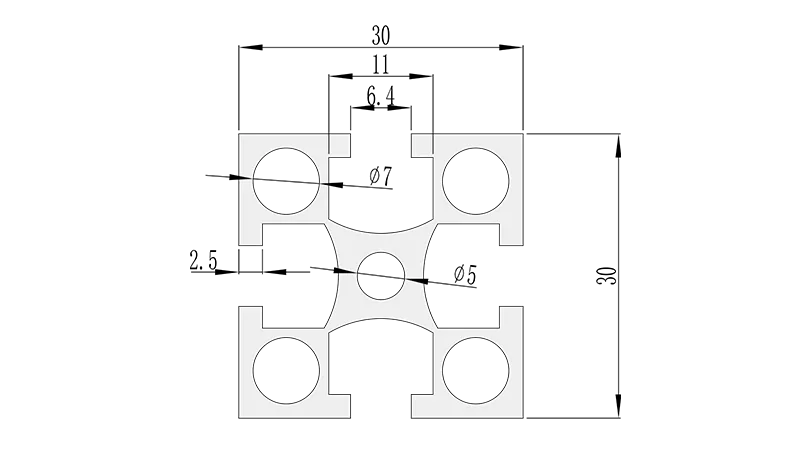
To understand why these carts are game-changers, we first need to talk about the star of the show: the 3030 National Standard Profile A. If you're not familiar with aluminum profiles, think of them as the building blocks of modern industrial design—lightweight, strong, and infinitely customizable. The "3030" refers to their dimensions: 30mm in width and 30mm in height, making them compact enough for tight spaces but robust enough to handle heavy loads. The "National Standard" label ensures consistency in manufacturing, meaning parts from different suppliers will fit together seamlessly—a huge plus for factories that need to repair or modify equipment on the fly.
But what really sets the 3030 National Standard Profile A apart is its T-slot design. Running along the length of the profile are grooves (or "slots") that allow accessories to be attached without welding or drilling. Need a shelf? Slide a bracket into the slot and tighten a bolt. Want to add a handle? Clip it on and secure it with a nut. This modularity is the secret sauce. Unlike traditional steel tubing, which requires cutting, welding, or drilling to modify, the 3030 profile lets you reconfigure your cart in minutes—no special tools, no downtime, no headaches.
And let's not overlook the material itself: aluminum. Aluminum is naturally lightweight, which makes the carts easy to push even when fully loaded. It's also resistant to rust and corrosion, a big advantage in factories where spills (oil, water, chemicals) are common. Compare that to steel, which rusts easily and adds unnecessary weight, or plastic, which can crack under heavy loads. Aluminum strikes the perfect balance: strong enough to carry 200-300kg (depending on the design), light enough for a single worker to maneuver, and durable enough to last for years.
Building Blocks: Construction of the 3030 Profile Turnover Cart
A 3030 National Standard Profile A turnover cart isn't just a hunk of aluminum—it's a carefully engineered system of parts working together. Let's break down its key components, starting with the frame.
The Frame: 3030 National Standard Profile A – The skeleton of the cart is built using 3030 profiles cut to length. Depending on the cart's size (common dimensions range from 600x400mm to 1200x800mm), the frame might use 4 vertical posts, 4 horizontal beams, and cross-braces for stability. The T-slots on each profile allow for easy attachment of shelves, handles, and other accessories. For extra strength, manufacturers often use profiles with a wall thickness of 1.5-2mm—thick enough to support heavy loads without adding excess weight.
Aluminum Profile Accessories: The Glue That Holds It All Together – If the 3030 profile is the frame, then aluminum profile accessories are the nuts and bolts (literally) that make customization possible. These include corner codes (to connect profiles at 90-degree angles), end caps (to smooth out sharp edges and prevent dust buildup), and shelf brackets (to hold up the storage surfaces). What's great about these accessories is their simplicity: most click into the T-slots and tighten with a hex key, so even a new employee can assemble or modify a cart with minimal training. For example, if you need to add a second shelf, you just slide two shelf brackets into the vertical posts, adjust to the desired height, and secure them—done.
Caster Wheels: The Cart's "Feet" – A cart is only as good as its ability to move, which is why caster wheels are a critical component. 3030 profile carts typically use 4-inch or 5-inch swivel caster wheels, often with brakes for safety. The wheels themselves are usually made of rubber or polyurethane, which grip the floor well (even on smooth concrete) and reduce noise—important in busy factories where constant clattering can wear on workers. Many models also feature dual-wheel casters for extra stability, especially when carrying uneven loads. And because the casters attach to the frame via simple mounting plates (another type of aluminum profile accessory), replacing a worn wheel is as easy as unscrewing a few bolts and popping on a new one.
Shelves and Surfaces: Where the Materials Rest – The shelves of the cart are often made of plywood, metal mesh, or aluminum panels, depending on the application. For example, in a food processing plant, you might use stainless steel shelves for easy cleaning. In an electronics factory, anti-static ESD shelves could be necessary to protect sensitive components. The beauty? The shelves attach to the frame using—you guessed it—aluminum profile accessories. So if you need deeper shelves for larger boxes, or shallower ones for small parts, you just swap out the brackets and adjust the position. No need to buy a whole new cart.
Design Features That Make a Difference
What really sets these carts apart from traditional options isn't just the materials—it's the thoughtful design features that solve real-world problems. Let's take a closer look at a few that matter most.
Modularity: Adapt to Change in Minutes – Factories rarely stay the same. One month you're producing small circuit boards; the next, you're switching to larger LED panels. With a traditional cart, you'd need to buy a new one or hire a welder to modify the old. With a 3030 profile cart? You just reconfigure it. For example, a cart used for small parts might have 3 narrow shelves. When you switch to larger panels, you remove two shelves, add longer brackets, and install a single wide shelf—done in 15 minutes. This adaptability is a game-changer for factories with mixed production runs or seasonal demand spikes.
Maneuverability: Glide Through Tight Spaces – Anyone who's pushed a steel cart through a narrow aisle knows the struggle: the wheels lock up, the cart scrapes the walls, and you end up sweating just to move 10 feet. 3030 profile carts solve this with two key features: lightweight aluminum frames and high-quality swivel casters. The aluminum keeps the total weight down (most carts weigh 20-30kg empty, compared to 50-60kg for steel), and the swivel casters (often with 360-degree rotation) allow the cart to pivot on a dime. Even in aisles as narrow as 1.2 meters, a 3030 cart can turn smoothly without jamming—saving time and reducing damage to walls (and egos).
Safety First: Protecting Workers and Materials – In factories, safety isn't optional. 3030 profile carts are designed with this in mind. The aluminum profiles have rounded edges (thanks to those end caps we mentioned earlier), reducing the risk of cuts or scrapes. The caster wheels often come with brakes, so the cart stays put when loading/unloading—no more runaway carts rolling into machinery. Some models even include handle grips with anti-slip rubber, making them easier to push without straining hands. And because the carts are lightweight, workers are less likely to strain their backs when pushing or pulling—lowering the risk of injuries and workers' compensation claims.
Cleanliness and Durability: Built to Last in Tough Environments – Factories are messy places. Oil drips from machines, water spills on the floor, and dust collects everywhere. Traditional steel carts rust quickly in these conditions, leading to squeaky wheels and wobbly frames. 3030 profile carts, with their aluminum frames and corrosion-resistant accessories, stand up to the elements. A quick wipe with a damp cloth is usually enough to keep them clean, and the aluminum won't rust or degrade over time. Even the caster wheels, often made of polyurethane, resist oil and chemical damage—so they won't crack or melt if they come into contact with spills.
The Benefits: More Than Just a Cart
So, what do these features add up to? Let's put it in concrete terms—how do 3030 National Standard Profile A turnover carts actually improve your factory's operations?
Faster Production, Less Waste – Time is money, and every minute a worker spends wrestling with a cart is a minute they're not adding value. With a 3030 profile cart, material handling becomes almost effortless. Workers can move materials faster, spend less time adjusting to rigid equipment, and focus on their core tasks. For example, a study by the Lean Manufacturing Institute found that factories using modular material handling equipment (like 3030 profile carts) saw a 15-25% reduction in non-value-added time—time that could be redirected to assembling products, inspecting quality, or training new employees.
Lower Costs Over Time – At first glance, a 3030 profile cart might cost more than a cheap steel cart from a big-box store. But let's do the math: A basic steel cart costs $150 but lasts 2-3 years before rusting or breaking. A 3030 profile cart costs $300 but lasts 7-10 years. Plus, when your needs change, you don't need to buy a new cart—just reconfigure the old one with aluminum profile accessories (which cost $5-$20 each). Over a decade, the steel cart would need to be replaced 3-4 times (total cost $450-$600), while the 3030 cart would still be going strong. Add in savings from fewer worker injuries and less downtime, and the ROI becomes clear.
Supporting Lean System Principles – Lean manufacturing is all about eliminating waste—whether it's time, materials, or effort. 3030 profile carts align perfectly with this philosophy. Their modular design reduces the need for excess equipment (one cart can do the job of three traditional carts). Their adaptability means you're not stuck with "dead" equipment that no longer fits your needs. And their lightweight design reduces physical waste (less energy used to move them) and human waste (less fatigue, more focus). In short, they're not just tools—they're enablers of a leaner, more efficient operation.
Happier, More Productive Workers – It's easy to overlook the human element, but happy workers are productive workers. When employees have tools that make their jobs easier, frustration decreases, and morale increases. Imagine pushing a heavy steel cart up a slight incline every hour versus gliding a lightweight 3030 cart with smooth-rolling caster wheels. The difference in how a worker feels at the end of the day is huge. And when workers are less fatigued, they're more alert—reducing mistakes and improving quality control. It's a ripple effect: better tools → happier workers → better results.
How Does It Compare to Other Carts? Let's Break It Down
Still not convinced? Let's compare the 3030 National Standard Profile A turnover cart to other common material handling solutions on the market.
| Feature | 3030 National Standard Profile A Cart | Traditional Steel Cart | Plastic Utility Cart | Wooden Hand Truck |
|---|---|---|---|---|
| Weight (Empty) | 20-30kg | 40-60kg | 15-25kg | 15-20kg |
| Max Load Capacity | 200-300kg | 300-500kg (but harder to push) | 100-150kg (risk of cracking) | 100-150kg (unstable with uneven loads) |
| Customization | High (adjustable shelves, add-ons via aluminum profile accessories) | Low (fixed design, requires welding to modify) | Very low (molded plastic, no adjustments) | None (fixed structure) |
| Maneuverability | Excellent (swivel caster wheels, lightweight) | Poor (heavy, stiff wheels) | Good (lightweight, but wheels often flimsy) | Fair (only moves forward/backward, hard to turn) |
| Durability | High (aluminum resists rust, corrosion) | Medium (steel rusts, welds can crack) | Low (plastic cracks, fades in sunlight) | Low (wood warps, splinters) |
| Cost (Initial) | Medium ($300-$500) | Low-Medium ($200-$400) | Low ($100-$200) | Very Low ($50-$100) |
| Cost (Long-Term) | Low (lasts 7-10 years, minimal maintenance) | High (replaced every 2-3 years, rusts) | High (replaced every 1-2 years, cracks) | High (replaced every 1-2 years, warps) |
As the table shows, while 3030 profile carts might have a slightly higher initial cost, their long-term value, adaptability, and performance make them the clear winner for most factories. They combine the best of all worlds: the strength of steel, the lightness of plastic, and the customization of a modular system—without the drawbacks of any.
Real-World Applications: Where These Carts Shine
3030 National Standard Profile A turnover carts aren't one-trick ponies—they excel in a wide range of factory settings. Here are just a few examples of where they're making a difference:
Automotive Manufacturing – Car and truck plants deal with a mix of heavy parts (engine blocks, axles) and delicate components (wiring harnesses, sensors). 3030 profile carts with adjustable shelves and ESD-safe surfaces (for sensitive electronics) are ideal. For example, a Toyota supplier in Michigan uses these carts to transport door panels between the painting shop and assembly line. The carts' aluminum frames resist paint overspray, and the adjustable shelves accommodate different door sizes for various car models—all without needing to buy new carts for each model year.
Electronics Assembly – In electronics factories, precision is key. Circuit boards, microchips, and semiconductors are fragile and sensitive to static electricity. 3030 profile carts with anti-static shelves (made of conductive materials) and soft rubber caster wheels (to avoid generating static) protect these components during transport. A smartphone factory in China reported a 15% reduction in damaged circuit boards after switching to these carts, thanks to their stable, vibration-resistant design.
Food and Beverage Processing – Cleanliness is non-negotiable in food production. 3030 profile carts, with their rust-resistant aluminum frames and easy-to-clean surfaces, are perfect for transporting ingredients, packaging, or finished products. A bakery in Germany uses them to move dough trays from the mixing area to the oven. The carts' smooth aluminum surfaces wipe clean easily (no cracks or crevices for crumbs to hide), and the caster wheels are sealed to prevent grease buildup—meeting strict EU food safety standards.
Warehousing and Distribution – In warehouses, speed and flexibility are critical. 3030 profile carts with fold-down shelves or removable sides can adapt to different storage needs—from picking small parts to moving bulk boxes. A logistics company in Texas uses them in their order fulfillment center, where workers adjust the cart shelves hourly to match the size of orders (small envelopes in the morning, larger packages in the afternoon). The result? A 20% faster picking rate and fewer errors from mismatched cart sizes.
Choosing the Right 3030 Profile Cart for Your Factory
Not all 3030 National Standard Profile A turnover carts are created equal. To get the most out of your investment, consider these factors when shopping:
Load Capacity – Start by estimating the heaviest load the cart will need to carry. Most standard models handle 200-300kg, but if you're moving very heavy items (like metal castings), look for reinforced frames with thicker aluminum profiles (2mm wall thickness vs. 1.5mm).
Size and Dimensions – Measure your factory aisles, doorways, and elevators to ensure the cart will fit. Standard cart sizes range from 600x400mm (small parts) to 1200x800mm (bulk items). Don't forget height—if you're storing items on shelves, make sure the cart's total height (including casters) doesn't exceed overhead clearance in your facility.
Caster Wheels – Not all caster wheels are the same. For smooth concrete floors, soft rubber wheels work best (quiet and grippy). For rough or uneven floors, polyurethane wheels are more durable. If you need to move the cart outdoors occasionally, look for pneumatic (air-filled) wheels to absorb bumps. And always choose casters with brakes—safety first!
Accessories – Think about what extras you might need. Do you need side rails to prevent items from falling off? Tool hooks for workers to hang gloves or tape? A push handle for better grip? Most suppliers offer aluminum profile accessories like these, so you can build a cart tailored to your needs.
Supplier Reputation – Finally, buy from a reputable supplier who specializes in aluminum profiles and lean system equipment. A good supplier will offer custom sizing, replacement parts (like extra caster wheels or brackets), and even assembly help if needed. Avoid cheap knockoffs—they may use low-quality aluminum or flimsy accessories that fail under stress.
Conclusion: More Than a Cart—A Partner in Productivity
Material handling might not be the most glamorous part of manufacturing, but it's the backbone of a successful operation. The 3030 National Standard Profile A turnover cart is more than just a way to move boxes—it's a tool that empowers your workers, adapts to your changing needs, and helps you build a leaner, more efficient factory. With its lightweight aluminum frame, modular design, and focus on safety, it's a small investment that delivers big returns: faster production, happier workers, and a bottom line that's healthier for it.
So, the next time you walk through your factory and see workers struggling with outdated carts, remember: there's a better way. A cart that doesn't fight against your workflow, but flows with it. A cart that grows with your business, not against it. That's the 3030 National Standard Profile A turnover cart—quietly revolutionizing material handling, one factory at a time.