- Company Articles
- Industry articles
- Industry standards
- 3030 National Standard Profile A vs. 2020 Profile: When to Choose Each for Lean Workstations

3030 National Standard Profile A vs. 2020 Profile: When to Choose Each for Lean Workstations
Related Product
3030 National Standard Profile A
Workbench, production line, logistic rack, warehouse rack Industry: Manufacturer workshop, Automobile, Electronic, Assembling, logistic
On a bustling factory floor, where every inch of space and every second of efficiency counts, the choice of workstation components can make or break daily operations. Lean manufacturing isn't just a buzzword—it's a philosophy that hinges on eliminating waste, streamlining workflows, and creating systems that adapt as needs change. At the heart of this philosophy lies the humble aluminum profile : the unsung hero that forms the backbone of lean workstations , material racks, and assembly lines worldwide.
But not all aluminum profiles are created equal. Two of the most widely used options in modern manufacturing are the 3030 National Standard Profile A and the 2020 Profile . While they may seem similar at first glance—both are lightweight, durable, and infinitely customizable—their differences in size, strength, and application can drastically impact your team's productivity. Choosing between them isn't just about picking a "bigger" or "smaller" option; it's about aligning your tools with your goals: Do you need to support heavy machinery, or is space so tight that every millimeter matters? Are you building a stationary workbench for assembly, or a mobile trolley for material transport?
In this guide, we'll dive deep into the nuances of these two profiles, exploring their specs, strengths, and ideal use cases. By the end, you'll have a clear roadmap to select the right profile for your lean system —one that balances strength, space, and cost to keep your operations running like a well-oiled machine.
Meet the Contenders: 3030 National Standard Profile A vs. 2020 Profile
3030 National Standard Profile A: The Workhorse of Heavy-Duty Applications
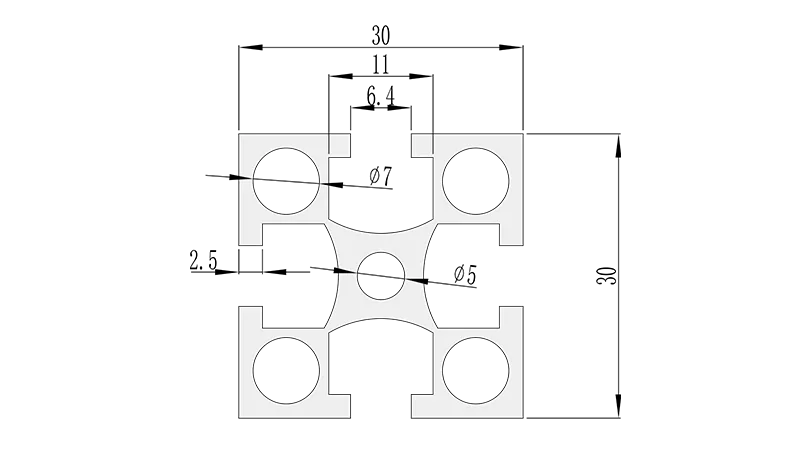
Let's start with the 3030 National Standard Profile A. True to its name, this profile measures 30mm by 30mm—a square cross-section that strikes a powerful balance between strength and versatility. Made from high-grade aluminum extrusion, it's designed to handle the rigors of industrial environments, where daily use involves heavy loads, constant movement, and the occasional bump or scrape.
What sets the 3030 apart is its load-bearing capacity. Thanks to its larger cross-section and thicker walls (typically 1.5mm to 2mm, depending on the variant), it can support upwards of 150-200 kg per linear meter when properly braced. This makes it ideal for applications where stability is non-negotiable: think material rack B (3 row and 3 floor) systems that hold stacks of raw materials, or workbenches where operators use power tools for assembly. Its T-slot design—those grooved channels running along its length—also means it plays well with a wide range of aluminum profile accessories , from 3030 aluminum angle yards that reinforce corners to gusset alp 3030 brackets that add extra stability to joints.
But the 3030 isn't just about brute strength. Its standardized design ensures compatibility with hundreds of off-the-shelf components, from caster wheels for mobile trolleys to roller track systems that turn static racks into dynamic flow lines. This modularity is a cornerstone of lean thinking: if your production line needs to reconfigure next month, you won't need to replace the entire frame—just swap out the accessories.
2020 Profile: The Space-Saving Specialist for Precision Work
Now, meet the 2020 Profile: the compact counterpart to the 3030. At 20mm by 20mm, it's significantly smaller, lighter, and designed for scenarios where space is at a premium. Don't let its size fool you, though—this little profile punches above its weight, thanks to aluminum's inherent strength-to-weight ratio. It's the go-to choice for applications where agility and precision matter more than raw load capacity, such as electronics assembly, lab workstations, or ESD workstations where static control is critical.
The 2020's claim to fame is its ability to fit into tight spaces. Imagine a manufacturing cell where operators work side-by-side on small components—say, assembling circuit boards or testing delicate sensors. A workstation built with 3030 profiles might feel bulky, crowding the area and forcing operators to stretch or twist to reach tools. The 2020, by contrast, creates a streamlined, ergonomic setup where everything stays within arm's reach. Its smaller T-slots also pair perfectly with lightweight aluminum profile accessories like 2020 aluminum corner codes and 20# aluminum corner code brackets, which add stability without adding bulk.
Another advantage? Weight. A 2020-based workstation is significantly lighter than its 3030 counterpart, making it easier to move (if needed) and cheaper to ship. This is a boon for facilities that frequently reconfigure layouts or for startups operating in temporary spaces. And while its load capacity is lower—typically around 50-80 kg per linear meter—it's more than enough for holding tools, bins of small parts, or even lightweight roller track systems for moving PCBs or small assemblies.
Side-by-Side: How 3030 and 2020 Profiles Stack Up
To truly understand how these profiles differ, let's break down their key attributes side by side. The table below compares everything from dimensions to ideal use cases, so you can see at a glance which profile aligns with your needs.
| Attribute | 3030 National Standard Profile A | 2020 Profile |
|---|---|---|
| Dimensions | 30mm x 30mm (square cross-section) | 20mm x 20mm (square cross-section) |
| Wall Thickness | 1.5mm – 2.0mm (varies by grade) | 1.0mm – 1.5mm (varies by grade) |
| Load Capacity (per linear meter) | 150 – 200 kg (with proper bracing) | 50 – 80 kg (with proper bracing) |
| Weight (per meter) | ~0.8 – 1.2 kg | ~0.4 – 0.6 kg |
| Typical Accessories | 3030 aluminum angle yards, gusset alp 3030, heavy-duty casters, material rack B (3 row and 3 floor), roller track placon mount for aluminum profile high | 2020 aluminum corner codes, 20# aluminum corner code, small iron corner code, ESD workbench (single deck-without caster), mini aluminum roller track |
| Best For | Heavy-duty workbenches, material storage racks, assembly lines with large components, mobile trolleys for heavy loads | Compact workstations, ESD-sensitive areas, electronics assembly, lab setups, lightweight material transport |
| Pros |
• Higher load capacity
• More stable for heavy tools/machinery • Wider range of heavy-duty accessories |
• Space-efficient for tight areas
• Lighter weight (easier to move/ship) • Lower cost per linear meter |
| Cons |
• Bulkier (takes up more space)
• Heavier (harder to reconfigure alone) • Higher cost per linear meter |
• Lower load capacity (not for heavy machinery)
• Fewer heavy-duty accessory options • Less stability for tall structures |
Choosing the Right Profile: A Practical Guide
Now that you understand the specs, how do you decide which profile is right for your project? The answer lies in asking yourself five key questions:
1. What's the Maximum Load You Need to Support?
This is the most critical question. If your workstation will hold heavy equipment—think power drills, soldering stations, or bins of metal parts weighing 50 kg or more—the 3030 is the safer bet. Its thicker walls and larger cross-section distribute weight more evenly, reducing the risk of sagging or instability over time. For example, a material rack B (3 row and 3 floor) filled with steel components would buckle under the strain if built with 2020 profiles; the 3030, however, handles that load with ease.
On the flip side, if you're working with small parts—like screws, PCBs, or medical devices—a 2020 profile will more than suffice. An ESD workbench (single deck-without caster) used for smartphone assembly, for instance, rarely needs to support more than 20-30 kg, making the 2020's lighter frame a perfect fit.
2. How Much Space Do You Have to Work With?
Space constraints can make the 2020 a non-negotiable choice. In electronics manufacturing, for example, production cells are often designed to maximize the number of operators per square meter. A 3030-based workstation might add 10-15cm to the overall footprint, which can quickly add up when you're fitting 10+ workstations into a room. The 2020's slimmer profile lets you pack more workstations into the same area without sacrificing functionality.
Conversely, if you're working in a spacious warehouse or factory with plenty of room, the 3030's extra size is a small price to pay for the added stability. In these cases, the goal is often to maximize load capacity and durability, not minimize space.
3. Will the Workstation Need to Move?
Mobility is another key factor. A 3030-based trolley loaded with tools and materials can quickly become heavy—too heavy for a single operator to push, even with casters. The 2020's lighter weight makes it ideal for mobile setups, like carts that transport components between assembly stations. That said, if you need to move heavy loads (e.g., 100+ kg), the 3030 is still the way to go—just pair it with heavy-duty casters and ensure the frame is properly reinforced.
4. What's Your Budget?
Cost is always a consideration, and here the 2020 has a clear edge. Because it uses less aluminum per linear meter, it's typically 30-40% cheaper than the 3030. For small projects or startups on a tight budget, this can make a big difference. However, it's important to avoid false economies: skimping on profile size to save money might lead to a workstation that can't handle your needs, requiring expensive upgrades later. If you're unsure, it's often better to overestimate your load requirements and choose the 3030—better to have extra capacity than not enough.
5. Do You Need ESD Protection?
Electrostatic discharge (ESD) can destroy sensitive electronics, making ESD workstations a must in industries like semiconductor manufacturing or medical device assembly. While both profiles can be integrated into ESD systems, the 2020 is often preferred here. Its smaller size pairs well with ESD-safe accessories like conductive mats and grounding clips, and its lightweight design makes it easier to position near static-sensitive equipment without crowding the area.
Real-World Scenarios: How Companies Choose Between 3030 and 2020
To bring these concepts to life, let's look at two hypothetical (but realistic) examples of how businesses might select between the 3030 and 2020 profiles.
Scenario 1: Automotive Parts Manufacturer
A mid-sized automotive parts company needs to build new workstations for assembling engine components. The parts are heavy—some weigh up to 80 kg—and operators use power tools that generate vibration. The factory floor has plenty of space, and the workstations will be stationary. They also need material racks to store incoming parts, with each rack holding 3 rows of 3 floors (sound familiar? That's material rack B (3 row and 3 floor) !).
Choice: 3030 National Standard Profile A. The heavy loads, vibration, and need for durable storage racks make the 3030 the clear winner here. They'll pair it with 3030 aluminum angle yards to reinforce joints and gusset alp 3030 brackets for extra stability. The material racks, in particular, will benefit from the 3030's load capacity, ensuring that stacks of metal parts don't cause the frame to warp over time.
Scenario 2: Consumer Electronics Startup
A startup that designs smart home devices is moving into a small industrial space. They need workstations for assembling circuit boards, testing prototypes, and packing finished products. Space is tight—they have room for 4 workstations, each shared by two operators. The components are lightweight (most parts weigh less than 5 kg), but they need ESD protection to avoid damaging sensitive chips. They also want the flexibility to reconfigure the layout as their team grows.
Choice: 2020 Profile. The 2020's compact size lets them fit 4 workstations into the limited space, and its lightweight design makes reconfiguration easy (two people can disassemble and move a workstation in minutes). They'll use 2020 aluminum corner codes to build sturdy but slim frames, and pair the profiles with ESD-safe work surfaces and grounding kits. For material transport, they'll add small, mobile trolleys built with 2020 profiles to move parts between stations without blocking walkways.
The Bottom Line: Align Your Profile with Your Purpose
At the end of the day, choosing between the 3030 National Standard Profile A and the 2020 Profile isn't about picking a "better" option—it's about picking the right option for your unique needs. The 3030 is the workhorse: strong, stable, and ready to handle heavy loads and industrial environments. The 2020 is the space-saver: nimble, lightweight, and perfect for tight spaces and precision work. Both are integral to building effective lean systems that adapt, grow, and eliminate waste.
Remember: the best lean workstation is one that works for your team, not against them. It should reduce frustration, minimize movement, and make it easy to do the job right the first time. Whether you opt for the 3030, the 2020, or a mix of both (yes, hybrid systems are possible!), the key is to start with a clear understanding of your goals: What do you need to support? How much space do you have? And how might those needs change in the future?
With the right profile in hand, you're not just building a workstation—you're building a foundation for efficiency, productivity, and success. And in the world of lean manufacturing, that's the ultimate win.