- Company Articles
- Industry articles
- Industry standards
- 3030 National Standard Profile A vs. 3030 Non-Standard: Cost-Effectiveness Analysis

3030 National Standard Profile A vs. 3030 Non-Standard: Cost-Effectiveness Analysis
Related Product
3030 National Standard Profile A
Workbench, production line, logistic rack, warehouse rack Industry: Manufacturer workshop, Automobile, Electronic, Assembling, logistic
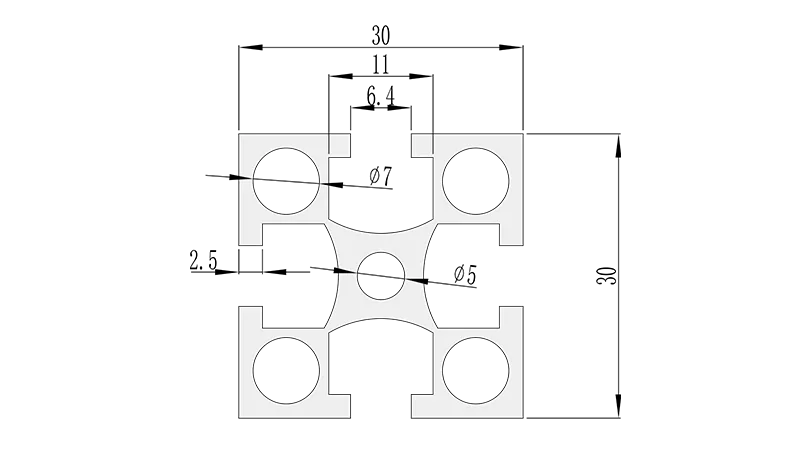
In the bustling world of manufacturing, where every minute of downtime and every dollar spent on equipment can make or break a business, the choice of materials isn't just about "getting the job done"—it's about building a foundation that lasts. For anyone setting up a production line, assembling workbenches, or organizing material flow, aluminum profiles are the unsung heroes. Lightweight, durable, and infinitely customizable, they're the backbone of lean systems, workbenches, and material racks. But not all aluminum profiles are created equal. Today, we're diving deep into a debate that plagues many facility managers and small business owners: 3030 National Standard Profile A versus non-standard 3030 profiles. Which one offers true cost-effectiveness in the long run? Let's unpack this.
Understanding the 3030 Profile: A Workhorse in Manufacturing
First, let's get on the same page about what a "3030 profile" actually is. The term "3030" refers to the cross-sectional dimensions: 30 millimeters in width and 30 millimeters in height. This compact size makes it incredibly versatile—think of it as the Swiss Army knife of aluminum profiles. You'll find it in everything from simple workbenches (like the aptly named Workbench E, a single-deck setup without casters) to complex lean system setups, including material racks (such as Material Rack B, a 3-row, 3-floor storage solution) and even lightweight conveyor systems. Its popularity stems from its balance of strength and flexibility: it's sturdy enough to support tools and materials but light enough to reconfigure when production needs change.
But here's the catch: while the "3030" label suggests uniformity, the reality is far more variable. Walk into any industrial supply market, and you'll find shelves lined with 3030 profiles at drastically different price points. Some are labeled "standard," others "economic" or "budget-friendly." The cheaper ones might seem like a steal at first glance, but as many manufacturers learn the hard way, "cheap" often comes with hidden costs. That's where the distinction between 3030 National Standard Profile A and non-standard alternatives becomes critical.
What is 3030 National Standard Profile A?
Let's start with the "gold standard": 3030 National Standard Profile A. This isn't just a marketing term—it's a profile that adheres strictly to national manufacturing standards, which vary by country but share core principles: consistency, quality, and performance. In China, for example, national standards for aluminum extrusion profiles (like GB/T 6892-2015) outline specific requirements for material composition, dimensional tolerance, mechanical properties, and surface treatment. 3030 National Standard Profile A is designed to meet or exceed these benchmarks.
Material: The Alloy Behind the Strength
At the heart of any aluminum profile is its alloy. National Standard Profile A typically uses 6063-T5 aluminum, a heat-treated alloy known for its excellent combination of strength, corrosion resistance, and machinability. The "6063" designation tells us it's composed of aluminum, magnesium, and silicon—elements that, when heat-treated (the "T5" part), form a microstructure that resists bending and warping under load. This isn't arbitrary: 6063-T5 is chosen for a reason. It has a tensile strength of around 180 MPa (megapascals), which means it can withstand 180 million Pascals of force before deforming—more than enough for most workshop applications, from supporting a 200kg workbench load to holding up multi-tiered material racks.
But it's not just the alloy itself; it's also the quality of the raw material. National standard profiles use primary aluminum (freshly mined and processed) rather than recycled scrap, which can contain impurities like iron or copper. These impurities might seem harmless, but over time, they weaken the alloy, making it prone to cracking or corrosion. Imagine building a workbench with recycled aluminum that starts to bend after a few months of holding heavy tools—that's the risk of cutting corners on material quality.
Manufacturing: Precision Through Extrusion
National Standard Profile A is produced using aluminum extrusion profile technology, a process where heated aluminum billets are forced through a die to create the desired cross-sectional shape. This method ensures uniformity: every meter of profile has the same wall thickness, the same internal structure, and the same mechanical properties. The dies used for standard profiles are machined to tight tolerances, so the 30mm x 30mm dimensions aren't just approximate—they're consistent within ±0.1mm. That might sound trivial, but when you're assembling a structure with aluminum profile accessories (like 90° connectors, hinges, or caster mounts), that precision matters. A profile that's even 0.5mm off in width can make it impossible to fit standard accessories, leading to wobbly joints or loose connections.
Surface Treatment: Protection That Lasts
Finally, standard profiles undergo rigorous surface treatment. Most are anodized—a process that creates a protective oxide layer on the aluminum's surface. National standards often require this layer to be at least 10 micrometers thick (that's 0.01 millimeters), which acts as a barrier against corrosion, scratches, and wear. In humid workshops or environments with oil and chemicals, this anodized layer prevents rust and ensures the profile maintains its structural integrity for years. Some non-standard profiles skip or skimp on anodization, using cheaper paint or powder coating that chips off easily, leaving the aluminum exposed to the elements.
What is a Non-Standard 3030 Profile?
Now, let's turn to the other side of the spectrum: non-standard 3030 profiles. These are profiles that don't adhere to national standards—either by choice (to cut costs) or by accident (due to poor manufacturing practices). They might be labeled "economic," "lightweight," or even "custom," but make no mistake: "non-standard" is often code for "inconsistent."
Material: Cutting Corners on Alloy and Purity
Non-standard profiles often use lower-grade alloys, like 1000-series aluminum (which is nearly pure aluminum, soft and weak) or recycled scrap with high levels of impurities. Some manufacturers even mix in cheaper metals like zinc or lead to reduce costs, which can make the profile brittle. Tensile strength drops dramatically—we're talking 120 MPa or lower—meaning a non-standard profile might bend under the same load that a standard profile handles with ease. Corrosion resistance? Forget about it. Without proper alloying, non-standard aluminum oxidizes quickly, especially in damp environments. I've visited workshops where non-standard profiles used in material racks started showing rust spots within six months, forcing a complete replacement.
Dimensional Chaos: When "3030" is Just a Suggestion
Remember the "30mm x 30mm" cross-section? For non-standard profiles, this is often a loose guideline. Tolerances can be as wide as ±0.5mm or more, meaning one section of profile might be 29.5mm wide, the next 30.5mm. This might not sound like a big deal until you try to assemble it with aluminum profile accessories . Take a simple 90° aluminum profile connector: designed to fit snugly into a 30mm slot. If the profile is too narrow, the connector wiggles loose; too wide, and you can't insert it at all. I once worked with a client who bought non-standard profiles to build a lean system, only to find that half their connectors didn't fit. They spent hours filing down the profiles to make them work—wasting time and that could have been spent on production.
Surface Treatment: A Quick Fix, Not a Solution
Non-standard profiles often skip anodization entirely, opting for a thin layer of paint or powder coating instead. While this might look shiny at first, it doesn't bond well to the aluminum. Scratches from tools or material handling strip the coating, exposing the raw metal. In one factory I visited, non-standard profiles used in a roller track system started chipping after a month of use, leaving sharp edges that damaged plastic components moving along the track. The result? Frequent jams and a 15% slowdown in material flow—hardly "cost-effective."
Cost-Effectiveness: Beyond the Initial Price Tag
So, non-standard profiles are cheaper upfront—sometimes by 20-30%. For a small business operating on tight margins, that difference can be tempting. But cost-effectiveness isn't just about what you pay today; it's about the total cost of ownership (TCO) over the profile's lifespan. Let's break this down.
| Factor | 3030 National Standard Profile A | Non-Standard 3030 Profile |
|---|---|---|
| Initial Cost (per meter) | $15–$20 | $10–$14 |
| Material Alloy | 6063-T5 (primary aluminum, 180 MPa tensile strength) | Recycled or low-grade alloy (120 MPa or lower) |
| Dimensional Tolerance | ±0.1mm | ±0.5mm or more |
| Surface Treatment | Anodized (10μm+ thickness) | Thin paint/powder coating (easily chipped) |
| Expected Lifespan | 5–8 years | 1–3 years |
| Annual Maintenance Cost | $50–$100 (minor cleaning, tightener checks) | $200–$300 (repairing bent sections, replacing corroded parts) |
| Downtime (per year) | 1–2 hours (routine checks) | 10–15 hours (fixing loose joints, replacing failed profiles) |
| Total Cost of Ownership (5-year estimate) | $125–$180 per meter | $250–$350 per meter |
Let's unpack that table. The initial cost of non-standard profiles is lower—no argument there. But look at the 5-year TCO: non-standard profiles end up costing twice as much as National Standard Profile A. Why? Because they need to be replaced more often (1–3 years vs. 5–8), require constant maintenance (tightening loose accessories, fixing bent sections), and cause costly downtime. For a factory running two shifts a day, 10 hours of downtime a year translates to lost production worth thousands of dollars—money that could have been saved by investing in standard profiles upfront.
Real-World Example: The Workbench That Broke the Bank
Case Study 1: ABC Electronics
ABC Electronics, a small manufacturer of circuit boards, needed 10 workbenches (Workbench E style) for their assembly line. They opted for non-standard 3030 profiles to save $500 upfront—each non-standard bench cost $300, vs. $350 for a standard one. The first six months went smoothly. But by month seven, the workbenches started wobbling. The non-standard profiles had bent under the weight of soldering equipment, and the aluminum profile accessories (like caster mounts and hinges) had loosened, causing tools to slide off the benches. To fix this, ABC had to hire a technician for 8 hours per bench, costing $80/hour—$6,400 total. Then, they replaced all 10 workbenches with National Standard Profile A benches a year later, spending another $3,500. Net loss? $6,400 (repairs) + $3,500 (replacements) – $500 (initial savings) = $9,400. All because they chose non-standard to save $500.
Another Example: Material Racks and the Cost of Corrosion
Case Study 2: XYZ Automotive Parts
XYZ Automotive needed Material Rack B (3 rows, 3 floors) to store plastic components. They chose non-standard profiles, reasoning that "plastic isn't heavy, so why splurge?" The racks cost $1,200 each, vs. $1,800 for standard. Within a year, the humid workshop environment caused the non-standard profiles to corrode. The racks started sagging, and plastic parts began falling off the shelves. XYZ had to replace the racks every 18 months, spending $1,200 x 3 = $3,600 over 4.5 years. Their competitor, using National Standard Profile A racks, spent $1,800 once and had racks that still looked new after 5 years. XYZ's "savings" cost them an extra $1,800—and countless headaches.
The Hidden Cost of Incompatibility
Beyond lifespan and maintenance, there's another cost that's easy to overlook: compatibility with accessories. National Standard Profile A is designed to work seamlessly with the entire ecosystem of aluminum profile accessories —from 45° connectors to T-slot rubber seal covers, from caster wheels to end caps. These accessories are mass-produced to fit standard tolerances, so you can walk into any supplier and buy a replacement hinge or connector without worrying about fit.
Non-standard profiles? Good luck. Because their dimensions vary, you're often locked into buying accessories from the same manufacturer—and if that manufacturer goes out of business or stops making that specific profile, you're stuck. I know a workshop that had to replace an entire lean system because the non-standard profile manufacturer went under, and no other accessories would fit their odd-sized slots. That's not just a cost—it's a business risk.
When Might Non-Standard Profiles Make Sense?
I'd be remiss if I didn't acknowledge that there are edge cases where non-standard profiles might be acceptable. If you're building a temporary structure—say, a display rack for a trade show that will be used for a week and then discarded—non-standard could save money. Or if the profile is used in a non-critical application with no load (like a lightweight sign holder), the risks are minimal. But for anything that's part of your core production process—workbenches, lean systems, material racks—non-standard is a gamble you can't afford to take.
Conclusion: Invest in Standards, Reap the Rewards
At the end of the day, cost-effectiveness isn't about the lowest upfront price—it's about getting the most value over time. 3030 National Standard Profile A might cost more initially, but its superior material quality, precise manufacturing, and compatibility with aluminum profile accessories translate to longer lifespans, lower maintenance, and less downtime. Non-standard profiles, with their shoddy alloys, inconsistent dimensions, and quick degradation, end up costing far more in the long run.
So, the next time you're shopping for aluminum profiles, remember: the label "3030" is just the start. Ask about the alloy, check the tolerances, and inquire about compliance with national standards. Your workbenches, your lean system, and your bottom line will thank you.
After all, in manufacturing, the strongest foundations aren't built on shortcuts—they're built on standards.