- Company Articles
- Industry articles
- Industry standards
- 3030 National Standard Profile A vs. 3060 Profile: When to Upsize Your Structure

3030 National Standard Profile A vs. 3060 Profile: When to Upsize Your Structure
Related Product
3030 National Standard Profile A
Workbench, production line, logistic rack, warehouse rack Industry: Manufacturer workshop, Automobile, Electronic, Assembling, logistic
Walk into any manufacturing plant, workshop, or even a small garage-turned-hobby space, and you'll likely spot them: sturdy, silver structures holding tools, parts, or entire workstations together. Those are aluminum profiles—the unsung heroes of efficient, adaptable workspace design. But here's the thing: not all profiles are created equal. Choosing between something like the 3030 National Standard Profile A and the 3060 Profile can feel like picking between a sedan and an SUV—both get the job done, but one's built for heavier loads and longer hauls.
If you've ever built a shelf that sagged under the weight of paint cans, or a workbench that wobbled when you leaned on it, you know the frustration of choosing the wrong "frame." Aluminum profiles work the same way. The 3030 and 3060 might look similar at first glance—both have those signature T-slots, that smooth aluminum finish—but their differences are make-or-break for your project. In this guide, we'll break down when to stick with the versatile 3030, when to call in the heavyweight 3060, and how to avoid the costly mistake of upsizing (or downsizing) at the wrong time.
First Things First: What Are These Profiles, Anyway?
Let's start with the basics. Aluminum profiles are extruded pieces of aluminum alloy—usually 6063-T5, a material known for its strength, corrosion resistance, and lightweight properties. They're called "profiles" because they're shaped into specific cross-sections during manufacturing, with those iconic T-slots running along their length. Those slots? They're not just for show. They let you slide in brackets, connectors, and other aluminum profile accessories to build everything from simple shelves to complex conveyor systems without welding or drilling.
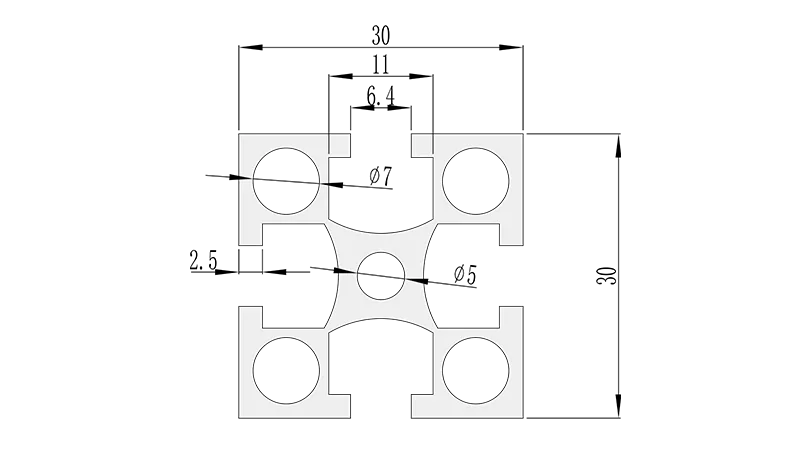
Now, the numbers: "3030" and "3060" refer to their cross-sectional dimensions in millimeters. So, a 3030 National Standard Profile A is 30mm wide and 30mm tall—a square. The 3060 Profile, on the other hand, is 30mm wide and 60mm tall—a rectangle. That extra height in the 3060 might not seem like much, but in structural engineering, even a few millimeters can mean doubling the load capacity. Think of it like comparing a 4x4 post to a 4x6 post in woodworking—the taller one resists bending under weight far better.
Both profiles are part of the "national standard" lineup, which means they're designed to work with a universal set of accessories. That means you can mix and match brackets, end caps, and connectors between them (more on that later), but their core strengths are tailored to different jobs.
Side-by-Side: Key Differences That Matter
To really understand which profile is right for you, let's put them head-to-head. The table below breaks down the specs that'll impact your project—from how much weight they can hold to how they fit into your budget.
| Feature | 3030 National Standard Profile A | 3060 Profile |
|---|---|---|
| Dimensions | 30mm (width) x 30mm (height) | 30mm (width) x 60mm (height) |
| Cross-Sectional Area | Approx. 800 mm² (varies by manufacturer) | Approx. 1,400 mm² (varies by manufacturer) |
| Weight per Meter | 0.8–1.0 kg/m (lightweight, easy to handle) | 1.4–1.6 kg/m (sturdier, but still manageable) |
| Static Load Capacity (per meter span) | Up to 50–80 kg (ideal for light to medium loads) | Up to 150–200 kg (built for heavy-duty use) |
| Common Uses | Small workbenches, turnover trolleys, light shelving, hobby projects | Heavy-duty workbenches, material racks, conveyor frames, industrial shelving |
| Cost (per meter) | Lower (30–50% less than 3060, depending on supplier) | Higher (but pays off for heavy loads) |
| Accessory Compatibility | Works with standard 30-series accessories (connectors, end caps, brackets) | Compatible with most 30-series accessories, but may need heavier-duty brackets for max load |
See that gap in load capacity? That's where the decision really starts to matter. Let's dig into when each profile shines.
When to Stick with 3030 National Standard Profile A: The "Everyday Workhorse"
The 3030 National Standard Profile A is like that reliable pickup truck you see everywhere—it's not flashy, but it handles 90% of daily tasks without breaking a sweat. If your project fits into one of these categories, save yourself the extra cost and stick with the 3030:
1. Light to Medium-Duty Workstations – Think of a small assembly bench in an electronics workshop, where you're placing a soldering iron, a few bins of resistors, and a laptop. A workbench built with 3030 profiles will easily support that. Even with a plywood top, the 3030's 50–80 kg per meter capacity is more than enough. I've seen hobbyists build 3030 workbenches that hold 3D printers (which weigh 15–30 kg) without a hint of wobble.
2. Turnover Trolleys for Small Parts – If you're moving bins of screws, washers, or small plastic components around a factory floor, a trolley made with 3030 is perfect. Its lightweight design (1 kg per meter) makes it easy to push, even with a load of 100–150 kg total. Plus, those T-slots let you add dividers or tool hooks without drilling—just slide in a bracket and tighten a knob.
3. Temporary or Mobile Structures – Need a shelf for a trade show booth, or a cart to wheel tools around a garage? The 3030's low weight and easy assembly (no heavy tools needed) make it ideal for structures you might take apart and rebuild later. I once helped a friend build a 3030-based photography backdrop stand that collapsed into a car trunk—try doing that with steel pipes.
4. Hobby and DIY Projects – Whether you're building a greenhouse frame, a gaming desk, or a bookshelf for your home office, the 3030 is forgiving for beginners. It's affordable enough to experiment with (you won't cry if you cut a piece too short), and the abundance of aluminum profile accessories (like corner brackets and end caps) means you can tweak the design as you go.
The bottom line: If your project's max load is under 80 kg per linear meter, and you don't need to span more than 1.2–1.5 meters without support, the 3030 will serve you well. It's the profile equivalent of "good enough"—but in the best way possible.
When to Upsize to 3060 Profile: The "Heavy Lifter"
Now, let's talk about when the 3030 just won't cut it. The 3060 Profile is the overachiever of the aluminum world—built for jobs where "good enough" could lead to sagging, wobbling, or even safety risks. Here are the red flags that mean it's time to upsize:
1. You're Supporting Heavy Machinery or Tools – Imagine mounting a drill press (which can weigh 50–100 kg) on a workbench. A 3030 frame might hold it at first, but over time, the constant vibration and weight could cause the profiles to flex. The 3060's beefed-up cross-section (remember that 1,400 mm² vs. 800 mm²?) resists bending, keeping your tools stable and your workspace safe.
2. Your Racks Need to Hold Bulky, Heavy Items – I visited a auto parts warehouse once where they'd used 3030 profiles for a rack storing car batteries. Big mistake. After a month, the middle shelves were visibly sagging under the 35-kg batteries. They had to rebuild with 3060, and the difference was night and day. If you're storing metal parts, engine components, or even stacks of thick plywood, the 3060's 150–200 kg per meter capacity is non-negotiable.
3. You Need Longer Spans Without Supports – Let's say you want a shelf that spans 2 meters between two walls, with no middle support. A 3030 profile here would sag like a hammock with a watermelon on it. The 3060, with its taller cross-section, can span 2–2.5 meters without noticeable deflection. This is huge for open-concept workspaces where extra support beams would get in the way.
4. Dynamic Loads (Think: Conveyors or Moving Parts) – It's not just about static weight. If you're building a conveyor frame that'll carry boxes bumping along rollers, or a cart that gets pushed over uneven floors, the 3060 handles "shock loads" better. The 3030 might vibrate or loosen connectors over time, but the 3060's rigidity keeps everything tight—even when parts are sliding or bouncing.
5. Future-Proofing Your Space – Maybe your current needs are light, but you know you'll expand. A small workshop today might add a CNC machine tomorrow, or a hobby space might turn into a small business. Building with 3060 now means you won't have to tear everything down and rebuild later. I've seen too many teams skimp on profiles to save money, only to spend twice as much a year later upgrading.
The "In-Between" Scenarios: When It's Tricky to Choose
Of course, not every project fits neatly into "light" or "heavy." What if you're building a shelf that holds 100 kg total, but spans 1.8 meters? Or a workbench that's currently for small tools, but might one day hold a laser cutter? Here's how to decide:
Calculate the "Worst-Case" Load – Don't just think about today's needs. Add 50% to your estimated load to account for "oops" moments (like piling extra boxes on a shelf) or future upgrades. If that adjusted load exceeds 80 kg per meter, go 3060.
Measure the Span – The longer the unsupported span, the more the profile will bend. A 3030 can handle 1.2 meters with 50 kg, but at 1.5 meters, that same load might cause 5mm of sag (which might not sound like much, but it'll make your shelf look uneven). The 3060 can span 1.8 meters with 100 kg and sag less than 2mm.
Check the Environment – Will the structure be indoors (climate-controlled) or outdoors (wind, rain, temperature swings)? Aluminum handles weather well, but the 3060's extra mass is more stable in windy conditions. I once saw a 3030 awning collapse in a storm because the wind caught it—wouldn't have happened with 3060.
Accessories Matter: Don't Skimp on the "Glue"
You could buy the strongest 3060 profiles on the market, but if you pair them with flimsy connectors, your structure will still fail. Aluminum profile accessories are the glue that holds everything together, and they matter just as much as the profiles themselves.
For 3030 projects, standard L-brackets, T-connectors, and plastic end caps work fine. But if you're using 3060 for heavy loads, invest in metal gussets (those triangular brackets that reinforce corners) and heavy-duty casters (rated for 100+ kg each). I once helped a client rebuild a 3060 material rack that kept wobbling—turns out they were using 3030-sized connectors, which were too small. Swapping in 3060-specific brackets fixed it instantly.
Common Mistakes to Avoid
Mistake #1: Downsizing to Save Money – A 3030 profile costs less per meter, but if it sags and you have to rebuild, you'll spend more in time and materials. I've seen a factory lose a week of production because they used 3030 for a conveyor frame that kept jamming—all to save $200 on profiles.
Mistake #2: Oversizing When You Don't Need To – On the flip side, using 3060 for a small hobby bench is like using a sledgehammer to hang a picture. You'll add unnecessary weight and cost. A 3030 bench is lighter, easier to move, and just as stable for light use.
Mistake #3: Ignoring T-Slot Compatibility – Both 3030 and 3060 use 30-series T-slots, so most accessories work across both. But some heavy-duty brackets are designed specifically for 3060's taller profile. Always check the accessory specs—"fits 30-series" doesn't always mean "fits 3060 at max load."
Final Verdict: Let Your Project's Needs Guide You
At the end of the day, the 3030 National Standard Profile A and 3060 Profile aren't rivals—they're teammates. The 3030 excels at light, flexible projects where cost and weight matter. The 3060 takes over when you need brute strength, longer spans, or future-proofing. The key is to be honest about your project's load, span, and growth potential.
So, next time you're staring at a pile of aluminum profiles, ask yourself: "What's the heaviest thing this will hold? How long will it span? And will I regret not upsizing later?" The answer will almost always point you to the right choice.
And if you're still unsure? Start small with 3030 for non-critical parts, and test it. If it sags, bends, or feels wobbly, you'll know the 3060 is worth the upgrade. After all, the best structures aren't just built—they're built to last.