- Company Articles
- Industry articles
- Industry standards
- 3030 National Standard Profile A vs. 4040: Which Profile Fits Your Production Line Needs?

3030 National Standard Profile A vs. 4040: Which Profile Fits Your Production Line Needs?
Related Product
3030 National Standard Profile A
Workbench, production line, logistic rack, warehouse rack Industry: Manufacturer workshop, Automobile, Electronic, Assembling, logistic
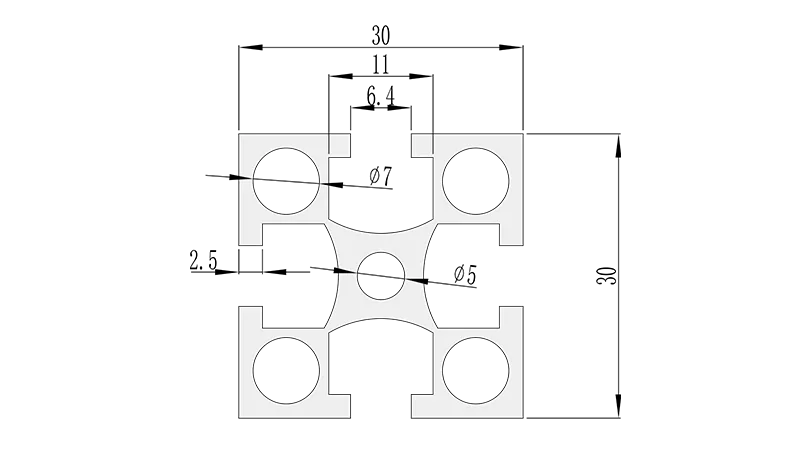
Walk into any modern manufacturing facility, and you'll notice a silent hero holding everything together: aluminum profiles. These unassuming metal structures form the backbone of workbenches, flow racks, and assembly lines, quietly ensuring that materials move smoothly, tools stay organized, and workflows remain efficient. But not all aluminum profiles are created equal. When it comes to outfitting your production line, two names often rise to the top: the 3030 National Standard Profile A and the 4040 aluminum extrusion profile. Choosing between them isn't just about picking a "bigger" or "smaller" option—it's about aligning your choice with the unique rhythm, demands, and goals of your operation. Let's dive into what makes each profile tick, how they stack up, and which one deserves a spot in your production line.
Understanding Aluminum Extrusion Profiles: The Backbone of Modern Production
Before we compare the 3030 and 4040, let's take a step back. Aluminum extrusion profiles are created by forcing heated aluminum through a die, shaping it into consistent cross-sections with built-in features like T-slots—those handy grooves running along the length that let you attach brackets, shelves, or guides without welding. This design is a game-changer for manufacturers: it's modular, customizable, and adaptable, making it easy to reconfigure workstations or scale up as your needs grow. Whether you're building a lightweight workbench for small-part assembly or a heavy-duty flow rack for bulk materials, the right aluminum profile can turn chaos into order.
But here's the thing: not every production line is the same. A electronics plant assembling circuit boards has different needs than an automotive facility moving engine parts. That's where profile size matters. The numbers "3030" and "4040" refer to the cross-sectional dimensions in millimeters—30mm x 30mm for the 3030, and 40mm x 40mm for the 4040. At first glance, that 10mm difference might seem small, but in the world of manufacturing, small differences can have big impacts on load capacity, stability, and flexibility.
3030 National Standard Profile A: The Compact Powerhouse
Let's start with the 3030 National Standard Profile A. As the name suggests, this profile measures 30mm by 30mm, making it the slimmer of the two options. Don't let its size fool you, though—this little profile packs a punch, especially for operations that prioritize agility and space efficiency.
Design and Build
The 3030 National Standard Profile A typically features a standard T-slot configuration, with grooves along all four sides (or sometimes three, depending on the variant) that allow for easy attachment of accessories like brackets, panels, or roller tracks. Its wall thickness usually ranges from 1.2mm to 2.0mm, balancing strength with weight. Made from high-grade aluminum alloy (often 6063-T5, a common choice for its strength and corrosion resistance), it's lightweight enough to be maneuvered during setup but sturdy enough to handle daily wear and tear.
Best For: Small-Scale Assembly and Tight Spaces
If your production line deals with small to medium-sized components—think electronics, medical devices, or precision parts—the 3030 shines. Its compact footprint makes it ideal for workbenches in crowded facilities where space is at a premium. Imagine a workshop where every square inch counts: a 3030-based workbench can fit neatly between machines, leaving room for operators to move freely without sacrificing stability. It's also a favorite for temporary or frequently reconfigured setups, like prototype labs or short-run production lines, because its lightweight design makes disassembly and reassembly a breeze.
Another sweet spot for the 3030 is in lean system setups. Lean manufacturing thrives on eliminating waste, and the 3030's modularity aligns perfectly with that goal. Need to add a small parts bin to a workstation? Just slot in a bracket. Want to reposition a light fixture above an assembly area? The T-slots make it quick and tool-free. This flexibility helps keep workflows tight and efficient, reducing the time wasted on unnecessary movement or adjustments.
Limitations to Consider
Of course, no profile is perfect. The 3030's smaller size means it has a lower load capacity compared to the 4040. While it can handle most small parts and tools (typically up to 50-80 kg per linear meter, depending on wall thickness and support), it might struggle with heavy equipment or bulk materials. If your line involves lifting 20kg toolboxes or stacking heavy pallets, you might need to reinforce the 3030 with additional supports, which can add complexity and cost.
4040 Aluminum Extrusion Profile: The Heavy-Duty Workhorse
Now, let's turn to the 4040 aluminum extrusion profile. At 40mm x 40mm, it's noticeably larger than the 3030, and that extra size translates to one key advantage: strength. This profile is built for the heavy hitters of manufacturing—operations that need to support more weight, withstand constant use, and maintain stability under pressure.
Design and Build
The 4040 profile often comes with a beefier wall thickness, ranging from 1.5mm to 3.0mm, and a more robust T-slot design. Some variants even feature reinforced internal ribs, adding extra rigidity. Like the 3030, it's typically made from 6063-T5 aluminum, but its larger cross-section and thicker walls make it significantly sturdier. This means it can support heavier loads, resist bending under stress, and last longer in high-traffic areas.
Best For: Heavy Loads and High-Volume Production
If your production line moves large components—think automotive parts, industrial machinery, or bulk packaging—the 4040 is your go-to. Its higher load capacity (often 100-150 kg per linear meter or more) makes it ideal for flow racks, material handling trolleys, and workbenches that need to support heavy tools or equipment. Imagine a warehouse where pallets of raw materials glide along a 4040-based roller track: the profile's strength ensures the track stays level and stable, even with constant use.
The 4040 also shines in permanent or semi-permanent setups, like main assembly lines or long-term storage racks. Its durability means it can handle the wear and tear of daily operations—bumping from forklifts, constant loading/unloading, or exposure to industrial environments—without warping or weakening. Plus, its larger size provides more surface area for attaching accessories, making it easier to mount heavier panels, lights, or even small machinery directly to the profile.
Limitations to Consider
The 4040's biggest downside? Its size. In tight spaces, that extra 10mm can make a difference. A 4040-based workbench might feel bulky in a small workshop, limiting operator movement or reducing the number of workstations you can fit. It's also heavier than the 3030, which can make installation more labor-intensive—you might need extra hands to maneuver longer lengths during setup. And let's not forget cost: the larger profile and thicker walls mean the 4040 is typically pricier than the 3030, both in material and shipping costs (thanks to its weight).
Head-to-Head: 3030 vs. 4040
To help you visualize the differences, let's break down the key features of the 3030 National Standard Profile A and 4040 aluminum extrusion profile side by side:
| Feature | 3030 National Standard Profile A | 4040 Aluminum Extrusion Profile |
|---|---|---|
| Dimensions | 30mm x 30mm | 40mm x 40mm |
| Wall Thickness | 1.2mm – 2.0mm | 1.5mm – 3.0mm |
| Load Capacity (per linear meter) | 50 – 80 kg | 100 – 150+ kg |
| Weight (per meter) | ~0.8 – 1.2 kg | ~1.5 – 2.5 kg |
| Best For | Small parts assembly, tight spaces, lean system setups, temporary workstations | Heavy loads, material handling, permanent workbenches, flow racks |
| Cost | Lower (material + shipping) | Higher (material + shipping) |
| Flexibility | High (easy to reconfigure, lightweight) | Moderate (sturdy but heavier, harder to move) |
How to Choose: 5 Questions to Ask Yourself
Now that you know the basics of each profile, how do you decide which one is right for your production line? Start by asking these five questions:
1. What's the Maximum Weight You Need to Support?
This is the most critical question. If your workbench or rack will hold tools, parts, or equipment weighing more than 80kg, the 4040 is a safer bet. For lighter loads (think small tools, circuit boards, or hand-held devices), the 3030 will do the job—and save you money.
2. How Much Space Do You Have?
Measure your workspace carefully. In a cramped facility where every centimeter counts, the 3030's compact size will help you fit more workstations or leave room for operators to move. If space isn't an issue—like in a large warehouse or open assembly area—the 4040's stability might be worth the extra footprint.
3. Will You Need to Reconfigure Often?
If your production line changes frequently—due to new product launches, seasonal demand, or lean system adjustments—the 3030's lightweight design makes it easier to disassemble and rebuild. The 4040 is better for set-it-and-forget-it setups where stability matters more than flexibility.
4. What's Your Budget?
Aluminum profiles aren't cheap, and the 4040 will cost more upfront—both in materials and installation (since it's heavier). If you're on a tight budget and don't need the extra strength, the 3030 is the more economical choice. But if you skimp on the 4040 when you need it, you might end up replacing bent or damaged profiles later, costing more in the long run.
5. What Accessories Will You Use?
Most aluminum profile accessories (brackets, joints, panels) are compatible with both 3030 and 4040, but some heavy-duty accessories (like large casters or thick panels) may require the 4040's larger T-slots for a secure fit. Check with your supplier to ensure your chosen accessories work with your profile size.
Real-World Examples: When to Pick Which Profile
Let's put this into context with a few scenarios to see how the 3030 and 4040 play out in real life.
Scenario 1: A Small Electronics Assembly Line
A company assembling smartwatches needs workbenches for operators to fit screens, batteries, and circuit boards. The parts are small (most under 500g), and the workshop is tight, with only 200 square meters of space. They also reconfigure the line quarterly to accommodate new watch models. Best choice: 3030 National Standard Profile A. Its compact size fits more workstations, and its lightweight design makes reconfiguration a snap. Plus, the lower cost helps stay within budget for a small operation.
Scenario 2: An Automotive Parts Warehouse
A warehouse stores and distributes engine blocks (each weighing ~30kg) and transmission parts (~20kg) to an assembly line. They need flow racks that can hold 5-6 parts per shelf, with roller tracks to slide parts to the picker. The warehouse has plenty of space, and the racks will stay in place for years. Best choice: 4040 Aluminum Extrusion Profile. Its high load capacity ensures the racks can handle the weight, and its durability stands up to constant use. The larger size also provides stability for the roller tracks, preventing jams or misalignment.
Scenario 3: A Mixed-Use Workshop
A manufacturer makes both small plastic components (for toys) and larger metal brackets (for furniture). They need some workbenches for assembling toys and flow racks for storing brackets. Best choice: A mix of both. Use 3030 for the toy assembly workbenches (small parts, frequent reconfigurations) and 4040 for the flow racks holding metal brackets (heavier loads, permanent setup). This way, they get the best of both worlds without overspending.
Final Thoughts: It's About Fit, Not "Better"
At the end of the day, there's no "better" profile—only the one that fits your production line's unique needs. The 3030 National Standard Profile A is the agile, budget-friendly option for small parts, tight spaces, and frequent changes. The 4040 aluminum extrusion profile is the strong, steady workhorse for heavy loads, large components, and permanent setups.
To make the right choice, start by mapping out your needs: weight, space, flexibility, budget, and accessories. If you're still unsure, talk to your aluminum profile supplier—they can help you run load tests or suggest custom configurations that blend both profiles for maximum efficiency. After all, the goal isn't just to pick a profile; it's to build a production line that works as hard as your team does.
So, whether you go with the compact 3030 or the robust 4040, remember: the best aluminum profile is the one that keeps your line moving, your operators efficient, and your business growing. Now go build something great.