- Company Articles
- Industry articles
- Industry standards
- 3030 National Standard Profile A vs. Carbon Steel: Weight & Durability Comparison

3030 National Standard Profile A vs. Carbon Steel: Weight & Durability Comparison
Related Product
3030 National Standard Profile A
Workbench, production line, logistic rack, warehouse rack Industry: Manufacturer workshop, Automobile, Electronic, Assembling, logistic
In the world of manufacturing, assembly lines, and industrial workspaces, the choice of material can make or break efficiency, safety, and long-term productivity. Whether you're building a workbench, setting up a material rack, or designing a lean production system, two materials often rise to the top of the consideration list: aluminum profiles and carbon steel. Today, we're diving deep into a head-to-head comparison between one of the most versatile aluminum options—3030 National Standard Profile A—and traditional carbon steel, focusing on two critical factors: weight and durability. By the end, you'll have a clear picture of which material better suits your specific needs, whether you're optimizing a factory floor, assembling a mobile workstation, or constructing a heavy-duty storage solution.
What is 3030 National Standard Profile A?
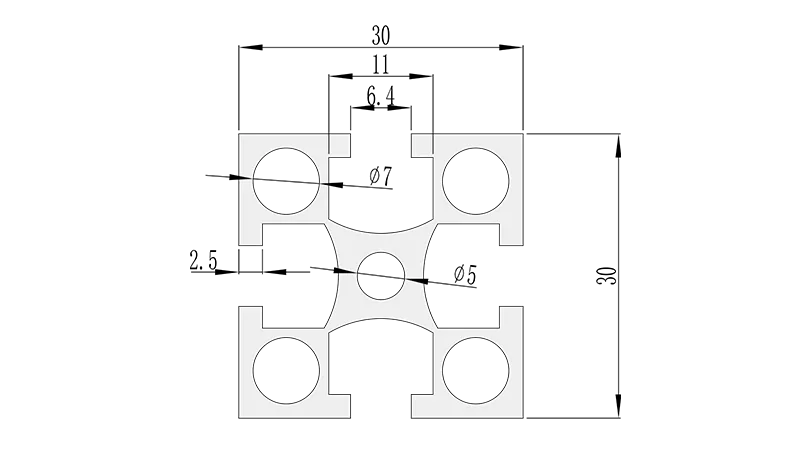
If you've ever walked through a modern factory or a well-organized workshop, chances are you've seen 3030 National Standard Profile A in action—even if you didn't know its name. This unassuming yet powerful material is part of the aluminum extrusion profile family, a category of materials shaped by forcing heated aluminum through a die to create consistent, precise cross-sections. As the name suggests, 3030 National Standard Profile A adheres to national manufacturing standards, ensuring uniformity in dimensions (30mm x 30mm in cross-section) and performance across suppliers.
What sets this aluminum profile apart is its T-slot design—a series of grooves running along its length that allow for easy attachment of aluminum profile accessories like connectors, brackets, casters, and panels. This design isn't just about convenience; it's about flexibility. Unlike welded steel structures, which are fixed once built, 3030 National Standard Profile A systems can be disassembled, reconfigured, and repurposed with minimal effort. This makes it a cornerstone of lean system setups, where adaptability and waste reduction are priorities.
Commonly made from 6063 aluminum alloy, 3030 National Standard Profile A strikes a balance between strength, lightweight, and corrosion resistance. It's used in everything from workbenches (like the aptly named Workbench E, a single-deck model without casters) to material racks (such as Material Rack B, a 3-row, 3-floor storage solution) and even turnover trolleys. Its popularity stems from its ability to handle daily industrial demands without weighing down operations—a trait we'll explore in detail later.
Carbon Steel: The Traditional Heavyweight
Carbon steel, on the other hand, is the old reliable of the industrial world. Composed primarily of iron and carbon (with trace amounts of other elements), it's been a staple in manufacturing for decades, valued for its raw strength and affordability. In the context of industrial frames, pipes, and structural components, carbon steel often comes in the form of solid bars, hollow tubes, or angle irons, used to build everything from heavy machinery bases to fixed shelving units.
Carbon steel's reputation is built on its mechanical properties: high tensile strength, hardness, and resistance to deformation under heavy loads. It's the go-to material when you need something that can withstand constant stress, whether from the weight of stacked materials or the vibrations of industrial equipment. However, this strength comes with a trade-off that's impossible to ignore: weight. Carbon steel is dense—significantly denser than aluminum—and that density translates to bulk, which can complicate installation, limit mobility, and even increase long-term operational costs.
Another consideration with carbon steel is its vulnerability to corrosion. Without protective coatings (like galvanization or paint), it's prone to rust when exposed to moisture, humidity, or chemicals. While coatings help, they add an extra step (and cost) to the manufacturing process and can wear off over time, requiring regular maintenance to keep the steel structurally sound.
Weight Comparison: Why Every Kilogram Counts
Let's start with the numbers—because when it comes to weight, the difference between 3030 National Standard Profile A and carbon steel is stark. Aluminum has a specific gravity of about 2.7 grams per cubic centimeter (g/cm³), while carbon steel clocks in at roughly 7.85 g/cm³. To put that in perspective: for the same volume of material, carbon steel weighs nearly three times as much as aluminum. That's not a small difference—it's a game-changer for anyone who has to lift, move, or install these materials.
Take a practical example: a 1-meter length of 3030 National Standard Profile A, which typically has a wall thickness of 1.5mm to 2mm, weighs approximately 0.8 to 1.2 kilograms. A carbon steel bar of the same dimensions (30mm x 30mm, 1-meter length, similar wall thickness) would weigh around 2.5 to 3.5 kilograms. Multiply that by the dozens or hundreds of profiles needed for a workbench, a material rack, or an assembly line, and the total weight difference becomes enormous. A simple Workbench E (single deck, without casters) built with aluminum profiles might weigh 30-40 kg, while the same workbench in carbon steel could tip the scales at 90-120 kg—so heavy that moving it, even a few feet, would require multiple people or a forklift.
The impact of this weight difference ripples through every stage of a project. During installation, lighter aluminum profiles reduce the risk of workplace injuries from heavy lifting. For mobile setups—like turnover trolleys or workbenches with casters—aluminum's low weight makes maneuvering easier, reducing strain on workers and increasing efficiency. Even transportation costs are lower: shipping a pallet of aluminum profiles costs significantly less than shipping the same number of carbon steel components, thanks to reduced fuel consumption and fewer logistical hurdles.
But weight isn't just about physical effort; it's about adaptability. In lean manufacturing, where production lines are reconfigured regularly to meet changing demands, a heavy carbon steel structure becomes a liability. Disassembling and rearranging a steel-framed workstation might take hours and a team of workers. With 3030 National Standard Profile A, one person can often make adjustments alone, using basic tools and aluminum profile accessories to reattach components in minutes. That flexibility is priceless in fast-paced environments where downtime equals lost revenue.
Durability Comparison: Strength, Corrosion, and Longevity
Weight is critical, but durability is where the rubber meets the road—or, more accurately, where the profile meets the daily grind of industrial use. Let's break down durability into four key categories: corrosion resistance, strength, wear resistance, and fatigue resistance.
Corrosion Resistance: Aluminum's Natural Advantage
Aluminum is inherently corrosion-resistant, thanks to a thin, protective oxide layer that forms on its surface when exposed to air. This layer acts as a barrier, preventing further oxidation (rust) and keeping the material intact even in humid or slightly acidic environments. For 3030 National Standard Profile A, this means it can withstand spills, moisture, and daily cleaning without degrading—making it ideal for food processing facilities, clean rooms, or outdoor applications where carbon steel would quickly rust without constant maintenance.
Carbon steel, by contrast, offers no such natural protection. Without a coating, it will start to rust within weeks of exposure to moisture. While galvanized steel (coated with zinc) or painted steel can delay this, the coating will eventually chip, scratch, or wear off, leaving the underlying steel vulnerable. In high-moisture environments—like a factory near the coast or a workshop that uses water-based coolants—carbon steel structures often require annual repainting or re-galvanizing to stay functional. Over time, that adds up to higher maintenance costs and more downtime.
Strength: It's About the Ratio
Carbon steel wins the raw strength contest—there's no denying that. A typical carbon steel bar has a tensile strength of 400-500 megapascals (MPa), while 3030 National Standard Profile A (made from 6063 aluminum alloy) has a tensile strength of around 180-220 MPa. But here's the catch: strength alone isn't the whole story. What matters more for many applications is the strength-to-weight ratio—the amount of strength per kilogram of material.
Aluminum's strength-to-weight ratio is significantly higher than carbon steel's. That means a structure built with 3030 National Standard Profile A can support nearly as much weight as a carbon steel structure but with a fraction of the mass. For example, a workbench frame made with aluminum profiles can easily support 200-300 kg of tools and materials—more than enough for most industrial tasks—while weighing half as much as a steel frame. Unless you're supporting extreme loads (like tons of heavy machinery), aluminum's strength-to-weight ratio makes it the smarter choice.
Wear Resistance: When Hardness Matters
Carbon steel is harder than aluminum, which gives it an edge in wear resistance. If you're building a structure that will be subject to constant friction—like a roller track for heavy pallets or a floor plate where metal parts are dragged—carbon steel might hold up better over time. However, aluminum isn't defenseless here. Many 3030 National Standard Profile A products come with surface treatments like anodizing, which increases hardness and wear resistance. Additionally, aluminum profile accessories like plastic or rubber bumpers can be added to high-contact areas, mitigating wear without adding significant weight.
Fatigue Resistance: Standing Up to Repeated Stress
Fatigue resistance refers to a material's ability to withstand repeated loading and unloading without breaking. Think of a workbench that's constantly being loaded with tools, or a material rack that's emptied and refilled daily. Carbon steel has a higher fatigue limit than aluminum, meaning it can handle more cycles of stress before developing cracks. But in most industrial settings, the stress levels are well within aluminum's capabilities. For example, a lean system workbench built with 3030 National Standard Profile A will easily last 10+ years with daily use, as the loads are consistent and moderate. Only in extreme cases—like a structure supporting vibrating machinery 24/7—would carbon steel's higher fatigue resistance become a deciding factor.
Real-World Applications: Where Each Material Shines
To understand which material is right for you, let's look at how they perform in common industrial scenarios.
When to Choose 3030 National Standard Profile A
Aluminum extrusion profile, and 3030 National Standard Profile A in particular, excels in environments where mobility, flexibility, and corrosion resistance are priorities. Here are a few examples:
- Lean Manufacturing Systems: Lean systems thrive on adaptability, and 3030 National Standard Profile A's T-slot design and lightweight nature make it perfect for reconfigurable workstations, flow racks, and assembly lines. Pair it with aluminum profile accessories like internal rotary aluminum joints or caster wheels, and you can quickly adjust layouts to match changing production needs.
- Mobile Workstations and Trolleys: Workbench E (single deck, without casters) can be easily upgraded with caster accessories to become a mobile workstation, while turnover trolleys built with aluminum profiles are light enough for one person to push, even when loaded with parts.
- Clean Rooms and Food Processing: Aluminum's corrosion resistance and easy-to-clean surface make it ideal for environments where hygiene is critical. Unlike carbon steel, it won't harbor bacteria in rust pits or require harsh chemicals to keep clean.
- Light-to-Medium Load Storage: Material Rack B (3 row, 3 floor) is a classic example of aluminum's storage capabilities. It can hold hundreds of kilograms of parts without bowing, yet remains light enough to relocate if your warehouse layout changes.
When to Choose Carbon Steel
Carbon steel still has its place, primarily in heavy-duty, stationary applications where raw strength and low cost are more important than weight or flexibility:
- Heavy Machinery Frames: Equipment like industrial presses or large CNC machines require a stable, vibration-resistant base—something carbon steel provides in spades.
- Fixed Outdoor Structures: Steel fences, outdoor storage racks, or shipping container ramps, where weight isn't an issue and the structure can be regularly painted to prevent rust.
- Extreme Load-Bearing: If you're storing tons of metal parts or heavy pallets, carbon steel's higher tensile strength makes it a safer choice than aluminum.
Side-by-Side Comparison: A Quick Reference Table
| Factor | 3030 National Standard Profile A (Aluminum Extrusion Profile) | Carbon Steel |
|---|---|---|
| Weight (1m length, 30x30mm) | 0.8–1.2 kg | 2.5–3.5 kg |
| Corrosion Resistance | Excellent (natural oxide layer) | Poor (requires coating) |
| Tensile Strength | 180–220 MPa | 400–500 MPa |
| Strength-to-Weight Ratio | High | Moderate |
| Flexibility/Reconfigurability | High (T-slot design, aluminum profile accessories) | Low (welded or bolted, hard to modify) |
| Maintenance Needs | Low (no rust, easy to clean) | High (coating touch-ups, rust prevention) |
| Best For | Lean systems, mobile workbenches, clean rooms, light-to-medium storage | Heavy machinery, fixed outdoor structures, extreme load-bearing |
Cost Considerations: Short-Term vs. Long-Term
It's impossible to talk about material choice without mentioning cost. Upfront, carbon steel is often cheaper per kilogram than aluminum. A meter of carbon steel bar might cost half as much as 3030 National Standard Profile A. But this initial savings can disappear when you factor in long-term costs:
- Installation Labor: Heavier steel requires more workers and specialized equipment (like forklifts) to install, driving up labor costs.
- Maintenance: Painting, galvanizing, or replacing rusted steel components adds recurring expenses over time.
- Transportation: Shipping steel costs more due to its weight, especially for large orders.
- Adaptability: If you need to reconfigure a steel structure, you'll likely have to cut, weld, or replace parts—costly and time-consuming. With aluminum, you can simply loosen a few bolts and rearrange.
For many businesses, the higher upfront cost of 3030 National Standard Profile A is offset by lower long-term expenses and improved efficiency. It's an investment in flexibility and reduced downtime that pays dividends over the life of the structure.
So, which material should you choose: 3030 National Standard Profile A or carbon steel? The answer depends on your priorities. If you value lightweight mobility, corrosion resistance, and the ability to adapt quickly to changing needs—whether you're building a workbench, a material rack, or an entire lean system—aluminum extrusion profile is the clear winner. Its strength-to-weight ratio, paired with aluminum profile accessories, makes it a versatile, cost-effective choice for most modern industrial applications.
Carbon steel, on the other hand, remains a solid option for heavy, stationary, or extreme-load scenarios where raw strength and upfront cost are the main drivers. But for the majority of workshops, factories, and assembly lines, 3030 National Standard Profile A offers a smarter balance of performance, practicality, and long-term value.
At the end of the day, the goal is to build a workspace that works for you—not against you. With 3030 National Standard Profile A, you're not just choosing a material; you're choosing efficiency, adaptability, and a foundation for growth. And in today's fast-paced manufacturing world, that's a choice that matters.