- Company Articles
- Industry articles
- Industry standards
- 3030 National Standard Profile A vs. European Standard Profiles: Compatibility Guide

3030 National Standard Profile A vs. European Standard Profiles: Compatibility Guide
Related Product
3030 National Standard Profile A
Workbench, production line, logistic rack, warehouse rack Industry: Manufacturer workshop, Automobile, Electronic, Assembling, logistic
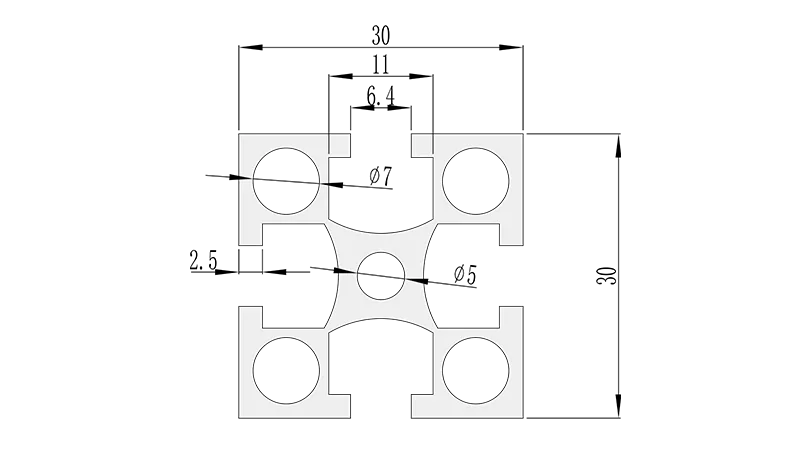
If you've ever stood in a workshop, staring at a pile of aluminum extrusion profiles and wondering why that bracket just won't slide into the slot, you're not alone. For manufacturers, DIY enthusiasts, and production managers alike, choosing between different aluminum profile standards can feel like navigating a maze—especially when mixing components from national and European systems. Today, we're diving deep into one of the most common dilemmas: the 3030 National Standard Profile A and its European counterparts. By the end, you'll understand their key differences, where they overlap, and how to ensure compatibility when your project demands the best of both worlds.
First Things First: What Are 3030 Profiles, Anyway?
Before we compare standards, let's get on the same page about the star of the show: 3030 profiles. These are aluminum extrusion profiles with a cross-sectional dimension of approximately 30mm x 30mm—hence the "3030" name. They're the workhorses of industrial and DIY projects, popping up in everything from assembly line workbenches to custom storage racks, machine guards, and even robotics frames. What makes them so popular? Their balance of strength, lightweight design, and versatility. Thanks to the T-slots running along their length, you can attach brackets, panels, and accessories without welding—just slide in a bolt, tighten, and you're good to go.
But here's the catch: not all 3030 profiles are created equal. Depending on where they're manufactured, they might follow either national standards (like China's GB/T specifications) or European standards (such as DIN or ISO norms). And while they might look identical at first glance, tiny differences in slot size, wall thickness, or tolerance can turn a seamless build into a frustrating afternoon of trial and error.
National vs. European Standards: A Quick Primer
National standards, like the 3030 National Standard Profile A, are often tailored to regional manufacturing practices, cost considerations, and local industry needs. They might prioritize affordability or specific load-bearing requirements common in domestic markets. European standards, on the other hand, are designed with pan-European compatibility in mind—think of them as the "universal language" of aluminum extrusion profiles. They're strict on tolerances, material consistency, and accessory standardization, making them a go-to for large-scale operations or projects with international components.
The 3030 National Standard Profile A, for example, is widely used in Asian manufacturing hubs. It's known for its robust build and cost-effectiveness, making it a favorite for small to medium enterprises (SMEs) looking to keep production costs low. European 3030 profiles, by contrast, often adhere to DIN 606 standards, which dictate precise measurements for slot width, wall thickness, and even the radius of corner edges. This precision ensures that a bracket bought in Germany will fit a profile made in France—but does that mean it will play nice with a National Standard Profile A from China? Let's find out.
Key Differences That Matter (Spoiler: It's in the Details)
To understand compatibility, we need to zoom in on the specs that separate these two profile types. Let's break them down one by one.
1. Slot Dimensions: The "Heart" of Compatibility
The T-slot is the lifeline of any aluminum extrusion profile—it's where all the magic happens (i.e., attaching accessories). For 3030 profiles, the slot width and depth are make-or-break for compatibility. Let's compare:
- 3030 National Standard Profile A: Typically features a slot width of 6mm and a depth of 10mm. This is a common size in many regional standards, optimized for standard M6 bolts and nuts.
- European Standard 3030 Profiles: Most follow a slot width of 8mm and a depth of 12mm. This larger slot accommodates M8 bolts, which are often used in heavier-duty applications.
Why does this matter? Imagine you have a European-style bracket designed for an 8mm slot. If you try to slide it onto a National Standard Profile A with a 6mm slot, it won't fit—simple as that. Conversely, a National Standard bracket with a 6mm tongue might wobble in an 8mm European slot, leading to loose connections and safety risks.
2. Wall Thickness and Material Strength
Aluminum extrusion profiles aren't just about shape—their structural integrity depends on wall thickness and alloy composition. National Standard Profile A often uses a wall thickness of 1.5mm to 2.0mm, balancing strength and cost. European profiles, however, tend to lean toward thicker walls (2.0mm to 3.0mm) and higher-grade alloys (like 6063-T5), which offer better corrosion resistance and load-bearing capacity. This doesn't mean one is "better" than the other—National profiles excel in lightweight, budget-friendly projects, while European ones shine in heavy-duty industrial settings.
But here's the compatibility angle: if you're mixing National and European profiles in a load-bearing structure (say, a workbench), the thinner National profile might flex under the same weight as its European counterpart, leading to uneven stress distribution. It's not a dealbreaker, but it's something to factor into your design.
3. Tolerances: When "Close Enough" Isn't Enough
Tolerances—how much a profile's actual dimensions can deviate from the stated specs—are where European standards really tighten the screws. European profiles often have tolerances of ±0.1mm for cross-sectional dimensions, ensuring every piece is nearly identical. National Standard Profile A, while still precise, might have slightly looser tolerances (±0.2mm to ±0.3mm). Why does this matter? If you're building a frame that requires multiple profiles to align perfectly (like a conveyor system), even a 0.2mm difference can throw off the entire assembly—especially when using European accessories designed for tight fits.
At a Glance: 3030 National vs. European Specs
| Feature | 3030 National Standard Profile A | European Standard 3030 Profile (DIN 606) |
|---|---|---|
| Slot Width | 6mm | 8mm |
| Slot Depth | 10mm | 12mm |
| Wall Thickness | 1.5–2.0mm | 2.0–3.0mm |
| Tolerance | ±0.2–0.3mm | ±0.1mm |
| Common Alloy | 6061-T6 | 6063-T5 |
Aluminum Profile Accessories: The Compatibility Wildcard
If profiles are the bones of your project, aluminum profile accessories are the muscles and joints. From brackets and corner codes to end caps and hinges, these small parts can make or break compatibility. Let's focus on a few common accessories and how they fare across standards.
Corner Codes and Brackets
Corner codes (like the 3060 aluminum angle yards or 20# aluminum corner code you might find in a supplier's catalog) are essential for joining profiles at 90-degree angles. European corner codes are designed for 8mm slots, with thicker tabs to match the sturdier European profiles. National Standard corner codes, by contrast, have narrower tabs (6mm) and often use lighter-duty materials. Mixing them? A European corner code tab will be too wide for a National slot, and a National tab will rattle in a European slot—unless you modify one or the other.
T-Slot Nuts and Bolts
T-slot nuts are the unsung heroes of profile assembly, sliding into the slot to secure bolts. European systems rely on M8 nuts for their 8mm slots, while National systems use M6 nuts for 6mm slots. You can sometimes use M6 nuts in European slots with washers to take up the slack, but it's a temporary fix. For a permanent solution, look for "hybrid" nuts designed to fit both slot sizes—many aluminum profile accessories suppliers now stock these to bridge the gap.
Panels and Covers
If your project includes panels (like safety guards or workbench tops), panel mounting brackets are key. European brackets often have longer bolts to reach through thicker profile walls, while National brackets are shorter. Mixing them might mean the bolt either doesn't reach the nut or protrudes too far, creating a hazard. Again, measuring the bracket length against your profile's wall thickness is critical.
Real-World Scenarios: When You Might Mix Standards
So, when would someone intentionally mix 3030 National Standard Profile A and European profiles? Let's paint a few pictures:
Scenario 1: The Budget-Conscious Workshop
A small electronics workshop in Shanghai has been using National Standard Profile A for years to build workbenches and storage racks—it's affordable and readily available from local suppliers. Now, they're expanding and need a specialized conveyor system, which only comes with European standard mounting brackets (since the manufacturer is based in Germany). To avoid replacing all their existing National profiles, they need to make the European brackets work with their current setup.
Scenario 2: The International Project
A furniture manufacturer in Italy is collaborating with a factory in Vietnam to produce modular shelving. The Italian team designs using European profiles, but the Vietnamese factory sources National Standard Profile A to cut costs. The challenge? Ensuring the Italian-designed accessories (like hinges and panel brackets) fit the Vietnamese-made profiles without delays.
Scenario 3: The DIY Enthusiast's Parts Bin
You're a hobbyist building a 3D printer enclosure, and your parts bin is a mix of leftovers: a few National Standard Profile A pieces from a local hardware store and some European profile scraps from a friend's industrial project. You want to combine them to save money—but will that corner bracket from the European set work with the National profile?
Troubleshooting Compatibility: 5 Tips to Save the Day
If you find yourself in one of these scenarios, don't panic. With a little creativity and planning, you can bridge the gap between National and European standards.
1. Measure Twice, Buy Once (or Modify Once)
Before you start drilling or cutting, measure everything: slot width, depth, profile length, and accessory dimensions. A digital caliper is your best friend here. If a European bracket's tab is 8mm wide and your National profile's slot is 6mm, you can carefully file down the tab by 2mm (or use a Dremel tool) to make it fit. Just be gentle—you don't want to weaken the bracket.
2. Invest in Adapter Kits
Many aluminum profile accessories suppliers now offer "adapter kits" specifically for mixing standards. These might include slotted shims to reduce European slot width from 8mm to 6mm, or spacer blocks to fill gaps between National brackets and European profiles. They're not expensive, and they'll save you hours of frustration.
3. Opt for Universal Accessories
Look for accessories labeled "universal" or "multi-standard." For example, some T-slot nuts are designed to expand or contract to fit 6mm and 8mm slots, and corner brackets with adjustable tabs can accommodate both profile types. A quick chat with your lean pipe supplier (yes, even they stock these!) can point you to the right products.
4. Reinforce Weak Points
If you're using a National profile in a load-bearing area where a European profile would normally go, add reinforcement. For example, attaching a second National profile alongside the first can mimic the strength of a single European profile. Just ensure the connection is secure with proper brackets and bolts.
5. Test Before Full Assembly
Don't wait until you've built the entire structure to discover a compatibility issue. Assemble a small test section first: attach a European bracket to a National profile, tighten the bolts, and check for wobble or stress. If it holds, proceed—if not, adjust your approach before scaling up.
Final Thoughts: Compatibility Is About Planning, Not Perfection
At the end of the day, 3030 National Standard Profile A and European standard profiles are both excellent tools—they just speak slightly different "languages." The key to compatibility isn't forcing one to act like the other, but understanding their differences and planning accordingly. Whether you're a factory manager sourcing components or a DIYer raiding your parts bin, measuring carefully, investing in adapters, and consulting your aluminum profile accessories supplier will go a long way.
Remember: the goal isn't to choose "better" or "worse"—it's to build something that works. With the right approach, you can leverage the affordability of National profiles and the precision of European accessories to create projects that are both functional and cost-effective. And who knows? You might even become the go-to person in your workshop for solving those tricky compatibility puzzles.