- Company Articles
- Industry articles
- Industry standards
- 3030 National Standard Profile A vs. Plastic Profiles: Durability in Industrial Environments

3030 National Standard Profile A vs. Plastic Profiles: Durability in Industrial Environments
Related Product
3030 National Standard Profile A
Workbench, production line, logistic rack, warehouse rack Industry: Manufacturer workshop, Automobile, Electronic, Assembling, logistic
Walk into any modern factory, warehouse, or manufacturing plant, and you'll notice a silent workhorse holding everything together: profiles. These unassuming structural components form the backbone of workbenches, material racks, conveyor systems, and assembly lines. But not all profiles are created equal. When it comes to choosing between materials, industrial managers and engineers often find themselves at a crossroads: aluminum or plastic? Today, we're diving deep into this debate by focusing on one of the most widely used aluminum profiles—the 3030 National Standard Profile A—and pitting it against common plastic profiles. Our goal? To uncover which material truly stands the test of time in the harsh, high-stakes world of industrial environments.
The Basics: What Are 3030 National Standard Profile A and Plastic Profiles?
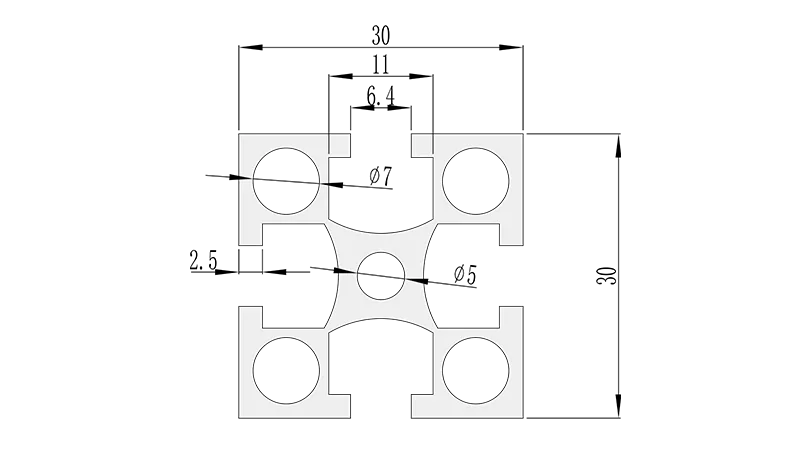
Before we compare durability, let's get clear on what we're talking about. The 3030 National Standard Profile A is a type of aluminum extrusion profile —a product of forcing heated aluminum alloy through a die to create a specific cross-sectional shape. The "3030" refers to its dimensions: 30mm in width and 30mm in height, making it a versatile choice for medium-load applications. As a national standard profile, it adheres to strict manufacturing guidelines, ensuring consistency in thickness, strength, and performance across batches.
Plastic profiles, on the other hand, are typically made from polymers like PVC (polyvinyl chloride), ABS (acrylonitrile butadiene styrene), or nylon. They're molded or extruded into shapes similar to aluminum profiles but rely on the inherent properties of plastics—lightweight, low cost, and ease of fabrication. Common plastic profiles include PVC angle bars, ABS channels, and nylon guide rails, often used in light-duty applications or where corrosion resistance (or low cost) is prioritized.
At first glance, both might seem interchangeable. They come in similar shapes, fit into similar assembly systems, and can be cut, drilled, or joined with accessories. But scratch the surface, and the differences in durability become stark—especially when exposed to the daily grind of industrial life.
Material Composition: The Foundation of Durability
Durability starts at the molecular level. Let's break down what makes these materials tick.
3030 National Standard Profile A: The Strength of Aluminum Alloys
The 3030 National Standard Profile A is crafted from aluminum alloy, typically 6063 or 6061—grades known for their balance of strength, corrosion resistance, and workability. Aluminum itself is a lightweight metal, but when alloyed with elements like magnesium and silicon, it transforms into a material that punches well above its weight class. The extrusion process further enhances its structural integrity: the uniform grain structure created during extrusion ensures consistent strength across the entire profile, with no weak spots or inconsistencies.
What does this mean for durability? Aluminum's metallic bonds are strong and stable, allowing it to withstand physical stress without deforming permanently. Unlike plastics, which are made of long polymer chains that can stretch or break under pressure, aluminum's atomic structure resists deformation, even when loaded with heavy equipment or materials.
Plastic Profiles: Polymers Under Pressure
Plastic profiles are composed of organic polymers—long chains of carbon atoms linked together. While modern plastics are engineered to be tough, their molecular structure has inherent limitations. Polymers are held together by covalent bonds, which are strong but less rigid than metallic bonds. Over time, these bonds can weaken when exposed to heat, chemicals, or mechanical stress, leading to "creep" (slow deformation under constant load) or brittleness.
For example, PVC profiles rely on plasticizers to remain flexible, but these additives can leach out over time, causing the plastic to become stiff and prone to cracking. ABS, while impact-resistant, can degrade when exposed to UV light or certain solvents, turning brittle and losing its strength. Even nylon, known for its toughness, struggles with high temperatures—exceeding 80°C (176°F) can cause it to soften and lose structural integrity.
Real-World Impact:
A manufacturer in the automotive industry once replaced aluminum profiles with ABS profiles on their assembly line workbenches to cut costs. Within six months, the ABS profiles began to bow under the weight of heavy toolboxes, and exposed sections near windows (hit by sunlight) developed cracks. The company ultimately switched back to aluminum, citing "unplanned downtime and replacement costs" that far exceeded the initial savings.
Environmental Resistance: How They Stand Up to the Elements
Industrial environments are no picnic. From sweltering heat in foundries to chemical spills in electronics plants, profiles must endure a barrage of environmental stressors. Let's see how our two contenders compare.
Temperature Extremes: Hot, Cold, and Everything In Between
Aluminum is a champion in temperature resistance. The 3030 National Standard Profile A, like most aluminum extrusion profiles, can operate comfortably in temperatures ranging from -40°C (-40°F) to 120°C (248°F) without significant loss of strength. This is critical in environments like food processing plants (where cold storage and high-temperature washing cycles are common) or automotive factories with welding stations and ovens.
Plastic profiles, by contrast, are temperature-sensitive. PVC starts to soften around 80°C (176°F) and melts at 160°C (320°F), while ABS becomes brittle below 0°C (32°F) and deforms above 90°C (194°F). Even high-performance plastics like PEEK (polyether ether ketone) are expensive and rarely used in standard industrial profiles, making them impractical for most applications.
Chemical Exposure: Oils, Solvents, and Acids
Factories are full of chemicals: machine oils, cleaning solvents, coolants, and even weak acids. The 3030 National Standard Profile A, when anodized (a common surface treatment for aluminum profiles), forms a protective oxide layer that resists most industrial chemicals. Anodized aluminum can withstand exposure to mineral oils, detergents, and mild acids without corroding or degrading. Even unanodized aluminum is naturally resistant to rust, thanks to its ability to form a thin, self-healing oxide layer when exposed to air.
Plastic profiles are a mixed bag. PVC is resistant to some acids and alkalis but can be dissolved by organic solvents like acetone or MEK (methyl ethyl ketone). ABS is vulnerable to gasoline, oils, and alcohols, which can cause it to swell or craze (develop tiny cracks). Nylon, while resistant to oils, can absorb moisture, leading to swelling and dimensional changes over time. In one electronics factory, plastic guide rails on a conveyor system began to warp after repeated exposure to isopropyl alcohol used for cleaning circuit boards—costing the plant thousands in replacement parts.
Moisture and Humidity: Rust vs. Swelling
Humid environments, like those in food processing or coastal factories, test a material's resistance to moisture. Aluminum profiles, as mentioned, are rust-proof. Even in 100% humidity, they won't corrode—though unanodized aluminum may develop a dull, powdery film (aluminum oxide), which is harmless and actually protects the underlying metal.
Plastic profiles don't rust, but they can absorb moisture. Nylon, for example, absorbs up to 8% of its weight in water, causing it to swell and lose dimensional stability. This is a problem for precision applications, like conveyor tracks where parts must slide smoothly. PVC and ABS are less hygroscopic, but prolonged exposure to moisture can still lead to mold growth or weakening of the material over time.
Load-Bearing Capacity: When the Going Gets Heavy
In industrial settings, profiles don't just hold up structures—they hold up weight . Whether it's a workbench supporting a 500kg assembly fixture or a material rack stacked with heavy components, load-bearing capacity is non-negotiable.
Test Case:
A manufacturer of automotive parts needed to build a material rack to store steel engine blocks, each weighing 80kg. They tested two designs: one using 3030 National Standard Profile A and another using PVC profiles of the same dimensions. The aluminum rack supported 10 engine blocks (800kg total) with minimal deflection (less than 2mm). The PVC rack began to bow after just 4 blocks (320kg) and collapsed when loaded with 6 blocks (480kg), cracking at the joints.
The 3030 National Standard Profile A's load-bearing superiority comes down to its strength-to-weight ratio. Aluminum is about one-third the weight of steel but offers comparable strength in structural applications. The 3030 profile, with its square cross-section and uniform wall thickness (typically 1.5–2mm for national standard profiles), is engineered to distribute weight evenly, reducing stress on individual points. When paired with aluminum profile accessories like corner brackets, T-joints, and end caps, it forms a rigid framework that can handle static and dynamic loads alike.
Plastic profiles, even reinforced ones, struggle with heavy loads. Their lower modulus of elasticity (a measure of stiffness) means they bend more under the same weight. Over time, this bending can lead to permanent deformation. For example, a plastic workbench leg might start straight but gradually curve after months of supporting a heavy drill press, compromising stability and safety.
| Factor | 3030 National Standard Aluminum Profile A | Plastic Profiles (PVC/ABS/Nylon) |
|---|---|---|
| Maximum Static Load (per meter) | Up to 500kg (with proper bracing) | 50–200kg (varies by material and thickness) |
| Deflection Under Load (100kg over 1m span) | 1–2mm (elastic, reversible) | 5–15mm (may be permanent) |
| Fatigue Resistance (repeated loading) | High—resists cracking after 100,000+ cycles | Low—prone to stress cracking after 10,000–50,000 cycles |
| Impact Resistance (dropped tool test) | Dents but doesn't crack or shatter | May crack or chip, especially in cold temperatures |
Wear and Tear: Scratches, Impacts, and Daily Abuse
Industrial environments are rough. Forklifts bump into racks, tools get dropped, and parts slide across surfaces. How do aluminum and plastic profiles hold up to this daily abuse?
Scratch Resistance: Keeping Its Shape
Aluminum profiles, especially anodized ones, have a hard surface that resists scratches. Anodizing increases surface hardness to around 30–50 Rockwell B (compared to 20–30 for unanodized aluminum), making it difficult for sharp objects to leave permanent marks. Even if scratched, aluminum doesn't splinter or chip—just a shallow groove that doesn't compromise structural integrity.
Plastic profiles are softer by nature. PVC has a hardness of 60–80 Shore D (lower than anodized aluminum), so it scratches easily. ABS is slightly harder but still prone to scuffing. Over time, these scratches can accumulate, weakening the profile and creating crevices where dirt, moisture, or bacteria can hide—problematic in cleanroom environments or food processing plants.
Impact Resistance: Bumps and Drops
A wayward forklift or a dropped wrench can test any material's mettle. Aluminum profiles are ductile, meaning they bend rather than break when hit. A 3030 profile might dent if struck hard, but it won't shatter or split, allowing for easy repair (e.g., hammering out a dent). This ductility is critical in safety-critical applications, where a broken profile could lead to equipment failure or injury.
Plastic profiles are more brittle, especially at low temperatures. ABS is impact-resistant at room temperature but can crack if hit when cold. PVC becomes rigid and shatters easily when temperatures drop below 0°C. Even nylon, which is tough, can split along stress lines if struck with enough force. In one warehouse, a plastic shelf bracket cracked after being hit by a pallet jack, causing a stack of boxes to collapse—a costly and dangerous incident that could have been avoided with aluminum.
Maintenance and Lifespan: The Long-Term View
Durability isn't just about surviving the first year—it's about lasting for decades with minimal upkeep. Let's compare maintenance needs and lifespan.
Maintenance: Set It and Forget It
The 3030 National Standard Profile A is almost maintenance-free. Anodized aluminum resists corrosion, so it doesn't need painting or coating. A quick wipe with a damp cloth is usually enough to keep it clean. Even if it gets scratched or dented, the structural integrity remains intact. Aluminum profile accessories like joints and brackets are also durable, with metal-to-metal connections that don't loosen or degrade over time.
Plastic profiles require more attention. They may need to be repainted or coated to protect against UV damage. Scratches can harbor bacteria, requiring frequent cleaning with harsh chemicals. Plastic joints, often made of the same material as the profiles, can wear out, leading to loose connections that need tightening or replacement. For example, a plastic hinge on a workbench door might start to squeak or bind after a year of use, requiring lubrication or replacement.
Lifespan: Decades vs. Years
In industrial environments, aluminum profiles like the 3030 National Standard Profile A typically last 10–20 years, and often longer with proper care. Many factories still use aluminum profiles installed in the 1990s, a testament to their longevity. Even when they're eventually replaced, aluminum is 100% recyclable, reducing waste and environmental impact.
Plastic profiles have a much shorter lifespan—usually 3–7 years in heavy industrial use. UV exposure, chemical degradation, and mechanical wear take their toll, leading to cracks, warping, or loss of strength. Once they fail, plastic profiles are often landfilled, as recycling mixed plastics is costly and inefficient. Over 20 years, a factory using plastic profiles would need to replace them 3–5 times, compared to just once (or not at all) with aluminum.
Cost: The Initial Investment vs. Long-Term Value
Let's address the elephant in the room: cost. Plastic profiles are often cheaper upfront—sometimes half the price of aluminum profiles. But industrial managers know that "cheap now" can mean "expensive later."
Consider a small factory building 10 workbenches. Using plastic profiles might save $500 initially, but if those workbenches need replacement in 5 years, the total cost over 15 years would be $1,500 (3 replacements). The aluminum workbenches, costing $1,000 upfront, would last 15+ years with no replacement cost—saving $500 in the long run. Add in maintenance costs (cleaning supplies, replacement parts for plastic) and downtime from failures, and aluminum becomes the clear financial winner.
Moreover, aluminum profiles retain their value. A used aluminum framework can be disassembled, reconfigured, and reused for a new project, whereas plastic profiles are often too degraded to repurpose. This flexibility makes aluminum a smarter investment for businesses that adapt and grow over time.
Real-World Applications: Where Aluminum Shines
Don't just take our word for it—look at industries that rely on durability day in and day out:
- Automotive Manufacturing: Assembly lines use 3030 National Standard Profile A for workbenches, tool racks, and conveyor frames, where they withstand constant vibration, heavy loads, and exposure to oils and coolants.
- Electronics Production: Cleanrooms and circuit board assembly areas use anodized aluminum profiles to avoid contamination, as they're easy to clean and resistant to solvents.
- Food Processing: Aluminum profiles resist moisture, bacteria, and cleaning chemicals, making them ideal for packaging lines and storage racks.
- Aerospace: Even in this high-precision industry, aluminum extrusion profiles are used for jigs, fixtures, and testing equipment, thanks to their stability and longevity.
Conclusion: Durability That Pays Off
When it comes to durability in industrial environments, the 3030 National Standard Profile A outperforms plastic profiles in nearly every category. From material composition and load-bearing capacity to resistance to chemicals, temperature, and wear, aluminum extrusion profiles offer a level of reliability that plastics simply can't match. While plastic profiles may seem cheaper upfront, their short lifespan, maintenance needs, and vulnerability to industrial stressors make them a risky choice in the long run.
For industrial managers who value safety, efficiency, and long-term savings, the choice is clear: aluminum profiles like the 3030 National Standard Profile A are more than just a material—they're an investment in durability that keeps your operations running smoothly, year after year.