- Company Articles
- Industry articles
- Industry standards
- 3030 National Standard Profile A Weight per Meter: Calculating for Transport & Installation

3030 National Standard Profile A Weight per Meter: Calculating for Transport & Installation
Related Product
3030 National Standard Profile A
Workbench, production line, logistic rack, warehouse rack Industry: Manufacturer workshop, Automobile, Electronic, Assembling, logistic
Why Does Weight per Meter Matter for Aluminum Profiles?
Imagine you're a small manufacturer gearing up to build a new production line. You've heard great things about aluminum profiles—lightweight, durable, and easy to assemble. You settle on the 3030 National Standard Profile A, a popular choice for workbenches, material racks, and lean system setups. But before you place that bulk order, there's a critical question you can't ignore: how much does each meter weigh?
It might seem like a minor detail, but the weight per meter of your aluminum profile impacts nearly every step of your project. From calculating shipping costs and ensuring your delivery truck doesn't exceed weight limits to determining how many workers are needed to lift and install the profiles safely, getting this number right can save you time, money, and headaches. Even the smallest miscalculation could lead to overloaded pallets, delayed shipments, or strained muscles on the factory floor.
In this guide, we'll break down everything you need to know about the 3030 National Standard Profile A's weight per meter. We'll start by explaining what this profile is, walk through how to calculate its weight, discuss factors that can change that number, and share practical tips for using this information to streamline transport and installation. Whether you're a seasoned operations manager or a first-time buyer, by the end, you'll be equipped to make smarter decisions for your next project.
What Is 3030 National Standard Profile A?
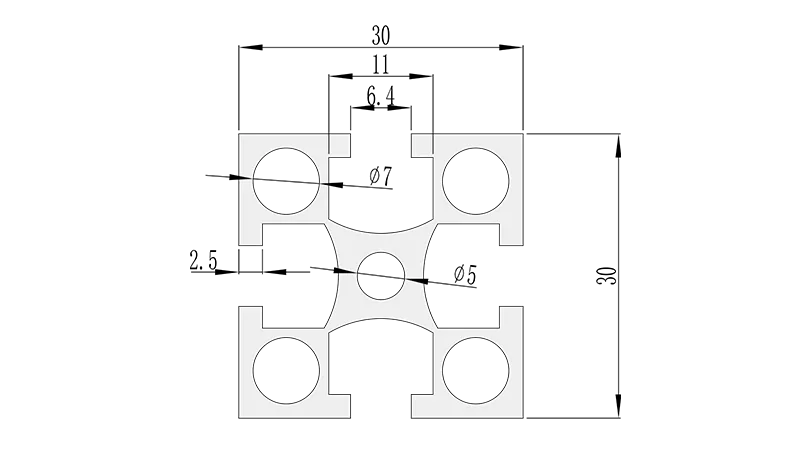
Let's start with the basics: the 3030 National Standard Profile A is a type of aluminum extrusion profile, a product made by forcing heated aluminum through a die to create a specific cross-sectional shape. The "3030" refers to its dimensions—30mm in width and 30mm in height—making it a compact yet sturdy option for a variety of industrial and commercial applications. The "National Standard" tag means it adheres to strict size and quality guidelines set by national regulatory bodies, ensuring consistency across manufacturers.
Unlike generic aluminum pipes, this profile is designed with functionality in mind. Most 3030 profiles feature T-slots—longitudinal grooves along their length—that allow for easy attachment of aluminum profile accessories like brackets, connectors, and panels. This makes them incredibly versatile: you can build a workbench one day, a material rack the next, and reconfigure it all later without welding or heavy tools. It's no wonder they're a staple in lean system setups, where adaptability and efficiency are key.
But what sets the "A" variant apart? National standard profiles often come in multiple sub-types, and "A" typically denotes a common, widely used design—think of it as the "standard of standards." It's usually hollow (to keep weight down) with uniform wall thickness, making it lightweight enough for manual handling but strong enough to support moderate loads. For example, a 3030 Profile A might be used to build a small assembly workbench or a three-tier material rack, where it needs to hold tools, components, or finished products without bending.
Understanding Aluminum Extrusion: The Basics of Profile Weight
To calculate the weight per meter of the 3030 National Standard Profile A, we first need to understand how aluminum extrusion works. When aluminum is extruded, it's shaped into a cross-section that determines its strength, weight, and functionality. For hollow profiles like the 3030, the cross-section is like a square frame: there's an outer dimension (30mm x 30mm) and an inner hollow space, with the difference between them being the wall thickness of the aluminum.
The weight of the profile depends on two key factors: its volume and the density of aluminum. Volume is calculated by multiplying the cross-sectional area of the profile by its length (in this case, 1 meter). Density is a fixed property of the material—in the case of aluminum alloys used for extrusions (like 6063-T5), the density is approximately 2.7 grams per cubic centimeter (g/cm³). So, the formula for weight per meter is simple:
Weight (kg/m) = (Cross-Sectional Area (mm²) × Length (mm) × Density (g/cm³)) / 1,000,000
Let's parse that. The cross-sectional area is the area of the aluminum part of the profile (not including the hollow space). Length is 1000mm (1 meter). Density is 2.7 g/cm³. We divide by 1,000,000 to convert from grams to kilograms. Seems straightforward, right? But there's a catch: the cross-sectional area can vary based on the profile's design, especially wall thickness.
Calculating the Weight of 3030 National Standard Profile A: A Step-by-Step Example
Let's put that formula to work with a real-world example. For the 3030 National Standard Profile A, let's assume a typical design: outer dimensions of 30mm x 30mm, a wall thickness of 1.5mm, and a hollow center. Here's how to calculate its cross-sectional area:
- Calculate the outer area: 30mm (width) × 30mm (height) = 900 mm².
- Calculate the inner area: Since the wall thickness is 1.5mm, the inner dimensions are reduced by twice the thickness (once on each side). So, inner width = 30mm – (2 × 1.5mm) = 27mm; inner height = 27mm. Inner area = 27mm × 27mm = 729 mm².
- Find the cross-sectional area of the aluminum: Outer area – Inner area = 900 mm² – 729 mm² = 171 mm².
Now, calculate the volume per meter: 171 mm² (cross-sectional area) × 1000 mm (length) = 171,000 mm³. To convert this to cubic centimeters (since density is in g/cm³), divide by 1000: 171,000 mm³ ÷ 1000 = 171 cm³.
Finally, multiply by aluminum's density: 171 cm³ × 2.7 g/cm³ = 461.7 grams per meter, or approximately 0.46 kg/m. That's just under half a kilogram per meter—not bad for a profile that can support up to 50kg per linear meter in some setups!
But wait—this is a simplified example. Real-world profiles might have variations. Some 3030 Profile A models have thicker walls (2.0mm, for instance) for heavier loads, which would increase the cross-sectional area and thus the weight. Others might have cutouts or reinforced sections for specific uses, like mounting heavy equipment. Always check the manufacturer's spec sheet for exact numbers, but this calculation gives you a solid starting point.
Factors That Affect Weight: Why Your Profile Might Weigh More (or Less)
While our example gives a baseline, the actual weight of your 3030 National Standard Profile A can vary. Let's break down the key factors that influence this number:
- Wall Thickness: The most obvious variable. A profile with a 2.0mm wall thickness will have a larger cross-sectional area than one with 1.5mm walls. For example, a 2.0mm thick 3030 Profile A would have an inner dimension of 26mm (30mm – 2×2.0mm), inner area of 676 mm², and cross-sectional area of 900 – 676 = 224 mm². Weight per meter would then be (224 × 1000 / 1000) × 2.7 = 604.8 g/m (0.605 kg/m)—a 31% increase!
- Surface Treatments: Many aluminum profiles undergo surface treatments like anodizing or powder coating to improve corrosion resistance or aesthetics. Anodizing adds a thin oxide layer (usually 5-20 microns), which adds negligible weight. Powder coating, however, can add 5-10 grams per meter, depending on the thickness of the coating. It's a small amount, but it adds up in bulk orders.
- Manufacturing Tolerances: National standards allow for minor variations in dimensions (usually ±0.1mm for width/height and ±0.05mm for wall thickness). These tiny differences can slightly alter the cross-sectional area. For example, a profile that's 30.1mm wide instead of 30mm would have an outer area of 906.01 mm², increasing the cross-sectional area by ~6 mm² and adding ~16 grams per meter.
- Design Features: Some 3030 Profile A variants include extra features like reinforced corners, slots for wiring, or notches for easier assembly. These can increase or decrease weight. A profile with a hollow center but reinforced T-slots might weigh more than a basic hollow design, while one with lightening holes (small cutouts) could weigh less.
The takeaway? Always request a detailed spec sheet from your aluminum profile supplier. Reputable suppliers will list the exact cross-sectional area, wall thickness, and weight per meter for each profile variant, taking the guesswork out of your calculations.
Practical Table: 3030 National Standard Profile A Specifications
| Specification | Details |
|---|---|
| Profile Name | 3030 National Standard Profile A |
| Material | 6063-T5 Aluminum Alloy (common for extrusions) |
| Dimensions (W×H) | 30mm × 30mm |
| Typical Wall Thickness | 1.5mm – 2.0mm (varies by load rating) |
| Cross-Sectional Area (Example: 1.5mm wall) | 171 mm² |
| Weight per Meter (Example: 1.5mm wall) | ~0.46 kg/m |
| Weight per Meter (Example: 2.0mm wall) | ~0.60 kg/m |
| Common Surface Treatments | Anodizing (clear, black), powder coating (custom colors) |
| Compatible Accessories | 3030 aluminum angle yards, T-slot nuts, end caps, brackets |
| Typical Applications | Workbenches, material racks, lean system frames, machine guards |
Transporting Your Profiles: Using Weight to Plan Efficiently
Now that you have a handle on weight, let's talk about transport. Whether you're shipping from a local supplier or ordering internationally, knowing the weight per meter helps you plan loading, avoid overages, and keep costs in check.
Start by calculating the total weight of your order. If you need 100 meters of 1.5mm wall 3030 Profile A, that's 100 × 0.46 kg = 46 kg. Add in the weight of aluminum profile accessories—brackets, connectors, and end caps can add another 10-15% to the total. For example, 50 brackets at 0.1kg each = 5kg, bringing your total to ~51kg. Most standard pallets can handle 500-1000kg, so this order would fit easily, but if you're ordering 1000 meters, that's 460kg plus accessories—you might need two pallets.
Next, check your delivery vehicle's weight limits. A small truck might have a payload capacity of 1 tonne (1000kg), while a larger lorry can handle 5+ tonnes. If you're picking up the profiles yourself, make sure your van or trailer is rated for the load. Overloading not only risks fines but also damage to the vehicle and the profiles.
Securing the load is another key step. Aluminum profiles are slippery, especially if they're anodized or powder-coated. Use ratchet straps rated for the total weight, and place dunnage (wooden blocks) between layers to prevent shifting. If you're stacking profiles, alternate directions to distribute weight evenly—this reduces the risk of bending or warping during transit.
Installation Tips: Using Weight to Keep Workers Safe and Projects On Track
Once the profiles arrive, it's time to install them. Here's how weight per meter guides this process:
- Manual Handling: A 3-meter length of 0.46kg/m profile weighs ~1.38kg—light enough for one person to carry. But a 6-meter length? That's 2.76kg, which might require two people to avoid strain. Train your team to lift with their legs, not their backs, and consider using lifting gloves for a better grip.
- Tool Selection: Lightweight profiles mean you might not need heavy lifting equipment, but for overhead installations (like ceiling racks), a small hoist or pulley system can save time. For wall-mounted setups, use anchors rated for the total weight of the profile plus any loads it will carry.
- Assembly Order: Build from the bottom up. Start with the base frame (heavier, more stable sections) before adding upper tiers. This reduces the risk of the structure tipping as you add weight above.
- Safety Margins: Always factor in the weight of the materials the profile will support. A workbench made with 3030 Profile A might hold tools, parts bins, and a worker's weight—easily 100kg or more. Ensure the profile's load capacity exceeds your needs, and distribute weight evenly across the structure.
Pro tip: If you're building a lean system, like a material flow rack, test the structure with dummy weights before full installation. This helps you spot weak points and adjust the design if needed.
Real-World Example: How One Manufacturer Used Weight Data to Save Time
Let's wrap up with a quick case study. A small electronics manufacturer in Guangzhou needed to build 10 workbenches for their assembly line, each using 20 meters of 3030 National Standard Profile A (1.5mm wall) and assorted aluminum profile accessories. Initially, they guessed the total weight, ordered a single pallet, and scheduled two workers for installation.
When the shipment arrived, they realized their mistake: the total weight (20m × 10 benches × 0.46kg/m = 92kg, plus 20kg of accessories) came to 112kg—easily fitting on one pallet, but the installation took longer than expected. The workers struggled to lift 6-meter profiles alone, leading to delays. They quickly adjusted, assigning two workers per bench and using a small trolley to move profiles around the factory. The project finished on time, but they learned a valuable lesson: weight data isn't just for shipping—it's for planning labor, too.
Final Thoughts: Why Weight per Meter Is Your Secret Weapon
The 3030 National Standard Profile A is a workhorse in the world of aluminum extrusion profiles, and understanding its weight per meter is the key to using it effectively. From calculating shipping costs to keeping workers safe during installation, this number guides every step of your project.
Remember: always verify the exact weight with your supplier, account for accessories, and plan transport and installation around the total load. With this knowledge, you'll avoid common pitfalls, stay on budget, and build structures that stand the test of time.
So, the next time you're browsing aluminum profiles, don't just look at the price tag—ask about the weight per meter. It might be the most important number you'll need.