- Company Articles
- Industry articles
- Industry standards
- 3030b EU Standard Aluminum Profile Manufacturing Process: From Raw Material to Finished Product

3030b EU Standard Aluminum Profile Manufacturing Process: From Raw Material to Finished Product
Related Product
3030B EU Standard Aluminum Profile
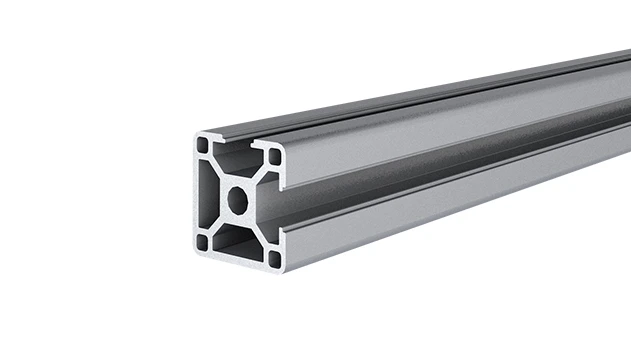
3030 is a 3.00 x 3.00CM fractional 30 series square extrusion T-slot profile with two side open T-slots, each side with 3.00cm face, 2 side with open slot, 2 side with closed face. The profile has align-a-grooves to assist in aligning connecting profiles.
Ever wondered how the sturdy, sleek aluminum frames holding up your workshop workbench or the smooth tracks guiding products on a conveyor system come to life? It all starts with a meticulous journey—one that turns raw ore into precision-engineered aluminum profiles. Today, we're pulling back the curtain on the making of the 3030b EU Standard Aluminum Profile, a workhorse in industrial and commercial design. Let's walk through each step, from the earth's crust to the factory floor.
1. Raw Material Selection: The Foundation of Quality
Before any melting or shaping happens, we start with the basics: high-quality raw materials. Aluminum doesn't come ready-made—it's extracted from bauxite, a reddish-brown ore found in tropical regions. But bauxite is more than just aluminum; it's mixed with impurities like iron oxide and silica. To get pure aluminum, we first refine bauxite using the Bayer process, which dissolves the aluminum oxide (alumina) and leaves the impurities behind. The result? White alumina powder, the building block of our profiles.
But pure aluminum is too soft for industrial use. That's where alloys come in. For the 3030b EU Standard Aluminum Profile, we blend alumina with small amounts of silicon and magnesium—typically 0.4-0.6% silicon and 0.8-1.2% magnesium. This creates 6063 aluminum alloy, prized for its excellent extrudability (meaning it shapes easily) and good strength-to-weight ratio. Think of it like baking a cake: the right mix of ingredients (alloying elements) ensures the final product is strong, flexible, and reliable.
Every batch of raw material is tested for purity. We use spectrometers to check the exact composition—too much iron, and the profile might crack during extrusion; too little magnesium, and it won't hold up under heavy loads. Only materials that meet EU standards (EN 573-3, to be precise) make the cut. After all, a strong building needs strong bricks, right?
2. Melting and Casting: Turning Powder into Billets
Now that we have our alloy mix, it's time to melt it down. The alumina powder and alloying elements go into a gas-fired furnace, where temperatures soar to around 750°C (1,382°F). That's hot enough to melt aluminum but gentle enough to avoid burning off the valuable alloying elements. As the mixture melts, it forms a molten pool that looks like liquid silver—shiny, smooth, and deceptively heavy.
But molten aluminum can still have impurities, like trapped gas bubbles or oxide particles. To fix this, we "degas" the melt by bubbling nitrogen through it—think of it as stirring a soda to release fizz, but on an industrial scale. Then, we add a flux (a chemical cleaner) that binds to impurities, forming a scum on top that we skim off. Cleanliness here is non-negotiable: even a tiny impurity can weaken the final profile.
Once the molten aluminum is pure, we cast it into billets—long, cylindrical logs that will later be extruded into profiles. We use direct chill casting, where the molten aluminum is poured into a water-cooled mold. As the aluminum touches the cold mold walls, it solidifies from the outside in, forming a dense, uniform billet. These billets are typically 6 meters long and 150mm in diameter—perfect for feeding into an extrusion press. After casting, the billets cool slowly over 24 hours to relieve internal stress, like letting a cake cool before slicing.

3. Extrusion: Shaping the Aluminum Extrusion Profile
If melting and casting are the "baking" stage, extrusion is where we "decorate the cake"—shaping the billet into the specific profile we need. The 3030b EU Standard Aluminum Profile has a rectangular cross-section, 30mm by 30mm, with T-slots along its length for attaching aluminum profile accessories like brackets or end caps. To get this shape, we use an extrusion die—a custom-made steel mold with a 30x30mm opening and slots cut into it.
First, the billet is preheated to around 500°C (932°F)—warm enough to be pliable but not molten. Then, it's loaded into a horizontal extrusion press, a massive machine that looks like a giant vice. A hydraulic ram pushes the billet into the die with up to 10,000 tons of force—that's like stacking 2,000 African elephants on top of the billet! As the billet is squeezed through the die, it takes on the die's shape, emerging as a long, continuous aluminum extrusion profile, gliding out of the press like toothpaste from a tube.
Extrusion is a delicate dance of speed and temperature. If we push too fast, the profile might warp; too slow, and it cools prematurely, causing cracks. Operators monitor the process in real time, adjusting the press speed and billet temperature to keep the profile straight and true. Once the profile reaches the desired length—often 6-12 meters—it's cut with a circular saw, creating individual lengths ready for the next step.
Watching an extrusion press in action is mesmerizing. The raw billet, once a shapeless log, transforms into a precise, uniform profile in seconds. It's a testament to human ingenuity—turning brute force into elegant engineering.
4. Heat Treatment: Strengthening the Profile
Freshly extruded aluminum is soft—great for shaping, but not for supporting heavy loads like a workbench or material rack. To give it strength, we use heat treatment, specifically the T6 temper process. This two-step method transforms the alloy's microstructure, making the profile strong yet still lightweight.
First, solution heat treatment: we heat the extruded profiles to 530°C (986°F) and hold them there for 2-3 hours. This dissolves the magnesium and silicon atoms into the aluminum matrix, like stirring sugar into hot water until it dissolves. Then, we quench the profiles—dunking them in cold water—to "freeze" the atoms in place before they can form large, weak crystals. The result? A supersaturated aluminum solution, unstable but full of potential.
Next, artificial aging: we heat the quenched profiles to 175°C (347°F) for 6-8 hours. This controlled heating allows the magnesium and silicon atoms to slowly form tiny, evenly distributed particles called precipitates. These particles act like microscopic "speed bumps," preventing the aluminum atoms from sliding past each other when the profile is under stress. The result? A profile with a tensile strength of around 215 MPa—strong enough to support a 200kg load without bending.
After heat treatment, the profiles are inspected for hardness using a Rockwell tester. We aim for a hardness of 80-90 HRB (Rockwell B scale)—soft enough to drill or cut, but hard enough to stand up to daily use. A profile that's too soft might bend under a workbench's weight; too hard, and it could crack when drilled for aluminum pipe accessories. Balance is key.
5. Surface Finishing: Beauty and Protection
Now that the profile is strong, it's time to make it look good and last longer. Aluminum naturally forms a thin oxide layer, but surface finishing takes this protection to the next level. The 3030b profile often gets anodizing or powder coating, depending on its end use.
Anodizing is like giving the profile a "permanent tan." The profile is submerged in an acid bath and becomes the anode in an electrolytic cell. When electricity is applied, oxygen ions react with the aluminum surface, forming a thick, porous oxide layer. We then seal the pores with hot water, creating a hard, scratch-resistant finish that won't fade or peel. Anodized profiles have a matte, metallic look—perfect for industrial settings where durability matters most.
Powder coating, on the other hand, is like painting with dry paint. Finely ground pigment particles are electrostatically charged and sprayed onto the profile, which is then baked at 200°C (392°F). The heat melts the powder, forming a smooth, colorful coating. Powder coating comes in endless shades—from bright yellows for safety rails to neutral grays for workbenches. It's durable, easy to clean, and adds a pop of color to otherwise utilitarian spaces.
Before finishing, the profiles are thoroughly cleaned. They're dipped in a degreasing solution to remove oil from extrusion, then etched with acid to create a uniform surface. Any leftover dirt or oil would ruin the finish—imagine painting over a dusty wall; the paint would peel right off. Cleanliness here ensures the finish adheres properly, lasting for years even in harsh environments.
6. Cutting, Machining, and Assembly: Precision and Versatility
With the profile finished, it's time to tailor it to specific needs. Most customers don't want 6-meter lengths—they need 1.2-meter pieces for a workbench or 2-meter sections for a material rack. We use precision saws with diamond blades to cut the profiles to exact lengths, accurate to within ±0.5mm. That's less than the width of a human hair—critical for ensuring aluminum profile accessories fit perfectly.
Next, we drill holes, tap threads, or mill slots for accessories. For example, a workbench might need holes for mounting a vice, while a conveyor track might need slots for attaching roller guides. We use CNC machines for this—computer-controlled tools that drill and cut with pinpoint accuracy. A misaligned hole could mean an aluminum pipe accessory won't screw in, turning a functional profile into a useless one. Operators double-check every measurement, using calipers and gauges to ensure precision.
Finally, the profiles are paired with accessories to create end products. A 3030b profile might be connected to another using a lean pipe joint, forming the frame of a workbench. T-slots along the profile allow for easy attachment of shelves, lights, or tool holders—no welding required. This modularity is what makes aluminum profiles so popular: you can reconfigure a workbench or rack in minutes, adapting to changing needs. It's like building with giant Lego blocks, but sturdier and more professional.
7. Quality Control: Ensuring EU Standards
At every step, we test, test, and test again. The 3030b is an EU standard profile, so it must meet strict criteria outlined in EN 755-9 (extruded profiles for general engineering). Here's a snapshot of our quality control checks:
We also do random batch testing. Every 500 profiles, we take a sample and bend it 90 degrees—if it cracks, the entire batch is rejected. We test corrosion resistance by exposing profiles to salt spray for 500 hours; a good anodized finish will show no signs of rust. These tests are tedious, but they're the reason customers trust our profiles to build everything from medical equipment to automotive assembly lines.
8. From Profile to Product: The Final Touch
The 3030b EU Standard Aluminum Profile rarely stands alone. It's part of a system, paired with aluminum profile accessories, lean pipe joints, and other components to create functional products. For example, a workbench might combine 3030b profiles with a plywood top, aluminum angle brackets, and caster wheels for mobility. A material rack could use the profiles as uprights, with crossbars and roller tracks for easy loading and unloading.
What makes the 3030b so versatile is its T-slots. These slots allow for quick, tool-free assembly using bolts, nuts, and brackets. Need to add a shelf to your workbench? Slide a bracket into the T-slot and tighten a bolt—it's that simple. No welding, no drilling new holes—just flexibility. This modularity is why industries from electronics to logistics rely on aluminum extrusion profiles: they adapt as needs change, reducing waste and saving time.
Before shipping, we assemble sample products to test functionality. A workbench prototype is loaded with 200kg of weight to see if it sags; a conveyor track is run with boxes to check for jams. If something doesn't work, we adjust the design—maybe a different lean pipe joint or a thicker profile. It's all about ensuring the end product does what it's supposed to, day in and day out.
Why It Matters: The Human Side of Manufacturing
Behind every 3030b profile is a team of people—metallurgists who perfect the alloy, operators who monitor the extrusion press, quality inspectors who check every measurement. It's not just about machines and processes; it's about pride in craftsmanship. When a worker uses a sturdy, well-built workbench, they're not just using a tool—they're using something made with care, designed to make their job easier and safer.
And in a world where sustainability matters, aluminum profiles shine. Aluminum is 100% recyclable, with no loss of quality. The energy needed to recycle aluminum is just 5% of what's needed to produce it from bauxite. So when a workbench reaches the end of its life, its 3030b profiles can be melted down and turned into new profiles, closing the loop.
Wrapping Up: More Than Just Metal
The journey of the 3030b EU Standard Aluminum Profile—from bauxite ore to finished workbench—is a story of precision, innovation, and human skill. Every step, from melting to assembly, is designed to create a product that's strong, flexible, and reliable. It's why aluminum extrusion profiles are the backbone of modern manufacturing, quietly supporting the products and processes that keep our world running.
Next time you see a workbench, a conveyor system, or a material rack, take a closer look. Chances are, it's built with profiles like the 3030b—each one a testament to the art and science of turning raw materials into something useful. And that, in the end, is what manufacturing is all about: solving problems, one profile at a time.