- Company Articles
- Industry articles
- Industry standards
- 3030r EU Standard Aluminum Profile: Alloy 6063-T5 vs. T6 – Which is Better?

3030r EU Standard Aluminum Profile: Alloy 6063-T5 vs. T6 – Which is Better?
Related Product
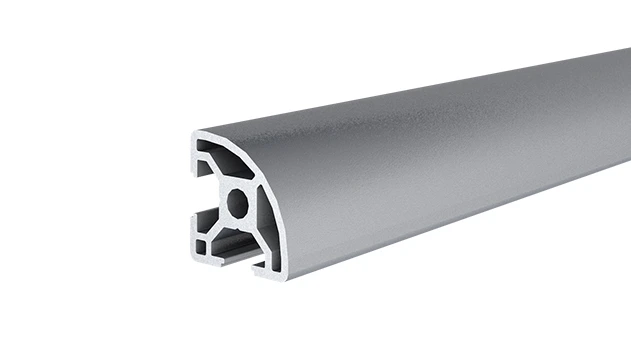
3030R EU Standard Aluminum Profile
3030R is a 3.00 x 3.00CM fractional 30 series square extrusion T-slot profile with four open T-slots, two side with 3.00cm face, the other side with round face. The profile has align-a-grooves to assist in aligning connecting profiles.
Let's start with a scenario we've all heard (or lived) before: A production manager walks into their workshop, coffee in hand, and stops short. The old workbench in the corner—once sturdy and reliable—now sags under the weight of tools and components. Nearby, the material rack that holds critical parts for the assembly line creaks every time someone pulls a bin. "We need an upgrade," they mutter. And so the search begins: new workbenches, sturdier material racks, maybe even a revamp of the entire workflow setup. If you've ever been in that position, you know the next question: What materials do we choose?
In the world of lean manufacturing and efficient production systems, aluminum profiles are the unsung heroes. They're lightweight, durable, and infinitely customizable—perfect for building everything from workbenches to conveyor systems. But not all aluminum profiles are created equal. Today, we're diving deep into one of the most common and versatile options out there: the 3030r EU Standard Aluminum Profile, specifically focusing on two variants of the 6063 alloy: T5 and T6. By the end, you'll know exactly which one fits your needs, whether you're setting up a new lean system, building a workbench, or stocking up on material racks.
First Things First: What Even Is the 3030r EU Standard Aluminum Profile?
Before we compare T5 and T6, let's make sure we're all on the same page about the star of the show: the 3030r EU Standard Aluminum Profile. The "3030" part is straightforward—it refers to the cross-sectional dimensions: 30mm by 30mm. Think of it as a square tube, but with a twist (literally, in some cases). The "r" likely stands for "rounded," hinting at its smooth, rounded edges—safer to handle and easier to integrate with accessories like brackets or connectors.
Then there's the "EU Standard" label. This means it meets strict European guidelines for dimensions, material quality, and compatibility. For manufacturers and facility managers, that's a big deal. It ensures the profile will work seamlessly with other EU-standard aluminum profile accessories—think T-slot nuts, end caps, hinges, and even caster wheels. No more guessing if a bracket from one supplier will fit a profile from another; the EU standard takes the guesswork out of assembly.
But why is this profile so popular? Simple: it's the Swiss Army knife of lean systems. At 30x30mm, it's large enough to support serious weight (we're talking hundreds of kilograms when properly braced) but small enough to keep structures lightweight. You'll find it in everything from simple workbenches to complex material racks, conveyor frames, and even turnover trolleys. Its T-slot design—those grooves running along its length—lets you attach accessories anywhere, anytime, without welding. Need to add a shelf to your workbench? Slide in a bracket. Want to mount a tool holder on your material rack? T-slot nuts and bolts make it a 5-minute job. That flexibility is why it's a staple in lean manufacturing—where adaptability and efficiency are king.
The Backbone: Understanding 6063 Aluminum Alloy
Now, the 3030r profile is just the shape—the real magic is in the material: 6063 aluminum alloy. If aluminum profiles are the unsung heroes, 6063 is their secret weapon. Let's break down what makes this alloy so special.
6063 is part of the "6000 series" of aluminum alloys, which are known for their excellent formability, corrosion resistance, and smooth finish. The key alloying elements here are magnesium and silicon, which work together to create a material that's strong enough for structural use but still easy to extrude into complex shapes (like the 3030r's T-slot design). Think of it as the Goldilocks of alloys—not too soft, not too brittle, just right for most manufacturing and industrial applications.
But what really sets 6063 apart is its versatility. It's used in everything from window frames to bicycle frames, and yes, aluminum profiles for lean systems. It takes anodization well, so you can get it in different colors (though natural silver is the most common in industrial settings). It's also resistant to rust and corrosion, which is a big plus if your workshop deals with moisture or chemicals. For anyone building a system that needs to last—whether it's a workbench that sees daily use or a material rack that holds heavy parts—6063 is a solid starting point.

T5 vs. T6: The Heat Treatment Showdown
Okay, so we know the profile (3030r EU standard) and the alloy (6063). Now, what's the deal with T5 and T6? Here's the short answer: they're heat treatment processes that dramatically change the material's properties. Heat treatment might sound technical, but it's actually pretty intuitive. Think of it like baking a cake: the ingredients (alloy) are the same, but the temperature and time in the oven (heat treatment) change how it turns out—fluffy vs. dense, soft vs. crusty. Similarly, T5 and T6 take the same 6063 alloy and "cook" it differently to get distinct characteristics.
T5: The "Quick and Steady" Option
T5 heat treatment is like making a cake in a hurry—still delicious, just with a simpler process. Here's how it works: When aluminum is extruded (pushed through a die to get its shape, like the 3030r's 30x30mm cross-section), it comes out of the extruder at a high temperature—around 500°C (932°F). For T5, instead of cooling it down rapidly, manufacturers let it air-cool to room temperature. Then, they "age" it—meaning they heat it again, but at a lower temperature (around 120–180°C) for a shorter time (a few hours). This aging process helps the alloy's molecules rearrange into a stronger structure, but it's a gentler, faster process than T6.
The result? A profile that's strong enough for most everyday tasks but still retains a lot of workability. It's like a reliable coworker—consistent, doesn't need a lot of fuss, and gets the job done without complaints.
T6: The "Slow and Strong" Contender
T6, on the other hand, is the "slow-cooked" version. The process starts similarly: the alloy is heated to a high temperature (solution heat treatment), but this time, it's held at that temperature longer to ensure all the alloying elements (like magnesium and silicon) dissolve evenly into the aluminum. Then, instead of air-cooling, it's quenched—rapidly cooled in water—to "lock" those elements in place. Finally, it's aged at a higher temperature (around 170–190°C) for a longer period (up to 12 hours). This extra time and temperature make the molecules form even stronger bonds, resulting in a much harder, stronger material.
T6 is like the overachiever of heat treatments. It takes more time and energy, but the payoff is a profile that can handle heavier loads and more stress. Think of it as the material you'd trust with the toughest jobs in the workshop.
Mechanical Properties: Let's Get Technical (But Not Too Technical)
Enough about the "how"—let's talk about the "what." What do these heat treatments actually do to the 3030r profile's performance? To answer that, we need to look at mechanical properties: strength, ductility, hardness, and more. To make it easy, I've put together a comparison table. Don't worry—I'll explain what each term means, too.
| Property | 6063-T5 | 6063-T6 |
|---|---|---|
| Heat Treatment Process | Extruded, air-cooled, then artificially aged (low temp, short time) | Solution heat treated, quenched, then artificially aged (high temp, long time) |
| Tensile Strength (MPa) | ~180 MPa (26,000 psi) | ~240 MPa (35,000 psi) |
| Yield Strength (MPa) | ~145 MPa (21,000 psi) | ~215 MPa (31,000 psi) |
| Elongation (%) | ~8% | ~5% |
| Hardness (HV) | ~50 HV | ~70 HV |
| Typical Applications | Workbenches, light-duty material racks, assembly stations | Heavy-duty material racks, conveyors, high-stress structural parts |
| Cost | Lower (simpler heat treatment) | Higher (more energy/ time in heat treatment) |
| Workability | Easier to cut, drill, and assemble with accessories | Harder; may require specialized tools |
Tensile Strength: This is the maximum stress the material can handle before breaking. Think of it as how much weight you can hang from a profile before it snaps. T6 wins here, with 240 MPa vs. T5's 180 MPa—that's a 33% increase in strength.
Yield Strength: This is the stress at which the material starts to bend permanently (plastic deformation). If you load a profile beyond its yield strength, it won't spring back—it'll stay bent. T6 again takes the lead, with 215 MPa vs. T5's 145 MPa. That means T6 can handle more weight before warping.
Elongation: This measures how much the material can stretch before breaking, expressed as a percentage. T5 has higher elongation (8% vs. T5's 5%), which means it's more ductile—softer and more flexible. Think of it like a rubber band vs. a wooden ruler: the rubber band (T5) stretches more before snapping, while the ruler (T6) is stiffer but breaks sooner.
Hardness (HV): This is how resistant the material is to indentation or scratching. T6 is harder (70 HV vs. T5's 50 HV), so it's less likely to get dented if you drop a tool on it or scrape it against other parts.
Practical Applications: When to Choose T5 vs. T6
Numbers on a page are helpful, but let's get real: when would you actually pick one over the other? Let's walk through common scenarios in a workshop or production facility.
Scenario 1: Building a Workbench
Workbenches are the heart of any workshop. They hold tools, components, maybe even small machines. For most standard workbenches—like the "Workbench E (single deck-without caster)" you might see in catalogs—T5 is usually the way to go. Why? Workbenches don't typically need to support extreme weights (unless you're setting up a heavy machinery station). T5's 180 MPa tensile strength is more than enough to hold a few hundred kilograms of tools and parts. Plus, T5 is easier to work with: you can cut it to length with a standard saw, drill holes for mounting accessories (like vices or tool holders), and assemble it with aluminum profile accessories (brackets, end caps) without needing industrial-grade equipment. And since T5 is cheaper, you'll save money that can go toward other upgrades—like adding casters later if you need mobility.
That said, if your workbench will be supporting something really heavy—say, a hydraulic press or a large 3D printer—T6 might be worth the splurge. Its higher yield strength means it won't sag over time, even under constant load.
Scenario 2: Material Racks (Including the Infamous "Material Rack B (3 row and 3 floor)")
Material racks are where things get interesting. Let's take a common example: Material Rack B (3 row and 3 floor). This is a multi-tiered rack designed to hold bins of parts, with three rows and three levels—so it's got a lot of surface area and potential weight. If you're storing lightweight components (like small plastic parts or electronics), T5 will work fine. The 3030r profile in T5 can easily support the weight of a few bins per shelf. But if you're storing heavy metal parts, tools, or large assemblies, T6 is the safer bet. Remember, T6 has 33% higher tensile strength and 48% higher yield strength—those numbers translate to a rack that won't bend or warp, even when fully loaded. Imagine walking into your workshop and seeing your Material Rack B sagging in the middle because you skimped on the profile—that's a disaster waiting to happen (not to mention a waste of money). For heavy-duty racks, T6 is an investment in safety and longevity.
Scenario 3: Setting Up a Lean System
Lean systems are all about efficiency—streamlining workflows, reducing waste, and keeping everything within arm's reach. This might include conveyor systems, flow racks, or modular assembly lines. Here, the choice between T5 and T6 depends on the specific component. For example, flow racks with roller tracks (like the "40 steel roller track yellow wheel" or "38 aluminum roller track black esd") might use T5 for the frame, since the weight is distributed across the rollers. But the rollers themselves? If they're part of a high-speed conveyor carrying heavy products, T6 could be better for the support brackets. Similarly, if you're building a turnover trolley (those mobile carts used to move parts between stations), T5 is great for the frame (lightweight = easier to push), but T6 might be better for the axle mounts or caster brackets, which take the brunt of the weight when moving.
Scenario 4: Conveyor Systems
Conveyors are all about constant motion and load. Whether it's a simple roller track or a complex belt conveyor, the frame needs to be strong enough to handle the weight of products plus the stress of continuous operation. T6 is often preferred here. For example, the "40 steel roller track black esd wheel" systems—used to move PCBs or sensitive electronics (hence the ESD, or electrostatic discharge, wheels)—need a sturdy frame to keep the rollers aligned and prevent jams. T6's stiffness ensures the frame doesn't flex under the weight of passing products, which keeps the conveyor running smoothly. T5 might work for very light-duty conveyors (like those moving small packages), but for industrial use, T6 is the more reliable choice.
Cost Considerations: Is T6 Worth the Extra Money?
Let's talk about the elephant in the room: cost. T6 is almost always more expensive than T5. Why? Because the heat treatment process is more intensive: longer aging times, higher temperatures, and quenching (which uses more energy). Depending on the supplier and order size, T6 can cost 10–20% more than T5. For a small order (like a single workbench), that might not seem like much, but if you're outfitting an entire factory with material racks, conveyors, and workbenches, the difference adds up fast.
So, when is T6 worth the premium? If failure isn't an option. For example, if a material rack collapses, it could damage expensive parts, injure workers, or shut down production. In that case, the extra cost of T6 is insurance against downtime and accidents. On the flip side, if you're on a tight budget and your application doesn't require extreme strength, T5 gives you solid performance at a lower price. It's all about balancing risk and reward.
Workability: Can You Actually Assemble It Yourself?
Here's a practical consideration many people overlook: how easy is the profile to work with? If you're a small workshop with basic tools, T5 is a dream. It cuts cleanly with a miter saw or even a hacksaw, drills without cracking, and bends slightly if you need to adjust a frame (though we don't recommend bending aluminum profiles regularly). This is a big deal when you're assembling with aluminum profile accessories—like "roller track placon mount for aluminum profile flat" or "caster accessories." With T5, you can tighten bolts without worrying about the profile warping or the threads stripping.
T6, on the other hand, is harder and more brittle. Cutting it requires a sharper blade and more patience—otherwise, you might get rough edges. Drilling can be tricky too; the material is harder, so drill bits dull faster. If you're not used to working with harder metals, you might end up with cracked profiles or misaligned holes. For large-scale operations with industrial tools (like CNC saws or drill presses), this isn't a problem. But for small shops or DIY setups, T5 is far more user-friendly.
Maintenance and Longevity: Will It Last?
Both T5 and T6 are made from 6063 aluminum, so they share the same corrosion resistance and general durability. You won't have to worry about rust, even in humid workshops. But there's a catch: T6's higher strength means it's less likely to deform over time. If you've got a T5 workbench that's loaded to the max every day, you might notice a slight sag after a year or two. With T6, that sagging is much less likely. So while both will last for years, T6 tends to maintain its shape and performance longer under heavy use.
Another thing to consider: scratches and dents. T6 is harder (70 HV vs. T5's 50 HV), so it's more resistant to accidental damage. If your workshop is a busy place with carts rolling around and tools being set down (or dropped), T6 profiles will stay looking newer longer. T5 might show more wear and tear, but honestly, in most industrial settings, a few scratches don't affect performance—they're just cosmetic.
The Verdict: T5 or T6?
At the end of the day, there's no "better" option—only the right option for your needs. Let's summarize:
Choose T5 if:
- You're building standard workbenches, light to medium-duty material racks, or assembly stations.
- Budget is a concern—you want to save money without sacrificing basic performance.
- You need to cut, drill, or modify the profile yourself with basic tools.
- Your application doesn't involve extreme weights or constant heavy stress.
Choose T6 if:
- You're building heavy-duty material racks (like Material Rack B 3 row 3 floor), conveyors, or structural components.
- You need maximum strength and durability—even if it costs more.
- You have access to industrial tools for cutting and drilling.
- Your setup will be under constant heavy load or stress (e.g., supporting machinery).
Final Thoughts: It's All About Your Lean System
The 3030r EU Standard Aluminum Profile in 6063-T5 or T6 is more than just a piece of metal—it's a building block for your lean system. Whether you're optimizing workflows, reducing waste, or creating a safer, more efficient workspace, the right profile choice can make or break your success. T5 is the practical, budget-friendly workhorse for everyday use, while T6 is the heavy-duty champion for high-stress applications.
So the next time you're standing in that workshop, coffee in hand, staring at a sagging workbench or a creaky material rack, you'll know exactly what to do. Assess your needs, consider the load, budget, and tools you have, and pick the profile that fits. And remember—whether you go with T5 or T6, you're investing in a system that will grow with your business, adapt to new challenges, and keep your production line running smoothly for years to come.