- Company Articles
- Industry articles
- Industry standards
- 3030r EU Standard Aluminum Profile: Material Composition & Alloy Grade (6063 vs. 6061)

3030r EU Standard Aluminum Profile: Material Composition & Alloy Grade (6063 vs. 6061)
Related Product
3030R EU Standard Aluminum Profile
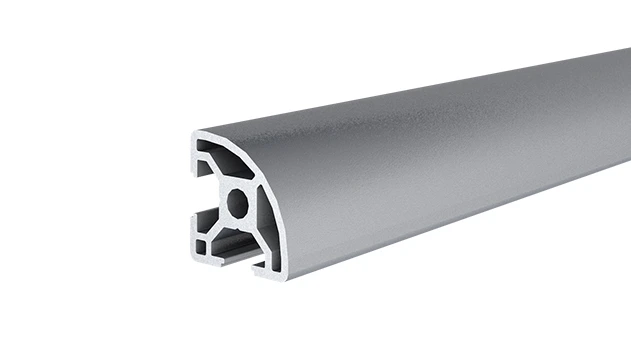
3030R is a 3.00 x 3.00CM fractional 30 series square extrusion T-slot profile with four open T-slots, two side with 3.00cm face, the other side with round face. The profile has align-a-grooves to assist in aligning connecting profiles.
Walk into any modern manufacturing facility, electronics workshop, or logistics warehouse, and you'll likely spot a familiar sight: sleek, modular structures that seem to adapt effortlessly to the space around them. Workbenches where technicians assemble delicate components, flow racks carrying parts from station to station, turnover trolleys gliding smoothly across the floor—these are the backbone of efficient operations, and more often than not, they're built from one unsung hero: the aluminum profile. Among the countless profiles available, one stands out for its versatility and adherence to strict quality standards: the 3030r EU Standard Aluminum Profile. But what makes this profile so reliable? How do its material composition and alloy grade influence its performance? And when should you choose between the two most common alloys, 6063 and 6061? Let's dive in.
Understanding the 3030r EU Standard Aluminum Profile
First things first: what exactly is a 3030r aluminum profile? The name itself gives away key details. The "3030" refers to its cross-sectional dimensions—30mm by 30mm, a size that strikes a perfect balance between strength and flexibility for medium-duty applications. The "r" stands for "rounded," indicating that the profile's edges are curved rather than sharp, a design choice that enhances safety (no more accidental cuts from sharp corners!) and gives it a cleaner, more modern look. But the real star here is the "EU Standard" label. This isn't just a marketing term; it's a guarantee that the profile meets rigorous European union specifications for material quality, dimensional accuracy, and performance. For manufacturers and facility managers, this means consistency—whether you're ordering 10 profiles or 10,000, each one will fit, function, and last the same way.
Why does this matter? Imagine you're setting up a lean system on your factory floor. You need workbenches that can support tools and components without wobbling, flow racks that keep materials moving smoothly, and turnover trolleys that handle daily wear and tear. Inconsistent profiles could mean parts that don't align, structures that sag under load, or joints that loosen over time—all recipe for inefficiency, downtime, and even safety risks. The 3030r EU standard profile eliminates these headaches by ensuring uniformity, making it a favorite for industries where precision and reliability are non-negotiable, from automotive assembly to electronics manufacturing.
A Profile Built for Modularity
What truly sets the 3030r apart is its modularity, a feature made possible by its T-slot design. Run your finger along the length of the profile, and you'll notice long, narrow slots (the "T-slots") that run parallel to its edges. These slots are where the magic happens: they allow you to attach aluminum profile accessories—connectors, brackets, end caps, and more—without welding or drilling. Need to add a shelf to your workbench? Slide a bracket into the T-slot and secure it with a bolt. Want to reconfigure a flow rack to accommodate larger parts? Loosen the connectors, adjust the profiles, and tighten them back up. This flexibility is the cornerstone of lean manufacturing, where adaptability and waste reduction are key. With 3030r, you're not stuck with a static setup; you can evolve your workspace as your needs change.
Material Composition: What's Inside the 3030r?
At its core, an aluminum profile is more than just "aluminum"—it's a carefully crafted alloy, a blend of aluminum and other elements that give it specific properties. Pure aluminum is soft and malleable, great for foil or wiring but not nearly strong enough for structural applications. By adding small amounts of other metals, we transform it into a material that's lightweight, strong, corrosion-resistant, and easy to shape. Let's break down the typical material composition of a 3030r EU standard aluminum profile, focusing on the two alloys that dominate this space: 6063 and 6061.
The Base: Aluminum (95-98%)
Aluminum is, of course, the main ingredient, making up 95-98% of the alloy. This high percentage is why aluminum profiles are so lightweight—aluminum has a density of just 2.7 g/cm³, about a third that of steel. But don't let the lightness fool you; when alloyed correctly, it becomes surprisingly strong. For the 3030r profile, this base of aluminum ensures that even with added elements, the material remains easy to extrude (the process of pushing heated metal through a die to form the profile's shape) and cost-effective compared to heavier metals like steel or copper.
Alloying Elements: The Secret to Performance
The remaining 2-5% of the alloy is where the real engineering happens. Let's look at the key elements and what they contribute:
- Silicon (Si): The most common alloying element in aluminum profiles, silicon improves "castability" and extrusion flow. When heated, aluminum-silicon alloys become more fluid, making it easier to push through complex die shapes (like the T-slots in 3030r). Silicon also helps reduce cracking during cooling, ensuring the profile retains its shape and strength.
- Magnesium (Mg): Often paired with silicon, magnesium forms magnesium silicide (Mg2Si) particles in the alloy, which strengthen the material through a process called precipitation hardening. The more magnesium, the stronger the alloy—up to a point. Too much can make the profile brittle.
- Copper (Cu): Adds strength and hardness but can reduce corrosion resistance. It's more common in high-strength alloys like 6061.
- Iron (Fe): Generally considered an impurity, iron can form brittle intermetallic compounds if present in high amounts. EU standards strictly limit iron content (usually below 0.5%) to ensure ductility and avoid weak points.
- Chromium (Cr) and Zinc (Zn): Added in small amounts to improve corrosion resistance and control grain structure, especially in marine or humid environments.
- Titanium (Ti): Helps refine the alloy's grain size during casting, resulting in a more uniform structure and better mechanical properties.
Now, let's zoom in on the two alloys that define the 3030r profile: 6063 and 6061. While they share the same base aluminum, their alloying elements differ just enough to give them distinct personalities—and distinct use cases.

6063 vs. 6061: The Alloys Behind the Profile
If the 3030r profile is the "body" of the structure, then the alloy is its "skeleton"—the part that determines how strong, flexible, and durable it will be. 6063 and 6061 are both part of the 6xxx series of aluminum alloys, which are heat-treatable and known for their excellent extrudability. But that's where the similarities end. Let's compare them side by side.
6063 Aluminum Alloy: The "Architectural" All-Rounder
Often called the "architectural alloy," 6063 is the go-to choice for profiles that prioritize aesthetics, smooth finishes, and moderate strength. Its composition is relatively simple: around 0.2-0.6% silicon, 0.45-0.9% magnesium, and trace amounts of iron, copper, and titanium. This low alloy content makes it highly extrudable, even through intricate dies—perfect for profiles with detailed features like the 3030r's T-slots and rounded edges.
What really sets 6063 apart is its surface finish. After extrusion, it takes anodization (an electrolytic process that adds a protective oxide layer) exceptionally well, resulting in a smooth, uniform color (often clear, black, or silver) that resists scratches and fading. This makes it ideal for applications where appearance matters, like consumer electronics workbenches or display racks in retail settings. It's also more ductile than 6061, meaning it can bend slightly under stress without breaking—a useful trait for structures that need to absorb minor impacts, like lightweight turnover trolleys.
But 6063 isn't just about looks. It offers good corrosion resistance, making it suitable for indoor environments with moderate humidity, and it's cost-effective—since it requires less alloying material and is easier to extrude, it's often cheaper than 6061. For many lean system applications—like basic workbenches (think "Workbench E (single deck-without caster)" from your keyword list) or small material racks—6063 is more than enough.
6061 Aluminum Alloy: The "Structural" Powerhouse
If 6063 is the artist, 6061 is the engineer. This alloy cranks up the strength with higher levels of magnesium (0.8-1.2%) and the addition of copper (0.15-0.4%), resulting in a material that's significantly stronger and stiffer. Tensile strength (the maximum stress it can handle before breaking) for 6061 is around 310 MPa, compared to 6063's 180-210 MPa. Yield strength (the stress at which it starts to deform permanently) is even more impressive: 276 MPa for 6061 vs. 110-145 MPa for 6063. In practical terms, this means a 3030r profile made with 6061 can support heavier loads—think full pallets on a flow rack or heavy machinery on a workbench—without bending or sagging.
But this strength comes with trade-offs. The higher copper content makes 6061 slightly less corrosion-resistant than 6063, though it still holds up well in most indoor and mild outdoor environments. It's also less ductile and harder to extrude, which can limit the complexity of the profile's design (though modern extrusion techniques still handle 3030r's T-slots with ease). And yes, it's pricier—all that extra magnesium and copper adds to the cost. But for applications where strength is non-negotiable—like heavy-duty material racks (say, "Material Rack B (3 row and 3 floor)" from your list) or conveyors carrying bulky parts—6061 is worth every penny.
Side-by-Side Comparison: 6063 vs. 6061
To make it easier to choose, let's put their key properties in a table:
| Property | 6063 Aluminum Alloy | 6061 Aluminum Alloy |
|---|---|---|
| Composition (Key Elements) | 0.2-0.6% Si, 0.45-0.9% Mg, <0.15% Cu | 0.4-0.8% Si, 0.8-1.2% Mg, 0.15-0.4% Cu |
| Tensile Strength | 180-210 MPa | 310 MPa |
| Yield Strength | 110-145 MPa | 276 MPa |
| Extrudability | Excellent (complex shapes, smooth finish) | Good (less complex shapes than 6063) |
| Surface Finish/Anodization | Superior (uniform, scratch-resistant) | Good (slightly rougher than 6063) |
| Corrosion Resistance | Very Good (indoor, moderate humidity) | Good (indoor, avoid extreme moisture) |
| Ductility | Higher (bends without breaking) | Lower (stiffer, less bendable) |
| Cost | Lower | Higher |
| Best For | Workbenches (E), lightweight racks, display structures, indoor use | Heavy-duty racks (Material Rack B), conveyors, load-bearing workbenches |
Choosing the Right Alloy for Your Lean System
So, how do you decide between 6063 and 6061 for your 3030r profile? It all comes down to three questions: What will the structure do? Where will it be used? and What's your budget?
When to Choose 6063
Opt for 6063 if:
- Your structure is lightweight or medium-duty (e.g., a workbench holding tools and small components, or a "Workbench E (single deck-without caster)" that stays in one place).
- Appearance matters—you want a smooth, anodized finish that looks professional.
- You need complex T-slot designs or rounded edges (the 3030r's "r" factor).
- Cost is a priority, and you don't need maximum strength.
- The environment is indoor with low to moderate humidity (no exposure to rain or chemicals).
When to Choose 6061
Go with 6061 if:
- Your structure needs to support heavy loads (e.g., a "Material Rack B (3 row and 3 floor)" storing metal parts or a conveyor carrying large assemblies).
- Durability is critical—think daily use, frequent reconfiguration, or minor impacts (like a turnover trolley being pushed into a wall).
- You can sacrifice a bit of surface smoothness for added strength.
- The budget allows for a higher upfront cost (the long-term durability often offsets this).
Here's a real-world example: A small electronics workshop might use 6063 3030r profiles for their assembly workbenches—they're lightweight, look clean, and don't need to support tons of weight. Down the hall, the warehouse team might opt for 6061 3030r profiles for their material racks, where stacks of circuit boards and metal enclosures require extra strength. Same profile, different alloys, tailored to the job.
Aluminum Profile Accessories: The Glue That Holds It All Together
A 3030r profile is just a length of metal without the right accessories. Aluminum profile accessories are the nuts and bolts (literally!) that turn individual profiles into functional structures. From connectors that join profiles at 90° angles to end caps that cover sharp edges, these small parts make a big difference in how your lean system performs.
Let's highlight a few must-have accessories for 3030r profiles:
- Connectors: These come in every angle you can imagine—90° aluminum profile connectors for corners, 45° connectors for slopes, and even 135° connectors for odd-shaped structures. Many are designed to fit snugly into T-slots, requiring only a hex key to tighten. For 3030r profiles, look for "3030 aluminum profile end cap" to protect edges and "gusset alp 3030" for extra stability at joints.
- Brackets and Supports: Used to mount shelves, panels, or tools to the profile. "Roller track placon mount for aluminum profile flat" (from your keyword list) is a great example—these brackets attach roller tracks to profiles, creating flow racks for parts to slide along.
- End Caps: Simple but essential. "3030 aluminum profile end cap" covers the open ends of the profile, preventing dust buildup and protecting workers from sharp edges.
- Casters: For mobile structures like turnover trolleys, casters (and caster accessories) turn stationary racks into movable ones. Look for "caster wheel" options with brakes for safety.
- Panels and Shelves: Aluminum honeycomb panels or plywood shelves can be mounted to profiles using brackets, turning a basic frame into a workbench or storage unit.
The best part? EU standard profiles and accessories are designed to be compatible across brands. That means you can mix and match components from different suppliers without worrying about fit issues. Need a connector from one supplier and a caster from another? As long as they're EU standard, they'll work together.
Why Lean Systems Love 3030r EU Standard Aluminum Profiles
Lean manufacturing is all about eliminating waste—waste of time, space, materials, and effort. 3030r EU standard aluminum profiles align perfectly with this philosophy for three big reasons:
- Modularity = No Waste: Unlike welded steel structures, which are fixed in place, aluminum profiles can be disassembled and reconfigured. If your production line changes, you don't need to scrap the old structure—just take it apart and build something new. Less waste, more flexibility.
- Lightweight = Energy Savings: Aluminum is lighter than steel, so structures are easier to move (with casters) and require less energy to transport. Even better, aluminum is 100% recyclable, so at the end of its life, it can be melted down and reused.
- Speed = Less Downtime: Assembling with T-slots and accessories is fast—no waiting for welds to cool or paint to dry. A basic workbench can be built in an hour, not a day. This means you can adapt to changes in production quickly, keeping downtime to a minimum.
In short, 3030r profiles don't just support lean systems—they enable them. By making it easy to build, modify, and reuse structures, they help businesses stay agile in a fast-paced market.
Conclusion: The 3030r Profile—A Foundation for Efficiency
The 3030r EU Standard Aluminum Profile is more than just a piece of metal. It's a building block for efficiency, a canvas for innovation, and a testament to how smart material choices can transform the way we work. Whether you opt for 6063 for its smooth finish and cost-effectiveness or 6061 for its brute strength, you're getting a profile that's designed to last, adapt, and perform—all while adhering to the strictest quality standards.
So the next time you walk through a workshop and see those sleek, modular structures, take a closer look. Chances are, you're looking at 3030r profiles hard at work—supporting lean systems, powering productivity, and proving that sometimes, the smallest details (like an alloy's magnesium content or a profile's rounded edge) make the biggest difference.
Whether you're building a workbench, a material rack, or an entire production line, remember: the right aluminum profile—paired with the right alloy and accessories—isn't just a purchase. It's an investment in efficiency, flexibility, and the future of your operation.