- Company Articles
- Industry articles
- Industry standards
- 3060 National Standard Profile A & Lean Manufacturing: Aligning with Continuous Improvement

3060 National Standard Profile A & Lean Manufacturing: Aligning with Continuous Improvement
Related Product
3060 National Standard Profile A
Workbench, production line, logistic rack, warehouse rack Industry: Manufacturer workshop, Automobile, Electronic, Assembling, logistic
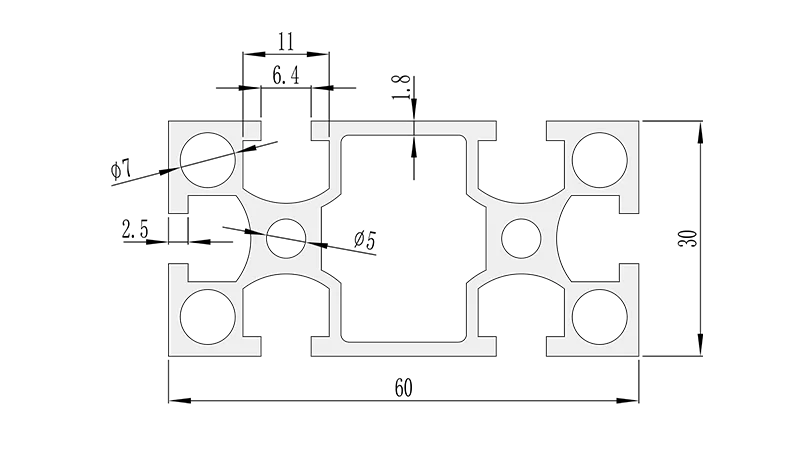
Walk into any manufacturing facility that's embraced lean principles, and you'll notice something immediately: order. Not the rigid, "everything in its place or else" order of a military barracks, but a fluid, purposeful rhythm where every tool, every material, and every step feels intentional. It's the kind of order that makes you think, "This isn't just organized—this is optimized." At the heart of that optimization lies a quiet hero: the right infrastructure. And today, we're diving deep into one such infrastructure star: the 3060 National Standard Profile A. How does this unassuming aluminum profile become a cornerstone of lean systems? Let's unpack it together.
The Heart of Lean: Continuous Improvement and Material Flow
First, let's ground ourselves in what lean manufacturing really is. It's not just a buzzword or a set of rules—it's a mindset. At its core, lean is about eliminating waste (anything that doesn't add value to the customer) and continuous improvement (always asking, "How can we do this better tomorrow?"). But here's the thing: you can't practice lean with clunky, one-size-fits-all equipment. If your workbenches are fixed and can't adapt when a new product line launches, if your material racks force workers to take extra steps to grab parts, or if your assembly lines are so rigid they resist even small tweaks, you're fighting an uphill battle.
Material flow is the lifeblood of lean. Imagine a worker on an assembly line having to walk 10 feet to retrieve a component, then 10 feet back— every single time they need that part. Over a shift, that's hundreds of extra steps, wasted time, and unnecessary fatigue. Multiply that across a factory, and suddenly you're looking at significant losses in productivity. Lean solves this by designing workspaces where materials arrive exactly when they're needed and exactly where they're needed —a concept called "just-in-time" (JIT) delivery. But JIT doesn't happen by accident. It requires infrastructure that can keep up with shifting demands, adapt to new products, and grow with your business.
Quick Lean Refresher: The seven types of waste (or "muda") in lean are: overproduction, waiting, transportation, overprocessing, inventory, motion, and defects. Notice how many of these tie directly to workspace design and material handling. A well-designed lean system cuts down on transportation (unnecessary movement of materials), motion (unnecessary movement of workers), and waiting (idle time because materials aren't ready). That's where the right tools—like the 3060 National Standard Profile A—come into play.
Meet 3060 National Standard Profile A: A Game-Changer in Lean Systems
Let's get acquainted. What exactly is the 3060 National Standard Profile A? In simple terms, it's a type of aluminum extrusion—a long, hollow beam with a specific cross-sectional shape—designed to be strong, lightweight, and infinitely adaptable. The "3060" refers to its dimensions: 30mm in width and 60mm in height. The "National Standard" part means it adheres to strict industry specifications, ensuring consistency across manufacturers, and "Profile A" denotes its specific T-slot configuration (more on that later).
At first glance, it might look like just another piece of metal. But looks can be deceiving. This profile is engineered with lean principles in mind, even if you don't realize it. Let's break down its key features and why they matter:
| Feature | What It Means | Why It Matters for Lean |
|---|---|---|
| 30mm x 60mm Dimensions | Wider than some smaller profiles (like 2020 or 3030) but more compact than larger ones (like 4080). Balances strength and space efficiency. | Strong enough to support heavy tools or materials but doesn't take up unnecessary floor space—critical in tight manufacturing areas. |
| High-Quality Aluminum Alloy | Typically made from 6063-T5 aluminum, which offers excellent strength-to-weight ratio and corrosion resistance. | Lightweight enough to be easily reconfigured (no heavy lifting required!) but durable enough to withstand daily use in industrial settings. |
| T-Slot Design | Longitudinal slots (T-slots) run the length of the profile, allowing accessories to be attached anywhere along the beam without drilling or welding. | Enables quick customization. Add a shelf here, a tool holder there, or reposition a bracket—all in minutes. No more waiting for a welder to modify a fixed structure. |
| National Standard Compatibility | Fits with a wide range of standardized aluminum profile accessories (connectors, brackets, panels, etc.) from various suppliers. | You're not locked into one brand. This flexibility lowers costs and ensures you can find the exact accessories you need for your unique setup. |
T-Slots: The Secret Sauce of Adaptability
If there's one feature that makes the 3060 National Standard Profile A a lean favorite, it's the T-slots. Imagine a groove that runs the entire length of the profile, with a narrow opening on the surface and a wider channel inside. This design lets you slide in T-nuts, bolts, or specialized brackets, then tighten them to secure accessories. Want to add a workbench top? Slide in brackets, bolt the top on, and you're done. Need to move a tool holder six inches to the left? Loosen the bolts, slide, retighten. It's that simple.
Compare this to traditional steel structures, which require welding or drilling to modify. Welding is permanent—if you need to change the layout next month, you're cutting and rewelding, which takes time and money. Drilling leaves holes that weaken the structure and limit future adjustments. T-slots eliminate all that. They turn "permanent" into "temporary" and "fixed" into "flexible"—two adjectives that lean managers love.
Why 3060 National Standard Profile A Aligns with Lean Principles
Now, let's connect the dots: why does this specific profile play so well with lean systems? Let's break it down into three key lean principles and see how 3060 Profile A supports each.
1. Flexibility for Adaptability (No More "Set It and Forget It")
Lean thrives on adaptability. Markets change, customer demands shift, and new products are developed—your workspace should keep up. The 3060 Profile A is like a Lego set for adults: you can build, disassemble, and rebuild it as needed. Let's say you're a electronics manufacturer, and you launch a new smartphone model that's slightly larger than the previous one. Your old assembly workbench might be too narrow to accommodate the new fixtures. With a workbench built from 3060 Profile A, you don't need to buy a whole new bench. Just add extension pieces using aluminum profile accessories (like corner brackets or straight connectors), adjust the shelf height, and you're ready for the new model. No downtime, no wasted money on new equipment—just quick, easy adaptation.
This flexibility also supports "kaizen events"—short, focused improvement workshops where teams brainstorm and implement small changes to boost efficiency. Maybe a kaizen team identifies that a flow rack is causing bottlenecks because it's too short. With 3060 Profile A, they can extend the rack in an afternoon using compatible aluminum tubes and connectors, test the new design, and if it works, keep it. If not, they can revert just as easily. This kind of rapid experimentation is core to continuous improvement.
2. Durability for Long-Term Efficiency
Lean isn't just about saving time—it's about saving resources, too. A cheap, flimsy workbench might cost less upfront, but if it bends under heavy loads, rusts in a humid factory, or needs replacement every year, it's actually wasteful (remember "inventory" waste? That includes unnecessary replacement parts). The 3060 National Standard Profile A is built to last. Aluminum is naturally resistant to corrosion, so it holds up in environments with moisture or chemicals. Its hollow design distributes weight evenly, making it surprisingly strong for its weight—3060 Profile A can support hundreds of pounds without bending. And because it's made from high-grade aluminum alloy, it resists dents and scratches, even in high-traffic areas.
Think about it: a well-built flow rack using 3060 Profile A might cost more than a basic steel rack upfront, but it'll last 10+ years, adapt to multiple product lines, and require minimal maintenance. Over time, that's a far better return on investment (ROI)—a key lean metric. Lean isn't about cutting costs at all costs; it's about investing in tools that deliver long-term value.
3. Cost-Effectiveness in Lean Budgets
Let's talk money—because lean is also about optimizing costs. While aluminum profiles can have a higher initial price tag than, say, wooden shelves or basic steel tubing, they more than make up for it in the long run. Here's how:
- Reduced Labor Costs: Assembling structures with 3060 Profile A is faster than welding steel or building wooden frames. No specialized skills needed—just basic hand tools and aluminum profile accessories. A team can put together a custom workbench in hours, not days.
- Lower Maintenance Costs: Aluminum doesn't rust, so you won't spend money on paint or rust treatments. T-slots mean no stripped screws from repeated disassembly—just replace a T-nut if needed, which costs pennies.
- Minimal Waste: When you're done with a structure, you can disassemble it and reuse the profiles elsewhere. Steel structures often end up in scrap yards; wooden ones rot or get thrown away. 3060 Profile A is recyclable and reusable, aligning with lean's "reduce waste" ethos.
Real-World Example: A Small Manufacturer's Lean Journey with 3060 Profile A
Let's meet "Acme Widgets," a hypothetical small manufacturer making plastic parts for the automotive industry. Before lean, their assembly area was a maze of fixed steel workbenches, wooden shelves that sagged under heavy toolboxes, and workers walking 20+ feet to grab materials. Their lead times were long, and errors were common because tools were disorganized.
They decided to go lean, starting with their workspace. They replaced all fixed workbenches with custom workstations built from 3060 National Standard Profile A. Here's what happened:
- Tool Placement: Using T-slots, they mounted tools directly to the bench frame at arm's reach, cutting down on "motion" waste. Workers no longer had to rummage through drawers.
- Material Flow: They added flow racks (also built with 3060 Profile A) next to each workstation, so parts rolled directly to the assembler—reducing "transportation" waste by 40%.
- Adaptability: When a new client ordered a larger widget, they extended the workbenches by 12 inches using aluminum profile accessories in under an hour. No new benches, no downtime.
Six months later, Acme reported a 25% increase in productivity, 15% fewer defects, and workers reported less fatigue. The 3060 Profile A wasn't the only change, but it was the backbone that made their lean transformation possible.
Bringing It All Together: Applications in Lean Workspaces
Now that we understand the "why," let's explore the "how." How do manufacturers actually use 3060 National Standard Profile A in their lean systems? Let's dive into three common applications: workbenches, flow racks, and modular assembly lines.
Workbenches: Customized for Every Task
Workbenches are the command centers of manufacturing—where the magic happens. A lean workbench should be ergonomic (to reduce worker strain), organized (to minimize errors), and adaptable (to handle new tasks). The 3060 Profile A excels here.
Imagine a workbench for electronics assembly: it needs to hold a soldering iron, a magnifying lamp, bins for small components, and a static-dissipative (ESD) top to protect sensitive parts. With 3060 Profile A, you can build the frame to the exact height of the tallest worker (eliminating bending), add a shelf halfway up for bins, and mount the lamp and soldering iron holder using T-slot brackets. If you hire a shorter worker later, adjust the height with leveling feet (another aluminum profile accessory). If you switch to larger components, add a second shelf. It's a bench that grows with your team and your products.
ESD workbenches (a must for electronics) are also a breeze with 3060 Profile A. Just add an ESD-safe top (secured via T-slots) and ground the frame using conductive accessories—no need for special tools. This customization ensures that even specialized workspaces stay lean and efficient.
Flow Racks: Streamlining Material Movement
Flow racks are the unsung heroes of JIT delivery. They use gravity to roll materials from the "stock" end to the "pick" end, ensuring the oldest parts are used first (FIFO—first in, first out) and reducing the need for workers to reach, bend, or lift. And yes, 3060 Profile A is perfect for building them.
A typical flow rack has sloped levels with rollers or skate wheels. The frame needs to be strong enough to support heavy boxes of parts but lightweight enough to adjust the slope if needed. 3060 Profile A provides that strength without the bulk. Using aluminum profile accessories like roller track connectors, you can attach roller tracks to the frame at a precise angle (usually 5-10 degrees) to control how fast materials roll. If a particular part is lighter and rolls too slowly, tweak the angle by adding shims under the frame legs—no rebuilding the entire rack.
Acme Widgets (our earlier example) used 3060 Profile A flow racks to cut down on material retrieval time. Before, workers walked to a central storage area; now, parts roll to them. The result? Less walking, more assembling, and happier employees.
Modular Assembly Lines: From Static to Dynamic
Traditional assembly lines are often fixed concrete or steel structures, making them hard to reconfigure. Lean assembly lines, by contrast, are dynamic—they can shrink, grow, or change shape as production needs evolve. Enter 3060 Profile A.
Imagine an automotive parts assembly line where each station builds a component of a car door. With a modular line built from 3060 Profile A, you can add a new station in a day if demand increases, or remove one if production slows. Use casters (another aluminum profile accessory) to make stations mobile, so you can reposition them for better workflow. Add conveyor sections (yes, even conveyors can be built with 3060 Profile A and roller tracks) to connect stations, ensuring parts move seamlessly from one worker to the next.
This modularity also supports "cellular manufacturing," a lean approach where teams work in small, self-contained cells instead of long assembly lines. Each cell is responsible for a complete sub-assembly, and cells can be rearranged based on demand. 3060 Profile A cells are easy to set up, take up less space, and foster better communication among team members—all lean wins.
Aluminum Profile Accessories: The Unsung Heroes of Lean Flexibility
We've mentioned aluminum profile accessories a few times, and for good reason: they're what turn a simple aluminum profile into a lean powerhouse. Think of the 3060 Profile A as the "bones" of your structure; the accessories are the "muscles" and "joints" that let it move and adapt. Let's highlight a few key ones and how they enhance lean systems:
- Connectors: These join profiles at angles (90°, 45°, 135°) or straight lines. Corner brackets, T-connectors, and 3-way connectors let you build frames, shelves, and racks without welding. They're quick to install and easy to adjust—perfect for kaizen tweaks.
- Casters and Leveling Feet: Casters turn static workbenches into mobile carts, so you can move tools to the work instead of the work to the tools. Leveling feet stabilize racks on uneven floors, preventing wobbling and ensuring smooth material flow on flow racks.
- Panels and Covers: Attach plywood, metal, or ESD-safe panels to the T-slots to create work surfaces, tool boards, or dividers. They're easy to swap out if a panel gets damaged or you need a different material.
- Roller Tracks and Skate Wheels: As we mentioned with flow racks, these accessories turn a simple frame into a gravity-fed material delivery system. They're compatible with 3060 Profile A's T-slots, so you can position them exactly where needed.
The best part? All these accessories are standardized, so you can mix and match from different suppliers. Need a longer roller track? Grab one from Supplier X. Need a specific caster? Supplier Y has it. This interoperability keeps costs low and ensures you're never locked into a single brand—another lean win for cost-effectiveness.
Real-World Impact: How Companies Benefit from 3060 Profile A
Let's move beyond hypotheticals. While we can't name real companies (due to privacy), the impact of using 3060 National Standard Profile A in lean systems is well-documented. Here are some common outcomes reported by manufacturers who've made the switch:
- 50% Reduction in Setup Time: When launching new product lines, reconfiguring workspaces takes hours instead of days.
- 30% Less Floor Space Used: Modular structures are more compact than fixed ones, freeing up space for other operations.
- 20% Fewer Defects: Organized workspaces with tools at arm's reach reduce errors caused by distraction or fatigue.
- Higher Employee Engagement: Workers feel empowered when their workspace adapts to their needs, leading to better morale and lower turnover.
One particularly compelling case is a medical device manufacturer that used 3060 Profile A to build cleanroom workstations. Cleanrooms have strict requirements for sterility and organization, and fixed equipment often harbors dust or is hard to sanitize. With modular 3060-based workstations, they could disassemble and deep-clean every component weekly, reducing contamination risks. Plus, when they introduced a new device, they reconfigured the workstations in a weekend—something that would have taken weeks with fixed steel tables.
Looking Ahead: 3060 Profile A and the Future of Lean
Lean manufacturing isn't static—it evolves as technology and best practices advance. So, where does 3060 National Standard Profile A fit in the future? As manufacturers move toward "smart factories" (Industry 4.0), with IoT sensors, automated guided vehicles (AGVs), and real-time data analytics, the need for flexible infrastructure will only grow. Smart factories require workspaces that can integrate with new technologies—like mounting sensors on workbenches to track tool usage, or adding charging stations for AGVs.
3060 Profile A is ready for this future. Its T-slots make it easy to mount sensors, cameras, or displays. Its modularity means you can add new components (like robot arms or automated feeding systems) without rebuilding the entire workspace. And because it's lightweight, it won't interfere with AGV navigation or floor-mounted sensors.
Additionally, as sustainability becomes a core business goal (and not just a buzzword), the recyclability and durability of aluminum will make 3060 Profile A even more attractive. Lean and sustainability go hand in hand—both focus on reducing waste and maximizing resources. Using aluminum profiles that last decades and can be reused repeatedly aligns perfectly with both.
Conclusion: Embracing Continuous Improvement with the Right Tools
At the end of the day, lean manufacturing is about people—empowering them to work smarter, not harder. The 3060 National Standard Profile A isn't just a piece of aluminum; it's a tool that gives teams the flexibility to design their ideal workspace, adapt to change, and continuously improve. It's the quiet infrastructure that lets lean principles shine—eliminating waste, streamlining flow, and fostering a culture of innovation.
Whether you're building a workbench for a small workshop or redesigning an entire assembly line, remember this: lean isn't about perfection—it's about progress. And progress requires tools that can keep up. The 3060 National Standard Profile A isn't just keeping up; it's leading the way. So, the next time you walk into a lean factory and notice that seamless flow, that adaptability, that sense of purpose—take a closer look. Chances are, you'll see the 3060 Profile A and its aluminum profile accessories hard at work, quietly supporting the continuous improvement journey.