- Company Articles
- Industry articles
- Industry standards
- 3060 National Standard Profile A for Medical Device Manufacturing: Hygienic Design Solutions

3060 National Standard Profile A for Medical Device Manufacturing: Hygienic Design Solutions
Related Product
3060 National Standard Profile A
Workbench, production line, logistic rack, warehouse rack Industry: Manufacturer workshop, Automobile, Electronic, Assembling, logistic
In the world of medical device manufacturing, precision isn't just a goal—it's a lifeline. Every component, every process, and every surface must adhere to the strictest standards to ensure patient safety. But what if the very tools we use to build these life-saving devices could themselves become a barrier to contamination? That's where the right materials come into play. Today, we're diving into a workhorse of modern medical manufacturing: the 3060 National Standard Profile A. This unassuming aluminum extrusion has quietly revolutionized how medical device assembly lines operate, blending durability, customization, and—most critically—hygienic design into a single, versatile solution. Let's explore why this aluminum profile has become a cornerstone for manufacturers aiming to balance efficiency with the uncompromising cleanliness required in healthcare.
Why Aluminum Profiles Matter in Medical Manufacturing
Walk into any medical device production facility, and you'll notice a common theme: surfaces that shine, equipment that looks almost clinical, and an air of meticulousness. That's by design. Unlike consumer goods, medical devices—from surgical instruments to diagnostic tools—directly interact with patients, making contamination risks a top concern. Traditional materials like wood or generic steel often fall short here: wood harbors bacteria in its pores, while uncoated steel can rust or chip, creating tiny crevices for pathogens to hide.
Enter aluminum profiles. Lightweight yet surprisingly strong, aluminum has long been favored in industries where corrosion resistance and cleanability matter. But not all aluminum is created equal. Aluminum extrusion profiles , in particular, have changed the game. These profiles are formed by pushing heated aluminum through a die, creating consistent, custom shapes with smooth surfaces and integrated features like T-slots. This process allows manufacturers to build everything from workbenches to material racks with precision—no welding, no rough edges, and no guesswork.
For medical device makers, this means equipment that's not just functional but intentionally hygienic . And among the many extrusion profiles available, one stands out for its versatility in this space: the 3060 National Standard Profile A. Let's take a closer look at what makes this profile a standout choice.
Understanding the 3060 National Standard Profile A
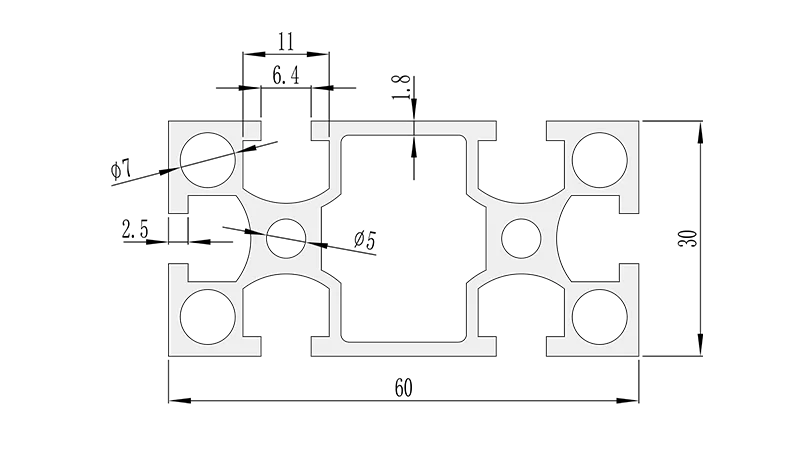
First things first: what exactly is the 3060 National Standard Profile A? At its core, it's a type of aluminum profile defined by its dimensions—30mm in width and 60mm in height—and adherence to strict national manufacturing standards. These standards ensure consistency across batches, meaning a 3060 Profile A from one supplier will fit seamlessly with accessories from another, a critical feature for facilities that need to scale or modify their setups quickly.
But numbers only tell part of the story. What truly sets this profile apart is its design. Made from high-grade aluminum alloy (typically 6061 or 6063, known for their strength and corrosion resistance), the 3060 Profile A is extruded to create a sleek, uniform cross-section. Unlike cut or machined metals, which can leave rough edges or tool marks, extrusion results in a surface that's naturally smooth—no extra finishing required. This smoothness isn't just for aesthetics; it's a hygiene superpower. Without pores or ridges, there's nowhere for bacteria, dust, or residue to cling, making cleaning a breeze.
Another key feature is its T-slot design. Running along the length of the profile are grooves (T-slots) that allow for easy attachment of accessories—think brackets, shelves, or even tools—without drilling or welding. This modularity is a game-changer for medical manufacturers, who often need to reconfigure workstations or adapt to new product lines. And because the T-slots are standardized, adding or removing components is as simple as sliding in a bolt or clip, reducing downtime and keeping production lines moving.
Fun fact: The "3060" designation isn't arbitrary. It refers to the profile's cross-sectional dimensions (30mm x 60mm), making it wider than it is tall. This shape provides excellent stability for horizontal structures like workbenches, while still being lightweight enough for vertical applications like racks or partitions.
Hygienic Design: The Make-or-Break Feature
In medical manufacturing, "hygienic design" isn't just a buzzword—it's a regulatory requirement. Organizations like the FDA and ISO set strict guidelines for surfaces in contact with medical devices, mandating that they be non-porous, easy to disinfect, and resistant to corrosion from cleaning agents. The 3060 National Standard Profile A checks all these boxes, and then some.
Let's start with the surface. The extrusion process leaves the aluminum with a naturally smooth finish, but most manufacturers take it a step further with anodization. Anodizing is an electrochemical process that creates a protective oxide layer on the aluminum's surface, making it even more resistant to scratches, stains, and chemicals. This layer is non-reactive, meaning it won't leach substances into cleaning solutions or interact with disinfectants like bleach or alcohol—common in medical facilities. Wiping down a 3060 Profile A workstation is as simple as using a cloth and the appropriate cleaner; no scrubbing, no special tools, and no lingering residue.
Then there are the edges. Unlike some metal profiles with sharp corners, the 3060 Profile A often features rounded edges (a design choice specified in the national standard). Sharp corners are magnets for dirt and grime—they're hard to reach with a cloth, and over time, they can trap moisture, leading to bacterial growth. Rounded edges eliminate this risk, ensuring every inch of the profile is accessible during cleaning. It's a small detail, but in a industry where even a single bacteria colony can compromise a batch, small details matter.
Modularity also plays a role in hygiene. Traditional workstations or racks are often welded together, creating joints that are impossible to fully disassemble. Over time, these joints can develop cracks or gaps where contaminants hide. With the 3060 Profile A's T-slot system, however, components are bolted or clipped together, allowing for easy disassembly. Need to deep-clean a workstation? Simply remove the shelves, wipe down each profile individually, and reassemble—no hidden crevices, no missed spots.
How 3060 Profile A Stacks Up Against Traditional Materials
To truly appreciate the 3060 National Standard Profile A, it helps to compare it to the materials it's replacing. Let's take a look at how it measures up against two common alternatives: stainless steel and plastic.
| Feature | Stainless Steel (Traditional) | Plastic (PVC/Polypropylene) | 3060 Aluminum Profile A |
|---|---|---|---|
| Surface Porosity | Low, but welding can create micro-gaps | High; prone to scratches that trap bacteria | Non-porous; anodized finish resists scratches |
| Cleaning Ease | Heavy; hard to move for thorough cleaning | Light, but can warp with harsh disinfectants | Lightweight; modular design allows full disassembly |
| Corrosion Resistance | Excellent, but heavy and expensive | Poor; reacts with many cleaning agents | Excellent; anodized layer resists chemicals |
| Customization | Limited; requires welding or cutting | Moderate; mold costs are high for unique shapes | High; T-slots allow easy accessory attachment |
| Long-Term Cost | High upfront and maintenance costs | Low upfront, but frequent replacement needed | Moderate upfront; durable with minimal maintenance |
As the table shows, the 3060 Profile A offers a sweet spot of durability, cleanability, and flexibility that traditional materials can't match. Stainless steel is durable but heavy and hard to reconfigure; plastic is lightweight but not built to last. The 3060 Profile A? It's the Goldilocks solution—strong enough to support heavy equipment, light enough to move, and designed from the ground up to keep contamination at bay.
Real-World Applications: From Workbenches to Material Racks
So, how exactly do manufacturers use the 3060 National Standard Profile A? The answer is: in just about every corner of the facility. Let's explore a few key applications where this aluminum profile shines.
Assembly Workbenches
The heart of any medical device production line is the workbench. This is where technicians assemble intricate components, test prototypes, and inspect finished products. A workbench built with 3060 Profile A offers several advantages. First, its modular design allows for customization—add a shelf for tools, a cable management tray, or a lighting fixture, all via the T-slots. Second, the smooth, anodized surface is easy to wipe down between shifts, preventing cross-contamination between batches. And because aluminum is lightweight, the workbench can be fitted with casters (another accessory that attaches via T-slots) for easy repositioning, adapting to changing production needs.
One medical device manufacturer in Minnesota, for example, replaced their old wooden workbenches with 3060 Profile A stations last year. They reported a 40% reduction in time spent cleaning and a 25% decrease in minor contamination incidents in the first six months. "It's not just that the benches are cleaner," said their production manager. "It's that the technicians feel more confident working on surfaces they know are safe. That peace of mind translates to better focus and fewer errors."
Material Racks and Storage
Storing components like surgical screws, catheters, or circuit boards requires racks that are both secure and accessible. The 3060 Profile A excels here, too. Manufacturers can build multi-tiered racks with adjustable shelves, allowing them to store different-sized components without wasted space. The anodized finish ensures that even if a rack is near a cleaning station (where moisture is common), it won't rust or degrade. Plus, the lightweight nature of aluminum means these racks can be moved if the facility rearranges its layout—no need for heavy machinery or walls.
Cleanroom Partitions
Many medical device processes require cleanrooms—controlled environments with low levels of airborne particles. Partitioning these spaces to separate different stages of production (e.g., assembly vs. packaging) is essential. The 3060 Profile A's rigidity and modularity make it ideal for building cleanroom dividers. By attaching panels (often made of clear acrylic for visibility) to the profiles, manufacturers can create custom-sized partitions that are easy to clean and reconfigure. Unlike fixed drywall partitions, these can be disassembled and reused if the cleanroom layout changes, saving time and money.
Aluminum Profile Accessories: The Cherry on Top
A profile is only as good as the accessories that bring it to life. The 3060 National Standard Profile A is supported by a wide range of aluminum profile accessories that enhance its functionality—all designed to attach seamlessly via T-slots. Let's highlight a few must-haves for medical manufacturing:
- End Caps: These plastic or aluminum caps fit over the ends of the profile, covering the T-slots and preventing debris from entering. They also add a finished look and eliminate sharp edges.
- Connectors: From 90° angles to T-joints, these metal brackets join profiles together securely without welding. Many are designed with rounded edges to maintain the hygienic design.
- T-Slot Rubber Seal Covers: These flexible strips slide into the T-slots when they're not in use, preventing dust and moisture from collecting inside. They're easy to remove when adding accessories.
- Adjustable Feet: For workbenches or racks that need to stay stationary, these feet attach to the bottom of the profile, leveling the surface on uneven floors and preventing wobbling.
- Tool Hooks and Holders: These simple accessories clip into T-slots, keeping tools like tweezers, scalpels, or torque wrenches within arm's reach—reducing clutter and ensuring tools are always where they're needed.
The beauty of these accessories is that they're standardized. No matter which supplier you buy from, a 3060 Profile A from one company will work with end caps or connectors from another. This interoperability is a huge plus for manufacturers that source components globally or need to replace parts quickly.
Compliance and Certification: Meeting the Strictest Standards
In medical manufacturing, compliance isn't optional—it's the law. The 3060 National Standard Profile A doesn't just meet industry standards; it exceeds them. Let's break down the key certifications and regulations it complies with:
ISO 13485: This international standard specifies requirements for a quality management system in medical device manufacturing. The 3060 Profile A's consistent production process (thanks to national standards) ensures traceability, a key ISO 13485 requirement. Manufacturers can track each profile batch back to its raw materials, proving compliance in audits.
FDA 21 CFR Part 820: The FDA's Quality System Regulation mandates that medical device manufacturers use materials that don't adulterate products. The anodized aluminum in 3060 Profile A is non-reactive, meaning it won't leach chemicals into devices or interact with cleaning agents—meeting FDA safety requirements.
Biocompatibility: While the profile itself isn't implanted in patients, it often comes into contact with components that are. Aluminum is biocompatible, and the anodized layer is inert, ensuring no harmful substances transfer to medical devices during production.
Many suppliers also provide material safety data sheets (MSDS) and third-party test reports, giving manufacturers the documentation they need to prove compliance to regulators. For a industry where audits are frequent and stakes are high, this peace of mind is invaluable.
Looking Ahead: The Future of Aluminum Profiles in Medical Manufacturing
As medical device technology advances—think smaller, more complex devices like wearable monitors or minimally invasive surgical tools—the demand for flexible, hygienic manufacturing solutions will only grow. The 3060 National Standard Profile A is well-positioned to meet this demand, but it's also evolving. Suppliers are experimenting with antimicrobial coatings (infused with silver ions, for example) to add an extra layer of protection against bacteria. Others are exploring lighter-weight aluminum alloys without sacrificing strength, making the profiles even easier to handle and transport.
Another trend is smart manufacturing integration. With the rise of Industry 4.0, manufacturers are adding sensors to production lines to monitor temperature, humidity, and even contamination levels. The T-slots in the 3060 Profile A make it easy to attach these sensors, turning static workstations into connected hubs that provide real-time data. Imagine a workbench that alerts the team if a surface hasn't been cleaned in the last hour, or a rack that tracks inventory levels automatically—all made possible by the profile's modular design.
Sustainability is also playing a bigger role. Aluminum is 100% recyclable, and the extrusion process uses significantly less energy than steel production. As medical device companies aim to reduce their carbon footprints, the 3060 Profile A's eco-friendly credentials are becoming a selling point. Some suppliers even offer profiles made from recycled aluminum, further lowering environmental impact without compromising quality.
Final Thoughts: More Than Just a Profile—A Commitment to Safety
At the end of the day, the 3060 National Standard Profile A is more than just a piece of aluminum. It's a tool that empowers medical device manufacturers to do what they do best: create products that save lives. By prioritizing hygienic design, modularity, and compliance, this aluminum profile has become a silent partner in the fight against contamination, ensuring that every device that leaves the factory is as safe as it is innovative.
Whether you're building a new production line or upgrading an existing one, the 3060 Profile A offers a simple truth: the materials we use to make medical devices matter just as much as the devices themselves. And in a industry where perfection is the only acceptable standard, having a reliable, hygienic foundation like this profile isn't just an advantage—it's a necessity.
So the next time you see a sleek, shiny workstation in a medical manufacturing facility, take a closer look. Chances are, it's built with a 3060 National Standard Profile A—quietly working behind the scenes to keep patients safe, technicians efficient, and the future of healthcare moving forward.