- Company Articles
- Industry articles
- Industry standards
- 3060 National Standard Profile A in Cleanroom Environments: Medical Device Racks

3060 National Standard Profile A in Cleanroom Environments: Medical Device Racks
Related Product
3060 National Standard Profile A
Workbench, production line, logistic rack, warehouse rack Industry: Manufacturer workshop, Automobile, Electronic, Assembling, logistic
In the world of medical device manufacturing, where precision is non-negotiable and sterility is a lifeline, every component of the production environment matters—including the humble material rack. These unassuming structures hold the keys to maintaining order, preventing contamination, and ensuring compliance with the strictest industry standards. Today, we're diving deep into a material that's quietly revolutionizing how medical facilities approach cleanroom storage: the 3060 National Standard Profile A. More than just aluminum extrusion, this profile is a testament to how smart design can elevate safety, efficiency, and adaptability in spaces where even a single particle can compromise patient health. Let's explore why this profile has become a cornerstone for medical device racks in cleanrooms, and how it integrates with everything from aluminum profile accessories to lean system principles.
The Critical Role of Material Racks in Medical Cleanrooms
Before we unpack the 3060 National Standard Profile A, let's first understand the high-stakes environment it operates in. Cleanrooms in medical device manufacturing are controlled spaces designed to minimize airborne particles, microbes, and chemical contaminants. They're governed by rigorous standards—ISO 14644 for air cleanliness, FDA regulations for medical device production, and cGMP (current Good Manufacturing Practices) to ensure consistency. In these spaces, material racks aren't just storage units; they're active participants in maintaining sterility.
Medical device racks hold everything from raw materials (like surgical-grade plastics or stainless steel components) to partially assembled devices and finished products. They must prevent dust accumulation, resist corrosion from frequent cleaning agents, and avoid shedding particles that could contaminate sensitive equipment. Traditional racks—often made of wood, painted steel, or even plastic—fall short here. Wood can harbor bacteria and splinter; painted steel chips and rusts; plastic may warp under sanitizing heat or chemical exposure. This is where the right material choice becomes critical.
Moreover, medical manufacturing workflows are rarely static. New devices are developed, production volumes fluctuate, and regulatory requirements evolve. Racks need to adapt without disrupting operations or requiring complete overhauls. A rigid, one-size-fits-all rack system can become a bottleneck, leading to inefficiencies that contradict the lean system goals many facilities strive for. The ideal rack material must balance durability, cleanliness, and flexibility—and that's where aluminum extrusion profiles, specifically the 3060 National Standard Profile A, enter the picture.
What Is 3060 National Standard Profile A?
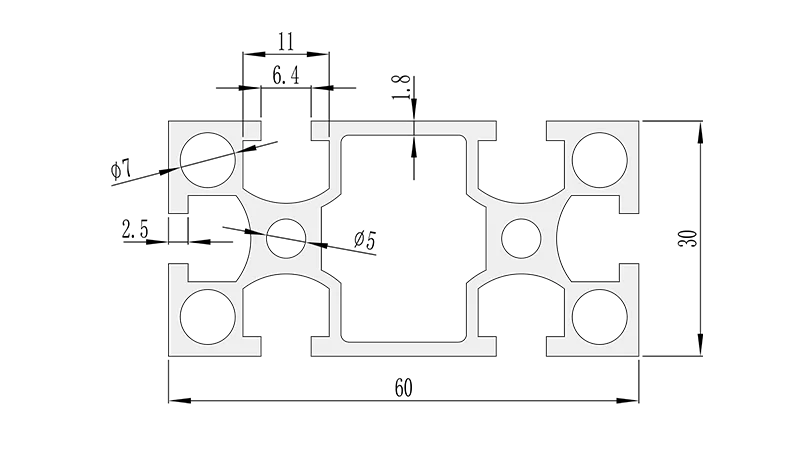
At its core, the 3060 National Standard Profile A is an aluminum extrusion profile defined by its cross-sectional dimensions: 30 millimeters in width and 60 millimeters in height. But its significance goes far beyond measurements. As part of the national standard aluminum profile series, it's engineered to meet strict quality and dimensional consistency requirements, ensuring compatibility across manufacturers and applications. This standardization is a game-changer for medical facilities, where component interchangeability and reliability are non-negotiable.
Aluminum, the base material, brings inherent advantages. It's lightweight—about one-third the density of steel—making the racks easy to reposition (a boon for workflow adjustments) without sacrificing structural integrity. Its natural corrosion resistance means it stands up to daily cleaning with disinfectants, steam, or even harsh chemicals like hydrogen peroxide vapor—common in cleanroom sanitization protocols. Unlike steel, aluminum doesn't require painting or coating to protect it, eliminating the risk of flaking or chipping that could introduce contaminants.
The "profile" aspect refers to the extrusion process, where aluminum alloy is forced through a die to create a specific cross-sectional shape. The 3060 Profile A typically features a T-slot design—longitudinal grooves along its length—that allows for easy attachment of accessories without welding or drilling. This design is what unlocks its modularity: shelves, dividers, casters, and other components can be slid into the T-slots and secured with bolts or brackets, making reconfiguration as simple as loosening a fastener and adjusting the position. For medical cleanrooms, where downtime for modifications is costly, this flexibility is invaluable.
Why 3060 Profile A Excels in Cleanroom Medical Device Racks
To appreciate why the 3060 National Standard Profile A is a standout choice for medical device racks, let's break down its cleanroom-specific benefits:
1. Smooth, Non-Porous Surface for Easy Sanitization
Cleanrooms demand surfaces that can be thoroughly cleaned and disinfected without harboring residue or microbes. The 3060 Profile A's extrusion process results in a smooth, seamless surface with no cracks, crevices, or weld seams where dust, bacteria, or chemicals can hide. Unlike stainless steel pipe series (a common alternative), which may have welded joints or threaded connections that trap particles, the 3060 profile's continuous extrusion minimizes these risk points. Even better, many manufacturers offer anodized finishes for the profile—an electrochemical process that thickens the aluminum's natural oxide layer, making it even more resistant to scratches, stains, and chemical corrosion. Anodized surfaces are also non-reactive, ensuring they don't leach substances into the environment or react with cleaning agents.
2. Modularity Driven by Aluminum Profile Accessories
A rack is only as useful as its ability to adapt to changing needs, and here, the T-slot design of the 3060 Profile A shines, especially when paired with aluminum profile accessories. These accessories—including brackets, connectors, end caps, and shelf supports—are designed to slide into the T-slots and lock in place, allowing for endless configurations. Need a rack with adjustable shelf heights to accommodate different device sizes? Simply move the shelf brackets. Want to add a side rail to prevent items from sliding off? Attach a rail using T-slot nuts and bolts. Need to convert a static rack into a mobile cart for material transport? Add casters (another accessory) with mounting plates that fit the T-slots.
This modularity aligns perfectly with lean system principles, which emphasize eliminating waste and optimizing flow. Instead of purchasing new racks when needs change, facilities can reconfigure existing ones using aluminum profile accessories, reducing costs and material waste. For example, a medical device manufacturer producing small catheters might start with a 3060-based rack with narrow shelves. When they expand to larger surgical instruments, they can adjust the shelf spacing or add deeper shelves using compatible accessories—no need for a complete rack replacement.
3. Strength Without the Weight
Medical device components and finished products can be surprisingly heavy. A rack holding stainless steel surgical tools or bulk packaging of implantable devices needs to support significant weight without bending or sagging. The 3060 Profile A, despite its lightweight nature, delivers impressive load-bearing capacity. Its 30x60mm cross-section provides a balance of vertical and horizontal strength, with the T-slot structure reinforcing the profile against torsion and bending. In testing, properly assembled 3060 racks can support hundreds of kilograms per shelf, depending on the shelf material and support spacing—more than enough for most medical storage needs.
This strength-to-weight ratio is a key advantage over stainless steel pipe series racks. Stainless steel is strong but dense, making racks heavy and difficult to move. In contrast, 3060 aluminum racks can be repositioned by a single technician, reducing the need for heavy equipment or multiple staff during workflow adjustments. This lightness also reduces wear on cleanroom floors, which are often made of sensitive materials like epoxy or vinyl that can be damaged by heavy, stationary equipment.
4. Compatibility with Cleanroom Classifications
Cleanrooms are classified by the number of particles per cubic meter (ISO 14644-1), with Class 1 being the strictest (fewer than 10 particles ≥0.1μm) and Class 9 the least (similar to ambient air). Medical device manufacturing often requires Class 7 or higher (≤352,000 particles ≥0.5μm per m³). The 3060 Profile A's design minimizes particle generation and accumulation, making it suitable for these high-class environments. Its smooth surface doesn't shed fibers or flakes, and its modular assembly avoids the need for adhesives or sealants that can outgas volatile organic compounds (VOCs)—a common source of air contamination in cleanrooms.
In comparison, plastic racks may off-gas, and stainless steel pipe series racks with welded joints can trap particles in crevices, requiring more frequent and intensive cleaning. The 3060 Profile A, with its minimal crevices and easy-to-wipe surface, reduces the frequency and complexity of cleaning, freeing up staff for other critical tasks.
Comparing 3060 Profile A to Other Materials: A Cleanroom Perspective
To truly understand the value of the 3060 National Standard Profile A, it helps to see how it stacks up against other common rack materials in cleanroom settings. The table below compares it to stainless steel pipe series (a popular alternative), plastic racks, and painted steel racks across key cleanroom criteria:
| Criteria | 3060 National Standard Profile A | Stainless Steel Pipe Series | Plastic Racks | Painted Steel Racks |
|---|---|---|---|---|
| Weight | Lightweight (easy to reposition) | Heavy (difficult to move) | Light but less rigid | Heavy (prone to floor damage) |
| Corrosion Resistance | Excellent (natural oxide layer; anodized options) | Excellent (but heavier and costlier) | Poor (may warp or degrade with chemicals) | Poor (paint chips; steel rusts) |
| Cleanability | High (smooth, non-porous surface; minimal crevices) | Moderate (welded joints trap particles) | Low (porous; may harbor bacteria) | Low (chips and scratches trap contaminants) |
| Modularity | High (T-slot design; compatible with aluminum profile accessories) | Low (requires welding or specialized connectors) | Low (fixed design; limited adjustment) | Low (welded or bolted; difficult to reconfigure) |
| Cost (Initial + Long-Term) | Moderate initial; low long-term (reconfigurable, durable) | High initial; moderate long-term (durable but inflexible) | Low initial; high long-term (frequent replacement) | Low initial; high long-term (rust, repainting costs) |
| Suitability for ISO 7+ Cleanrooms | Excellent (minimal particle generation) | Good (but heavier and harder to clean thoroughly) | Poor (off-gassing, porosity) | Poor (particle shedding from chips/rust) |
As the table shows, the 3060 Profile A strikes a balance that's hard to match. It offers the corrosion resistance of stainless steel without the weight or cost, the cleanability needed for high-class cleanrooms, and the modularity that plastic or painted steel can't provide. For medical device racks, this translates to a system that's not just functional, but future-proof.
Real-World Applications: 3060 Profile A in Medical Device Racks
To bring this to life, let's consider a hypothetical but realistic case study: a mid-sized medical device manufacturer producing orthopedic implants (e.g., knee and hip replacements) in an ISO 7 cleanroom. Their challenges include storing sterile components, organizing tools for assembly, and transporting materials between production stations—all while adhering to FDA and ISO standards.
Previously, the facility used welded stainless steel pipe series racks. These were durable but heavy, making it difficult to adjust workflows when introducing a new implant model. The welded joints required frequent deep cleaning to prevent particle buildup, and reconfiguring shelves meant hiring a welder and shutting down part of the cleanroom—costly and disruptive. The team switched to 3060 National Standard Profile A racks, and the results were transformative.
First, they used aluminum profile accessories to build custom racks with adjustable shelves. Sterile implant components, stored in sealed trays, now rest on shelves spaced to fit each tray size, reducing wasted space. The T-slot design allowed them to add dividers to separate different implant sizes, preventing mix-ups. For tool storage, they attached hooks and tool holders directly to the 3060 profiles, keeping frequently used instruments within arm's reach of assembly workbenches (another 3060-based structure, integrating the rack system with workstations for seamless flow).
Mobility was another win. By adding lockable casters (via compatible mounting plates) to some 3060 racks, the team created mobile material carts that could be moved to assembly stations as needed, reducing the time staff spent walking to retrieve items. When production scaled up, they expanded the rack system by adding more 3060 profiles and accessories—no welding, no downtime. Sanitization time decreased by 30% thanks to the smooth, crevice-free surfaces, and compliance audits showed a marked reduction in particle counts, as the aluminum racks didn't shed contaminants like the old steel ones.
This example illustrates how the 3060 Profile A isn't just a material—it's a catalyst for operational improvement. By combining with aluminum profile accessories and aligning with lean system principles, it transforms static storage into a dynamic, adaptable part of the manufacturing process.
Workbench Integration: Creating Cohesive Cleanroom Workspaces
Material racks don't exist in isolation; they're part of a larger ecosystem that includes workbenches, where assembly, inspection, and packaging happen. The 3060 National Standard Profile A excels here too, as it can be used to build workbenches that integrate seamlessly with the rack system. This cohesion is critical for lean system success, as it reduces unnecessary movement and streamlines workflows.
A 3060-based workbench shares the same modularity as the racks. Its frame can be built to custom heights (ergonomic for technicians), with shelves, drawers, or overhead racks added using aluminum profile accessories. For example, a workbench used for implant inspection might have a 3060 frame with a stainless steel top (for durability and cleanability), a lower shelf for tools, and an overhead rack (also 3060-based) for storing documentation or inspection equipment. The overhead rack can be positioned to align with the material rack behind the workbench, so components can be easily transferred from storage to inspection without extra steps.
ESD (electrostatic discharge) protection is another consideration in medical device manufacturing, as static electricity can damage sensitive electronics in devices like pacemakers. While the 3060 Profile A itself is not conductive, it can be paired with ESD-safe accessories (e.g., conductive shelf mats, ESD casters) to create ESD-compliant workbenches and racks. This versatility makes it suitable for a wide range of medical applications, from electronics assembly to mechanical component production.
Maintenance and Longevity: Keeping 3060 Racks in Peak Condition
Like any equipment in a cleanroom, 3060 Profile A racks require regular maintenance to ensure they remain effective. Fortunately, their design makes this straightforward. Daily cleaning involves wiping down surfaces with a lint-free cloth and a mild, non-abrasive disinfectant (e.g., isopropyl alcohol or quaternary ammonium compounds). The smooth, anodized surface resists staining, so even frequent cleaning won't degrade its appearance or performance.
Periodic inspections should focus on aluminum profile accessories: checking that bolts and brackets are tight, replacing any worn casters or shelf supports, and ensuring T-slot nuts haven't loosened. Unlike stainless steel pipe series racks, which may require welding repairs, 3060 racks can be fixed by simply replacing a damaged accessory—a process that takes minutes, not hours. This minimizes downtime and keeps maintenance costs low.
With proper care, 3060 National Standard Profile A racks can last 10+ years, far outperforming plastic or painted steel alternatives. Their aluminum construction is also fully recyclable at the end of their lifespan, aligning with sustainability goals increasingly important to medical manufacturers and regulators.
Conclusion: Why 3060 Profile A Is the Future of Cleanroom Medical Racks
In the high-pressure world of medical device manufacturing, every detail matters. The 3060 National Standard Profile A isn't just a rack material—it's a solution that addresses the unique challenges of cleanroom environments: contamination control, regulatory compliance, workflow adaptability, and cost efficiency. Its lightweight strength, smooth cleanable surface, and modular design (powered by aluminum profile accessories) make it superior to traditional options like stainless steel pipe series or plastic racks.
By integrating with lean system principles and workbench setups, 3060-based racks transform storage from a static necessity into a dynamic asset that supports innovation and growth. For medical device manufacturers committed to quality, safety, and efficiency, the choice is clear: the 3060 National Standard Profile A isn't just meeting today's needs—it's building the foundation for tomorrow's cleanrooms.