- Company Articles
- Industry articles
- Industry standards
- 3060 National Standard Profile A in Turnover Carts: Enhancing Flexible Material Handling

3060 National Standard Profile A in Turnover Carts: Enhancing Flexible Material Handling
Related Product
3060 National Standard Profile A
Workbench, production line, logistic rack, warehouse rack Industry: Manufacturer workshop, Automobile, Electronic, Assembling, logistic
Walk into any warehouse, factory, or distribution center, and you'll quickly realize that material handling isn't just a background task—it's the beating heart of operations. Every cart, rack, and trolley moving across the floor carries the weight of productivity, efficiency, and even employee satisfaction. Yet, for too long, many teams have struggled with the same old problems: carts that feel like they're set in stone, too heavy to maneuver, or too rigid to adapt when workflows change. If you've ever watched a worker strain to push a steel cart loaded with parts, or sighed at the sight of a broken wooden shelf that can't be repaired, you know the frustration of material handling systems that don't keep up. That's where 3060 National Standard Profile A comes in—a quiet game-changer that's redefining what turnover trolley and rack systems can do.
What Even Is 3060 National Standard Profile A?
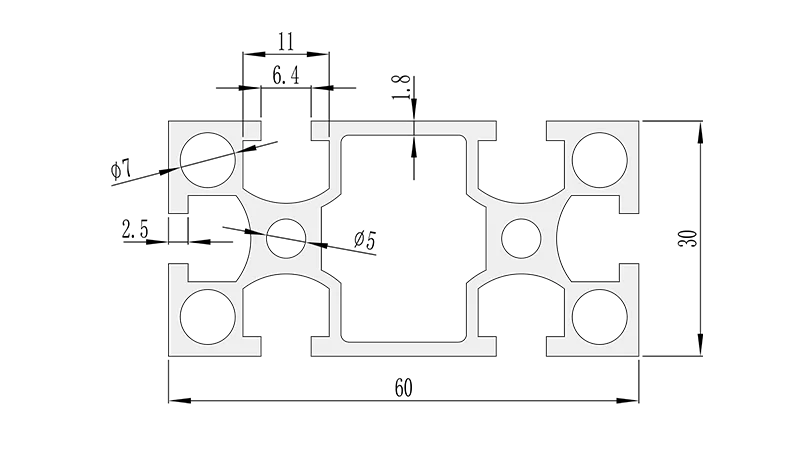
Let's start with the basics. 3060 National Standard Profile A is an aluminum extrusion profile, and its name gives away the key details: "3060" refers to its cross-sectional dimensions (30mm in width, 60mm in height), "National Standard" means it's built to consistent, widely recognized specifications across industries, and "A" denotes its specific design variant—think of it as the reliable, all-purpose model in the aluminum profile family. But numbers and codes only tell part of the story. What makes this profile special is its T-slot design—long, parallel grooves running along its length that act like built-in connection points. These slots aren't just for show; they're the reason 3060 Profile A has become a favorite for anyone tired of one-size-fits-all material handling.
Unlike traditional steel pipes or wooden planks, which require welding, drilling, or glue to assemble, 3060 Profile A is designed for flexibility. It's lightweight (aluminum is about a third the weight of steel) but surprisingly strong, thanks to its hollow, reinforced structure. And because it's aluminum, it resists rust and corrosion—no more dealing with flaky paint or rust stains on your warehouse floor. For teams that need equipment that can handle daily bumps, spills, and heavy loads without falling apart, this profile checks a lot of boxes.
Why Turnover Carts Love 3060 Profile A (And Your Team Will Too)
Turnover carts—those workhorses that shuttle parts from assembly lines to storage, or finished products to shipping—need to be two things: tough and adaptable. 3060 Profile A nails both. Let's break down why it's become a go-to for these critical tools.
First: It's light enough to move, but strong enough to trust. Steel carts are durable, sure, but have you ever tried pushing a fully loaded steel cart up a slight incline? It's like dragging a small car. 3060 Profile A flips that script. Aluminum's natural lightness means a typical turnover cart built with this profile weighs 40-50% less than a steel equivalent. That might not sound like much until you're a warehouse worker making 20 trips a day—suddenly, fatigue drops, and productivity climbs. And don't let the weight fool you: 3060 Profile A can handle loads up to 300kg per linear meter, depending on the design. That's more than enough for most parts, boxes, or tools.
Second: It bends (metaphorically) to your needs. The T-slot design is where the magic happens. Want to add a shelf halfway up the cart? Slide a bracket into the slot, tighten a bolt, and done. Need to lower the handle for shorter workers? Adjust the position of the aluminum profile accessories, no welding required. Traditional carts lock you into one design—if your parts get bigger, or your workflow shifts, you're stuck buying a whole new cart. With 3060 Profile A, you can reconfigure the same cart in minutes. One week, it's a flatbed for large components; the next, add side rails and dividers, and it's a cart for small, delicate parts. That adaptability isn't just convenient—it's a cost-saver. Instead of buying five different carts for five tasks, you buy one and tweak it as needed.
Third: It's built to last (without the hassle). Wood rots, steel rusts, plastic cracks—but aluminum? It's practically maintenance-free. Spill some oil on the cart? Wipe it off with a cloth. Leave it out in the rain during loading? No rust, no flaking. Even after years of bumps against walls or heavy use, 3060 Profile A holds its shape. And if a part does wear out—say, a bracket gets bent—you don't need to replace the entire cart. Just swap out that one aluminum profile accessory, and you're back in business. For teams tired of constant repairs or short-lived equipment, this durability is a game-changer.
The Secret Sauce: Accessories That Make 3060 Profile A Shine
A great profile is only as good as the accessories that bring it to life. 3060 National Standard Profile A works hand-in-hand with a range of aluminum profile accessories that turn a simple length of extrusion into a fully functional turnover cart. Let's talk about the unsung heroes here.
Caster wheels: The unsung mobility experts. What good is a lightweight cart if it's hard to move? Caster wheels designed for 3060 Profile A solve that. These aren't your average hardware store casters—they're engineered to lock into the T-slots, ensuring a tight, wobble-free fit. Want to move smoothly across concrete? Go for rubber wheels. Need to stop on a dime? Brake-equipped casters lock both the wheel and swivel, so the cart stays put even on inclines. And since they're easy to swap, you can switch from soft rubber to hard plastic wheels if your floor type changes—no tools required beyond a hex key.
Connectors and brackets: The building blocks of flexibility. Remember that adaptability we talked about? It's all thanks to accessories like 90° aluminum profile connectors, parallel joint brackets, and adjustable shelf supports. These small parts let you build angles, add layers, or adjust heights without cutting or welding. For example, a "material rack b (3 row and 3 floor)" design—common in warehouses for storing multiple part sizes—can be built in an hour with 3060 profiles and a handful of brackets. And if next month you need a 2-row, 4-floor rack? Just loosen a few bolts, reposition the brackets, and you're done. No new materials, no wasted time.
End caps and edge protectors: The finishing touches (that matter). Ever noticed how sharp edges on carts can scratch products or snag gloves? 3060 Profile A's aluminum profile accessories include soft, durable end caps that snap into the T-slots, covering those edges. They come in colors too—yellow for high-visibility areas, grey for a sleek look—so your carts can be both safe and easy to spot in a busy warehouse. Small details, but they add up to fewer damaged parts and happier workers.
From the Factory Floor: Real-World Wins with 3060 Profile A Carts
Let's step out of the specs and into real life. Take a mid-sized electronics manufacturer I worked with last year. Their assembly line was using steel turnover carts that weighed 80kg empty—so heavy that even two workers struggled to push them when loaded. Worse, the carts had fixed shelves, so they could only carry one type of circuit board at a time. When they launched a new product line with larger, bulkier components, they had to buy 10 new steel carts at $500 each. Six months later, another product change meant those carts were obsolete, cluttering up their storage area.
They switched to 3060 National Standard Profile A carts, and the difference was night and day. The new carts weighed just 35kg empty—light enough for one worker to maneuver. Using aluminum profile accessories like adjustable shelves and dividers, they reconfigured the same carts for the new product line in an afternoon. No new carts, no storage headaches. And because the aluminum was lighter, workers reported less shoulder and back strain—absenteeism dropped by 15% in the first quarter. "It's like going from pushing a boulder to rolling a suitcase," one team lead told me. That's the kind of impact flexible material handling can have.
How Does 3060 Profile A Stack Up Against the Competition?
You might be thinking, "Why not just use steel, wood, or plastic?" Let's break it down. The table below compares 3060 National Standard Profile A to common alternatives for turnover carts:
| Feature | 3060 Aluminum Profile A | Traditional Steel | Wood | Plastic |
|---|---|---|---|---|
| Weight (empty cart, ~1m length) | 30-40kg | 70-90kg | 45-60kg | 20-30kg (but low load capacity) |
| Max Load Capacity | 300-400kg | 500+kg (but overkill for most tasks) | 150-200kg (varies by wood type) | 100-150kg (prone to bending) |
| Flexibility (reconfigurability) | High—easily add/remove shelves, adjust heights with accessories | Low—welded joints mean fixed design | Very low—cutting/drilling required for changes | Low—molded design, hard to modify |
| Durability | High—resists rust, dents, and corrosion | High (but rusts without paint; heavy = more wear on floors) | Low—rots, warps, or splinters with moisture | Low—cracks under heavy loads; fades in sunlight |
| Maintenance | Almost none—wipe clean, replace accessories as needed | High—repaint to prevent rust; lubricate wheels frequently | High—sand, seal, or replace damaged boards | Medium—clean with mild soap; avoid harsh chemicals |
| Long-Term Value | High—adaptable to future needs; lasts 10+ years | Medium—lasts long but can't adapt; higher replacement cost | Low—needs replacement every 2-3 years | Low—replacement every 1-2 years with heavy use |
The takeaway? 3060 Profile A hits the sweet spot: light enough to move, strong enough to handle daily loads, flexible enough to adapt, and durable enough to stick around. It's not the cheapest upfront, but when you factor in reusability, low maintenance, and fewer replacements, it pays for itself in a year or two.
Beyond Carts: 3060 Profile A and the Lean System Mindset
Flexible material handling isn't just about carts—it's about aligning with lean principles. Lean systems focus on eliminating waste, and traditional rigid carts are a hidden source of waste: wasted time moving heavy equipment, wasted money on redundant carts, wasted space storing unused ones. 3060 National Standard Profile A fits right into this mindset. By letting you build one cart that does the job of five, it cuts down on excess inventory (of carts, at least). By reducing worker fatigue, it frees up time for more valuable tasks. And by lasting longer, it reduces the waste of replacing short-lived equipment.
Take "just-in-time" (JIT) production, for example. In JIT, you want materials to arrive exactly when they're needed—not before, not after. A rigid cart that can only carry one type of part might mean you're stuck waiting for that cart to be free, slowing down the line. But a 3060 Profile A cart that can be quickly reconfigured to carry different parts? It keeps materials flowing, even when orders or workflows change at the last minute. That's lean material handling in action.
Wrapping Up: Why 3060 Profile A Deserves a Spot in Your Material Handling Toolkit
Material handling might not be the most glamorous part of running a facility, but it's one of the most critical. And in a world where flexibility and efficiency are everything, 3060 National Standard Profile A is more than just a piece of aluminum—it's a tool that empowers your team to work smarter, not harder. Whether you're dealing with turnover trolley and rack systems, workbenches, or even custom material racks, this profile brings together light weight, durability, and adaptability in a way that traditional materials just can't match.
So, the next time you see a worker struggling with a heavy cart, or hear someone sigh about "needing another cart" for a new product, remember: the solution might be simpler than you think. 3060 National Standard Profile A isn't just changing carts—it's changing how teams approach material handling, one T-slot at a time.