- Company Articles
- Industry articles
- Industry standards
- 3060 National Standard Profile A: Material Composition & Aluminum Alloy Properties Explained

3060 National Standard Profile A: Material Composition & Aluminum Alloy Properties Explained
Related Product
3060 National Standard Profile A
Workbench, production line, logistic rack, warehouse rack Industry: Manufacturer workshop, Automobile, Electronic, Assembling, logistic
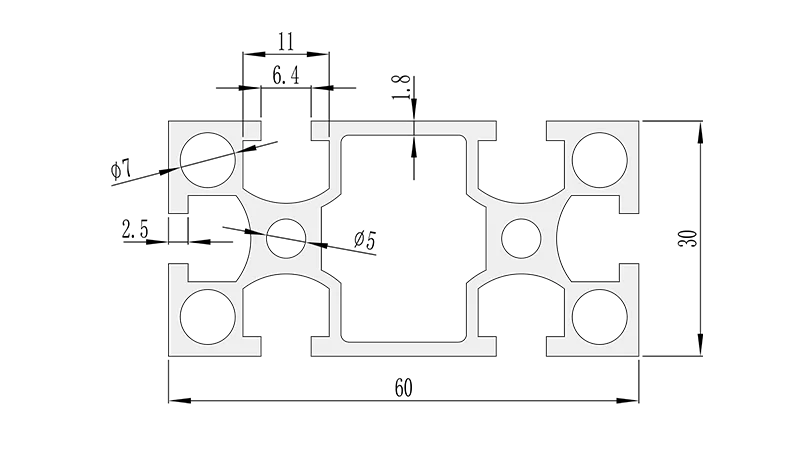
In the world of industrial manufacturing, automation, and workspace design, the choice of materials can make or break efficiency, durability, and adaptability. Among the countless components that keep production lines running smoothly and workshops organized, aluminum profiles stand out as unsung heroes. These versatile structures form the backbone of everything from workbenches to conveyor systems, shelving units to machine frames. Today, we're diving deep into one specific star of this category: the 3060 National Standard Profile A. As a key player in the aluminum extrusion profile family, this profile has earned its reputation for balancing strength, flexibility, and cost-effectiveness. Whether you're a factory manager looking to upgrade your facility, a designer crafting custom workstations, or simply curious about the materials that power modern industry, understanding the 3060 National Standard Profile A—from its material composition to its real-world applications—will give you a new appreciation for the engineering behind everyday industrial solutions.
What Is the 3060 National Standard Profile A?
Before we unpack its composition and properties, let's start with the basics: what exactly is the 3060 National Standard Profile A? In short, it's a type of aluminum extrusion profile—a long, uniform shape created by forcing heated aluminum alloy through a die to achieve a specific cross-sectional design. The "3060" in its name refers to its dimensions: 30 millimeters in width and 60 millimeters in height. The "National Standard" label ensures it adheres to strict domestic manufacturing guidelines, guaranteeing consistency in size, tolerance, and performance across suppliers. The "A" designation typically denotes a specific variation in its cross-sectional geometry, often featuring T-slots along its length. These T-slots are more than just a design quirk; they're the profile's superpower, allowing for easy attachment of accessories like brackets, connectors, and panels without the need for welding or drilling. This makes the 3060 National Standard Profile A infinitely customizable, a trait that has made it a favorite in industries ranging from automotive to electronics, aerospace to logistics.
Unlike generic aluminum bars or tubes, aluminum extrusion profiles like the 3060 National Standard Profile A are engineered with purpose. Their standardized dimensions mean they can be easily integrated with other compatible profiles and aluminum profile accessories, creating modular systems that grow and adapt with your needs. Whether you're building a lightweight but sturdy workbench, a flexible material rack, or a custom machine guard, this profile provides a reliable foundation. Now, let's take a closer look at what's inside this unassuming yet powerful component.
Material Composition: The Alloy Behind the Profile
At its core, the 3060 National Standard Profile A is made from aluminum alloy—a mixture of pure aluminum and carefully selected alloying elements. While pure aluminum is soft and malleable, adding small amounts of other metals transforms it into a material with enhanced strength, durability, and workability. The specific alloy used for the 3060 National Standard Profile A is typically 6063, a widely popular choice for extrusion profiles. Let's break down its composition to understand how each element contributes to the profile's performance.
| Element | Percentage Range | Role in the Alloy |
|---|---|---|
| Aluminum (Al) | 97.3% – 98.3% | Base metal; provides lightweight properties and corrosion resistance. |
| Silicon (Si) | 0.2% – 0.6% | Improves extrudability, allowing the alloy to flow smoothly through dies during manufacturing. Also enhances strength when combined with magnesium. |
| Magnesium (Mg) | 0.45% – 0.9% | Works with silicon to form Mg₂Si precipitates, which strengthen the alloy through heat treatment. Boosts tensile strength and yield strength. |
| Iron (Fe) | ≤ 0.35% | Impurity element; kept low to avoid reducing ductility and corrosion resistance. |
| Copper (Cu) | ≤ 0.1% | Trace amounts may be present but are minimized to prevent reducing corrosion resistance. |
| Manganese (Mn) | ≤ 0.1% | Helps control grain structure during extrusion, improving mechanical properties. |
| Zinc (Zn) | ≤ 0.1% | Trace element with minimal impact on overall properties. |
| Titanium (Ti) | ≤ 0.1% | Refines grain size, enhancing strength and surface finish after extrusion. |
The magic of 6063 alloy lies in its balance. By limiting impurities and carefully calibrating the ratios of silicon and magnesium, manufacturers create an alloy that's easy to extrude into complex shapes (like the 3060 profile's T-slots) while still delivering impressive mechanical properties. This composition also makes post-extrusion treatments like anodizing highly effective, allowing the profile to develop a durable, corrosion-resistant surface layer. For the 3060 National Standard Profile A, this means it can withstand the wear and tear of daily industrial use—from heavy tool placement on a workbench to exposure to oils and coolants in a factory setting—without compromising its structural integrity.
Aluminum Alloy Properties: Why 6063 Stands Out
The 3060 National Standard Profile A's performance isn't just a result of its shape; it's deeply tied to the properties of its 6063 aluminum alloy. Let's explore the key characteristics that make this combination so effective in industrial applications:
Mechanical Strength: Sturdy Without the Weight
One of the most critical properties of any structural material is its mechanical strength—the ability to withstand forces without deforming or breaking. The 6063 alloy in the 3060 profile offers a impressive balance here:
- Tensile Strength: Typically ranges from 180 to 240 MPa (megapascals). For context, this means a 3060 profile can handle a pulling force of 180–240 Newtons per square millimeter before breaking. To put that in practical terms, a 1-meter length of 3060 profile can support hundreds of kilograms when properly mounted, making it ideal for heavy-duty workbenches or material racks.
- Yield Strength: Around 110–180 MPa. This is the point at which the material starts to deform permanently. A higher yield strength means the profile can absorb impacts (like tools being dropped on a workbench) without bending out of shape.
- Elongation: 8–12%. Elongation measures how much the material can stretch before breaking. This ductility is crucial for extrusion, as the alloy needs to flow through the die without cracking, and it also helps the profile withstand sudden loads in real-world use.
What's truly remarkable is that the 3060 profile achieves this strength while remaining lightweight. Aluminum has a density of about 2.7 g/cm³, roughly one-third that of steel. This makes structures built with 3060 profiles easier to move, install, and reconfigure—no small advantage in dynamic work environments where layouts change frequently.
Corrosion Resistance: Built to Last
Industrial settings are harsh. From humidity in warehouses to chemical spills in factories, materials need to stand up to corrosion. The 6063 alloy excels here thanks to its high-purity aluminum base and minimal copper content (copper can reduce corrosion resistance in some alloys). When exposed to air, aluminum naturally forms a thin, protective oxide layer that prevents further oxidation. For added protection, 3060 profiles are often anodized—a process that thickens this oxide layer, giving the surface a hard, scratch-resistant, and corrosion-resistant finish. This makes the profile suitable for use in damp environments, such as food processing facilities, or areas with frequent cleaning, like electronics assembly lines.
Thermal Conductivity: Keeping Things Cool
Aluminum is an excellent thermal conductor, and 6063 alloy is no exception. With a thermal conductivity of around 201 W/(m·K) (watts per meter-kelvin), the 3060 profile can efficiently dissipate heat. This property is particularly valuable in applications where heat management is critical, such as mounting electronic components or creating frames for machinery that generates heat. For example, in a workbench used for soldering or 3D printing, a 3060 profile frame can help prevent heat buildup, protecting sensitive equipment and improving worker comfort.
Machinability and Customization
While the 3060 National Standard Profile A is extruded into a standard shape, its alloy composition makes it easy to modify post-production. Whether you need to drill holes, cut it to length, or tap threads for fasteners, the 6063 alloy responds well to machining. This flexibility is enhanced by the profile's T-slots, which allow for quick attachment of aluminum profile accessories without permanent modifications. Want to add a shelf to your workbench? Slide a bracket into the T-slot and secure it with a bolt. Need to mount a tool holder? Use a T-nut to fasten it in place. This level of customization is a big reason why the 3060 profile is a staple in lean manufacturing systems, where adaptability equals efficiency.
From Billet to Profile: The Extrusion Process
To truly appreciate the 3060 National Standard Profile A, it helps to understand how it's made. The aluminum extrusion process is a marvel of engineering, turning raw aluminum billets into the precise, uniform profiles we rely on. Here's a step-by-step look at how your 3060 profile goes from ore to finished product:
1. Billet Preparation
The process starts with aluminum billets—cylindrical blocks of 6063 alloy. These billets are heated to around 480–520°C (900–970°F), a temperature that softens the alloy without melting it, making it pliable enough for extrusion. The billet is then cleaned to remove any impurities or oxides that could mar the final product.
2. Extrusion: Shaping the Profile
The heated billet is loaded into a hydraulic press, where a ram pushes it through a steel die. The die is precision-machined with the inverse of the 3060 profile's cross-section—including its 30x60mm dimensions and T-slots. As the billet is forced through the die, it takes on the die's shape, emerging as a long, continuous length of 3060 National Standard Profile A. This is where the term "aluminum extrusion profile" comes to life—each meter of profile is a perfect replica of the one before it, thanks to the die's consistency.
3. Cooling and Stretching
As the extruded profile exits the die, it's rapidly cooled with water or air to set its shape. Even with careful cooling, however, the profile may have slight twists or bends. To correct this, it's pulled through a stretcher—a machine that applies tension to straighten the profile and ensure it meets strict straightness tolerances. This step is critical for applications like workbenches, where a warped profile would result in an uneven surface.
4. Heat Treatment (Aging)
To maximize the 6063 alloy's strength, the profile undergoes heat treatment. This typically involves "solution heat treatment"—heating the profile to around 520°C to dissolve alloying elements into the aluminum matrix—followed by quenching (rapid cooling) to trap these elements in a supersaturated state. The profile is then "aged" at room temperature or in a low-heat oven, allowing the elements (like magnesium and silicon) to form small, strengthening precipitates within the aluminum grains. This process, called precipitation hardening, gives the 3060 profile its final mechanical properties.
5. Surface Finishing
Finally, the profile receives its surface finish. As mentioned earlier, anodizing is a common choice, but other options include powder coating (for color customization) or electrophoresis (for a smooth, glossy finish). These treatments not only enhance appearance but also boost corrosion resistance and durability, ensuring the 3060 profile is ready for the rigors of industrial use.
Real-World Applications: Where the 3060 Profile Shines
Numbers and processes are important, but the true test of any material is how it performs in the real world. The 3060 National Standard Profile A has carved out a niche in countless industries, thanks to its unique blend of strength, versatility, and cost-effectiveness. Let's explore some of its most common applications:
Workbench Construction: The Heart of the Workshop
Walk into any modern workshop, factory, or lab, and chances are you'll find a workbench built with aluminum profiles—and the 3060 National Standard Profile A is a top choice for this role. Why? Because it offers the perfect balance of stability and flexibility. A workbench frame made with 3060 profiles can support heavy tools, equipment, and materials without sagging, while the T-slots allow for easy customization. Need a vice mounted on one end? A shelf halfway up? A power strip along the back? All can be added (and removed) with simple aluminum profile accessories. For example, a "Workbench E (single deck-without caster)" (a common configuration) might use 3060 profiles for the legs and frame, paired with a plywood or steel top. The result is a sturdy, level workspace that can adapt as projects change—no need to buy a new workbench every time your needs evolve.
Material Handling and Conveyor Systems
In warehouses and production lines, moving materials efficiently is key. The 3060 profile plays a vital role here, often used to build frames for conveyor systems, roller tracks, and material racks. Its strength supports the weight of boxes, components, or raw materials, while its lightweight nature keeps the overall system easy to install and maintain. For example, aluminum guide rail A—another component in the material handling toolkit—can be mounted to 3060 profiles to create smooth tracks for sliding bins or carts. The T-slots make it simple to adjust the rail's position, ensuring the system works with different-sized items.
Automation and Machine Frames
Automated machinery requires rigid, precise frames to keep moving parts aligned. The 3060 National Standard Profile A fits the bill, offering the dimensional accuracy and stability needed for robotic arms, assembly stations, and testing equipment. Its thermal conductivity also helps dissipate heat from motors and electronics, preventing overheating during long production runs. And because the profile is easy to modify, manufacturers can prototype and refine machine designs quickly, reducing time to market.
Shelving and Storage Solutions
Gone are the days of one-size-fits-all shelving. Today's warehouses and workshops demand storage that can grow and change with inventory. The 3060 profile excels here, used to build adjustable shelving units and racks. By combining 3060 vertical posts with horizontal cross members (often 2040 or 3030 profiles), you can create shelves that are strong enough for heavy parts but easy to reposition. Add aluminum profile accessories like end caps to protect against sharp edges, and you have a storage system that's both functional and safe.
Aluminum Profile Accessories: The Perfect Partners
A profile is only as good as the accessories that bring it to life. The 3060 National Standard Profile A's T-slots are designed to work seamlessly with a range of aluminum profile accessories, each adding a new layer of functionality. Let's highlight some of the most essential ones:
Connectors and Brackets
Connectors are the glue that holds profile structures together. For 3060 profiles, common options include corner brackets, T-connectors, and 90° aluminum profile connectors. These accessories slide into the T-slots and are secured with bolts, creating strong, rigid joints without welding. For example, a 90° connector joins two 3060 profiles at a right angle, forming the corner of a workbench or shelf.
End Caps and Covers
Extruded profiles have open ends, which can be sharp or collect dust. End caps—like the 3060 aluminum profile end cap—snap or bolt onto the ends of the profile, protecting workers from cuts and keeping debris out. T-slot rubber seal covers are another useful accessory, filling in the T-slots to prevent dirt buildup and give the profile a cleaner, finished look.
Fasteners and T-Nuts
To attach accessories to the T-slots, you'll need T-nuts, bolts, and washers. T-nuts slide into the T-slot and rotate to lock in place, providing a secure mounting point for everything from shelves to tool holders. These fasteners are reusable, making it easy to reconfigure your setup as needed.
Wheels and Casters
For mobile structures like workbenches or material carts, casters are a must. The 3060 profile can support caster mounting plates, allowing you to add wheels for easy mobility. Whether you need swivel casters for maneuverability or locking casters for stability when in use, there's an accessory to fit.
Together, these accessories transform the 3060 National Standard Profile A from a simple extrusion into a building block for endless industrial solutions. The key is compatibility: because the profile adheres to national standards, accessories from different suppliers work together seamlessly, giving you the freedom to mix and match based on your needs and budget.
3060 vs. Other Profiles: When to Choose 3060?
With so many aluminum profiles available—like the 2040 National Standard Profile, 4040 profiles, or even larger 4080 profiles—why opt for the 3060 National Standard Profile A? The answer lies in its balance of size, strength, and versatility. Let's compare it to a few common alternatives:
3060 vs. 2040 National Standard Profile
The 2040 profile (20mm x 40mm) is smaller and lighter than the 3060. It's great for lightweight applications like small shelving, prototype frames, or DIY projects. However, it lacks the load-bearing capacity of the 3060. If you're building a workbench or material rack that needs to support heavy items, the 3060 is the better choice.
3060 vs. 4040 Profile
The 4040 profile (40mm x 40mm) is square and slightly larger than the 3060. It offers similar strength but with a more symmetrical design, which can be advantageous for frames that need equal load distribution in both directions. However, the 3060's rectangular shape (30x60mm) makes it better for applications where height is more important than width—like workbench legs or vertical supports in shelving.
3060 vs. Steel Profiles
Steel profiles are stronger than aluminum, but they're also heavier, more expensive, and prone to rust. The 3060 aluminum profile sacrifices some absolute strength for significantly lower weight and better corrosion resistance. For most industrial applications where weight and adaptability matter, the 3060 offers a better overall value.
In short, the 3060 National Standard Profile A shines in mid-weight, medium-strength applications where customization and versatility are key. It's not the lightest or the strongest, but it's the "just right" option for countless industrial needs.
Conclusion: The 3060 Profile—A Foundation for Industrial Innovation
From its carefully calibrated 6063 aluminum alloy composition to its precise extrusion process, the 3060 National Standard Profile A is more than just a piece of metal. It's a testament to the power of engineering simplicity—taking a basic material and shaping it into a tool that drives efficiency, adaptability, and progress in industrial settings. Whether it's forming the frame of a workbench where new products are designed, supporting a conveyor system that moves goods across a warehouse, or providing the backbone for an automated assembly line, this profile plays a quiet but critical role in keeping modern industry running.
What makes the 3060 National Standard Profile A truly special is its accessibility. It's not reserved for large corporations with unlimited budgets; small workshops, startups, and hobbyists can all benefit from its versatility. With a few lengths of profile, some aluminum profile accessories, and a little creativity, anyone can build custom solutions tailored to their unique needs. In a world where efficiency and flexibility are more important than ever, the 3060 profile is more than a component—it's a partner in innovation.
So the next time you walk through a factory, use a workbench, or see a conveyor system in action, take a moment to look for those familiar T-slots and 30x60mm dimensions. Chances are, you'll be looking at the 3060 National Standard Profile A—proof that great things often come in unassuming packages.