- Company Articles
- Industry articles
- Industry standards
- 3060 vs 3030 National Standard Profile A: Which is Better for Light-Duty Workbenches?

3060 vs 3030 National Standard Profile A: Which is Better for Light-Duty Workbenches?
Related Product
3030 National Standard Profile A
Workbench, production line, logistic rack, warehouse rack Industry: Manufacturer workshop, Automobile, Electronic, Assembling, logistic
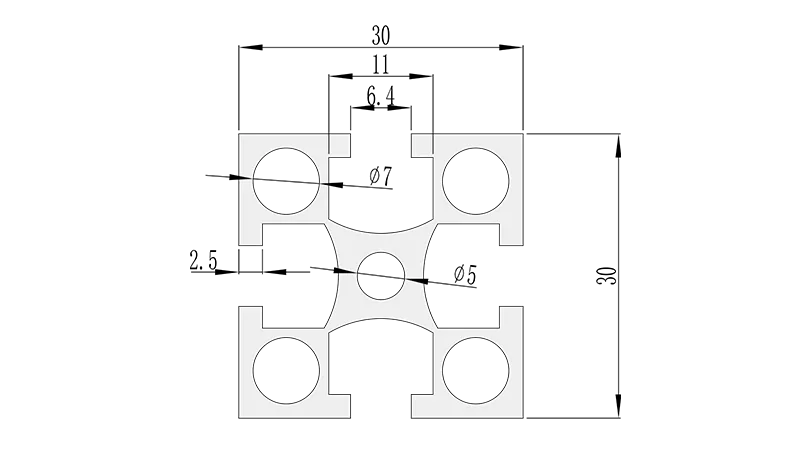
Walk into any modern workshop, electronics lab, or small-scale production facility, and you'll likely spot a common workhorse: the light-duty workbench. These sturdy, versatile surfaces are where ideas take shape, components get assembled, and tasks from soldering tiny circuit boards to packing delicate parts get done. But what makes a great light-duty workbench? Beyond the surface material or the presence of drawers, the backbone of its strength and functionality often lies in something you might not immediately notice: the aluminum extrusion profile that forms its frame.
Aluminum extrusion profiles have revolutionized how workbenches are built. Unlike traditional wooden frames or heavy steel structures, they offer a perfect blend of strength, lightweight design, and adaptability. And when it comes to national standard profiles, two names often pop up in conversations about light-duty workbenches: the 3030 National Standard Profile A and the 3060 National Standard Profile A . If you're in the market for a workbench—whether you're setting up a home garage, a startup's assembly line, or a school lab—you've probably asked: Which one should I choose? Is the slimmer 3030 enough, or is the wider 3060 worth the extra cost and space?
In this article, we're diving deep into this debate. We'll break down what these profiles are, how they perform in real-world light-duty scenarios, and which one might be the better fit for your specific needs. By the end, you'll have a clear picture of whether the 3030 or 3060 deserves a spot as the backbone of your next workbench.
Understanding Aluminum Extrusion Profiles: The Basics
Before we jump into the 3030 vs. 3060 showdown, let's make sure we're on the same page about what aluminum extrusion profiles are and why they matter. Aluminum extrusion is a manufacturing process where raw aluminum is heated and pushed through a die to create long, uniform shapes with specific cross-sections. Think of it like squeezing toothpaste through a tube—except the result is a strong, lightweight, and highly customizable building block.
National standard profiles, like the 3030 and 3060, are designed to meet strict industry specifications for dimensions, material quality, and performance. This standardization is a game-changer: it means parts from different suppliers are interchangeable, assembly is straightforward, and you can easily source replacements or upgrades down the line. For workbenches, these profiles form the legs, frames, and supports that hold everything together—so their design directly impacts how sturdy, flexible, and long-lasting your workbench will be.
Now, let's decode those numbers: "3030" and "3060." The first two digits represent the width of the profile in millimeters, and the last two represent the height. So, a 3030 profile is 30mm wide and 30mm tall (a square), while a 3060 is 30mm wide and 60mm tall (a rectangle). That seemingly small difference in height might not look like much on paper, but in practice, it can change everything from how much weight the workbench can hold to how many accessories you can attach.
Deep Dive: 3030 National Standard Profile A
Let's start with the 3030 National Standard Profile A—the "smaller sibling" in this comparison. At 30x30mm, it's compact, lightweight, and has long been a favorite for projects where space and maneuverability are priorities. But don't let its size fool you: this profile is no pushover.
Key Specs of 3030 Profile A
Most 3030 National Standard Profile A models have a wall thickness ranging from 1.2mm to 2.0mm (with 1.5mm being a common choice for light-duty applications). They're typically made from 6063-T5 aluminum alloy, a material known for its excellent balance of strength, corrosion resistance, and machinability. This alloy is why your workbench won't rust easily in a humid workshop and can handle the occasional bump or scrape without denting.
One of the standout features of the 3030 profile is its T-slot design. T-slots are the grooves running along the length of the profile, and they're what make aluminum extrusion so versatile. You can slide in nuts, brackets, or accessories like shelves, tool holders, or even small monitors, allowing you to customize your workbench on the fly. In the 3030 Profile A, these T-slots are usually 6mm or 8mm wide—plenty for most light-duty accessories.
Why Choose 3030 for Light-Duty Workbenches?
If you're building a light-duty workbench, the 3030 Profile A has a lot going for it. Let's start with weight . A 3030 profile with a 1.5mm wall thickness weighs roughly 0.8-1.0 kg per meter—light enough that you can assemble the workbench by yourself without needing a second pair of hands. This is a big plus if you're setting up a home workshop or need to move the bench occasionally (say, to rearrange your space for a new project).
Then there's cost . Since it uses less aluminum than the 3060, the 3030 is generally more budget-friendly. For small businesses or hobbyists watching their pennies, this can be a deciding factor. You get a sturdy frame without overspending on material you don't need.
Another advantage is space efficiency . The 30x30mm cross-section takes up less room, making it ideal for tight workshops or workbenches that need to fit into corners. If your workbench is against a wall or sandwiched between other equipment, the slimmer profile won't stick out awkwardly or waste valuable floor space.
Let's talk about real-world use cases. Imagine you're a jewelry maker: your workbench needs to hold small tools, a magnifying lamp, and trays of beads or gemstones. The total weight on the surface might be 20-30 kg at most. A 3030 frame would handle this with ease. Or maybe you're a electronics hobbyist building Arduino projects—your bench holds a soldering iron, a few circuit boards, and a laptop. Again, the 3030's load capacity (typically around 50-80 kg per linear meter for light-duty setups) is more than enough.
Limitations to Keep in Mind
Of course, no profile is perfect, and the 3030 has its limits. The most obvious is load capacity . While it's great for light tasks, if you plan to place heavy equipment on your workbench—like a large 3D printer, a metalworking vice, or stacks of heavy toolboxes—the 3030 might start to flex or wobble over time. Its smaller cross-section simply can't distribute weight as effectively as a wider profile.
T-slot space is another consideration. The 3030's T-slots are functional, but they're not as deep or wide as those on the 3060. This means you might struggle to attach bulkier accessories, like heavy-duty cable management systems or large monitor arms. If your workbench needs to support multiple heavy tools or custom add-ons, the 3030 could feel restrictive.
Deep Dive: 3060 National Standard Profile A
Now, let's turn to the 3060 National Standard Profile A. At 30mm wide and 60mm tall, it's the "wider sibling" with a rectangular cross-section. This extra height gives it a few key advantages that might make it worth considering, even for light-duty workbenches.
Key Specs of 3060 Profile A
Like the 3030, the 3060 Profile A is typically made from 6063-T5 aluminum alloy, ensuring strength and corrosion resistance. Wall thicknesses range from 1.5mm to 2.5mm, with 2.0mm being common for applications where a bit more durability is needed. Thanks to its larger size, it weighs in at around 1.2-1.5 kg per meter—heavier than the 3030, but still manageable for most DIY assembly projects.
The T-slots on the 3060 are where things get interesting. With its taller profile, there's more room for deeper, wider T-slots—often 8mm or 10mm. This might not sound like a big difference, but it opens up a world of accessory options. You can fit larger nuts, heavier brackets, or even multiple accessories along the same slot without overcrowding.
Why Choose 3060 for Light-Duty Workbenches?
At first glance, you might think: "If it's light-duty, why go bigger?" But the 3060 has some compelling benefits that make it a strong contender, even for tasks that don't require maximum load capacity.
The biggest draw is stability . The 3060's taller cross-section gives it better resistance to bending and twisting. Even if you're not loading it up with heavy gear, this stability translates to a workbench that feels solid under your hands. No more wobbly surfaces when you're trying to make precise cuts or solder tiny components. For tasks that demand steady hands—like medical device assembly or watch repair—this can be a game-changer.
Future-proofing is another big reason to consider the 3060. Maybe today, you only need a light-duty bench, but what if your needs grow? Suppose you start a small business and suddenly need to add a heavier tool or expand the workbench's surface area. The 3060's higher load capacity (often 80-120 kg per linear meter) gives you room to grow without rebuilding the entire frame. It's like buying a slightly bigger shirt—you might not need the extra space now, but you'll be glad it's there later.
Then there's accessory flexibility . The larger T-slots mean you can attach almost any accessory designed for aluminum profiles. Want to add a power strip holder, a shelf for bulky tool cases, or a fold-down writing surface? The 3060 can handle it. This flexibility is especially valuable if your workbench needs to adapt to different tasks—say, one day you're assembling small parts, and the next you're packing orders in boxes. The 3060's frame won't limit your creativity.
Let's look at a real example: a small electronics assembly line. The workbench needs to hold a soldering station, a small parts feeder, and a computer monitor for work instructions. The total weight might be 40-50 kg, which the 3030 could handle—but the 3060 would do it with less flex, making the workspace feel more professional and reliable. Employees would notice the difference in stability, which can boost confidence and productivity.
Limitations to Keep in Mind
The 3060 isn't without downsides, especially for strictly light-duty use. The first is cost . It uses more aluminum, so it's pricier than the 3030. If you're on a tight budget and don't need the extra stability or accessory space, this could be a waste of money.
It's also heavier . While 1.2-1.5 kg per meter isn't back-breaking, it adds up when you're assembling a full workbench (which might use 6-8 meters of profile). You'll likely need help moving the frame into place, and if you ever need to relocate the bench, it'll be more of a hassle.
Finally, space . The 30x60mm profile takes up more room, which can be a problem in tiny workshops. If your space is limited, the 3060 might make the area feel cramped, or you might have to sacrifice storage space to fit it in.
3030 vs. 3060: Head-to-Head Comparison
To make this decision easier, let's put the 3030 and 3060 side by side in a table. We'll compare key factors that matter most for light-duty workbenches:
| Feature | 3030 National Standard Profile A | 3060 National Standard Profile A |
|---|---|---|
| Dimensions | 30mm (width) x 30mm (height) | 30mm (width) x 60mm (height) |
| Weight per Meter (1.5mm wall) | ~0.8-1.0 kg | ~1.2-1.5 kg |
| Typical Load Capacity (Light-Duty) | 50-80 kg per linear meter | 80-120 kg per linear meter |
| T-Slot Size | 6-8mm | 8-10mm |
| Cost (per Meter) | Lower (30-40% cheaper than 3060) | Higher (due to more material) |
| Best For | Small workspaces, tight budgets, light tasks (≤50 kg total load), hobbyists | Stability-focused tasks, future expansion, accessory-heavy setups, semi-light loads (50-80 kg total load) |
| Assembly Ease | Easier (lighter, simpler to maneuver alone) | Slightly harder (heavier, may need help) |
How to Choose: Key Factors for Your Light-Duty Workbench
Now that we've broken down the pros and cons of each profile, how do you decide which one is right for your workbench? Here are the key questions to ask yourself:
1. What's the Maximum Weight You'll Put on the Workbench?
Start with the basics: what will actually sit on your workbench? List out all the items—tools, equipment, materials—and estimate their total weight. If the total is under 50 kg, the 3030 is probably sufficient. If it's between 50-80 kg, or if you think you might add heavier items later, the 3060 is a safer bet. Remember: it's better to overestimate than to have a wobbly bench!
2. How Much Space Do You Have?
Measure your workshop or lab space carefully. If you're working in a closet-sized area, the 3030's slimmer profile will be easier to fit. If you have room to spare, the 3060's stability might be worth the extra space. Also, consider how the bench will be positioned: against a wall, in the middle of the room, or between other equipment. A 3060 bench in a tight corner might be more trouble than it's worth.
3. What Accessories Do You Need?
Make a list of accessories you can't live without. Do you need a simple shelf and a tool hook, or do you want a monitor arm, cable management tray, and a fold-out work surface? If you're sticking to basic accessories, the 3030's T-slots will work. For bulkier or multiple accessories, the 3060's larger slots are better. Pro tip: Check the specs of your favorite accessories—most will list the minimum T-slot size they require.
4. What's Your Budget?
Be honest about how much you can spend. The 3030 is cheaper upfront, which matters if you're on a tight budget. But if you can afford the extra cost, the 3060 might save you money in the long run by avoiding the need to upgrade later. Think of it as an investment: a slightly higher cost now for more flexibility down the line.
5. Will You Ever Need to Move the Workbench?
If you plan to rearrange your space frequently or take the bench to events (like maker fairs), the 3030's lighter weight is a huge advantage. The 3060 is doable but will require more effort (or help) to move. If the bench will stay in one spot forever, weight is less of a concern.
Real-World Stories: When to Pick 3030 vs. 3060
Sometimes, hearing real examples helps clarify things. Let's look at two hypothetical (but realistic) scenarios:
Scenario 1: The Hobbyist's Home Workshop
Meet Alex, a hobbyist woodworker who's setting up a small workshop in his garage. He needs a workbench for assembling small wooden projects (like jewelry boxes and picture frames), storing hand tools, and occasionally using a small benchtop sander. His total load is around 30 kg, and his garage space is limited (he also parks his car there). He wants to keep costs low and plans to move the bench out of the way when he's not using it.
For Alex, the 3030 Profile A is the clear choice. It's lightweight enough to move alone, fits in his tight space, and costs less than the 3060. The sander and hand tools don't require extra stability, and his accessory needs are simple (a shelf, a few tool hooks). The 3030 gives him everything he needs without overcomplicating things.
Scenario 2: The Startup's Assembly Station
Now meet Priya, who's starting a small business assembling custom phone cases. She needs a workbench for her team of two to use. The bench will hold a heat press (25 kg), a laptop (2 kg), trays of materials (15 kg), and a monitor arm for work instructions. She also wants to add a cable management system and a fold-down packing shelf. Her workshop has plenty of space, and she expects to expand to 4-5 employees in the next year.
For Priya, the 3060 Profile A makes sense. The total load (around 42 kg) is under the 3060's capacity, but more importantly, she needs stability for the heat press and flexibility for the monitor arm and packing shelf. As her team grows, she can add more accessories or even extend the bench. The 3060 future-proofs her setup, so she won't need to buy a new frame when business picks up.
Aluminum Profile Accessories: The Cherry on Top
No workbench is complete without accessories, and both the 3030 and 3060 work with a wide range of aluminum profile accessories. From brackets and hinges to feet and casters, these add-ons turn a basic frame into a fully functional workspace. Let's highlight a few must-haves:
- Adjustable Feet: These screw into the bottom of the profile to level the bench on uneven floors—critical for stability. Both 3030 and 3060 work with standard feet, but the 3060 can handle heavier-duty options if needed.
- Casters: Want to make your bench mobile? Add casters (wheels) to the feet. The 3030's lighter weight makes casters more effective here—you'll be able to roll the bench around easily.
- Shelf Brackets: Attach these to T-slots to add shelves for storage. The 3060's larger T-slots can support wider, heavier shelves without bending.
- Tool Hooks and Holders: Keep tools within reach with hooks for hammers, screwdrivers, or cable ties. Both profiles work, but the 3060 can fit more hooks per slot.
- Panel Mounts: Use these to attach a wooden or metal work surface to the frame. Both profiles support panel mounts, but the 3060's extra height can make the bench more rigid (less sagging in the middle).
Remember: accessories are where the 3060's T-slot advantage really shines. If you want to get creative with your setup, the extra space in the 3060's slots makes it easier to mix and match accessories without limitations.
Conclusion: Which Profile is Right for You?
At the end of the day, there's no "one size fits all" answer. Both the 3030 and 3060 National Standard Profile A are excellent choices for light-duty workbenches—they just excel in different scenarios.
Choose the
3030
if:
• Your total load is under 50 kg.
• You're short on space or need a lightweight, movable bench.
• You're on a tight budget and don't need fancy accessories.
• Your needs are simple and unlikely to change.
Choose the
3060
if:
• Your load is 50-80 kg, or you might add heavier items later.
• Stability and accessory flexibility are top priorities.
• You have the space and budget for a slightly larger, heavier frame.
• You want to future-proof your setup.
Whichever you choose, you can't go wrong—both profiles are built to last and will serve you well in light-duty applications. The key is to be honest about your current needs and future goals. And remember: aluminum extrusion profiles are designed to be modular, so even if you start with one, you can always expand or modify your workbench later. Happy building!