- Company Articles
- Industry articles
- Industry News
- 3C Industry Trends: Why Aluminum Workbench A is Gaining Popularity

3C Industry Trends: Why Aluminum Workbench A is Gaining Popularity
Related Product
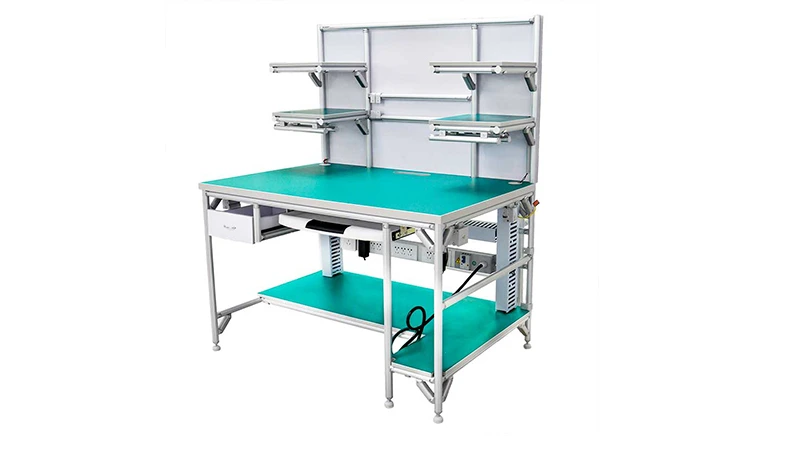
Aluminum Workbench A
Aluminum tube workbench is more flexible and durable, compared with traditional PE/ABS coated steel tube. It is easy to assemble, anti corrosion, rust protection, and recycle use after disassemble.
The 3C industry—encompassing consumer electronics, communication devices, and computers—is a powerhouse of innovation, driving global technological advancement at a breakneck pace. From sleek smartphones with foldable screens to ultra-lightweight laptops and wearable health monitors, the demand for smarter, smaller, and more powerful devices has never been higher. But behind every cutting-edge gadget lies a manufacturing floor grappling with a critical challenge: how to keep up with rapid product cycles, ensure precision assembly, and maintain the highest standards of quality—all while staying agile enough to adapt to shifting consumer demands.
For decades, traditional workbenches have been the backbone of 3C production lines. Heavy steel tables, bulky wooden stations, or rigid plastic setups were the norm, but they've increasingly become a bottleneck. These workbenches are often immovable, difficult to reconfigure, and ill-equipped to handle the industry's unique needs—like electrostatic discharge (ESD) protection for sensitive microchips or modularity for frequent line changes. Enter the Aluminum Workbench A : a modern solution built with aluminum extrusion profiles that's rapidly transforming how 3C manufacturers operate. In this article, we'll explore why this workstation has become the go-to choice for forward-thinking factories, and how its design aligns with the industry's most pressing trends.
What is Aluminum Workbench A?
At its core, Aluminum Workbench A is a modular workstation engineered specifically for the demands of 3C manufacturing. Unlike one-size-fits-all traditional workbenches, it's constructed using lightweight yet durable aluminum extrusion profiles—hollow, T-slot aluminum beams that serve as the "building blocks" of the system. These profiles are paired with a range of accessories, including joints, brackets, ESD-safe mats, and optional casters, to create a fully customizable workspace. While some models (like the "Workbench E" variant) come with a single deck and no casters for fixed assembly lines, Aluminum Workbench A often prioritizes flexibility, allowing teams to add mobility, shelves, tool holders, or storage as needed.
What sets it apart is its modularity. Think of it as a "Lego set" for manufacturing: using simple hand tools, operators can reconfigure the bench's height, add side extensions, or attach new accessories in minutes—no welding, drilling, or heavy lifting required. This adaptability is a game-changer in 3C production, where a single assembly line might switch from assembling smartwatch components in the morning to testing tablet circuit boards in the afternoon.
Key Features Driving Aluminum Workbench A's Rise in 3C Factories
To understand why Aluminum Workbench A is gaining traction, let's break down its most impactful features and how they address the 3C industry's unique pain points.
1. Aluminum Extrusion Profiles: The Foundation of Strength and Flexibility
At the heart of Aluminum Workbench A are aluminum extrusion profiles —typically made from 6063-T5 aluminum alloy, a material prized for its exceptional strength-to-weight ratio. This alloy is lightweight (about 1/3 the weight of steel) but remarkably rigid, capable of supporting heavy equipment like soldering stations, testing rigs, or batches of components without bending or warping. For 3C manufacturers, this means workbenches that are easy to move (when equipped with casters) but stable enough for precision tasks like microchip placement or screen alignment.
The profiles' T-slot design is another stroke of genius. These slots—running the length of the aluminum beams—allow accessories to be attached quickly using bolts, nuts, or specially designed brackets. Need a shelf for tools? Slide a bracket into the T-slot and tighten a screw. Want to add a cable management tray? Clip it on in seconds. This eliminates the need for custom fabrication or permanent modifications, making it simple to adapt the workstation to new tasks. Compare this to a traditional steel workbench, where adding a shelf would require drilling holes or welding—time-consuming and irreversible.
Aluminum's natural resistance to corrosion is also a boon in 3C environments, where cleaning agents and humidity control systems are common. Unlike steel, which can rust over time, or wood, which absorbs moisture and warps, aluminum profiles maintain their integrity for years, reducing replacement costs and downtime.
2. ESD Protection: Safeguarding Sensitive Electronics
In the 3C industry, electrostatic discharge (ESD) is a silent killer. A single static spark—often imperceptible to humans—can damage or destroy microchips, circuit boards, or sensors, leading to costly defects, product returns, or even safety hazards. Traditional workbenches, especially those made of plastic or untreated wood, offer little to no ESD protection, putting components at risk the moment they touch the surface.
Aluminum Workbench A, by contrast, is designed with ESD safety in mind. Many models integrate ESD-compliant mats (made from conductive rubber or vinyl) that dissipate static charges, along with grounding points that connect the workstation to the facility's electrical ground. The aluminum frame itself can also be grounded, creating a continuous path for static to flow away from sensitive components. For manufacturers operating ESD workstations —critical for assembling smartphones, laptops, or IoT devices—this integration is non-negotiable. It ensures compliance with industry standards like ANSI/ESD S20.20, reducing the risk of expensive production errors.
3. Lean System Compatibility: Streamlining Workflows for Efficiency
The 3C industry thrives on lean manufacturing principles—eliminating waste, optimizing workflows, and maximizing productivity. Traditional workbenches, with their fixed layouts and heavy construction, often hinder these goals. A steel table that takes four people to move, for example, makes it impossible to rearrange the production line for a new product launch without halting operations for hours.
Aluminum Workbench A, however, is a lean system enabler. Its lightweight design and modular components make it easy to reconfigure production lines in line with 5S methodology (Sort, Set in Order, Shine, Standardize, Sustain). Need to create a U-shaped assembly cell to reduce worker movement? Disassemble the benches, move them into place, and reassemble—all in under an hour. Want to add a flow rack for component storage next to the workstation? Attach it directly to the aluminum profile using T-slot brackets. This agility reduces downtime, minimizes motion waste, and allows teams to adapt quickly to changes in demand or product design.
Many manufacturers also pair Aluminum Workbench A with roller tracks or conveyor systems (common in 3C lines for moving components between stations). The workbench's modularity ensures seamless integration: roller track connectors can be slotted into the T-slot profiles, creating a smooth material flow from one workstation to the next—no gaps, no misalignments, just efficient production.
4. Ergonomics: Prioritizing Worker Wellbeing
3C assembly lines are often high-pressure environments, with workers spending hours hunched over small components, performing repetitive tasks. Poor ergonomics can lead to fatigue, reduced productivity, and even long-term injuries like carpal tunnel syndrome. Traditional workbenches, with fixed heights and rigid layouts, do little to address this—forcing workers to adapt to the workstation, rather than the other way around.
Aluminum Workbench A puts ergonomics front and center. Many models offer adjustable height (via telescoping aluminum profiles or hydraulic lifts), allowing workers to set the bench to a comfortable level—whether they're standing or sitting. The modular accessories also support better posture: tool holders can be positioned at eye level to reduce reaching, while monitor arms (attached via T-slots) keep screens at a comfortable angle. For 3C manufacturers, this translates to happier, healthier teams and lower turnover—a critical advantage in an industry struggling with labor shortages.

Aluminum Workbench A vs. Traditional Workbenches: A Comparison
To truly appreciate why Aluminum Workbench A is gaining ground, let's compare it to the traditional workbenches still in use in many 3C factories:
| Feature | Aluminum Workbench A | Steel Workbench | Wooden Workbench | Plastic Workbench |
|---|---|---|---|---|
| Weight | Lightweight (easy to move with casters) | Heavy (requires multiple people to move) | Moderate (heavier than aluminum, prone to water damage) | Lightweight (but less stable for heavy loads) |
| Modularity | High (T-slot design allows quick reconfiguration) | Low (permanent welding/drilling required) | Low (difficult to modify without damage) | Low (limited accessory compatibility) |
| ESD Protection | Yes (integrated mats, grounding points) | No (unless specially treated) | No (insulative, can generate static) | No (insulative, high static risk) |
| Durability | High (corrosion-resistant, 10+ year lifespan) | High (prone to rust without coating) | Low (warps, cracks, absorbs moisture) | Moderate (can crack under heavy loads) |
| Lean System Compatibility | Excellent (supports 5S, quick line reconfiguration) | Poor (rigid, slows workflow changes) | Poor (immovable, difficult to clean) | Fair (lightweight but limited adaptability) |
The table tells a clear story: Aluminum Workbench A outperforms traditional options across key metrics critical to 3C manufacturing. Its combination of lightweight design, modularity, ESD safety, and durability makes it a versatile tool for modern production lines.

Real-World Applications: How 3C Manufacturers Are Using Aluminum Workbench A
To understand the impact of Aluminum Workbench A, let's look at how it's being deployed in real 3C manufacturing scenarios:
Smartphone Assembly Lines
A leading smartphone manufacturer recently switched to Aluminum Workbench A for its final assembly line, where workers install batteries, cameras, and screens into device frames. The T-slot profiles allowed the team to attach custom jigs for holding phone casings at precise angles, reducing errors during screen alignment. When the company launched a new model with a larger screen, the workbenches were reconfigured in hours by adding extendable arms—no downtime, no custom tools. ESD mats and grounding points cut static-related defects by 30%, saving the company millions in rework costs.
Laptop Component Testing
A laptop producer uses Aluminum Workbench A in its component testing area, where circuit boards are checked for functionality before assembly. The workbenches are equipped with adjustable-height shelves (attached via T-slots) to hold testing equipment, and cable management trays to keep wires organized. When the company introduced a smaller, more powerful motherboard, the benches were quickly modified to accommodate new testing rigs, avoiding the need to purchase entirely new workstations.
Wearable Device Production
Wearables like fitness trackers and smartwatches require ultra-precise assembly, with components smaller than a grain of rice. A manufacturer in this space uses Aluminum Workbench A with ESD-safe lighting (attached to the T-slot frame) and magnifying glasses to aid workers in placing tiny sensors. The benches' lightweight design allows the team to rearrange the production line daily to prioritize high-demand models, keeping lead times short and customers satisfied.
Choosing the Right Aluminum Workbench A Supplier
As Aluminum Workbench A grows in popularity, so too does the number of suppliers. To ensure you're getting a workstation that meets your 3C manufacturing needs, look for these key qualities in a supplier:
- Customization Support: A good supplier should offer design assistance to tailor the workbench to your specific tasks—whether you need extra shelves, ESD upgrades, or specialized accessories.
- Quality Aluminum Profiles: Verify that the supplier uses high-grade aluminum alloys (like 6063-T5) and offers profiles with precise T-slot dimensions to ensure compatibility with accessories.
- ESD Compliance Testing: Ask for documentation proving ESD protection meets industry standards (e.g., ANSI/ESD S20.20) to avoid liability for component damage.
- Range of Accessories: Look for suppliers that offer a full line of aluminum profile accessories —joints, casters, brackets, ESD mats—to simplify future upgrades.
Future Trends: Aluminum Workbench A in the Age of Smart Manufacturing
The 3C industry is rapidly moving toward smart manufacturing—integrating IoT sensors, AI-driven analytics, and automation to create "lights-out" factories. Aluminum Workbench A is poised to play a central role in this evolution. Here's how:
IoT Integration: Future workbenches could include embedded sensors in the aluminum profiles to monitor temperature, humidity, or vibration—alerting managers to issues like equipment malfunctions or environmental changes that could affect production. T-slot brackets could also house smart tool holders that track inventory levels, automatically reordering screws, tapes, or other consumables when stock runs low.
AI-Driven Layout Optimization: With data from IoT sensors, AI algorithms could suggest optimal workstation layouts to reduce worker movement, minimize bottlenecks, or prioritize high-demand products—all adjustable via the workbench's modular components.
Sustainability: As 3C brands commit to carbon neutrality, aluminum's recyclability will become even more valuable. Suppliers are already exploring profiles made from recycled aluminum, reducing the environmental footprint of workbench production.
Conclusion: Aluminum Workbench A—More Than a Workstation, a Strategic Asset
In the fast-paced world of 3C manufacturing, success hinges on adaptability, precision, and efficiency. Aluminum Workbench A delivers on all three fronts, combining the strength of aluminum extrusion profiles, the safety of ESD protection, and the flexibility of modular design to meet the industry's evolving needs. It's not just a workstation—it's a strategic asset that helps manufacturers stay ahead of the curve, reduce costs, and build better products.
As 3C devices continue to shrink in size and grow in complexity, the demand for workbenches that can keep up will only increase. Aluminum Workbench A, with its proven track record of improving productivity, reducing defects, and supporting lean manufacturing, is poised to remain the gold standard for years to come. For manufacturers looking to thrive in this competitive industry, the choice is clear: it's time to make the switch.