- Company Articles
- Industry articles
- Industry standards
- 4040A vs 4040B EU Standard Aluminum Profile: Structural Differences Explained

4040A vs 4040B EU Standard Aluminum Profile: Structural Differences Explained
Related Product
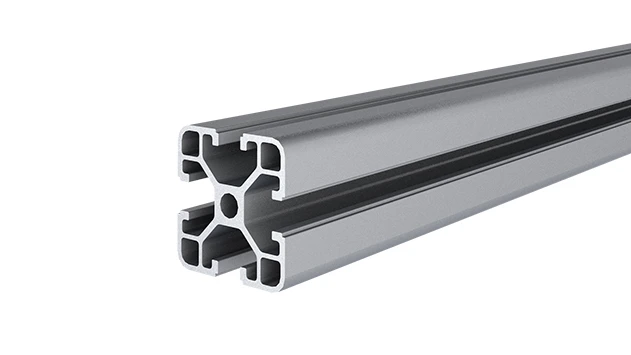
4040B EU Standard Aluminum Profile
4040B is a 4.00x4.00 CM fractional 40 series square extrusion T-slot profile with four open T-slots, each side with 4.00cm face. The profile has align-a-grooves to assist in aligning connecting profiles.
Walk into any modern manufacturing facility, warehouse, or workshop, and you'll likely spot a silent workhorse holding everything together: the aluminum profile. These unassuming yet versatile structures form the backbone of assembly lines, workbenches, material racks, and even custom machinery. Among the most widely used are the 4040 series EU standard profiles—specifically, the 4040A and 4040B. At first glance, they might seem identical; after all, both boast a 40mm x 40mm outer dimension, a staple size for balancing strength and flexibility. But dig deeper, and you'll uncover critical structural differences that can make or break your project's efficiency, durability, and cost-effectiveness. In this guide, we'll unpack everything you need to know about these two profiles, from their extrusion roots to real-world applications, helping you choose the right one for your next build.
Understanding EU Standard Aluminum Profiles: Why 4040 Series Matters
Before diving into the A vs. B debate, let's ground ourselves in what makes EU standard aluminum profiles so essential. These aren't just any metal bars—they're precision-engineered aluminum extrusion profiles , shaped under high pressure through dies to create consistent, repeatable cross-sections. The EU standards (EN 755) ensure uniformity in dimensions, material quality, and performance, so engineers and manufacturers across Europe (and beyond) can trust that a 4040 profile from one supplier will fit accessories from another. This interoperability is the cornerstone of modular design, a key principle in lean manufacturing systems.
The 4040 series, in particular, strikes a sweet spot. At 40mm by 40mm, it's compact enough for desktop workbenches and small trolleys but robust enough to support heavy machinery and multi-level racks. It's the go-to choice for everything from light-duty assembly stations to mid-weight material handling systems. But within this series, the 4040A and 4040B stand out as the most commonly specified variants—and their differences are far from trivial.
Anatomy of the 4040A: The Lightweight Workhorse
Let's start with the 4040A, often the first choice for projects where weight and cost are priorities. To understand its design, we need to look beyond the outer 40x40mm frame and examine its cross-section—the "blueprint" that dictates how it performs.
Cross-Section Design: Simplicity Meets Functionality
The 4040A features a symmetrical cross-section with four T-slots—one on each side. These slots are the profile's "attachment points," allowing you to secure brackets, panels, and other aluminum profile accessories using T-nuts and bolts without drilling. In the 4040A, each slot typically measures 8mm wide and 10mm deep, with a rounded bottom to accommodate standard T-nut designs. The walls between the slots are relatively thin, usually around 1.5mm to 2mm thick, which keeps the profile lightweight.
But what truly defines the 4040A is its internal structure. Unlike some heavier profiles, it lacks complex reinforcing ribs or thickened corners. Instead, it relies on a simple, open rectangular core with minimal internal bracing. This design makes extrusion faster and cheaper, as the die (the tool used to shape the profile) is less intricate. For applications where the profile isn't bearing extreme loads, this simplicity is an asset: it's easy to cut, drill, and modify on-site, even with basic tools.
Material and Weight: Balancing Strength and Economy
Most 4040A profiles are made from aluminum alloy 6063, a heat-treatable alloy known for its excellent extrudability and moderate strength. After extrusion, the profiles undergo a T5 tempering process (artificial aging at room temperature), which enhances their hardness and tensile strength without making them brittle. The result is a profile that weighs in at around 1.5kg to 1.8kg per meter—light enough to be handled by one person during assembly but strong enough for many common tasks.
This lightweight nature has a ripple effect on costs: lighter profiles are cheaper to ship, easier to install, and require less robust support structures. For small workshops or startups watching their budget, the 4040A often makes sense as a cost-effective solution that doesn't skimp on basic functionality.
Load Capacity: What It Can (and Can't) Handle
Don't let its light weight fool you—the 4040A is no pushover. When used vertically as a support column, it can typically bear static loads of 200kg to 300kg per linear meter, depending on the mounting method and accessory reinforcement. Horizontally, as a beam spanning between supports, its capacity drops to around 50kg to 80kg over a 1-meter span (more if the span is shorter). This makes it ideal for applications like:
- Light-duty workbenches (e.g., electronics assembly stations where tools and components are lightweight)
- Small shelving units for parts storage
- Mobile trolleys for transporting small batches of goods
- Guardrails and machine enclosures (where impact resistance is more critical than heavy load-bearing)
However, push it beyond these limits, and you'll notice deflection (bending) or, in extreme cases, permanent deformation. For example, mounting a heavy power tool like a drill press directly to a 4040A workbench without additional bracing might cause the surface to sag over time—a frustration no manufacturer wants to deal with.

Inside the 4040B: The Heavy-Duty Performer
Now, meet the 4040B—a profile built for projects that demand more muscle. While it shares the same 40x40mm outer dimensions as the 4040A, its internal design is a masterclass in engineering for strength. If the 4040A is a sprinter, the 4040B is a weightlifter.
Cross-Section Design: Reinforced for Rigidity
At first glance, the 4040B's cross-section looks similar to the A variant—four T-slots, one per side. But look closer, and you'll spot key upgrades. The slots themselves are often slightly wider (up to 10mm) and deeper (12mm), allowing for larger, more secure T-nuts and bolts. More importantly, the walls are thicker: typically 2mm to 3mm, with critical areas like the corners reinforced with internal ribs. These ribs act like trusses, distributing stress more evenly across the profile and preventing bending under heavy loads.
Some 4040B models also feature a "double-web" design, where an extra vertical or horizontal wall runs through the center of the profile, dividing the internal space into smaller compartments. This not only boosts rigidity but also increases resistance to torsion (twisting forces)—a common issue in dynamic applications like conveyor systems or robotic arm supports.
Material and Weight: Strength Comes with a Heavier Price Tag
Like the 4040A, the 4040B is usually extruded from alloy 6063, but it often undergoes a more rigorous T6 tempering process (solution heat treatment followed by artificial aging). This results in higher tensile strength (up to 240 MPa compared to the A's 180 MPa) and better fatigue resistance—critical for applications with repeated loading and unloading.
All this strength comes with added weight: the 4040B typically weighs 2.2kg to 2.5kg per meter, a 30-40% increase over the A variant. This extra mass translates to higher material costs and more challenging handling during installation (you'll likely need two people to maneuver longer lengths). But for projects where failure isn't an option, the investment is often worth it.
Load Capacity: Built to Bear More
The 4040B's reinforced design pays off in load capacity. Vertically, it can handle static loads of 400kg to 600kg per linear meter—double that of the 4040A in some cases. Horizontally, over a 1-meter span, it supports 100kg to 150kg with minimal deflection. This makes it the profile of choice for:
- Heavy-duty workbenches for industrial manufacturing (e.g., automotive part assembly)
- Multi-level material racks storing metal components or large batches of goods
- Conveyor systems that transport heavy parts (e.g., engine blocks in automotive plants)
- Machine bases and frames where vibration and stability are critical
I once worked with a client who switched from 4040A to 4040B for their assembly line workbenches after repeated issues with sagging. The A profiles couldn't handle the constant weight of power tools, fixtures, and half-assembled products. Within a month of upgrading to B, the sagging stopped, and the workbenches felt noticeably sturdier—proof that the B variant's extra heft translates to real-world reliability.
Side-by-Side: Key Structural Differences
To truly grasp how these profiles differ, let's put them head-to-head in a detailed comparison. The table below breaks down their structural and performance characteristics, so you can see exactly where the A and B variants diverge.
| Characteristic | 4040A EU Standard Profile | 4040B EU Standard Profile |
|---|---|---|
| Outer Dimensions | 40mm x 40mm | 40mm x 40mm |
| Wall Thickness | 1.5mm – 2mm | 2mm – 3mm |
| T-Slot Dimensions | 8mm width x 10mm depth | 10mm width x 12mm depth (typical) |
| Internal Structure | Simple rectangular core, minimal ribs | Reinforced ribs, thicker corners, sometimes double-web design |
| Weight per Meter | 1.5kg – 1.8kg | 2.2kg – 2.5kg |
| Material Temper | T5 (room temperature aging) | T6 (solution heat treatment + aging) |
| Vertical Static Load Capacity* | 200kg – 300kg/m | 400kg – 600kg/m |
| Horizontal Load Capacity (1m span)* | 50kg – 80kg | 100kg – 150kg |
| Typical Extrusion Cost | Lower (simpler die, less material) | Higher (complex die, more material) |
*Note: Load capacities are approximate and depend on mounting method, accessory reinforcement, and environmental factors (e.g., temperature, vibration).
The T-Slot Difference: Why Size Matters
One of the most overlooked but critical differences is the T-slot design. The 4040B's wider, deeper slots might seem like a minor upgrade, but they have a big impact on usability. A 10mm slot can accommodate larger T-nuts, which distribute clamping force more evenly and reduce the risk of stripping—essential when securing heavy accessories. For example, mounting a workbench top to a 4040B using M8 bolts (common in industrial settings) is far easier than with the 4040A's narrower slots, which often require smaller M6 bolts. This might not matter for light tasks, but for heavy-duty applications, the extra peace of mind is invaluable.
Rigidity: The Hidden Advantage of the 4040B
Rigidity—the profile's resistance to bending or twisting—is another area where the 4040B shines. Thanks to its thicker walls and internal ribs, it has a higher moment of inertia (a measure of resistance to bending) than the 4040A. In practical terms, this means less deflection under load, which is critical for precision applications. Imagine a lean system where parts must align perfectly during assembly: a sagging 4040A beam could throw off tolerances, leading to faulty products. The 4040B's rigidity ensures that the system stays true, even under stress.
Accessories Compatibility: Do They Play Well Together?
One of the biggest perks of EU standard profiles is their compatibility with a wide range of accessories—corner brackets, hinges, casters, and more. But do the 4040A and 4040B play nice with the same aluminum profile accessories ? The short answer: mostly, but with caveats.
Many basic accessories (e.g., angle brackets, end caps) are designed to fit any 40mm profile, regardless of variant. However, accessories that rely on T-slot size or wall thickness may need adjustment. For example:
- T-nuts and bolts: The 4040B's wider slots require larger T-nuts (e.g., M8 vs. M6 for the 4040A). Using 4040A T-nuts in a 4040B slot will result in a loose fit, risking accessory failure.
- Profile connectors: Some heavy-duty connectors clamp around the profile's outer walls. The 4040B's thicker walls may require adjustments to the connector's clamping mechanism to ensure a tight grip.
- Panel mounts: Accessories that attach panels (e.g., polycarbonate guards) often use the T-slots to secure screws. The 4040B's deeper slots allow for longer screws, which can provide a more secure hold for thicker panels.
The good news? Most accessory manufacturers clearly label which profiles their products fit (e.g., "for 40mm profiles with 8mm slots" or "for 40mm profiles with 10mm slots"). A quick check of the product specs will save you from compatibility headaches down the line.
Real-World Applications: When to Choose A vs. B
At this point, you might be wondering: "Which one should I pick for my project?" The answer depends on three factors: load requirements, budget, and application. Let's break down common scenarios to help you decide.
Choose 4040A If…
Your loads are light to moderate. If you're building a workbench for assembling small electronics, a shelving unit for lightweight components, or a mobile cart for office supplies, the 4040A will serve you well without overspending.
Weight is a priority. For applications where the structure itself needs to be moved (e.g., temporary workstations, portable display stands), the 4040A's lighter weight makes handling easier. It also reduces shipping costs—a boon for large projects with tight budgets.
You need flexibility for on-site modifications. The 4040A's thinner walls are easier to cut, drill, or tap with basic tools, making it ideal for custom projects where designs might evolve during assembly.
Choose 4040B If…
Heavy loads or dynamic stress are involved. Industrial workbenches, heavy-duty racks, conveyor systems, or machine frames all demand the 4040B's strength. Remember: it's better to over-engineer than to risk failure and downtime.
Long-term durability is critical. If your structure will be in use 24/7 (e.g., in a high-volume manufacturing plant), the 4040B's thicker walls and reinforced design will stand up to wear and tear better than the 4040A. It's an investment that pays off in fewer replacements and repairs.
Precision alignment is non-negotiable. In lean systems where parts must move smoothly (e.g., roller tracks, linear slides), the 4040B's rigidity ensures that the structure doesn't flex, keeping operations running smoothly.
Cost Considerations: Is the 4040B Worth the Premium?
Let's talk numbers. The 4040B typically costs 20% to 30% more per linear meter than the 4040A, thanks to its extra material and complex extrusion process. For a small project—say, a single workbench using 10 meters of profile—the difference might be just $50 to $100. But for a large-scale system requiring 100 meters or more, that premium adds up quickly.
However, it's essential to consider the total cost of ownership, not just the upfront price. A 4040A system that sags or fails under load will cost more in repairs, downtime, and replacements than the 4040B's initial premium. For example, a manufacturing plant that replaces sagging 4040A racks every two years could save money in the long run by investing in 4040B racks that last five years or more.
As a rule of thumb: if the application involves heavy loads, precision, or continuous use, the 4040B is worth the splurge. For light, occasional use, the 4040A is the smarter budget choice.
Conclusion: Matching the Profile to Your Needs
The 4040A and 4040B EU standard aluminum profiles may share the same outer dimensions, but they're worlds apart in performance. The 4040A is a lightweight, cost-effective solution for light to moderate loads, perfect for small workbenches, shelving, and mobile carts. The 4040B, with its thicker walls, reinforced design, and superior load capacity, is built for heavy-duty applications where strength and rigidity are non-negotiable.
When choosing between them, start by asking: What's the maximum load my structure will bear? How critical is precision and rigidity? What's my long-term budget for maintenance and replacements? By answering these questions, you'll ensure that your project is built on a foundation that can handle whatever you throw at it—whether that's a few small tools or a full-scale lean manufacturing system.
At the end of the day, both profiles are testaments to the versatility of aluminum extrusion profiles in modern industry. They're not just pieces of metal—they're the building blocks of efficiency, innovation, and productivity. Choose wisely, and your structure will serve you well for years to come.