- Company Articles
- Industry articles
- Industry standards
- 4040B EU Standard Aluminum Profile: Material Composition & Manufacturing Process

4040B EU Standard Aluminum Profile: Material Composition & Manufacturing Process
Related Product
4040B EU Standard Aluminum Profile
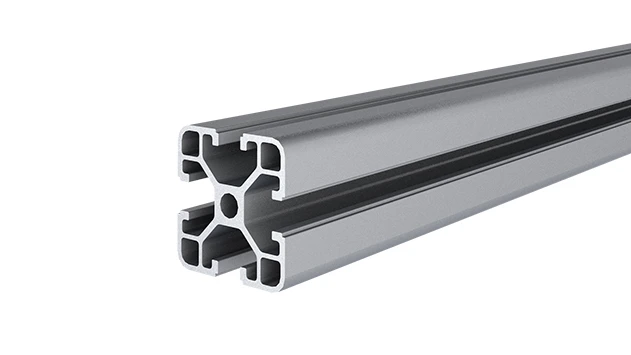
4040B is a 4.00x4.00 CM fractional 40 series square extrusion T-slot profile with four open T-slots, each side with 4.00cm face. The profile has align-a-grooves to assist in aligning connecting profiles.
Walk into any modern factory, warehouse, or workshop, and you'll likely spot the unsung hero of industrial efficiency: aluminum profiles. These sleek, modular structures form the backbone of workbenches, conveyor systems, material racks, and even automated production lines. Among the countless profiles available, the 4040B EU Standard Aluminum Profile stands out as a workhorse—trusted by manufacturers, engineers, and lean system suppliers worldwide for its reliability, versatility, and adherence to strict quality standards. Whether you're assembling a lightweight workbench or designing a high-capacity conveyor, understanding what makes the 4040B tick—from its material makeup to how it's made—can transform how you approach efficiency in your operations.
As a lean system supplier, I've seen firsthand how the right aluminum profile can turn a chaotic production floor into a streamlined, adaptable workspace. The 4040B isn't just a piece of metal; it's a building block for lean principles—minimizing waste, maximizing flexibility, and ensuring every component works in harmony. In this article, we'll dive deep into the 4040B EU Standard Aluminum Profile: what it's made of, how it's manufactured, and why it's become a cornerstone for anyone serious about building efficient, durable systems.
Material Composition: The Recipe for Strength and Versatility
At its core, the 4040B EU Standard Aluminum Profile is a product of careful material science. Think of it as a well-balanced recipe—each ingredient (or alloy element) plays a specific role in creating a profile that's strong yet lightweight, rigid yet easy to shape, and durable enough to withstand the rigors of daily industrial use. Most 4040B profiles are crafted from 6063 aluminum alloy, a popular choice for extrusion due to its excellent formability and mechanical properties. Let's break down its key components and what they bring to the table.
| Element | Symbol | Percentage Range | Role in the Alloy |
|---|---|---|---|
| Aluminum | Al | 97.3 – 98.3% | The base material, providing lightweight properties and corrosion resistance. |
| Silicon | Si | 0.2 – 0.6% | Improves fluidity during extrusion, ensuring the molten alloy flows smoothly through the die to form complex shapes. |
| Magnesium | Mg | 0.45 – 0.9% | Works with silicon to form Mg₂Si precipitates, enhancing strength through heat treatment (aging). |
| Iron | Fe | ≤ 0.35% | A residual element; kept low to avoid brittle intermetallic compounds that weaken the alloy. |
| Copper | Cu | ≤ 0.1% | Minimized to maintain corrosion resistance, critical for profiles used in humid or industrial environments. |
| Manganese | Mn | ≤ 0.1% | Refines grain structure, improving toughness and reducing cracking during forming. |
| Zinc | Zn | ≤ 0.1% | Kept low to prevent brittleness, especially after heat treatment. |
| Titanium | Ti | ≤ 0.1% | Controls grain growth during casting and extrusion, ensuring uniform mechanical properties. |
This blend results in a profile that hits the sweet spot between strength and workability. The 6063 alloy offers a tensile strength of 180-240 MPa (megapascals)—strong enough to support heavy tools on a workbench or withstand the vibrations of a conveyor system—while remaining lightweight (about 2.7 g/cm³, a third the density of steel). Its corrosion resistance means it holds up in damp warehouses or outdoor settings, and its excellent extrudability allows for the precise, consistent dimensions that EU standards demand.
But what does this mean for you? If you're a manufacturer, it means a 4040B frame won't warp under load or rust after a few months of use. If you're a lean system supplier, it means you can confidently design modular setups that last—no surprise failures, no costly replacements. It's the kind of reliability that turns "good enough" systems into ones that stand the test of time.
Manufacturing Process: From Raw Billet to Finished Profile
Creating a 4040B EU Standard Aluminum Profile is a blend of art and engineering. It's not just about melting metal and pouring it into a mold; it's a precise, multi-step process that ensures every profile meets the exacting standards of the EU. Let's walk through how raw aluminum becomes the sleek, T-slot profile you'll find in workshops around the world.
1. Billet Preparation: The Foundation of Quality
It all starts with aluminum billets—cylindrical logs of 6063 alloy, typically 6-12 meters long and 150-200 mm in diameter. These billets are cast from molten aluminum in a foundry, but casting alone isn't enough. To ensure uniformity, they undergo homogenization —a heat treatment process where the billet is heated to around 570°C (1058°F) and held there for several hours. Think of it like marinating a steak: the heat allows alloy elements to distribute evenly, eliminating "hot spots" that could weaken the final profile. After homogenization, the billet is cooled slowly, making it ready for extrusion.
2. Extrusion: Shaping the Profile
Extrusion is where the magic happens. Imagine squeezing toothpaste out of a tube—except the "toothpaste" is a heated aluminum billet, and the "tube opening" is a custom die that shapes the profile. Here's how it works:
- Heating: The billet is reheated to 450-500°C (842-932°F)—soft enough to flow but not molten. This temperature is critical: too cold, and the billet won't extrude; too hot, and it might crack or lose structural integrity.
- Die Design: The die is a steel mold with a 40x40mm cross-section (hence "4040B") and T-slots along its length. These T-slots are what make the profile modular—they let you attach aluminum profile accessories like connectors, end caps, or brackets without welding. Crafting the die is a precision job; even a 0.1mm error can throw off the profile's dimensions, making it incompatible with standard accessories.
- Pressing: The heated billet is loaded into a hydraulic press, where a ram pushes it through the die at pressures up to 10,000 tons. As the billet exits the die, it emerges as a long, continuous 4040B profile. The extrusion speed is carefully controlled—too fast, and the profile might warp; too slow, and production becomes inefficient.
3. Cooling and Aging: Locking in Strength
Freshly extruded, the profile is soft—like warm taffy. To harden it, it's cooled rapidly with water sprays or air jets, locking the alloy's structure in place. But the real strength comes from artificial aging : the profile is heated again to 175-185°C (347-365°F) for 6-12 hours. This process encourages magnesium and silicon atoms to form tiny Mg₂Si precipitates, which act like microscopic "anchors" in the aluminum matrix, boosting strength and hardness. After aging, the 4040B has the toughness to support heavy loads, making it ideal for everything from workbenches to material racks.
4. Surface Treatment: Protection and Aesthetics
The final step is surface treatment, which enhances both durability and appearance. Common options include:
- Anodizing: The profile is submerged in an electrolyte bath and charged with electricity, forming a thick, porous oxide layer on its surface. This layer is then sealed, creating a hard, scratch-resistant finish that also adds color (silver, black, or custom hues).
- Powder Coating: Dry powder is electrostatically sprayed onto the profile, then baked at 180-200°C (356-392°F) to form a smooth, durable coating. Great for vibrant colors or textured finishes.
- Electrophoresis: A water-based paint is applied via electric current, ensuring even coverage—perfect for profiles that need a sleek, uniform look.
For industrial use, anodizing is often preferred; it adds minimal thickness (5-20 μm) while significantly improving corrosion resistance—critical for profiles exposed to oils, coolants, or humidity in factories.

Aluminum Profile Accessories: Making the 4040B Modular
A 4040B profile on its own is just a metal bar. What makes it truly powerful is its compatibility with aluminum profile accessories—the nuts, bolts, connectors, and brackets that turn it into a fully functional system. Think of the profile as a Lego brick; the accessories are the studs and connectors that let you build anything from a simple shelf to a complex conveyor.
Common accessories for 4040B include:
- End Caps: Snap-on covers for the profile's ends, preventing dust buildup and protecting workers from sharp edges (e.g., 4040 aluminum profile end cap).
- Connectors: 90° aluminum profile connectors, 45° connectors, or T-joints that link profiles at angles without welding. These are often secured via T-slot nuts, which slide into the profile's slots and tighten with a hex key.
- Gussets: Triangular brackets (like gusset alp 4040) that reinforce corners, adding rigidity to frames or workbenches.
- Rubber Strips: T-slot rubber seal covers that fill gaps in the T-slots, reducing noise, preventing debris buildup, and adding a finished look.
As a lean system supplier, I can't overstate how crucial this modularity is. Need to reconfigure a workbench for a new product? Swap out the accessories. Want to add a shelf to a material rack? Slide in a connector and secure a crossbar. No welding, no drilling, no downtime—just quick, tool-free adjustments that keep your operation agile.
Why EU Standards Matter: Quality You Can Trust
The "EU Standard" in 4040B isn't just a label—it's a promise of quality. EU standards (like EN 755 for aluminum extrusions) set strict guidelines for dimensions, mechanical properties, and surface finish. For example, the 40x40mm cross-section must be consistent within ±0.2mm, ensuring that a 4040B from one supplier fits perfectly with aluminum profile accessories from another. The T-slot dimensions are standardized too, so a nut from Brand A won't jam in a profile from Brand B.
Why does this matter? Imagine ordering a batch of profiles that are slightly undersized. Your connectors won't tighten properly, leading to wobbly workbenches or misaligned conveyor tracks. Or surface finish that's uneven, causing accessories to stick or wear prematurely. For a lean system supplier, these inconsistencies translate to wasted time, rework, and unhappy clients. EU standards eliminate that risk—you know exactly what you're getting, every time.
Compliance also extends to safety. EU standards require profiles to meet strict load-bearing and impact resistance criteria, ensuring they won't fail under normal use. For example, a 4040B profile must support at least 200 kg/m when used as a horizontal beam—critical for workbenches holding heavy machinery or material racks stacked with parts.
Real-World Applications: Where the 4040B Shines
The 4040B EU Standard Aluminum Profile isn't just a theoretical success—it's a workhorse in factories, labs, and workshops worldwide. Here are a few places you'll find it hard at work:
Workbenches and Assembly Stations
From electronics assembly to automotive repair, 4040B is the go-to for workbench frames. Its rigidity supports tools, fixtures, and components, while T-slots let you mount LED lights, tool holders, or ESD mats (for static-sensitive work). Pair it with aluminum profile accessories like gussets and leveling feet, and you've got a stable, adjustable workspace that adapts to any task.
Conveyor Systems
Conveyors rely on lightweight, strong frames to keep parts moving smoothly. 4040B profiles form the backbone of roller conveyors, belt conveyors, and flow racks, supporting roller tracks and accessories while keeping the overall system light enough for motors to drive efficiently. Its corrosion resistance also makes it ideal for conveyors in food processing or pharmaceutical facilities, where cleanliness is key.
Material Racks and Storage Solutions
Lean manufacturing thrives on organized storage, and 4040B delivers. Whether it's a 3-row, 3-floor material rack or a mobile turnover trolley, the profile's strength lets you stack heavy parts without sagging, while its lightweight nature makes racks easy to move (with casters, another popular accessory). T-slots even let you add dividers or label holders, keeping inventory organized at a glance.
Custom Machinery Frames
For small-scale automation or prototype machines, 4040B is a cost-effective alternative to welded steel. Its modularity lets engineers iterate quickly—adding or removing sections as designs evolve—without the need for a welder. And because it's compatible with standard aluminum extrusion profile accessories, sourcing parts is a breeze.
Conclusion: More Than a Profile—A Foundation for Efficiency
The 4040B EU Standard Aluminum Profile is more than just a piece of extruded metal. It's a testament to the power of thoughtful material science and precision manufacturing. Its 6063 alloy composition balances strength, weight, and workability; its extrusion process ensures consistent, EU-standard dimensions; and its compatibility with aluminum profile accessories makes it infinitely adaptable. For lean system suppliers, manufacturers, and anyone building efficient workspaces, it's not just a component—it's a foundation for success.
Whether you're setting up a new production line, upgrading an old workbench, or designing a custom conveyor, choosing 4040B means investing in reliability. It's the kind of profile that doesn't just meet your needs today—it grows with them, adapting as your operations evolve. And in a world where efficiency is everything, that's a profile worth relying on.