- Company Articles
- Industry articles
- Industry standards
- 4040C EU Standard Aluminum Profile Extrusion: How Shape Consistency Ensures Quality

4040C EU Standard Aluminum Profile Extrusion: How Shape Consistency Ensures Quality
Related Product
4040C EU Standard Aluminum Profile
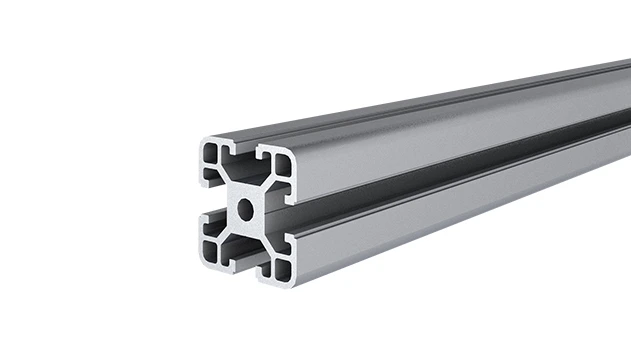
4040C is a 4.00x4.00 CM fractional 40 series square extrusion T-slot profile with four open T-slots, each side with 4.00cm face. The profile has align-a-grooves to assist in aligning connecting profiles.
Walk into any modern factory, warehouse, or workshop, and you'll likely spot them: sleek, silver structures holding up workbenches, guiding conveyor belts, or organizing tools with precision. These unsung heroes of manufacturing are aluminum profiles—and among them, the 4040C EU Standard Aluminum Profile Extrusion stands out as a quiet champion of consistency. But why does "shape consistency" matter so much? Let's pull back the curtain on this unassuming component and discover how its uniformity shapes the reliability of everything from assembly lines to workbenches, and even the lean systems that keep production floors running like well-oiled machines.
First Things First: What *Is* a 4040C EU Standard Aluminum Profile?
Before we dive into consistency, let's get familiar with the star of the show. The 4040C is part of the EU standard aluminum extrusion profile family—a category of aluminum shapes created by forcing heated aluminum alloy through a die to form a specific cross-section. The "4040" refers to its dimensions: 40mm in width and 40mm in height, making it a square profile. The "C" denotes a specific design variant, often with T-slots (those handy grooves along the edges) that allow for easy attachment of aluminum profile accessories like brackets, connectors, and end caps. Think of it as the building block of modular manufacturing—versatile, strong, and designed to play well with others.
But here's the thing: not all aluminum profiles are created equal. EU standards set strict benchmarks for everything from material composition to dimensional accuracy, and the 4040C takes these standards seriously. This isn't just about meeting a checklist; it's about ensuring that every single 4040C profile that rolls off the production line behaves the same way—whether it's used in a workbench in Berlin, a conveyor system in Barcelona, or a lean system in Lisbon. That consistency? It's the secret sauce that turns a simple piece of metal into a cornerstone of industrial reliability.
Why Shape Consistency Isn't Just a "Nice-to-Have"—It's Everything
Imagine you're assembling a workbench. You've got your 4040C profiles, a set of aluminum profile accessories (corner brackets, end caps, maybe a few casters), and a vision for a sturdy, level surface where your team will spend hours assembling products. Now, what if the first profile you pick is 40.2mm wide, the next is 39.8mm, and the third has a slight bow in the middle? Suddenly, the brackets don't line up, the end caps won't snap into place, and the workbench wobbles like a table with a missing leg. Frustrating, right? But beyond frustration, inconsistent shapes can lead to bigger problems: loose joints that fail under weight, uneven surfaces that damage delicate parts, and even safety hazards when structures don't bear loads as expected.
In manufacturing, where precision is non-negotiable, shape consistency becomes a silent quality control officer. It ensures that when you design a lean system—say, a flow rack for moving components between stations—every 4040C profile fits into its connectors exactly as planned. It means that when you scale up production and order 100 more profiles, they'll integrate seamlessly with the ones you already have. And it guarantees that the workbench you build today will still be level, stable, and reliable five years from now, even after daily use.
The Hidden Costs of Inconsistency
Inconsistent profiles don't just cause headaches during assembly—they eat into your bottom line. Let's break it down: if 10% of your profiles are "off spec," you're wasting time sorting through them, returning defective ones, or worse, trying to make them work (which often leads to shoddy structures). Then there's the cost of rework: if a conveyor track built with inconsistent profiles jams, you're looking at downtime, missed deadlines, and frustrated workers. Over time, these small inefficiencies add up. The 4040C, with its EU-standard consistency, eliminates these hidden costs by ensuring that "good enough" is never the standard—*exact* is.

How 4040C Profiles Achieve Such Stunning Shape Consistency
So, how do manufacturers ensure that every 4040C profile is practically identical? It's a mix of science, technology, and old-fashioned attention to detail. Let's walk through the process step by step.
1. Starting with the Right Alloy
Aluminum extrusion profile quality begins with the material itself. 4040C profiles are typically made from 6063 aluminum alloy—a blend prized for its excellent extrudability, strength, and corrosion resistance. But not just any 6063 will do: EU standards specify exact ratios of silicon, magnesium, and other elements to ensure the alloy flows uniformly during extrusion. Think of it like baking a cake: if you change the ratio of flour to sugar, the texture changes. Similarly, inconsistent alloy composition leads to inconsistent flow, which means some profiles might have thicker walls or uneven surfaces.
2. Precision Die Design
The extrusion die is the mold that shapes the aluminum. For 4040C profiles, these dies are engineered with microscopic precision—often using computer-aided design (CAD) and 3D modeling to simulate how the molten aluminum will flow. Even a tiny imperfection in the die (a 0.1mm nick, for example) can create a ripple effect, leading to profiles with uneven T-slots or warped edges. To prevent this, die makers use high-grade steel and put each die through rigorous testing before it ever touches molten aluminum. Some manufacturers even use laser scanning to verify that the die matches the 4040C's exact specifications down to the micrometer.
3. Controlled Extrusion Parameters
Extrusion is a delicate dance of temperature, pressure, and speed. Molten aluminum is pushed through the die at temperatures around 500°C (932°F), but even a 5°C swing can change how the metal flows. To keep things consistent, modern extrusion lines use computer-controlled systems to monitor and adjust temperature, pressure, and speed in real time. Sensors track the profile as it exits the die, and if something drifts out of spec—say, the speed increases slightly—the system corrects it instantly. It's like having a co-pilot who never blinks, ensuring the process stays on track.
4. Cooling and Stretching: Setting the Shape
After extrusion, the hot profile needs to cool evenly to maintain its shape. Uneven cooling can cause warping—think of a pizza crust shrinking unevenly in the oven. 4040C profiles are cooled using precision water baths or air jets that distribute cold evenly across the surface. Once cooled, they're "stretched" slightly (a process called straightening) to remove any residual bends. This step is critical: even a small curve in a 3-meter profile can throw off an entire assembly. Manufacturers use hydraulic presses and laser alignment tools to ensure each profile is straight within 0.2mm per meter—about the thickness of two sheets of paper.
5. Rigorous Quality Checks
Finally, every 4040C profile undergoes a battery of tests before it leaves the factory. Laser scanners measure dimensions (width, height, wall thickness) to ensure they're within EU standard tolerances (usually ±0.1mm for critical dimensions). Inspectors check for surface defects like scratches or dents, and some even perform load tests to verify strength. It's overkill? Maybe—but when consistency is the goal, overkill is just thoroughness.
Seeing Consistency in Action: 4040C in Real-World Applications
To truly appreciate 4040C's shape consistency, let's look at how it performs in the applications that matter most. From workbenches to lean systems, these profiles are the backbone of efficient, reliable manufacturing.
Workbenches: The Foundation of Productivity
A workbench is more than just a table—it's where ideas become products. Whether you're assembling electronics, packaging goods, or testing prototypes, you need a surface that's level, stable, and built to last. 4040C profiles excel here because their consistent dimensions ensure that every frame is square, every shelf is level, and every accessory (like tool hooks or monitor mounts) attaches securely. Imagine a workbench built with non-standard profiles: one leg is slightly shorter, the top sags in the middle, and the vice won't tighten properly. Now compare that to a 4040C workbench: solid, steady, and ready to keep up with your team's pace. It's the difference between fighting your tools and focusing on the work.
Lean Systems: Streamlining Efficiency
Lean manufacturing is all about eliminating waste—whether it's time, materials, or space. A well-designed lean system uses flow racks, conveyors, and modular structures to keep materials moving smoothly from one station to the next. Here, 4040C's consistency is a game-changer. For example, a flow rack built with 4040C profiles ensures that bins glide along roller tracks without sticking (thanks to evenly spaced T-slots for mounting rollers). A conveyor system uses 4040C as its frame, with brackets that align perfectly to keep belts tight and rollers spinning freely. When every component fits like a puzzle piece, you reduce downtime, speed up production, and create a workflow that feels almost effortless.
Aluminum Profile Accessories: The Perfect Partners
Even the best profile is only as good as its accessories—and 4040C's consistency makes it a dream to accessorize. Aluminum profile accessories like 90° connectors, end caps, and adjustable feet are designed to fit 4040C's T-slots exactly. No forcing, no filing, no "making it work." For example, a 4040C end cap snaps into place with a satisfying click, protecting workers from sharp edges and giving the profile a clean, finished look. A corner bracket slides into the T-slot and tightens with a hex key, creating a joint that's both strong and easy to disassemble if you need to reconfigure your setup. When profiles and accessories work in harmony, you get flexibility without sacrificing reliability.
Comparing the Competition: 4040C vs. Non-Standard Profiles
Curious how 4040C stacks up against non-standard aluminum profiles? Let's take a closer look with a side-by-side comparison:
| Feature | 4040C EU Standard | Non-Standard Aluminum Profile | Impact of Difference |
|---|---|---|---|
| Dimensional Tolerance | ±0.1mm (width/height) | ±0.5mm or more | 4040C brackets and accessories fit perfectly; non-standard may require modification. |
| Wall Thickness Uniformity | Max 5% variance across profile | Up to 15% variance | 4040C bears weight evenly; non-standard may bend or fail under stress. |
| Surface Flatness | ≤0.2mm per meter | ≤1.0mm per meter | 4040C creates level work surfaces; non-standard may cause wobbling or uneven material flow. |
| Material Distribution | Even, consistent alloy flow | Uneven, leading to weak spots | 4040C resists corrosion and fatigue; non-standard may degrade faster. |
As the table shows, the differences go beyond numbers—they translate to real-world performance. 4040C's tight tolerances and uniform quality mean less hassle, less waste, and more confidence in your structures.
The Future of Manufacturing: Why Consistency Will Only Grow More Important
As manufacturing evolves—with automation, IoT, and custom production on the rise—consistency will become even more critical. Imagine a smart factory where robots assemble products on 4040C workbenches, and AI monitors conveyor systems for jams. If the profiles are inconsistent, the robots might misalign parts, and the AI could misinterpret sensor data. But with 4040C, you create a stable foundation for innovation. Your automated systems work as programmed, your data is reliable, and you can scale up without worrying about whether your new profiles will play nice with the old ones. In a world where change is constant, consistency becomes the anchor that keeps your operations steady.
Final Thoughts: Why 4040C Isn't Just a Profile—It's a Promise
At the end of the day, the 4040C EU Standard Aluminum Profile Extrusion is more than a piece of metal. It's a promise—a promise that the structures you build will be strong, reliable, and built to last. It's a promise that your team won't waste time fighting with ill-fitting parts or wobbly workbenches. And it's a promise that when you invest in quality, you're investing in your factory's future.
So the next time you walk through your production floor, take a closer look at those aluminum profiles. If they're 4040C, you're not just looking at a building block—you're looking at the result of decades of engineering, a commitment to excellence, and a dedication to consistency. And in manufacturing, that's the difference between good and great.