- Company Articles
- Industry articles
- Industry standards
- 4040C EU Standard Aluminum Profile Specifications: Dimensions, Tolerances & Compliance

4040C EU Standard Aluminum Profile Specifications: Dimensions, Tolerances & Compliance
Related Product
4040C EU Standard Aluminum Profile
4040C is a 4.00x4.00 CM fractional 40 series square extrusion T-slot profile with four open T-slots, each side with 4.00cm face. The profile has align-a-grooves to assist in aligning connecting profiles.
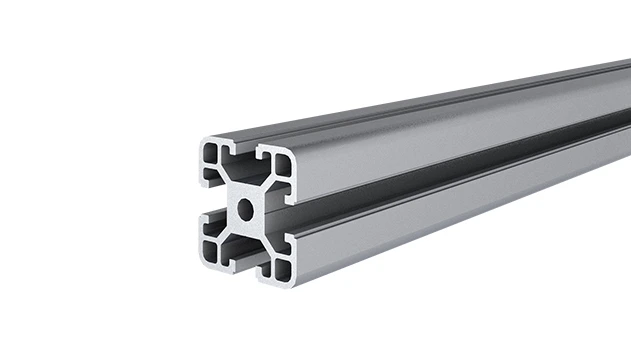
Let's start with a scenario many manufacturing managers know all too well: Your team is rushing to assemble a new production line. The workbenches wobble because the frames don't align, the material racks sag under light loads, and the connectors keep slipping out of the profile slots. By the end of the day, you've wasted hours troubleshooting, and the line isn't even halfway done. Sound familiar? More often than not, the root cause isn't poor craftsmanship—it's using the wrong building blocks. Enter the 4040C EU Standard Aluminum Profile : a hero that turns chaos into efficiency, one precisely engineered extrusion at a time.
In the world of lean manufacturing, where every second and every square inch counts, standardized components are the backbone of productivity. The 4040C isn't just another piece of metal; it's a globally recognized standard that ensures compatibility, durability, and adaptability across endless applications—from lean pipe workbenches to automated conveyor systems, from material racks to turnover trolleys. Today, we're diving deep into its specifications, uncovering why its dimensions, tolerances, and compliance certifications matter, and how it can transform your operations from frustrating to frictionless.
Understanding 4040C: The Workhorse of EU Standard Aluminum Profiles
First, let's clarify what "4040C" actually means. The "4040" refers to its cross-sectional dimensions: 40mm by 40mm, a sweet spot that balances strength and versatility for most industrial tasks. The "C" denotes its specific design within the EU's 4040 series, distinguishing it from variants like 4040A (with rounded edges) or 4040B (thicker walls for heavy loads). What makes the C model so popular? It's the Goldilocks of profiles—not too specialized for niche tasks, not too generic to lack precision. It's built to work seamlessly with a vast ecosystem of aluminum profile accessories , from connectors to panels, making it the go-to choice for everything from small workstations to large-scale production lines.
At its core, the 4040C is an aluminum extrusion profile , born from the extrusion process: heated aluminum billets are forced through a die to create its signature 40x40mm shape, complete with T-slots that run the length of the profile. These slots are more than just design features—they're the secret to its flexibility. By allowing bolts, brackets, and other accessories to slide in and lock securely, they eliminate the need for welding or drilling, cutting assembly time by up to 50% compared to traditional steel frames. And because aluminum is 30% lighter than steel but boasts comparable strength (especially when alloyed with elements like magnesium and silicon), the 4040C delivers a strength-to-weight ratio that makes it ideal for both stationary structures and mobile equipment like trolleys.
Dimensions: The Building Blocks of Precision
Precision starts with dimensions, and the 4040C leaves no room for guesswork. Every millimeter is calibrated to EU standards, ensuring that no matter which aluminum profile supplier you source from, the profiles will fit together like puzzle pieces. Let's break down the key measurements:
| Parameter | Specification | Typical Tolerance | Why It Matters |
|---|---|---|---|
| Cross-Sectional Dimensions | 40mm (width) x 40mm (height) | ±0.2mm | Ensures compatibility with standard 40-series accessories; a 0.3mm could mean a connector won't seat properly. |
| Wall Thickness | 2.0mm (standard); 1.5mm (light-duty variant) | ±0.15mm | Thickness directly impacts load capacity—too thin, and the profile bends; too thick, and it adds unnecessary weight. |
| T-Slot Dimensions | Width: 8mm; Depth: 10mm; Slot Spacing: 20mm (center-to-center) | Slot width: ±0.1mm; Depth: ±0.2mm | T-slots are the profile's "interface" with accessories. Inconsistent slot size leads to loose brackets or stuck bolts. |
| Length Options | Standard: 1m, 2m, 3m, 4m; Custom lengths available | Length tolerance: ±0.5mm/m | Longer profiles (e.g., 4m) need tight length tolerances to avoid bowing, which could throw off entire assembly alignments. |
| Corner Radius | 1.5mm (external); 0.8mm (internal) | ±0.2mm | Smooth corners prevent snagging on materials and reduce injury risks during handling. |
Take the T-slots, for example. Their 8mm width is designed to pair perfectly with M6 bolts—industry-standard fasteners used in most aluminum profile accessories. If a slot is just 0.2mm too narrow, the bolt won't slide in; 0.2mm too wide, and the bolt will wiggle, weakening the joint. The 4040C's tight slot tolerance eliminates these headaches, letting your team focus on building, not fixing.
Another critical dimension is the wall thickness. The standard 2.0mm walls give the 4040C a load capacity of up to 200kg per linear meter when properly supported—more than enough for most workbench tops or light material racks. For applications like heavy-duty shelving, some suppliers offer a 2.5mm wall variant, but the C model's sweet spot is its ability to handle everyday tasks without overcomplicating things.

Tolerances: Why Every Micrometer Counts
If dimensions are the "what," tolerances are the "how precise." Tolerances define the acceptable range of variation from the ideal measurement, and in manufacturing, they're the difference between a product that works and one that frustrates. The 4040C's tolerances are so strict, they're measured in micrometers (1 micrometer = 0.001mm)—and for good reason.
Let's start with straightness. Imagine installing a 3-meter 4040C profile as the beam for a conveyor track. If it's bent by just 0.5mm over its length, the conveyor belt will rub against the sides, wearing out prematurely and creating noise. The 4040C's straightness tolerance is ≤0.3mm per meter, meaning even a 4-meter profile will deviate by no more than 1.2mm—negligible for most applications. This level of precision comes from post-extrusion processes like cold drawing and heat treatment, which stabilize the aluminum and eliminate warping.
Then there's squareness. The 4040C's cross-section should be a perfect right angle (90°), but in reality, slight deviations happen. The EU standard limits this to ≤0.15° per meter, ensuring that when you connect two profiles at a corner, they form a true right angle. Why does this matter? On a lean pipe workbench , a skewed frame will cause the tabletop to tilt, making it harder to place tools or assemble products. Over time, this tilt can even lead to musculoskeletal strain for workers—a hidden cost of poor tolerances.
Wall thickness variation is another tolerance to watch. If one side of the profile is 2.0mm thick and the opposite side is 1.8mm, the profile will be weaker on the thinner side, leading to uneven stress distribution. The 4040C limits this variation to ±0.15mm, ensuring consistent strength across its entire cross-section. For manufacturers, this means predictable performance: you can calculate load limits with confidence, knowing the profile won't fail unexpectedly.
Compliance: Meeting EU Standards (and Then Some)
In today's global market, compliance isn't just a box to check—it's a promise of quality. The 4040C isn't labeled "EU Standard" lightly; it must pass a battery of tests to meet strict European directives, ensuring safety, sustainability, and reliability.
First and foremost is CE marking, a mandatory certification for products sold in the EU. To earn the CE mark, the 4040C must comply with the Construction Products Regulation (CPR), which sets standards for mechanical resistance, fire behavior, and chemical emissions. This includes testing its tensile strength (minimum 160 MPa for 6063-T5 alloy, the material used in most 4040C profiles), yield strength (≥110 MPa), and elongation (≥8%), ensuring it can withstand the stresses of industrial use.
Then there's RoHS compliance, which restricts the use of hazardous substances like lead, mercury, and cadmium. For manufacturers in electronics or medical device industries, where contamination risks are high, RoHS-certified 4040C profiles are non-negotiable. They ensure that even if the profile is scratched or worn, no harmful chemicals leach into the environment or products.
Beyond EU-specific standards, the 4040C often meets international benchmarks like DIN 17610 (for aluminum alloys) and ISO 6892 (for tensile testing). This global recognition is why lean system integrators worldwide trust it—whether you're building a production line in Berlin, a warehouse in Barcelona, or a workshop in Brussels, the 4040C speaks the same language of quality.
Applications: Where 4040C Shines (and Saves You Money)
The 4040C's true power lies in its versatility. It's not limited to one industry or one task; it adapts to your needs, evolving as your operations grow. Let's explore a few real-world applications where it excels:
Lean Pipe Workbenches: A standard lean pipe workbench built with 4040C profiles can support up to 500kg on its top (when paired with aluminum honeycomb panels), all while remaining lightweight enough to move with casters. The T-slots let you add tool holders, monitor arms, and bins exactly where you need them, keeping the workspace organized and reducing motion waste—a cornerstone of lean manufacturing.
Material Racks: Whether you're storing boxes, components, or finished products, 4040C-based racks are both strong and flexible. For example, a "Material Rack B (3 row and 3 floor)" (a common configuration) uses 4040C uprights and horizontal beams, with adjustable shelves that can be repositioned in seconds using T-slot bolts. No more drilling new holes or welding—just loosen, slide, and tighten.
Conveyor Systems: The 4040C's straightness and strength make it ideal for roller track frames. Pair it with aluminum profile accessories like roller track placon mounts or aluminum guide rails, and you've got a conveyor that runs smoothly, even at high speeds. Its light weight also reduces the load on motors, cutting energy costs over time.
Turnover Trolleys: Moving heavy loads? A 4040C trolley with reinforced corners and swivel casters can carry up to 300kg without tipping. The T-slots let you add dividers or bins to keep items secure, and because aluminum resists corrosion, the trolley will look and function like new for years—even in humid warehouses.
Choosing the Right Aluminum Profile Supplier: Your Partner in Precision
Even the best design is only as good as the manufacturer behind it. When sourcing 4040C profiles, not all aluminum profile suppliers are created equal. Here's what to look for to ensure you're getting the real deal:
Certifications: Ask for CE, RoHS, and DIN certifications—not just a generic "compliant" claim. Reputable suppliers will provide test reports from accredited labs, proving their profiles meet EU standards.
Quality Control: Inquire about their production process. Do they inspect every batch for dimensions and tolerances? Do they use virgin aluminum alloy (6063-T5 is standard) or recycled material with unknown impurities? Recycled aluminum can have inconsistent properties, leading to weak spots in the profile.
Accessory Ecosystem: A great supplier doesn't just sell profiles—they offer the full range of accessories you need, from joints to panels to casters. This ensures compatibility and saves you the hassle of sourcing from multiple vendors.
Customization: While the 4040C is standardized, you may need custom lengths or finishes (like anodizing for extra corrosion resistance). Choose a supplier that offers these options without exorbitant fees or long lead times.
Conclusion: 4040C – More Than a Profile, a Catalyst for Efficiency
At the end of the day, the 4040C EU Standard Aluminum Profile is more than metal and tolerances—it's a tool that empowers your team to work smarter, not harder. Its precise dimensions eliminate guesswork, its tight tolerances ensure reliability, and its compliance certifications give you peace of mind. Whether you're building a single workbench or an entire factory, it's the foundation that turns your vision into reality—on time, on budget, and built to last.
So, the next time you're facing a manufacturing challenge, remember: the right building blocks make all the difference. And in the world of lean, efficient, and adaptable systems, the 4040C isn't just a profile—it's your partner in progress.