- Company Articles
- Industry articles
- Industry standards
- 4040C EU Standard Aluminum Profile vs. 4040 ANSI Profile: Global Standards Comparison

4040C EU Standard Aluminum Profile vs. 4040 ANSI Profile: Global Standards Comparison
Related Product
4040C EU Standard Aluminum Profile
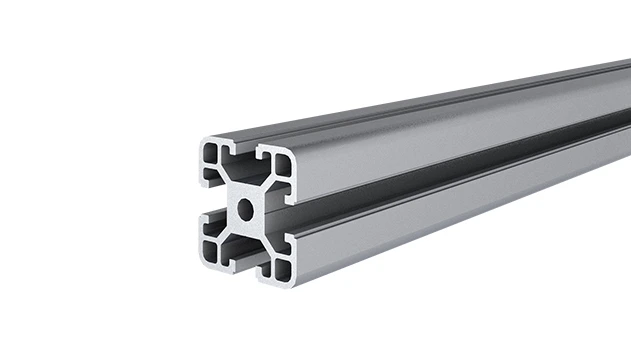
4040C is a 4.00x4.00 CM fractional 40 series square extrusion T-slot profile with four open T-slots, each side with 4.00cm face. The profile has align-a-grooves to assist in aligning connecting profiles.
If you've ever walked through a manufacturing plant, a warehouse, or even a DIY workshop, you've probably seen them—those sleek, modular metal frames holding up workbenches, material racks, or conveyor systems. Chances are, those frames were made of aluminum extrusion profiles —the unsung heroes of modern industrial design. But here's the thing: not all aluminum profiles are created equal. When it comes to global manufacturing, two standards stand out: the 4040C EU Standard and the 4040 ANSI Profile. Whether you're a small business owner building a custom workbench, a factory manager upgrading your lean system, or a global supplier sourcing parts, understanding the differences between these two standards can save you time, money, and a lot of headaches. Let's dive in.
What Are Aluminum Extrusion Profiles, Anyway?
Before we compare the two standards, let's make sure we're on the same page. Aluminum extrusion profiles are long, uniform pieces of aluminum shaped by forcing heated aluminum through a die—a process called extrusion. This method allows for complex cross-sectional shapes, making them ideal for modular systems. They're lightweight, strong, corrosion-resistant, and infinitely customizable, thanks to a wide range of aluminum profile accessories like connectors, brackets, and end caps. From workbenches in electronics factories to material racks in warehouses, these profiles are the backbone of efficient, flexible workspaces.
The "4040" in both profiles refers to their nominal cross-sectional size: roughly 40mm by 40mm. But that's where the similarities start to fade. The EU and ANSI standards each have their own take on what a 40x40mm profile should look like, and those differences matter—especially if you're sourcing parts from global suppliers or building systems that need to last.
EU vs. ANSI: A Tale of Two Standards
Standards exist to keep things consistent. In Europe, aluminum profiles often follow standards set by organizations like DIN (Deutsches Institut für Normung) or ISO (International Organization for Standardization). The 4040C EU profile, for example, adheres to strict European norms for dimensions, material quality, and performance. On the other side of the Atlantic, the American National Standards Institute (ANSI) sets the bar for U.S. manufacturers, with the 4040 ANSI Profile designed to meet North American industry needs.
Think of it like electrical outlets: a European plug won't fit in an American socket, and vice versa. The same logic applies here—EU and ANSI profiles, while both 40x40mm, have subtle (and not-so-subtle) differences that make them incompatible in many cases. Let's break down what those differences are, and why they matter.

Dimensional Differences: It's All in the Details
At first glance, a 40x40mm profile from the EU and one from ANSI might look identical. But measure them closely, and you'll spot key variations that affect everything from assembly to load capacity. Let's compare the 4040C EU Standard and the 4040 ANSI Profile side by side:
| Feature | 4040C EU Standard | 4040 ANSI Profile |
|---|---|---|
| Cross-Sectional Dimensions | 40mm x 40mm (nominal); actual dimensions may vary slightly by manufacturer but adhere to DIN 6060 standards | 40mm x 40mm (nominal); ANSI allows for minor tolerances, but slot spacing differs from EU |
| Slot Width | 8mm (standard for EU profiles); designed for M6 or M8 bolts | 10mm (common in ANSI); compatible with larger bolts (often M8 or M10) |
| Slot Depth | 5mm (measured from the outer edge to the slot base) | 6mm (deeper slots to accommodate heavier-duty connectors) |
| Wall Thickness | 1.5mm–2.0mm (varies by grade; 1.8mm is typical for general use) | 2.0mm–3.0mm (thicker walls for higher load-bearing capacity) |
| Corner Radius | Smaller (R1.5mm–R2.0mm) for a sleeker, more compact design | Larger (R2.5mm–R3.0mm) for durability in heavy-impact environments |
These differences might seem tiny, but they add up. For example, the EU's 8mm slot is perfect for lightweight to medium-duty applications, like a workbench in a electronics assembly line. The ANSI's 10mm slot, with its thicker walls, is better suited for heavy machinery or material racks that need to support hundreds of pounds. If you try to use an EU-style aluminum profile connector (designed for 8mm slots) on an ANSI profile, the bolt will wiggle loose, or the connector might not seat properly—compromising the entire structure.
Material Composition: All Aluminum, but Not All the Same
Aluminum profiles are made from aluminum alloys, and both EU and ANSI standards favor alloys from the 6000 series—known for their excellent extrudability and strength. However, there are subtle differences in alloy composition and temper (heat treatment) that affect performance:
EU 4040C: 6063-T5 Alloy
Most EU profiles, including the 4040C, use the 6063-T5 alloy. This alloy is prized for its smooth finish, corrosion resistance, and ease of extrusion—perfect for creating complex shapes with tight tolerances. The "T5" temper means it's artificially aged to increase strength without sacrificing ductility. It's a great all-around choice for applications like lean systems, workbenches, and light-duty material racks.
ANSI 4040: 6061-T6 Alloy (Common Variant)
ANSI profiles often use 6061-T6, a slightly stronger alloy than 6063. T6 temper involves solution heat treatment followed by artificial aging, resulting in higher tensile strength (around 310 MPa vs. 215 MPa for 6063-T5). This makes ANSI profiles better suited for heavy loads and high-stress environments, like industrial conveyor systems or outdoor structures where durability is key. However, 6061 is less malleable than 6063, so it's not as easy to extrude into intricate shapes—hence the simpler, thicker-walled design of many ANSI profiles.
So, which is better? It depends on your needs. If you're building a lightweight, modular lean system that needs to be reconfigured often, 6063-T5 (EU) is ideal. For a fixed structure that needs to support heavy machinery, 6061-T6 (ANSI) might be the way to go.
Load-Bearing Capacity: How Much Can They Handle?
When it comes to industrial applications, load capacity is non-negotiable. A profile that bends or fails under weight can lead to damaged equipment, production delays, or even safety hazards. Let's compare how the 4040C EU and 4040 ANSI profiles stack up in real-world scenarios:
Vertical Load (Compression)
Vertical load refers to how much weight a profile can support when standing upright (e.g., as a leg on a workbench). Thanks to its thicker walls and stronger alloy, the ANSI 4040 profile typically outperforms the EU 4040C here. A 1-meter length of ANSI 4040 can often support 500–700 kg before bending, while the EU 4040C averages 300–500 kg. For most workbenches, this difference might not matter—until you start stacking heavy tools or materials on top.
Horizontal Load (Bending)
Horizontal load is critical for applications like overhead racks or conveyor supports, where the profile is suspended between two points. Here, the EU 4040C holds its own, thanks to its precise extrusion and uniform wall thickness. A 1-meter span of EU 4040C can typically support 80–120 kg without excessive deflection (bending), while the ANSI profile, with its thicker walls, can handle 120–150 kg over the same span. Again, context matters: a small parts bin rack might work fine with EU profiles, but a rack holding heavy automotive components would benefit from ANSI's extra strength.
Accessories Compatibility: Why Your Connectors Matter
One of the biggest headaches for global manufacturers is compatibility between profiles and accessories. Aluminum profile accessories —connectors, brackets, end caps, and hinges—are designed to work with specific profile standards. Mixing EU and ANSI accessories is a recipe for frustration (and potentially unsafe structures).
Connectors: 90° Joints, Brackets, and More
Take the humble 90° aluminum profile connector , a staple for building frames. EU connectors are designed for 8mm slots and smaller bolts (M6/M8), while ANSI connectors fit 10mm slots and larger bolts (M8/M10). If you try to use an EU connector on an ANSI profile, the bolt will be too small for the slot, leading to a loose fit. Conversely, an ANSI connector on an EU profile might not even fit into the slot, or could crack the profile's thinner walls when tightened.
End Caps and Covers
Even small accessories like aluminum profile end caps differ. EU end caps are sized to fit the EU's 40mm x 40mm dimensions with smaller radii, while ANSI end caps account for the ANSI profile's larger corner radius and thicker walls. A mismatched end cap won't seal properly, leaving the profile's interior exposed to dust, moisture, or debris—something you don't want in a clean manufacturing environment.
A Word of Warning: Mixing Standards
Some manufacturers claim to sell "universal" accessories, but proceed with caution. These often compromise on fit or strength to work with both standards, and they rarely perform as well as accessories designed for a specific profile. If you're building a system with EU profiles, stick to EU accessories—and the same goes for ANSI. Your local aluminum profile supplier should be able to guide you, but it's always best to double-check dimensions before ordering.
Application Scenarios: Where Each Profile Shines
Now that we've covered the technical differences, let's talk about real-world use cases. Where do EU and ANSI profiles excel?
EU 4040C: Lean Manufacturing and Modular Systems
In Europe, the 4040C is the go-to for lean manufacturing. Its lightweight design, precise tolerances, and wide range of accessories make it perfect for building flexible workstations, kanban racks, and assembly lines that can be reconfigured as production needs change. For example, a German automotive parts supplier might use 4040C profiles to build a modular workbench with tool holders, storage bins, and a conveyor track—all connected with 90° and 135° aluminum connectors. When the production line switches to a new part, the workbench can be disassembled and rebuilt in hours, not days.
EU profiles are also popular in labs, retail displays, and DIY projects, where aesthetics and precision matter as much as function. Their smooth finish and slim profile make them less industrial-looking than ANSI profiles, which is a plus for customer-facing applications.
ANSI 4040: Heavy-Duty Industrial and North American Markets
In North America, ANSI profiles dominate heavy-duty industrial settings. Think factories producing large machinery, warehouses with high-capacity storage racks, or construction sites where profiles need to withstand harsh weather. For example, a U.S.-based aerospace manufacturer might use ANSI 4040 profiles to build a jig for assembling aircraft parts—relying on the profile's thick walls and high-strength alloy to maintain precision under heavy loads.
ANSI profiles are also common in outdoor applications, like solar panel mounts or signage frames, where their corrosion resistance (especially with added coatings) and durability shine. They're less about flexibility and more about long-term reliability in demanding environments.
Cost Comparison: Which Is More Affordable?
Cost is always a factor, and here's where things get interesting: EU profiles are often cheaper per meter than ANSI profiles, but that's not the whole story. Let's break down the costs:
Raw Material and Production Costs
EU profiles use less aluminum (thinner walls, lighter alloy), so raw material costs are lower. Extruding 6063-T5 is also faster and more energy-efficient than extruding 6061-T6, which reduces production costs. As a result, a 3-meter length of 4040C EU might cost $20–$30, while an ANSI 4040 of the same length could run $30–$45.
Accessories and Long-Term Costs
However, EU accessories are often pricier than ANSI ones, especially if you're sourcing them outside Europe. ANSI accessories, being simpler in design and made for mass production, are widely available and affordable in North America. Plus, if you need to replace a damaged ANSI profile, its thicker walls may mean it lasts longer than an EU profile in a high-wear environment—offsetting the initial cost difference.
Shipping and Sourcing
If you're in Europe, EU profiles are readily available from local suppliers, with fast shipping and low logistics costs. In North America, ANSI profiles are similarly easy to source. The problem arises when importing: shipping EU profiles to the U.S. (or vice versa) adds significant costs, and you'll still need to source compatible accessories locally. For global companies, maintaining inventory for both standards can be expensive—but it's often necessary to serve regional markets.
Choosing the Right Profile: A Quick Guide
Still unsure whether to go with EU or ANSI? Ask yourself these questions:
- Where is your system located? If in Europe, the EU 4040C is the default. In North America, ANSI is more common.
- What's the load requirement? Light to medium loads (under 500 kg per linear meter)? EU. Heavy loads (500+ kg)? ANSI.
- Will you need to reconfigure the system? EU profiles and accessories are better for modular, frequently changed setups.
- Who is your supplier? A local supplier with quick access to your chosen standard's profiles and accessories will save you time and money.
Final Thoughts: Standards Matter, but So Does Flexibility
At the end of the day, both the 4040C EU Standard and the 4040 ANSI Profile are excellent choices—when used in the right context. They're products of regional engineering priorities: Europe's focus on lean, modular design vs. North America's emphasis on heavy-duty durability. Understanding their differences helps you build safer, more efficient systems, whether you're assembling a simple workbench or a complex lean manufacturing line.
And remember: standards evolve. As global manufacturing becomes more interconnected, we may see more convergence between EU and ANSI profiles—but for now, it's best to stick to the standard that aligns with your location, application, and supplier network. After all, the goal of using aluminum extrusion profiles is to make your workflow smoother, not more complicated. Choose wisely, and your profiles will serve you well for years to come.