- Company Articles
- Industry articles
- Industry standards
- 4040D EU Standard Aluminum Profile: Key Dimensions & Tolerance Requirements

4040D EU Standard Aluminum Profile: Key Dimensions & Tolerance Requirements
Related Product
4040D EU Standard Aluminum Profile
4040D is a 4.00x4.00 CM fractional 40 series square extrusion T-slot profile with two side open T-slots, two side with closed face, each side with 4.00cm face. The profile has align-a-grooves to assist in aligning connecting profiles.
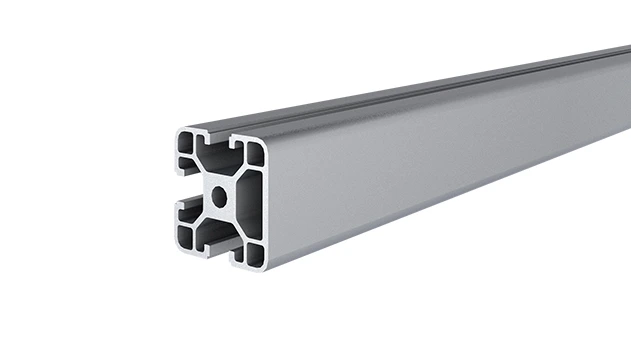
Walk into any modern manufacturing facility, and you'll likely spot a familiar sight: sturdy, silver-gray structures holding up workbenches, organizing tools, and keeping production lines flowing. These unsung heroes of the factory floor? Chances are, they're built from aluminum extrusion profile —a material prized for its strength, flexibility, and precision. Among the most widely used profiles in industrial settings is the 4040D EU standard aluminum profile. But what makes this profile a go-to choice for engineers and facility managers? Today, we're diving deep into its key dimensions and tolerance requirements, uncovering why these details matter in real-world applications—from building a reliable workbench to assembling a heavy-duty material rack.
What is 4040D EU Standard Aluminum Profile?
Before we get into dimensions and tolerances, let's clarify what the 4040D EU standard aluminum profile actually is. The "4040" refers to its cross-sectional size: roughly 40mm in width and 40mm in height, making it a square or near-square profile. The "D" is a specific variant within the EU standard series, often indicating design nuances like wall thickness, T-slot configuration, or corner radii—details that set it apart from other 4040 profiles (like 4040A or 4040C). As an aluminum extrusion profile , it's created by forcing molten aluminum through a die, which shapes it into the precise cross-section we need. This process allows for consistent, repeatable production—critical for industrial applications where parts must fit together seamlessly.
EU standards (often aligned with EN 755, the European norm for aluminum extrusions) ensure that 4040D profiles meet strict criteria for quality, strength, and dimensional consistency. This isn't just about following rules; it's about ensuring that a profile bought from a supplier in Germany fits perfectly with aluminum profile accessories sourced from Italy, or that a workbench built in Spain can be replicated exactly in France. In short, the 4040D is a workhorse: strong enough for medium-load applications, versatile enough to adapt to countless setups, and precise enough to make assembly straightforward.
Key Dimensions: The Building Blocks of Precision
When engineers or manufacturers specify a 4040D profile, they're not just asking for a "40x40mm aluminum bar." They're relying on a set of tightly controlled dimensions that dictate how the profile performs, how it interacts with accessories, and how it holds up under stress. Let's break down the most critical dimensions and why they matter.
1. Cross-Sectional Dimensions: Width, Height, and Corner Radii
At first glance, "40x40mm" seems simple—but in reality, the cross-sectional dimensions are far more nuanced. The EU standard defines the nominal width and height as 40mm, but real-world measurements must stay within a narrow tolerance range. For example, the actual width might be 40.0mm ±0.3mm, meaning it can be as small as 39.7mm or as large as 40.3mm. Why such precision? Imagine building a frame for a workbench : if one profile is 39.7mm wide and the next is 40.3mm, the frame could end up lopsided, with gaps between joints or uneven weight distribution. Over time, that wobble could loosen connections or even compromise safety.
Corner radii are another key detail. 4040D profiles typically have rounded corners (often R1.5mm or R2.0mm) to prevent sharp edges, which is both a safety feature (no more scraped hands during assembly!) and a structural one (rounded corners distribute stress more evenly than sharp angles). The tolerance here is usually ±0.2mm—so a corner specified as R1.5mm might measure between 1.3mm and 1.7mm. Too sharp (smaller radius) and the corner could weaken; too rounded (larger radius) and it might interfere with accessories designed to fit flush against the profile's edges.
2. Length Tolerance: Getting the Right Fit for Frames and Racks
Length is another critical dimension, especially when you need to join multiple profiles end-to-end or cut them to specific sizes for a project. 4040D profiles are commonly sold in standard lengths like 2m, 3m, or 6m, but custom lengths are also available. The tolerance here depends on the length: for a 3m profile, the standard tolerance might be ±1mm (so 3000mm ±1mm), while a 6m profile could have a tolerance of ±2mm. Why does 1-2mm matter? Think about assembling a material rack b (3 row and 3 floor) —a multi-level storage rack with three rows and three floors. If the vertical profiles (which support the entire structure) are all supposed to be 1.8m tall but vary by 2mm each, the top shelf might end up sloping, causing boxes or components to slide off. Even small length differences add up, leading to uneven frames and frustrated assemblers.
3. Wall Thickness: Balancing Strength and Weight
The wall thickness of the 4040D profile is a hidden but vital dimension. It determines how much weight the profile can support, how rigid it is, and even how much it weighs (critical for applications where portability matters). The standard wall thickness for 4040D is often around 1.5mm, though some variants might use 2.0mm for heavier loads. The tolerance here is tight: typically ±0.1mm. So a 1.5mm wall might measure between 1.4mm and 1.6mm.
Why does 0.1mm matter? Let's say you're building a workbench that needs to support a 100kg load. If a section of the profile has a wall thickness of 1.4mm instead of 1.5mm, that area is slightly weaker. Over time, with repeated loading, it might bend or deform, compromising the workbench's stability. On the flip side, a wall thickness of 1.6mm adds unnecessary weight and cost—aluminum isn't cheap, and extra material you don't need is just wasted budget. Tight tolerances here ensure you get the strength you need without the extra bulk.
4. T-Slot Specifications: The "Interface" for Accessories
If cross-sectional dimensions are the profile's "body," the T-slots are its "hands"—the part that connects to the rest of the world. T-slots are the grooves running along the length of the profile, designed to accept bolts, nuts, brackets, and other aluminum profile accessories . For 4040D, the T-slot is a defining feature, and its dimensions are among the most tightly controlled.
A typical T-slot in 4040D has three key measurements: the opening width (the narrowest part of the slot), the base width (the wider part where the bolt head sits), and the depth (how far the slot extends into the profile). For example, the EU standard might specify an opening width of 8mm, a base width of 10mm, and a depth of 12mm. Tolerances here are strict: ±0.2mm for the opening width, ±0.3mm for depth. Why? Because aluminum guide rail a —a common accessory used to create sliding tracks for materials—relies on the T-slot to seat properly. If the opening is 7.8mm instead of 8mm, the guide rail's mounting bracket might not fit through. If the depth is 11.7mm instead of 12mm, the bracket might not lock into place, causing the rail to slide loose during use.
Even the position of the T-slot matters. The slot is usually centered on one or more sides of the profile (4040D often has slots on all four sides for maximum flexibility). The distance from the profile's edge to the slot's center (the "offset") is specified to within ±0.1mm. This ensures that when you attach two brackets to adjacent sides of the profile, they align perfectly—no gaps, no misalignment, just a clean, secure fit.

Tolerance Requirements: Why "Close Enough" Isn't Good Enough
By now, you've probably noticed a recurring theme: tolerances. Tolerances are the acceptable range around a nominal dimension—how much a measurement can vary without compromising performance. For 4040D profiles, tolerances aren't just "nice to have"; they're make-or-break for reliability, safety, and efficiency. Let's explore why tolerances matter and what the EU standard requires.
Why Tolerances Matter: The Cost of Poor Precision
Imagine ordering 100 4040D profiles for a production line workbench. If half of them are 40.2mm wide and the other half are 39.8mm wide, assembling the frames becomes a nightmare. Brackets that fit one profile are loose on another; holes don't align; the workbench wobbles. Not only does this slow down assembly, but it also creates safety risks—wobbly structures can fail under load, and misaligned accessories can jam or break. In a worst-case scenario, poor tolerances could lead to production delays, product defects, or even workplace injuries.
Tolerances also impact cost. Profiles with looser tolerances might be cheaper to produce, but they require more time to sort, modify, or replace during assembly. A manufacturer might spend hours filing down a profile to make it fit, or return an entire batch that's out of spec—costing far more than the savings from buying "cheaper" profiles upfront. For 4040D, tight tolerances are an investment in efficiency and reliability.
Dimensional Tolerances in Detail: A Closer Look
The EU standard (EN 755-2, specifically) classifies aluminum extrusions into tolerance classes, from normal (N) to high precision (P). 4040D profiles are typically manufactured to high precision (P) for industrial use, meaning tighter allowable variations. Below is a summary of key dimensional tolerances for 4040D, based on common EU standards:
| Parameter | Nominal Dimension | Tolerance Range (High Precision, P) | Why It Matters |
|---|---|---|---|
| Cross-Section Width/Height | 40mm | ±0.3mm | Ensures profiles fit into frames and accessories without gaps. |
| Length (3m profile) | 3000mm | ±1.0mm | Prevents uneven frames when joining multiple profiles. |
| Wall Thickness | 1.5mm | ±0.1mm | Maintains consistent strength and load capacity. |
| T-Slot Opening Width | 8mm | ±0.2mm | Ensures compatibility with standard bolts and accessories. |
| T-Slot Depth | 12mm | ±0.3mm | Allows accessories to lock securely into the profile. |
These tolerances might seem small, but they add up to big results. For example, the wall thickness tolerance of ±0.1mm ensures that every section of the profile can support roughly the same weight. A 1.5mm wall can typically handle around 500kg of vertical load (depending on length), but a 1.4mm section would only support ~450kg—enough to make a difference in a fully loaded material rack b (3 row and 3 floor) .
Surface Tolerances: Beyond Dimensions
Tolerances aren't just about size—they also apply to the profile's surface. The EU standard specifies limits on defects like scratches, dents, or uneven anodization (the protective coating applied to most aluminum profiles). For example, a scratch deeper than 0.05mm might be unacceptable, as it can trap dirt, weaken the anodization, or create stress points that lead to cracking. Similarly, the surface must be flat within a certain tolerance: a bow (curvature along the length) of more than 1mm per meter would make the profile useless for building a straight workbench or rack.
These surface tolerances are about more than aesthetics. A smooth, consistent surface ensures that accessories like sliding brackets or aluminum guide rail a move freely without catching. It also prevents corrosion, as defects in the anodization can let moisture seep in, leading to rust (though aluminum is naturally corrosion-resistant, anodization adds an extra layer of protection).
Compatibility with Accessories: A System, Not Just a Profile
A 4040D profile on its own is just a piece of metal. Its real value comes from how well it works with the ecosystem of aluminum profile accessories —brackets, hinges, guide rails, casters, and more. This compatibility hinges entirely on the profile's dimensions and tolerances. Let's look at a few common accessories and how they rely on the 4040D's precision.
Gusset Plates (Gusset Alp 4040): Reinforcing Connections
Gusset plates are small, triangular brackets used to reinforce corners where two profiles meet (like the joints of a workbench frame). The gusset alp 4040 is designed specifically for 40x40mm profiles. It has holes that align with the T-slots on adjacent profile sides, allowing bolts to pass through and secure the joint. For this to work, the distance between the T-slots (on perpendicular sides) must be precise. If the 4040D's cross-sectional width is off by 0.3mm, the gusset's holes might not line up with the T-slots, forcing assemblers to drill new holes or use shims—both time-consuming and risky (drilling can weaken the profile).
Aluminum Guide Rail A: Sliding Tracks for Materials
Aluminum guide rail a is a long, narrow rail with a groove that holds rollers or sliders, allowing materials to glide smoothly along a production line. It mounts to 4040D profiles via brackets that slide into the T-slots. The rail's height, width, and mounting hole positions are all designed around the 4040D's T-slot dimensions. If the T-slot opening is too narrow, the bracket can't be inserted; if too wide, the bracket wobbles, causing the rail to shift. Even the rail's length tolerance must match the profile's—if the rail is 2mm shorter than the profile it's mounted on, there will be a gap at the end, which can catch materials or create a tripping hazard.
Casters: Adding Mobility to Workbenches and Trolleys
Casters (wheels) turn a stationary workbench into a mobile trolley, but they need to attach securely to the 4040D profile. Caster mounts bolt into the T-slots, and their base plates are sized to fit the profile's cross-section. If the profile is 40.3mm wide instead of 40mm, the caster mount might overhang, making the trolley unstable. If the T-slot depth is too shallow, the bolts might not tighten enough, causing the caster to loosen and wobble. In short, every part of the system—profile, accessory, and fastener—depends on the others' precision.
Real-World Applications: How Dimensions and Tolerances Impact Us
To bring this all to life, let's look at two common applications of 4040D profiles: a workbench and a material rack b (3 row and 3 floor) . In both cases, dimensions and tolerances directly affect functionality, safety, and efficiency.
Case Study 1: Workbench E (Single Deck, Without Caster)
Workbench E is a simple, sturdy work surface used for assembly, testing, or packaging. It typically has a frame made of 4040D profiles, with a top deck (often plywood, MDF, or aluminum honeycomb panel) secured to the frame. Here's how dimensions and tolerances come into play:
- Frame Squareness: The 4040D profiles for the legs and rails must have consistent cross-sectional dimensions and length tolerances. If the front rail is 3000mm and the back rail is 3001mm, the frame will be trapezoidal instead of rectangular, causing the top deck to sit unevenly. Workers might complain of back pain from leaning, or small parts might roll off the bench.
- Top Deck Mounting: The deck is attached to the frame using brackets that slide into the T-slots. If the T-slot depth is inconsistent, some brackets will grip tightly while others are loose. Over time, the loose brackets will fail, causing the deck to sag or even detach.
- Accessory Compatibility: Tools, lighting, or storage bins are often mounted to the bench's side or back rails via T-slot accessories. If the T-slot opening width varies, some accessories will fit, others won't—leading to a cluttered, disorganized workspace.
Case Study 2: Material Rack B (3 Row and 3 Floor)
Material Rack B is a multi-level storage solution, with three vertical columns (rows) and three horizontal shelves (floors) per column. It's designed to hold boxes, components, or raw materials, often in high-traffic areas. For this rack to be safe and functional:
- Shelf Leveling: The horizontal shelves are supported by brackets that slot into the T-slots of the vertical 4040D columns. If the vertical columns have varying cross-sectional widths, the brackets on one column might sit higher than those on another, making the shelf slope. Materials could slide off, or the uneven weight distribution could cause the rack to tip.
- Weight Capacity: Each shelf must support a specific load (e.g., 50kg per floor). The 4040D's wall thickness tolerance ensures that every section of the horizontal shelf profile can handle this load. A weak spot (due to a thinner wall) could bend under weight, damaging materials or collapsing the shelf.
- Assembly Speed: In a busy warehouse, assembling a rack quickly is key. With tight tolerances, workers can slide brackets into T-slots, tighten bolts, and move on. Without them, they're forced to adjust, modify, or replace parts—turning a 2-hour job into a 4-hour job.
Conclusion: Precision That Powers Productivity
The 4040D EU standard aluminum profile might seem like a humble component, but its dimensions and tolerances are the unsung heroes of industrial efficiency. They ensure that profiles fit with accessories, that structures are strong and safe, and that assembly is straightforward. From the 40x40mm cross-section to the 0.1mm wall thickness tolerance, every detail is designed to make the lives of engineers, manufacturers, and workers easier.
Whether you're building a workbench , a material rack b (3 row and 3 floor) , or a custom production line, choosing a 4040D profile that meets EU dimensional and tolerance standards isn't just a "best practice"—it's an investment in reliability. And when paired with high-quality aluminum profile accessories , it becomes a system that can adapt, grow, and perform for years to come.
So the next time you walk through a factory or warehouse, take a closer look at those silver-gray frames. Behind their simple appearance lies a world of precision—one that keeps production lines moving, workers safe, and businesses thriving. That's the power of the 4040D EU standard aluminum profile.