- Company Articles
- Industry articles
- Industry standards
- 4040E EU Standard Aluminum Profile Material Composition: Alloy Types & Strength Analysis

4040E EU Standard Aluminum Profile Material Composition: Alloy Types & Strength Analysis
Related Product
4040E EU Standard Aluminum Profile
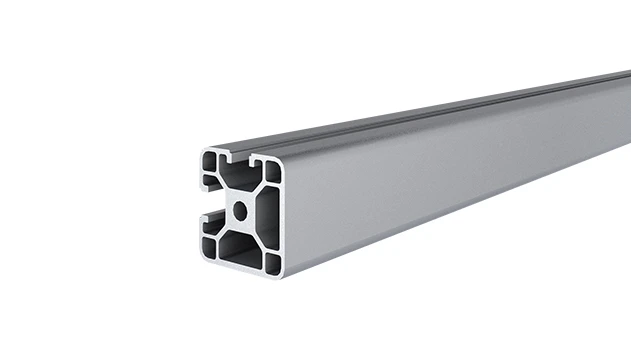
4040E is a 4.00x4.00 CM fractional 40 series square extrusion T-slot profile with two side open T-slots, two side with closed face, each side with 4.00cm face. The profile has align-a-grooves to assist in aligning connecting profiles.
Introduction: The Backbone of Modern Industrial Setups
Walk into any manufacturing facility, warehouse, or even a tech startup's workshop, and you'll likely spot a familiar sight: sleek, silver structures holding up workbenches, guiding conveyor belts, or organizing tools. Chances are, many of those structures are built with aluminum extrusion profiles —and among the most versatile and widely used is the 4040E EU standard aluminum profile. But what exactly makes this profile a go-to for engineers, designers, and facility managers? To answer that, we need to dig into its material composition, the alloys that give it strength, and how those elements work together to deliver the performance industrial environments demand.
EU standard profiles like the 4040E aren't just about uniformity in size—though that's crucial for modular builds. They're a promise of quality, durability, and consistency, engineered to meet strict European standards for material safety, mechanical performance, and dimensional accuracy. Whether you're assembling a lightweight but sturdy workbench or designing a complex material handling system, understanding what the 4040E is made of and how strong it really is can make all the difference in creating efficient, long-lasting solutions.
What Is the 4040E EU Standard Aluminum Profile?
Before diving into alloys and strength, let's clarify what "4040E" actually means. The name itself is a code: "4040" refers to the profile's cross-section dimensions—40mm by 40mm—making it a square profile ideal for balanced load-bearing and structural support. The "E" denotes its specific design within the EU standard lineup, which includes variations like 4040A, 4040B, and 4040C, each with slight differences in groove design, wall thickness, or weight capacity.
What sets the 4040E apart? Its T-slot design—longitudinal grooves along its length—allows for easy attachment of aluminum profile accessories like brackets, connectors, and panels without welding or drilling. This modularity is a game-changer: a single 4040E profile can be part of a workbench today, a shelving unit tomorrow, and a machine guard next month, all by swapping out accessories. But none of this would matter if the profile itself couldn't stand up to the demands of daily use. That's where its material composition comes in.

Material Composition: The Alloys That Define Performance
Why Aluminum Alloys, Not Pure Aluminum?
Pure aluminum is soft, malleable, and prone to bending under stress—hardly ideal for industrial structures. To make it useful, manufacturers mix it with other elements to create alloys, balancing strength, ductility, and corrosion resistance. For extrusion profiles like the 4040E, one alloy reigns supreme: 6063. You'll hear this alloy called the "architectural alloy" for its workability and aesthetic appeal, but its real strength lies in how well it combines form and function.
Breaking Down the 6063 Alloy: Key Elements and Their Roles
The 6063 alloy is a member of the 6xxx series, which are aluminum-magnesium-silicon alloys. Let's break down its main components and why each matters for the 4040E profile:
- Aluminum (97-99%): The base metal, providing lightweight properties (about 1/3 the weight of steel) and natural corrosion resistance thanks to its oxide layer.
- Magnesium (0.45-0.9%): The primary strengthener. When combined with silicon, it forms magnesium silicide (Mg₂Si), tiny particles that reinforce the aluminum matrix, boosting tensile and yield strength.
- Silicon (0.2-0.6%): Works with magnesium to create those Mg₂Si precipitates. It also improves "extrudability"—how easily the alloy can be pushed through a die to form complex shapes like the 4040E's T-slots.
- Iron (up to 0.3%): A trace element, kept low to avoid forming brittle intermetallic compounds that weaken the alloy.
- Copper, Manganese, Zinc (trace amounts): These are tightly controlled to avoid compromising corrosion resistance or workability. For example, too much copper can make the alloy prone to stress corrosion cracking.
This precise blend is why 6063 is perfect for the 4040E: it's malleable enough to be extruded into the profile's intricate T-slot design, yet strong enough to support heavy loads once formed. But the alloy alone isn't the whole story—heat treatment takes its performance to the next level.
Strength Analysis: How the 4040E Stands Up to Stress
Mechanical Properties 101: Tensile Strength, Yield Strength, and Hardness
When we talk about a profile's "strength," we're referring to specific mechanical properties that determine how it behaves under load. Let's define these in plain language, then see how the 4040E measures up:
- Tensile Strength: The maximum stress the profile can withstand before breaking. Measured in megapascals (MPa), it's like the "breaking point" of the material.
- Yield Strength: The stress at which the profile starts to deform permanently (plastic deformation). Think of it as the "bending point"—beyond this, the profile won't spring back to its original shape.
- Hardness: Resistance to indentation or scratching, often measured on the Brinell (HB) or Vickers (HV) scale. A harder profile is more wear-resistant, important for parts like aluminum guide rail A that slide against other components.
Heat Treatment: T5 vs. T6 Temper—Unlocking the Alloy's Potential
The 6063 alloy's strength is largely unlocked through heat treatment, a process that controls the formation of those Mg₂Si precipitates. For the 4040E profile, two tempers are common: T5 and T6. Let's compare their effects on mechanical properties:
| Property | T5 Temper (Air-Cooled) | T6 Temper (Water-Quenched + Aged) |
|---|---|---|
| Tensile Strength | 160-180 MPa | 200-220 MPa |
| Yield Strength | 110-130 MPa | 180-200 MPa |
| Hardness (HB) | 45-55 | 65-75 |
| Elongation (ductility) | 8-10% | 5-7% |
What's the difference between T5 and T6? T5 temper involves cooling the extruded profile in air after it exits the die. This allows some Mg₂Si precipitates to form, but slowly, resulting in moderate strength and good ductility (the ability to bend without breaking). T6 temper is more aggressive: the hot profile is quenched in water to "freeze" the magnesium and silicon in solution, then aged at 175-200°C for several hours. This causes Mg₂Si to precipitate as fine, evenly distributed particles, drastically increasing strength—though at the cost of slight ductility.
For most industrial applications, T6-tempered 4040E profiles are preferred. Imagine a workbench in an automotive assembly line, supporting heavy tools and components all day: T6's 200 MPa tensile strength ensures it won't sag or break under constant load. For lighter-duty uses, like a lab bench, T5 might be sufficient, offering cost savings without sacrificing practicality.
Comparative Strength: How 4040E Stacks Up Against Other Profiles
The 4040E isn't the only 40x40mm profile out there. Let's see how it compares to two close relatives: the 4040A (thinner walls) and 4040B (heavier duty). Using T6 temper as a baseline:
- 4040A: Wall thickness ~1.5mm, weight ~1.2 kg/m, tensile strength ~180 MPa. Lighter, but less rigid—good for lightweight frames but not heavy loads.
- 4040E: Wall thickness ~2mm, weight ~1.8 kg/m, tensile strength ~200 MPa. The sweet spot: balances weight, strength, and cost for most general industrial use.
- 4040B: Wall thickness ~3mm, weight ~2.5 kg/m, tensile strength ~210 MPa. Stronger, but heavier and pricier—overkill for many applications unless extreme load-bearing is needed.
This balance is why the 4040E is so popular. It's strong enough for workbenches, material racks, and conveyor supports, yet light enough to keep assembly and installation manageable.
Real-World Applications: Where the 4040E Shines
Workbenches: Sturdy, Customizable, and Built to Last
Walk into any workshop, and the workbench is the heart of the operation. It needs to hold tools, parts, and sometimes heavy machinery—all while remaining stable and easy to modify. The 4040E profile excels here. Its 40x40mm frame provides a solid base, and T-slots let you attach shelves, tool hooks, or even aluminum guide rail A for sliding drawers or material feeders. Pair it with a plywood or aluminum top, and you've got a workbench that can handle daily abuse without wobbling or warping.
Material Handling: Smooth Flow with Aluminum Guide Rail A
In warehouses and production lines, moving materials efficiently is key. The 4040E often forms the frame for conveyor systems, with aluminum guide rail A mounted along its T-slots to guide boxes, bins, or parts along roller tracks. The guide rail's smooth surface reduces friction, ensuring materials glide seamlessly, while the 4040E's strength keeps the entire system stable—even when loaded with heavy cartons or metal components.
Modular Racks and Cages: Flexibility for Changing Needs
Manufacturing needs evolve, and so should storage. The 4040E's modular design lets you build racks that grow with your inventory. Add shelves by attaching brackets to the T-slots, or expand vertically by stacking profiles with corner connectors. Need to reconfigure? Just loosen the bolts, rearrange, and tighten—no welding or cutting required. This flexibility is why lean system supplier often recommend 4040E for kanban systems or 5S organization setups.
The Role of Accessories: Making the 4040E Even More Versatile
A profile is only as good as the accessories that bring it to life. Aluminum profile accessories turn a simple 4040E beam into a fully functional system. Here are some essentials:
- Connectors: Corner brackets, T-joints, and swivel joints let you join profiles at any angle—90°, 45°, or even custom angles for complex structures.
- End Caps: Plastic or aluminum caps that cover the profile's ends, preventing dust buildup and adding a finished look.
- Aluminum Guide Rail A: As mentioned, these linear rails attach to T-slots to guide movement in conveyors, sliding doors, or adjustable shelving.
- Panels and Covers: Polycarbonate or metal panels for machine guards, enclosures, or privacy screens, secured via T-slot nuts.
- Leveling Feet: Adjustable feet that stabilize racks or workbenches on uneven floors, ensuring safety and precision.
A good lean system supplier will offer a full range of these accessories, ensuring you don't have to source parts from multiple vendors—a huge time-saver during assembly.
Choosing the Right Supplier: Why Quality Matters
Not all 4040E profiles are created equal. EU standards set minimum requirements, but reputable suppliers go above and beyond. When selecting a lean system supplier for your 4040E needs, look for:
- Material Certifications: Ensure the 6063 alloy meets EN 573-3 standards, with test reports for mechanical properties (tensile strength, yield strength) and chemical composition.
- Precision Extrusion: Inconsistent wall thickness or misaligned T-slots can make accessories fit poorly. Check for tight tolerances (±0.1mm on dimensions).
- Surface Finish: A smooth, anodized finish (clear or colored) not only looks better but also enhances corrosion resistance. Avoid profiles with scratches, dents, or uneven coloring.
- Accessory Compatibility: Not all T-slots are the same—some have different groove widths or depths. Make sure the supplier's accessories (like aluminum guide rail A ) are designed specifically for the 4040E's slot dimensions.
Cutting corners on supplier quality might save money upfront, but it can lead to wobbly structures, frequent repairs, or even safety hazards down the line. Investing in a reliable supplier pays off in durability and peace of mind.
Conclusion: The 4040E—More Than Just a Profile
The 4040E EU standard aluminum profile is a testament to how smart material science and engineering can transform a simple alloy into a cornerstone of modern industry. Its 6063 alloy composition, balanced between strength and workability, and enhanced by heat treatment, delivers the performance needed for workbenches, conveyors, and racks. Paired with aluminum profile accessories like aluminum guide rail A , it becomes a modular solution that adapts to any need—all while staying lightweight and corrosion-resistant.
Whether you're a small business owner building your first workshop or a large manufacturer revamping a production line, understanding the 4040E's material composition and strength helps you make informed choices. And with the right lean system supplier by your side, you can trust that every profile, every accessory, and every structure you build will stand the test of time.
In the end, the 4040E isn't just a piece of metal—it's a tool for efficiency, flexibility, and innovation. And in today's fast-paced industrial world, that's something worth investing in.