- Company Articles
- Industry articles
- Industry standards
- 4040E EU Standard Aluminum Profile Quality Control: Ensuring EU Compliance

4040E EU Standard Aluminum Profile Quality Control: Ensuring EU Compliance
Related Product
4040E EU Standard Aluminum Profile
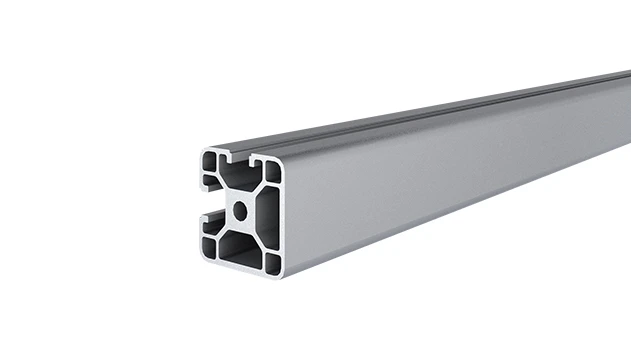
4040E is a 4.00x4.00 CM fractional 40 series square extrusion T-slot profile with two side open T-slots, two side with closed face, each side with 4.00cm face. The profile has align-a-grooves to assist in aligning connecting profiles.
In the fast-paced world of industrial manufacturing, where precision and reliability can make or break production lines, few components carry as much weight as the aluminum profile. Among these, the 4040E EU Standard Aluminum Profile stands out as a workhorse—used in everything from lean workbenches and material racks to automated conveyor systems. But what truly sets a high-quality 4040E profile apart? It's not just about the aluminum itself; it's about the rigorous quality control processes that ensure every piece meets the strict standards of the European union. For manufacturers, suppliers, and end-users alike, compliance isn't just a box to check—it's a promise of durability, safety, and performance. Let's dive into the journey of a 4040E aluminum profile, from raw material to finished product, and explore how meticulous quality control ensures it doesn't just "fit" EU standards, but excels.
Why EU Compliance Matters for Aluminum Profiles
EU compliance isn't a arbitrary set of rules—it's a framework built on decades of engineering expertise, safety research, and environmental responsibility. For aluminum profiles like the 4040E, which often serve as structural backbones in factories, laboratories, and even medical facilities, meeting EU standards (such as EN 755-9 for extrusion tolerances or EN 12346 for surface treatments) is non-negotiable. Why? Because a subpar profile can lead to wobbly workbenches that compromise operator safety, material racks that fail under load, or conveyor systems that jam, grinding production to a halt. Worse, non-compliant materials might contain harmful substances, violating REACH regulations and exposing businesses to fines or reputational damage.
For a lean system supplier , compliance is also a competitive edge. In a market where customers demand transparency, a supplier that can trace every 4040E profile back to its raw material batch, provide test certificates for every production run, and demonstrate adherence to EU norms becomes a trusted partner, not just a vendor. It's the difference between selling a "product" and selling peace of mind.
The Quality Control Journey: From Ore to Profile
Creating a compliant 4040E EU Standard Aluminum Profile isn't a one-step process. It's a multi-stage dance of science, technology, and human expertise. Let's break down the key checkpoints that ensure quality at every turn.
1. Raw Material Inspection: The Foundation of Quality
Every 4040E profile starts as aluminum alloy, typically 6063-T5—a material prized for its excellent extrudability, corrosion resistance, and strength. But not all 6063-T5 is created equal. Before a single ingot enters the extrusion press, it undergoes rigorous testing. Suppliers source aluminum from certified mills, but they don't stop there. Samples are analyzed using optical emission spectroscopy to verify alloy composition: is the magnesium content within the 0.45-0.9% range specified by EU standards? Is silicon held to 0.2-0.6%? Even trace elements like iron are checked—too much can weaken the final profile.
Physical tests are equally critical. Tensile strength, yield strength, and elongation are measured using universal testing machines. A 4040E profile destined for heavy-duty use (like supporting a multi-tier material rack B (3 row and 3 floor) ) needs to withstand static loads without deforming. If the raw aluminum fails these tests, it's rejected—no exceptions. After all, you can't build a strong house on a weak foundation.
2. Extrusion: Shaping Precision
Extrusion is where the 4040E profile takes its iconic "T-slot" shape, and precision here is everything. The process involves heating the aluminum billet to around 500°C, then forcing it through a steel die under extreme pressure. But even a slight miscalculation in temperature, speed, or die design can result in dimensional errors that render the profile non-compliant.
Enter the aluminum extrusion profile specialists. Before extrusion begins, dies are 3D-scanned to ensure their dimensions match the 4040E's design specs—40mm x 40mm cross-section, slot width of 8mm, wall thickness of 1.5mm (tolerances of ±0.1mm for critical dimensions, per EN 755-9). During extrusion, laser micrometers continuously measure the profile's width, height, and slot geometry as it exits the press. If a deviation is detected—say, the slot width drifts to 7.8mm—the machine automatically adjusts speed or temperature to correct it. Operators also perform manual checks, using calipers and gauges to verify critical points. It's a blend of automation and human oversight that leaves no room for error.
3. Surface Treatment: More Than Just Aesthetics
A 4040E profile's surface isn't just about looking good—it's a barrier against corrosion, a canvas for paint adhesion, and a factor in friction control (critical for sliding accessories like aluminum profile accessories such as end caps or connectors). EU standards demand strict control over surface finishes, whether it's anodizing, powder coating, or mechanical polishing.
Anodizing, a common treatment for 4040E profiles, involves immersing the extrusion in an electrolytic bath to create a protective oxide layer. EU standards (like EN 12373-6) specify the thickness of this layer (typically 10-20μm for general use) and its corrosion resistance. To test this, samples undergo salt spray testing: exposed to a mist of 5% sodium chloride for 48-96 hours, they must show no signs of red rust. For powder-coated profiles, adhesion is key—cross-cut tests (per EN ISO 2409) ensure the coating doesn't peel, even when scratched with a sharp blade. These tests aren't just "one and done"; every batch of profiles undergoes random sampling to ensure consistency.
4. Dimensional and Mechanical Testing: The Final Verdict
Once extruded and treated, the 4040E profile faces its final exams. Dimensional checks involve verifying straightness (no more than 1mm deviation per meter, per EN 755-2), squareness of the cross-section, and the accuracy of T-slot dimensions—because even a 0.2mm misalignment can make it impossible to attach accessories like brackets or hinges. Mechanical tests, meanwhile, confirm the profile can handle real-world stress: flexural strength (to resist bending), compressive strength (for load-bearing applications), and impact resistance (to withstand accidental knocks in a busy factory).
| Quality Check | EU Standard Reference | Testing Method | Acceptance Criteria |
|---|---|---|---|
| Alloy Composition | EN 573-3 | Optical Emission Spectroscopy | 6063-T5: Mg 0.45-0.9%, Si 0.2-0.6% |
| Extrusion Tolerance | EN 755-9 | Laser Micrometry, Manual Calipers | ±0.1mm for width/height; ±0.05mm for T-slot |
| Surface Corrosion Resistance | EN 12373-6 | Salt Spray Test (48 hours) | No red rust or pitting |
| Flexural Strength | EN ISO 178 | Three-Point Bending Test | Minimum 200 MPa |
5. Accessories: The Unsung Heroes of Compliance
A 4040E profile is only as good as the aluminum profile accessories that accompany it. Take the 4040 aluminum profile end cap , for example—a small plastic or metal piece that seals the end of the profile, preventing dust buildup and protecting workers from sharp edges. EU standards (like EN ISO 13857 for machinery safety) require end caps to stay securely in place under vibration and temperature changes, and to be free of burrs or sharp edges. Suppliers test end caps by subjecting them to 10,000 cycles of vibration (simulating a year of factory use) and checking for looseness. Similarly, connectors and brackets must meet torque specifications (e.g., M8 bolts tightened to 25 Nm without stripping) to ensure they don't fail under load.
Even something as seemingly minor as the T-slot's internal geometry matters for accessories. If the slot's angle is off by 1 degree, a bracket might not lock into place, creating a safety hazard. That's why quality control extends beyond the profile itself to the entire ecosystem of parts that make it functional.

The Role of the Lean System Supplier: Beyond Manufacturing
For a lean system supplier , quality control doesn't end when the 4040E profile leaves the factory. It's about creating a culture of accountability. This means maintaining detailed records: batch numbers linked to raw material certificates, test reports for every production run, and traceability logs that let customers track a profile's journey from extrusion press to their warehouse. It also means investing in continuous improvement—using customer feedback to refine processes, upgrading testing equipment to meet new EU standards, and training staff to spot potential issues before they become problems.
Consider a scenario: a customer orders a batch of 4040E profiles for a material rack B (3 row and 3 floor) , a heavy-duty storage solution designed to hold 500kg per shelf. A compliant supplier doesn't just ship the profiles—they provide a certificate of conformity, detailing the alloy grade, extrusion tolerances, and surface treatment results. If the customer later has questions, the supplier can pull up the batch record, showing which ingot was used, which die was in the press that day, and who inspected the final product. That level of transparency builds trust, turning first-time buyers into long-term partners.
Challenges in Maintaining EU Compliance
Ensuring EU compliance isn't without its hurdles. Raw material costs fluctuate, and sourcing certified aluminum alloy can be more expensive than generic alternatives. Extrusion dies wear over time, requiring regular maintenance to keep tolerances tight. New EU regulations (like updates to REACH or the introduction of stricter environmental standards) mean suppliers must constantly adapt, investing in new testing methods or modifying production processes.
But these challenges are also opportunities. A supplier that absorbs these costs and turns compliance into a selling point isn't just "complying"—they're innovating. For example, switching to recycled aluminum (meeting EU circular economy goals) or developing low-VOC surface treatments (aligning with EU emissions standards) can open doors to eco-conscious customers. Compliance, in short, drives progress.
Conclusion: Quality Control as a Promise
The 4040E EU Standard Aluminum Profile may seem like a simple piece of metal, but its journey from raw material to finished product is a testament to the power of quality control. Every test, every inspection, every certificate isn't just about meeting EU standards—it's about honoring a commitment to the people who will use it: the factory worker relying on a stable workbench, the logistics manager trusting a material rack to protect valuable inventory, the engineer designing a system that needs to run smoothly for years.
For a lean system supplier , this commitment is what defines success. In a world where "good enough" is increasingly unacceptable, the suppliers who treat quality control as a core value—rather than a cost center—are the ones who will thrive. Because at the end of the day, EU compliance isn't just about aluminum profiles. It's about building a manufacturing ecosystem where reliability, safety, and excellence are the norm, not the exception.
So the next time you see a 4040E profile supporting a workbench, holding a material rack, or guiding a conveyor belt, remember: it's more than metal. It's the result of thousands of small, careful choices—all driven by a dedication to quality. And that's a standard worth celebrating.