
Walk into any modern factory, workshop, or logistics center across Europe, and you'll likely spot the unassuming backbone of their operations: aluminum profiles. These sleek, modular structures quietly power assembly lines, support workbenches, and organize material racks, making spaces more efficient, adaptable, and productive. Among the most widely used profiles are the 4040E EU Standard Aluminum Profile and DIN 4040—two options that share a 40x40mm cross-section but embody distinct philosophies in engineering and application. For manufacturers, facility managers, and DIY enthusiasts alike, choosing between them isn't just about dimensions; it's about aligning with your project's unique demands for strength, compatibility, and cost. Let's dive into what makes each standard tick, how they stack up in real-world use, and how to decide which one deserves a spot in your next build.
The Rise of Aluminum Extrusion Profile: Why Standards Matter
Aluminum extrusion profile has revolutionized industrial design by solving a longstanding problem: how to create structures that are strong yet lightweight, durable yet flexible, and sturdy yet easy to modify. Unlike traditional steel frames that require welding or heavy tools, aluminum profiles use a T-slot system—grooves running along their length that let you attach accessories like brackets, panels, and connectors with simple bolts. This modularity means a single profile can transform from a workbench frame to a conveyor guardrail or a mobile trolley, all without specialized skills. But this flexibility hinges on one critical factor: standardization. Without agreed-upon specs for slot sizes, wall thicknesses, and tolerances, a bracket from one brand might not fit a profile from another, turning modular dreams into logistical nightmares.
That's where organizations like the European Committee for Standardization (CEN) and Germany's DIN step in. By setting clear guidelines, they ensure that aluminum profile accessories from different suppliers work seamlessly together, giving users the freedom to mix, match, and innovate. For businesses, this translates to lower costs, faster assembly times, and the ability to reconfigure spaces as needs evolve. Whether you're a small workshop owner ordering parts from a local aluminum profile supplier or a multinational manufacturer sourcing components across borders, standardized profiles eliminate guesswork and keep projects on track.
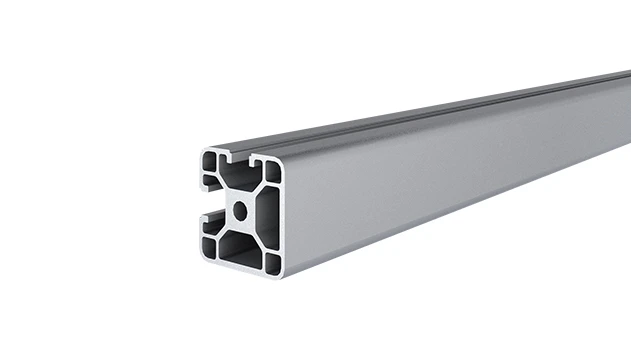
Inside the 4040E EU Standard Aluminum Profile: Designed for Accessibility
The 4040E EU Standard Aluminum Profile is a product of European harmonization, crafted to meet the EN 10278 standard—a set of rules ensuring consistency across the EU market. Let's break down its defining features:
Dimensions and T-Slot Design: Balancing Versatility and Precision
True to its name, the 4040E measures 40mm by 40mm, a sweet spot for medium-duty tasks. Its T-slots—typically 8mm or 10mm wide—are engineered for universal compatibility. Most models feature two slots per side (some have three), spaced evenly to accommodate common accessories like 4040 aluminum profile end caps, which snap into place to cover sharp edges, or 90° aluminum profile connectors that join profiles at right angles. The EU standard prioritizes accessibility, so these slots are designed to work with off-the-shelf hardware, making it easy to source parts from any reputable aluminum profile supplier.
Material and Performance: Lightweight Strength for Everyday Use
EU profiles like the 4040E are usually made from 6063-T5 aluminum alloy, a popular choice for its excellent balance of strength and malleability. This alloy resists corrosion, handles moderate loads, and extrudes smoothly into complex shapes—ideal for the T-slot design. With a standard wall thickness of 1.5mm to 2mm, the 4040E can support around 50-80kg per linear meter (depending on span), enough for most workbenches, light material racks, or machine guards. Heavier-duty versions with 3mm walls push that capacity to 100kg+, but even the standard model feels sturdy enough for daily use without weighing down assembly teams.
Surface Finish: Practicality Meets Aesthetics
EU profiles often come with an anodized finish—an electrochemical process that forms a protective oxide layer, boosting corrosion resistance and giving the aluminum a clean, matte look. While the anodizing thickness (typically 10-15μm) is sufficient for most indoor environments, many suppliers offer powder coating for added durability or custom colors. This makes the 4040E a favorite for settings where appearance matters, like customer-facing workstations or retail displays, without sacrificing functionality.

DIN 4040: German Precision for Demanding Environments
DIN 4040, developed by Germany's DIN, takes a different approach: prioritizing precision, durability, and heavy-duty performance. Think of it as the "industrial-grade" option, built for environments where reliability isn't just a bonus—it's a requirement.
Tighter Tolerances, Thicker Walls: Built to Last
While DIN 4040 also measures 40x40mm, its tolerances are stricter. Where EU profiles might allow ±0.3mm variance in width, DIN specs often call for ±0.1mm—critical for applications where components must align perfectly, like automated assembly lines or precision testing rigs. Even more noticeable is the wall thickness: DIN 4040 typically starts at 2mm (vs. 1.5mm for EU) and goes up to 4mm for heavy-duty variants. This extra metal translates to higher load capacity—often 60-120kg per linear meter—making it the go-to for storing heavy parts, supporting machinery, or building frames that withstand constant vibration.
T-Slots and Material: Engineered for Specialized Use
DIN 4040's T-slots are often deeper or narrower than EU counterparts, designed to work with specialized fasteners that lock into place more securely. While this limits compatibility with generic accessories, it ensures a tighter, more stable connection—essential for high-stress applications. Material-wise, DIN profiles use 6063-T5 as standard, but some suppliers offer 6082-T6 alloy (a stronger, heat-treated variant) for extreme loads. Surface finishes also reflect this focus on durability: anodizing thickness can reach 20μm, and options like passivation (for stainless steel-like corrosion resistance) make DIN 4040 ideal for harsh environments, from automotive factories to food processing plants.
Head-to-Head: 4040E EU vs. DIN 4040
To see how these standards compare, let's put them side by side:
| Feature | 4040E EU Standard Aluminum Profile | DIN 4040 |
|---|---|---|
| Cross-Section | 40x40mm (±0.3mm tolerance) | 40x40mm (±0.1mm tolerance) |
| Wall Thickness | 1.5-2mm (standard); up to 3mm (heavy-duty) | 2mm+ (standard); up to 4mm (heavy-duty) |
| T-Slot Width | 8mm or 10mm (universal fit) | 8mm, 10mm, or specialized (narrow/deep slots) |
| Load Capacity (1m span) | 50-100kg | 60-120kg |
| Material | 6063-T5 (standard) | 6063-T5 (standard); 6082-T6 (high-strength) |
| Surface Finish | Anodized (10-15μm); powder coating optional | Anodized (15-20μm); specialized finishes (passivation) available |
| Accessory Compatibility | Widely compatible with EU-standard aluminum profile accessories | Best with DIN-specific accessories; adapters needed for EU parts |
Aluminum Profile Accessories: The Unsung Heroes of Modularity
A profile is only as good as the accessories it works with, and here's where the EU and DIN standards diverge most noticeably. For 4040E EU profiles, the market is flooded with affordable, easy-to-find aluminum profile accessories. Need a 4040 aluminum profile end cap to cover a sharp edge? A 90° aluminum profile connector to build a corner? A T-slot rubber seal cover to keep dust out of slots? Chances are your local aluminum profile supplier stocks them all, often at budget-friendly prices. This ecosystem of (universal parts) is a huge plus for small businesses or DIYers who need to iterate quickly.
DIN 4040, by contrast, relies on specialized accessories. Its tighter tolerances and unique slot designs mean DIN-specific brackets, hinges, and fasteners are often required for a perfect fit. While these parts are built to last—think heavy-duty brackets that won't bend under stress or corrosion-resistant connectors for wet environments—they're less widely available and often pricier. If you're building a one-off project, this might not matter, but for large-scale operations, the cost of DIN accessories can add up. That said, many manufacturers now offer "hybrid" accessories designed to work with both standards, bridging the gap for mixed systems.
Choosing Your Profile: 4 Key Questions
Still on the fence? Ask yourself these questions to narrow it down:
1. What's the Maximum Weight You Need to Support?
If you're building a workbench for light assembly (think electronics or small parts), 4040E EU is more than enough. But if you're storing engine blocks, stacking heavy pallets, or mounting industrial machinery, DIN 4040's thicker walls and higher load capacity are non-negotiable. Remember: under-sizing a profile can lead to sagging, instability, or even safety hazards.
2. How Important is Access to Accessories?
If you need parts fast or want to save on accessories, 4040E EU has the edge. Most aluminum profile suppliers keep EU-standard parts in stock, and generic options are widely available online. DIN accessories, while robust, may require ordering from specialized suppliers, which can delay projects. If you're based in Germany or Central Europe, DIN parts are easier to source—but elsewhere, EU is often more convenient.
3. Will Your Project Need to Adapt Over Time?
EU profiles thrive in dynamic environments. Their universal accessories make it easy to add a shelf, extend a workbench, or repurpose a rack as your needs change. DIN systems, while durable, are harder to modify on the fly due to their specialized parts. If you anticipate frequent reconfigurations, EU's flexibility is a game-changer.
4. What's Your Budget?
EU profiles and accessories are generally more affordable. For small projects or tight budgets, 4040E lets you build quality structures without overspending. DIN 4040, with its premium materials and tighter tolerances, costs more upfront—but if your project demands durability or precision, the investment pays off in fewer replacements and less downtime.
Real-World Scenarios: When to Pick Which
Scenario 1: A Small Furniture Workshop
A family-run shop building custom wooden furniture needs a mobile workbench with tool storage. They'll use it to assemble chairs and tables, occasionally move it around the shop, and might add a shelf or vice later. For them, 4040E EU is ideal: lightweight enough to maneuver, compatible with affordable accessories (like casters and tool hooks), and easy to modify. They order profiles and a 4040 aluminum profile end cap from their local supplier, assemble the bench in a day, and can tweak it as their workflow evolves.
Scenario 2: A Automotive Parts Warehouse
A warehouse storing car transmissions (each 80kg) needs racking that can handle 50 units per shelf, with forklifts accessing them daily. DIN 4040 is the clear choice here. Its 2mm walls and 120kg load capacity ensure the racks won't bow, and the tight tolerances keep shelves level, preventing parts from sliding. DIN's corrosion-resistant finish stands up to oil and grease, and specialized heavy-duty brackets secure the structure to the floor, reducing vibration. While the initial cost is higher, the racks will last for decades, making it a smart long-term investment.
Final Thoughts: Standards That Serve You
At the end of the day, 4040E EU and DIN 4040 aren't rivals—they're tools designed for different jobs. The EU standard excels in flexibility, accessibility, and cost, making it perfect for small projects, dynamic workspaces, and budget-conscious builders. DIN 4040, with its precision engineering and heavy-duty performance, shines in high-stress, high-load environments where reliability is critical. Whichever you choose, you're tapping into the power of aluminum extrusion profile—a material that has redefined what's possible in industrial design.
Still unsure? Talk to your aluminum profile supplier. They can review your project specs, recommend the right standard, and even provide samples to test. After all, the best profile is the one that fits your needs—seamlessly, reliably, and without limiting your vision. Whether you're building a simple shelf or a complex production line, the right aluminum profile will quietly get the job done, so you can focus on what matters: creating, innovating, and growing.