- Company Articles
- Industry articles
- Industry standards
- 4040F EU Standard Aluminum Profile for Automated Conveyor Systems: Structural Requirements

4040F EU Standard Aluminum Profile for Automated Conveyor Systems: Structural Requirements
Related Product
4040F EU Standard Aluminum Profile
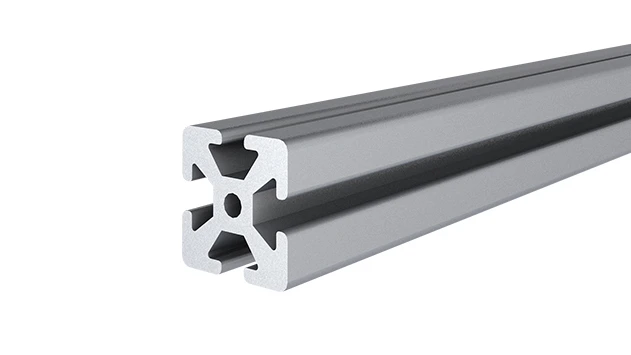
4040F is a 4.00x4.00 CM fractional 40 series square extrusion T-slot profile with four side open T-slots, each side with 4.00cm face. The profile has align-a-grooves to assist in aligning connecting profiles.
In the fast-paced world of modern manufacturing, automated conveyor systems have become the unsung heroes of efficiency. They keep production lines moving, reduce manual labor, and ensure that products flow seamlessly from one stage to the next. But behind every reliable conveyor system lies a critical component that often goes unnoticed: the aluminum profile. Among the various options available, the 4040F EU standard aluminum profile stands out as a top choice for engineers and system integrators. Its unique structural properties make it ideal for supporting the demands of automated conveyors, from heavy loads to precise alignment. In this article, we'll dive deep into the structural requirements that make the 4040F profile indispensable, explore how it integrates with key components like roller tracks and aluminum profile accessories, and understand why it's become a cornerstone of modern conveyor design.
Understanding the 4040F EU Standard Aluminum Profile
Before we delve into structural requirements, let's first get to know the star of the show: the 4040F EU standard aluminum profile. As the name suggests, this profile follows European union standards, ensuring consistency in dimensions, material quality, and performance across manufacturers. The "4040" refers to its cross-sectional dimensions—40mm in width and 40mm in height—making it a compact yet robust choice for framing structures. The "F" designation denotes a specific variation within the 4040 series, often characterized by unique T-slot configurations and wall thicknesses that set it apart from other 4040 profiles like the 4040A or 4040B.
Manufactured using the aluminum extrusion process, the 4040F profile is crafted from high-grade 6063-T5 aluminum alloy. This alloy is prized for its excellent balance of strength, corrosion resistance, and machinability—qualities that are non-negotiable in industrial environments. The extrusion process itself ensures that the profile has a uniform cross-section, with precise T-slots running along its length. These T-slots are more than just a design feature; they're the backbone of the profile's versatility, allowing for easy attachment of accessories like brackets, connectors, and roller track components without the need for welding or drilling.
| Profile Type | Wall Thickness (mm) | T-Slot Width (mm) | Weight (kg/m) | Key Application |
|---|---|---|---|---|
| 4040F EU Standard | 2.0 | 8 | 1.45 | Automated conveyor frames, workbenches |
| 4040A EU Standard | 1.5 | 6 | 1.10 | Light-duty shelving, small machinery frames |
| 4040B EU Standard | 2.5 | 10 | 1.80 | Heavy-duty industrial machinery, large conveyor systems |
The table above compares the 4040F with two other common 4040 profiles. Notice that the 4040F strikes a sweet spot between the lighter 4040A and the heavier 4040B. Its 2.0mm wall thickness provides ample strength for most conveyor applications, while its 8mm T-slot width is compatible with a wide range of standard accessories. This balance of strength and flexibility is why it's become a go-to for automated conveyor systems, where adaptability and durability are equally important.
Key Structural Requirements for Automated Conveyor Systems
Automated conveyor systems are subjected to a unique set of stresses: constant vibration from moving parts, varying load weights (from small components to bulky assemblies), temperature fluctuations in factory environments, and the need for precise alignment to prevent jams or product damage. The 4040F profile must meet several structural requirements to ensure it can handle these challenges. Let's break them down one by one.
1. Load-Bearing Capacity: Supporting the Weight of Production
Perhaps the most critical structural requirement for any conveyor frame is load-bearing capacity. Conveyors don't just carry products—they support motors, roller tracks, guides, and sometimes even auxiliary equipment like sensors or labeling machines. The 4040F profile's 2.0mm wall thickness and 6063-T5 aluminum alloy composition give it impressive load-bearing capabilities. In practical terms, this means it can support static loads of up to 500kg per linear meter when properly braced, and dynamic loads (like moving products) of 200-300kg per meter without deformation.
But load capacity isn't just about raw strength; it's also about distribution. The 4040F's square cross-section ensures that weight is evenly spread across its structure, reducing stress points. This is especially important for conveyor systems where loads are often unevenly distributed—for example, when a heavy product sits on one section of the roller track. The profile's rigidity prevents bending or warping, which could otherwise lead to misalignment and conveyor malfunctions.
2. Dimensional Accuracy: Precision for Perfect Alignment
In automated conveyors, even a tiny misalignment can cause big problems. A roller track that's off by just 1mm might lead to products jamming, slowing down production, or even damaging goods. That's why dimensional accuracy is a non-negotiable structural requirement for the 4040F profile. EU standards mandate tight tolerances for this profile: the cross-sectional dimensions (40x40mm) must be consistent within ±0.1mm, and the profile must be straight with a maximum deflection of 0.5mm per meter length.
This precision is achieved through the extrusion process, where molten aluminum is forced through a die with the exact 4040F shape. Post-extrusion, the profiles are often precision-cut and anodized to further stabilize their dimensions. The result? When you assemble a conveyor frame using 4040F profiles, you can trust that each section will line up perfectly with the next, ensuring that roller tracks, guides, and other components fit together without gaps or twists. This level of accuracy is a game-changer for system integrators, who can spend less time adjusting and more time building.
3. Compatibility with Aluminum Profile Accessories: Flexibility in Design
A profile is only as good as the accessories it works with. Automated conveyor systems require a wide range of components: brackets to mount roller tracks, connectors to join profiles at angles, end caps to protect workers from sharp edges, and feet to level the frame. The 4040F profile's T-slot design is specifically engineered for compatibility with standard aluminum profile accessories, making it incredibly flexible to work with.
Take roller track installation, for example. To attach a roller track to the 4040F profile, you might use a "roller track placon mount for aluminum profile flat" (a type of bracket designed to secure roller tracks to flat-profile surfaces). The T-slot allows you to slide this bracket into place, tighten a bolt, and have a secure connection in seconds—no drilling or welding required. Similarly, 90° aluminum profile connectors let you join two 4040F profiles at right angles, creating the corners of your conveyor frame with minimal effort. This compatibility not only speeds up assembly but also makes it easy to reconfigure the conveyor later if production needs change—say, adding a new branch or extending the line. In the world of manufacturing, where flexibility is key to adapting to market demands, this is a huge advantage.
4. Corrosion Resistance: Durability in Harsh Environments
Factory floors are tough places for equipment. Conveyors are exposed to dust, oils, coolants, and sometimes even moisture—all of which can cause metal components to rust or degrade over time. The 4040F profile addresses this with its inherent corrosion resistance. The 6063-T5 aluminum alloy naturally forms a thin oxide layer when exposed to air, which acts as a barrier against corrosion. To enhance this protection, most 4040F profiles undergo anodization—a process where the oxide layer is thickened and hardened through electrolysis. This anodized finish not only improves corrosion resistance but also adds a smooth, scratch-resistant surface that's easy to clean.
For conveyors in particularly harsh environments—like food processing facilities or pharmaceutical plants—some manufacturers offer 4040F profiles with specialized coatings, such as powder coating or chemical-resistant anodization. But even the standard anodized 4040F profile holds up well in most industrial settings, ensuring that your conveyor frame remains structurally sound for years with minimal maintenance.
5. Vibration Damping: Stability for Smooth Operation
Automated conveyors are never completely still. Motors hum, rollers spin, and products rattle as they move along the line—all of which create vibration. Over time, this vibration can loosen connections, fatigue materials, and even cause structural failure. That's why vibration damping is an important structural requirement, and the 4040F profile excels here.
Aluminum has natural vibration-damping properties, thanks to its low density and high modulus of elasticity. When vibration hits the 4040F profile, the material absorbs and dissipates the energy rather than transferring it to other parts of the conveyor. This is enhanced by the profile's closed-square design, which creates a rigid structure that resists resonant frequencies (the vibrations that can cause a structure to "sing" or amplify movement). The result is a conveyor frame that stays stable even during long hours of operation, reducing wear and tear on components and extending the system's lifespan.

Integration with Roller Tracks: A Perfect Partnership
No conveyor system is complete without roller tracks—the components that actually move products along the line. The 4040F profile's structural design makes it an ideal partner for roller tracks, providing a stable, precise foundation that ensures smooth product flow. Let's take a closer look at how these two components work together.
Roller tracks come in various materials, including plastic, steel, and aluminum, and are designed to support different product weights and speeds. For example, a plastic roller track guide rail (like the yellow or grey versions mentioned in the keywords) might be used for lightweight products, while a steel roller track is better for heavy loads. Regardless of the type, the roller track needs to be securely mounted to a frame that keeps it level and aligned.
The 4040F profile's T-slots make mounting roller tracks a breeze. Using accessories like "roller track placon mount for rail connection" or "roller track placon mount center support bracket," you can attach the track to the profile at regular intervals, ensuring that it doesn't sag under load. The brackets slide into the T-slots and are tightened with bolts, creating a connection that's both strong and adjustable. If you need to change the height of the roller track or angle it slightly to accommodate a slope, you can simply loosen the bolts, reposition the brackets, and retighten—no need to disassemble the entire frame.
Another advantage of the 4040F profile is its ability to support both straight and curved roller tracks. For straight sections, the profile's rigidity ensures that the track remains aligned over long distances. For curves, the profile can be cut at angles and joined using 45° or 90° aluminum profile connectors, creating smooth bends that guide products without jamming. This flexibility allows system designers to create conveyor layouts that fit the unique needs of their facility, whether it's a simple straight line or a complex maze of turns and merges.
Real-World Applications: 4040F in Action
To truly appreciate the 4040F profile's structural capabilities, let's look at a real-world example: a automotive parts manufacturer in Germany that upgraded its conveyor system to use 4040F profiles. Previously, the company used a steel frame conveyor that was heavy, difficult to reconfigure, and prone to rust in the humid factory environment. After switching to 4040F aluminum profiles, they saw immediate benefits:
- Reduced Weight: The aluminum frame was 40% lighter than steel, making it easier to move and reposition when the production line needed to be rearranged.
- Improved Durability: The anodized 4040F profiles resisted rust and corrosion, even in areas where coolant spills were common.
- Faster Maintenance: When a roller track needed replacement, technicians could quickly loosen the T-slot brackets, swap out the track, and get the conveyor running again in minutes—compared to hours with the old steel frame, which required welding.
- Enhanced Precision: The dimensional accuracy of the 4040F profiles reduced product jams by 90%, cutting downtime and improving overall productivity.
This case study highlights how the 4040F profile's structural requirements—load capacity, dimensional accuracy, compatibility, and corrosion resistance—translate into real business benefits for manufacturers.
Installation Best Practices for 4040F Conveyor Frames
To get the most out of your 4040F EU standard aluminum profile conveyor system, proper installation is key. Here are some best practices to ensure structural integrity and optimal performance:
• Use the Right Accessories
Always pair 4040F profiles with compatible aluminum profile accessories. Using non-standard brackets or connectors can compromise load capacity and alignment. For example, a "roller track placon mount for aluminum profile high" is designed for profiles with taller T-slots, so using it with the 4040F's 8mm slot might result in a loose fit. Stick to accessories labeled for 4040F or EU standard 40x40 profiles.
• Secure Connections with Proper Torque
When tightening bolts in the T-slots, use a torque wrench to ensure you're applying the right amount of force (typically 8-10 Nm for M8 bolts). Over-tightening can strip the T-slot threads, while under-tightening can lead to loose connections that vibrate loose over time.
• Level the Frame Before Mounting Components
Even the most precise 4040F profiles won't perform well if the frame isn't level. Use adjustable feet (like the "anti-slip adjustable leveling feet" from the keywords) to level the frame before mounting roller tracks or other components. A spirit level can help ensure that the frame is flat both horizontally and vertically.
• Brace Long Spans
For conveyor sections longer than 2 meters, add cross-braces using 4040F profiles and 90° connectors. This reduces deflection and improves load capacity, preventing the frame from sagging in the middle.
Conclusion: Why 4040F is the Future of Conveyor Design
Automated conveyor systems are the backbone of modern manufacturing, and the 4040F EU standard aluminum profile is the backbone of those systems. Its structural requirements—exceptional load capacity, pinpoint dimensional accuracy, compatibility with aluminum profile accessories, corrosion resistance, and vibration damping—make it uniquely suited to support the demands of today's production lines. Whether you're building a small conveyor for electronics assembly or a large system for automotive parts, the 4040F profile offers the perfect balance of strength, flexibility, and durability.
As manufacturing continues to evolve toward greater automation and flexibility, the role of the 4040F profile will only grow. Its ability to adapt to changing production needs, reduce maintenance costs, and improve system reliability makes it a smart investment for any facility looking to stay competitive. So the next time you walk past an automated conveyor, take a moment to appreciate the unsung hero holding it all together—the 4040F EU standard aluminum profile. It may not be the flashiest component, but it's the reason your favorite products move smoothly from assembly to shipping, day in and day out.