- Company Articles
- Industry articles
- Industry standards
- 4040F EU Standard Aluminum Profile Surface Hardness: Testing & Performance Metrics

4040F EU Standard Aluminum Profile Surface Hardness: Testing & Performance Metrics
Related Product
4040F EU Standard Aluminum Profile
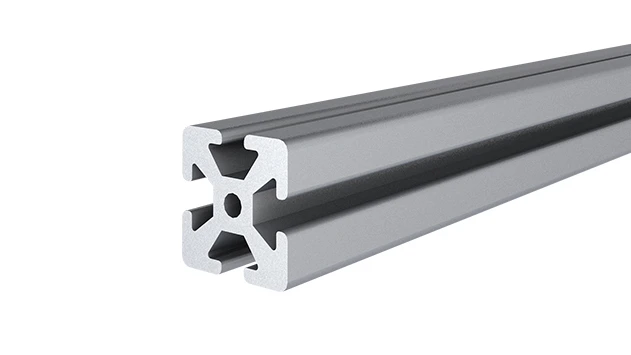
4040F is a 4.00x4.00 CM fractional 40 series square extrusion T-slot profile with four side open T-slots, each side with 4.00cm face. The profile has align-a-grooves to assist in aligning connecting profiles.
Walk into any modern manufacturing facility, warehouse, or assembly plant, and you'll likely spot a common workhorse: aluminum profiles. These versatile, lightweight structures form the backbone of everything from workbenches and material racks to conveyor systems and machine guards. But not all aluminum profiles are created equal. Among the most widely used in industrial settings is the 4040F EU standard aluminum profile —a staple for engineers and operations managers who prioritize durability, precision, and compliance with strict European standards. Today, we're diving deep into one of its most critical specifications: surface hardness. Why does it matter? How is it tested? And what do the numbers really mean for your day-to-day operations? Let's break it down.
Understanding the 4040F Aluminum Profile: More Than Just a Shape
First, let's get familiar with the star of the show. The 4040F is part of the EU standard aluminum extrusion profile family, named for its dimensions: 40mm in width and 40mm in height. The "F" designation isn't arbitrary—it refers to specific groove designs, wall thickness, and tolerances defined by European norms (EN 10274, to be precise). Unlike generic aluminum tubes, aluminum extrusion profiles like the 4040F are engineered with precision: their T-slot grooves, uniform wall thickness, and consistent cross-sections make them ideal for modular assembly. You can attach brackets, panels, or accessories with ease, turning a single profile into a custom workbench, a parts trolley, or a full production line setup.
But what sets the 4040F apart from other 40x40 profiles (like the 4040A or 4040B)? It's all in the details. The F variant typically features deeper T-slots and slightly thicker walls, making it better suited for medium-to-heavy-duty applications. Think of it as the reliable mid-size truck of the aluminum profile world—not too light for tough jobs, not overly bulky for everyday use. And at the heart of its reliability? Surface hardness.
Why Surface Hardness Matters: It's Not Just About Scratches
When we talk about "surface hardness" in aluminum profiles, we're referring to the material's resistance to permanent deformation—like dents, scratches, or indentations—when subjected to external force. You might be thinking, "So what? My profiles just hold up shelves or support a workbench." But in reality, surface hardness impacts nearly every aspect of performance:
Durability in High-Traffic Areas: Imagine a material rack in a busy warehouse, where workers slide heavy bins onto and off the shelves dozens of times a day. A profile with low surface hardness might develop deep scratches or dents over time, weakening its structural integrity. The 4040F's hardness ensures it can handle this daily wear without losing shape.
Tool and Accessory Compatibility: Those T-slots we mentioned earlier? They're designed to hold aluminum profile accessories like bolts, nuts, and end caps. A hard surface ensures that when you tighten a bolt or snap on an end cap, the profile doesn't warp or crack under pressure. Ever had a cheap profile where the T-slot stripped after a few uses? That's often a hardness issue.
Corrosion Resistance: While aluminum naturally forms a protective oxide layer, a harder surface is less prone to micro-scratches that can penetrate this layer, exposing the metal to rust or corrosion. In humid or industrial environments, this can extend the profile's lifespan by years.
Load-Bearing Capacity: Harder aluminum is stiffer, meaning it can support more weight without bending. For applications like workbenches or overhead racks, this directly translates to safety and reliability. A 4040F with optimal hardness can comfortably hold hundreds of kilograms, whereas a softer variant might sag or fail under the same load.

Testing Surface Hardness: The Methods That Matter
So how do manufacturers determine if a 4040F profile meets the EU standard for surface hardness? It all comes down to standardized testing. Three methods are most common in the industry, each with its own strengths and ideal use cases. Let's unpack them:
| Test Method | Indenter Type | Load Range | Measurement Unit | Best For 4040F Profiles |
|---|---|---|---|---|
| Brinell Hardness Test (HB) | 10mm hardened steel ball | 500-3000 kgf | HBW (Brinell Hardness Number) | Large, uniform surfaces; gives average hardness over a wider area |
| Vickers Hardness Test (HV) | Diamond pyramid (square-based) | 1-100 kgf | HV (Vickers Pyramid Number) | Precision measurements; works well for thin walls (like 4040F's 2mm thickness) |
| Rockwell Hardness Test (HR) | Diamond cone (HRC) or steel ball (HRB) | 60-150 kgf (major load) | HRC (Rockwell C) or HRB (Rockwell B) | Quick, non-destructive testing; ideal for quality control on production lines |
Let's take a closer look at each, using the 4040F as our example. The Brinell test, for instance, involves pressing a 10mm steel ball into the profile's surface with a heavy load (usually 1000 kgf for aluminum). The indentation diameter is then measured, and the hardness is calculated using a formula: HB = (2P) / (πD(D - √(D² - d²))), where P is the load, D is the ball diameter, and d is the indentation diameter. For 4040F profiles, a typical Brinell hardness value ranges from 60 to 80 HBW—enough to resist most everyday impacts without permanent damage.
The Vickers test, on the other hand, uses a tiny diamond pyramid indenter with a lighter load (often 5 kgf for thin aluminum profiles). Because the indentation is small (sometimes less than 0.1mm), it's perfect for measuring hardness in tight spots, like the edges of the T-slots or near welds. Vickers values for 4040F profiles usually fall between 65 and 90 HV. Why the range? It depends on the alloy (most 4040F profiles use 6063-T5 aluminum, a common structural alloy) and the extrusion process—factors like cooling rate and heat treatment can tweak hardness slightly.
Lastly, the Rockwell test is the speed demon of the bunch. It uses a two-step load: a small "preload" to set the indenter, followed by a larger "major load" to create the indentation. For aluminum, the HRB scale (with a 1/16" steel ball and 100 kgf major load) is standard. A 4040F profile will typically score between 65 and 80 HRB. What makes Rockwell popular? It's fast—results in seconds—and leaves a tiny indentation, so the profile remains usable after testing. That's why lean pipe suppliers and aluminum extrusion plants rely on it for batch testing: they can check hundreds of profiles a day without wasting material.
Performance Metrics: What Do the Numbers Mean for You?
Now that we know how hardness is tested, let's translate those numbers into real-world performance. For the 4040F EU standard profile, here's what you can expect, based on industry standards and typical test results:
1. Baseline Hardness: 60-80 HBW (Brinell), 65-90 HV (Vickers), 65-80 HRB (Rockwell)
These ranges aren't arbitrary—they're set by the EU standard to ensure compatibility with common industrial uses. A 4040F profile at the lower end (60 HBW) is still harder than annealed aluminum (which might be 30-40 HBW) but softer than heat-treated alloys like 6061-T6 (which can hit 95 HBW). This sweet spot balances machinability (you can still cut, drill, and tap the profile easily) with durability. For example, a workbench made with 60 HBW 4040F profiles will resist dents from dropped tools, while a material rack with 80 HBW profiles can handle heavier loads without deforming.
2. Scratch Resistance: 5N to 10N (ASTM D3363 Standard)
Scratch resistance is a practical offshoot of surface hardness. Using a pencil hardness test (yes, like the ones artists use!), labs measure how much force is needed to scratch the profile's surface. A 4040F profile typically resists scratches from pencils rated 2H to 4H under 5N of force—meaning a metal tool dragged across it with moderate pressure (like sliding a wrench off a workbench) won't leave a permanent mark. This is crucial for maintaining a clean, professional look in customer-facing areas (think showroom displays) or for preventing debris buildup in scratch grooves (which can trap dirt and accelerate corrosion).
3. Impact Resistance: 2-3 J (Charpy Test, Notched)
Hardness doesn't tell the whole story—toughness (resistance to fracture under impact) matters too. The Charpy test measures this by swinging a pendulum at a notched sample of the profile and recording the energy absorbed. A 4040F profile absorbs about 2-3 joules of energy before fracturing, which is more than enough for accidental bumps (like a forklift grazing a rack) or sudden loads (like a heavy bin slamming onto a shelf). Compare that to brittle materials like cast iron (which might shatter at 1 J), and you see why aluminum's combination of hardness and toughness is so valuable.
4. Corrosion Resistance: Passes 500-Hour Salt Spray Test (ASTM B117)
As mentioned earlier, a harder surface helps protect the aluminum's oxide layer. To verify this, labs subject 4040F profiles to salt spray tests, exposing them to a mist of 5% sodium chloride solution for 500 hours. A profile will show no signs of red rust or pitting—only minor discoloration at worst. This makes the 4040F suitable for humid environments, like food processing plants or coastal warehouses, where corrosion is a constant threat.
How 4040F Stacks Up Against Other Profiles
To truly appreciate the 4040F's hardness, let's compare it to two close relatives: the 4040A EU standard profile and the non-standard "40x40 generic" aluminum extrusion you might find from budget suppliers.
| Profile Type | Surface Hardness (HBW) | Typical Use Case | Key Tradeoff |
|---|---|---|---|
| 4040F EU Standard | 60-80 | Medium-heavy duty: workbenches, material racks, conveyor frames | Balances hardness, cost, and machinability |
| 4040A EU Standard | 50-70 | Light-medium duty: machine guards, shelving, display racks | Softer, but cheaper and lighter |
| Generic 40x40 (Non-EU) | 30-50 | Temporary structures, low-load applications | Prone to dents/scratches; may not fit standard accessories |
The 4040A, for example, has thinner walls and a lower hardness (50-70 HBW), making it better for lightweight projects but less suitable for heavy loads. The generic profile, often made with lower-grade aluminum, is significantly softer (30-50 HBW) and may not even use the 6063 alloy—meaning it's more likely to warp, scratch, or fail under stress. When you're investing in equipment that needs to last 5-10 years, the extra hardness of the 4040F is worth the slightly higher cost.
Accessories and Compatibility: Why Hardness Matters for Fittings
No profile is an island—its performance depends largely on how well it works with aluminum profile accessories . Take the humble aluminum profile end cap , for instance. These plastic or metal caps snap into the ends of profiles to cover sharp edges and prevent debris buildup. A profile with low surface hardness might crack around the T-slot when you press the end cap in, ruining the fit and leaving gaps for dirt. The 4040F's hard, uniform surface ensures a tight, secure fit that won't loosen over time.
The same goes for brackets, hinges, and connectors. When you bolt a 90° angle bracket to a 4040F profile, the hard surface distributes the clamping force evenly, preventing the T-slot from deforming. In contrast, a softer profile might "mushroom" around the bolt, making it hard to reposition the bracket later. For lean manufacturing setups, where flexibility (reconfiguring workstations quickly) is key, this is a game-changer.
Choosing a Supplier: What to Ask About Hardness Testing
Not all 4040F profiles are created equal—even if they claim to meet EU standards. To ensure you're getting the hardness and performance you need, here's what to ask your lean pipe supplier or aluminum profile vendor:
- Do you provide test certificates for each batch? Reputable suppliers will have Brinell, Vickers, or Rockwell test reports from an accredited lab, showing hardness values for the specific batch you're ordering.
- What alloy and temper are used? Look for 6063-T5 (the standard for structural profiles). Avoid "unknown alloy" or "annealed" (O-temper) profiles, which are softer.
- How do you ensure uniformity? Hardness can vary across a profile if extrusion temperatures aren't controlled. Ask about their quality control process—do they test multiple samples per batch?
Remember: a supplier who can't answer these questions is a red flag. Investing in high-quality 4040F profiles might cost 10-15% more upfront, but it pays off in fewer replacements, less downtime, and safer operations.
Final Thoughts: Hardness as a Foundation for Reliability
At the end of the day, surface hardness might seem like just another number on a spec sheet. But for anyone who relies on aluminum profiles to keep their operations running smoothly, it's the difference between a workstation that stands up to years of abuse and one that starts failing after a few months. The 4040F EU standard aluminum profile's 60-80 HBW hardness range is a testament to thoughtful engineering—balancing strength, flexibility, and compatibility to meet the demands of modern industry.
Whether you're building a production line, a warehouse rack, or a custom workbench, don't overlook this critical metric. And when you're sourcing your next batch, remember: the right supplier doesn't just sell profiles—they provide peace of mind, backed by rigorous testing and a commitment to quality. After all, in manufacturing, reliability isn't optional. It's built in—one hard, precise aluminum profile at a time.