- Company Articles
- Industry articles
- Industry standards
- 4040F EU Standard Aluminum Profile vs ANSI Standard: Which Is Better for Global Manufacturing?

4040F EU Standard Aluminum Profile vs ANSI Standard: Which Is Better for Global Manufacturing?
Related Product
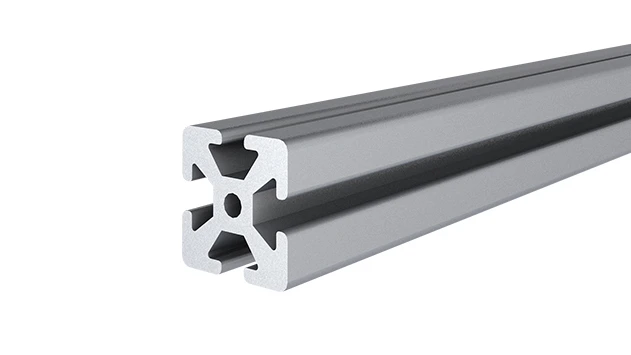
4040F EU Standard Aluminum Profile
4040F is a 4.00x4.00 CM fractional 40 series square extrusion T-slot profile with four side open T-slots, each side with 4.00cm face. The profile has align-a-grooves to assist in aligning connecting profiles.
Navigating the world of standardized components can feel like solving a puzzle—especially when your factory floor spans continents. Let's break down two of the most common aluminum profile standards and figure out which one deserves a spot in your global workflow.
The Backbone of Modern Factories: Why Aluminum Profiles Matter
Walk into any manufacturing plant today, and you'll see them everywhere: sleek, modular structures holding up assembly lines, organizing tools, and moving parts from station to station. These are aluminum extrusion profiles—long, hollow beams shaped through a process that pushes molten aluminum through a die, creating consistent cross-sections. They're the unsung heroes of lean systems, the building blocks of workbenches, flow racks, and conveyor systems that keep production humming.
But here's the catch: not all aluminum profiles are created equal. Depending on where your suppliers are based, you might end up with profiles built to either European (EU) standards or American National Standards Institute (ANSI) specs. And when your business operates across borders, mixing these standards can turn a smooth workflow into a logistical nightmare. Mismatched brackets, ill-fitting connectors, and wobbly structures—none of which help with that whole "lean manufacturing" thing we're all aiming for.
Today, we're zooming in on one of the most popular EU profiles—the 4040F EU standard aluminum profile—and pitting it against its ANSI counterparts. By the end, you'll know which one plays nicer with global supply chains, which keeps your assembly lines adaptable, and which might just save you from a headache (or ten) down the line.
First Up: The 4040F EU Standard Aluminum Profile—What Makes It Tick?
Let's start with the basics. The "4040" in 4040F refers to its dimensions: 40mm by 40mm, a square cross-section that's become a workhorse in European factories. The "F" denotes a specific slot design—think of it as the profile's "personality." EU standards, governed by organizations like DIN (Deutsches Institut für Normung), prioritize precision and modularity. These profiles aren't just pieces of metal; they're part of a larger ecosystem built around adaptability.
Design Philosophy: Modularity Above All
EU standards, including the 4040F, are all about flexibility. The T-slots running along each side of the profile are standardized, meaning any EU-compliant accessory—whether it's a bracket, a caster, or a panel mount—will slide right in without custom machining. This is a game-changer for lean systems, where reconfiguring a workbench or adding a new shelf should take minutes, not days.
Take aluminum profile accessories, for example. A 4040F profile from a German supplier will play nicely with end caps from a Polish manufacturer or hinges from a French distributor. That's because EU standards lock in critical details: slot width (often 8mm or 10mm), hole spacing, and material thickness. No guesswork, no last-minute trips to the hardware store—just plug-and-play efficiency.
Real-World Example: A automotive parts plant in Hungary recently retooled its assembly line to produce electric vehicle components. Using 4040F profiles, they swapped out old workbenches for new ones in under 48 hours—simply by unbolting the old accessories and screwing on new ones. No welding, no cutting, just modular magic.
Material Matters: Strength Meets Sustainability
EU profiles like the 4040F are typically made from 6063-T5 aluminum alloy. It's not the strongest alloy out there, but it's lightweight, corrosion-resistant, and easy to extrude—perfect for applications where you need a balance of durability and adaptability. The "T5" refers to the tempering process, which gives the aluminum just enough hardness to handle daily wear without being brittle.
Sustainability is another EU focus. Many 4040F profiles are made from recycled aluminum, and their modular design means less waste when reconfiguring lines. For factories aiming for carbon neutrality, that's a nice bonus.

On the Other Side: ANSI Standard Aluminum Profiles—Built for Toughness
Now, let's hop across the Atlantic. ANSI standards, developed by the American National Standards Institute, take a slightly different approach. While they still prioritize consistency, ANSI profiles often emphasize raw strength and heavy-duty performance. Think of them as the pickup trucks of the aluminum profile world—built to haul more, take more abuse, and stick to tried-and-true designs.
Design Philosophy: Robustness First
ANSI profiles come in similar sizes (40mm x 40mm is common here too), but their T-slots and accessory systems can vary more between manufacturers. That's not to say they're disorganized—ANSI sets guidelines for load capacities, material thickness, and safety factors—but there's more room for interpretation. For example, one ANSI profile might have a 9mm slot, another a 12mm slot, depending on the intended use.
This flexibility can be a strength. If you need a profile that can support 500kg per meter (say, for a heavy-duty conveyor), ANSI standards often have options with thicker walls or reinforced corners. They're less about "one profile fits all" and more about "here's a tool for every job."
Material Matters: Alloys for the Long Haul
ANSI profiles frequently use 6061-T6 aluminum alloy. Compared to the EU's 6063-T5, 6061-T6 is stronger and more heat-treatable, making it ideal for applications where structural integrity is non-negotiable—like aerospace components or industrial machinery frames. The downside? It's a bit heavier and less malleable, which can make extrusion more complex (and sometimes pricier).
Corrosion resistance is another consideration. ANSI profiles often skip the extra finishing steps EU profiles use, assuming they'll be used indoors or in controlled environments. That's fine for a factory in Ohio, but might be a problem if your plant is near the coast (hello, salt air).
Head-to-Head: EU 4040F vs ANSI—The Critical Differences
Enough theory—let's get practical. How do these standards stack up when you're ordering parts for a factory in Texas and a warehouse in Germany? Let's break it down with a side-by-side comparison.
| Feature | 4040F EU Standard | ANSI Standard | Implications for Global Manufacturers |
|---|---|---|---|
| Dimensional Tolerances | Extremely tight (±0.1mm on width/height) | More lenient (±0.3mm common) | EU profiles guarantee a perfect fit across suppliers; ANSI may require testing before bulk orders. |
| Accessory Compatibility | Universal T-slot sizes; accessories work across brands. | Slot sizes vary by manufacturer; accessories may need to be brand-specific. | EU systems reduce inventory (one set of accessories fits all); ANSI may require stocking multiple accessory types. |
| Material & Strength | 6063-T5 alloy (lighter, easier to extrude) | Often 6061-T6 (stronger, heavier) | EU profiles excel in lightweight, modular setups; ANSI is better for heavy loads or high-stress environments. |
| Cost Per Meter | Slightly higher (due to tight tolerances and quality control) | Often lower upfront (but hidden costs in customization) | EU may cost more initially, but saves on rework; ANSI's lower price can vanish if accessories don't fit. |
| Global Availability | Widely available in Europe, growing in Asia | Dominate North America, common in Latin America | EU profiles may incur higher shipping costs in the U.S.; ANSI can be harder to source in Europe. |
The T-Slot Problem: Why Compatibility Isn't Just About Size
Let's zoom in on that "accessory compatibility" row because it's where most global manufacturers get tripped up. Imagine this: Your U.S. plant orders ANSI profiles, and your Czech plant uses 4040F EU profiles. You decide to standardize on one set of aluminum profile accessories to save money. Sounds smart, right? Wrong.
An 8mm T-slot in a 4040F profile isn't just 8mm wide—it's also positioned a specific distance from the edge, with rounded corners that match EU-standard bolts. An ANSI profile with an 8mm slot might have that slot 2mm closer to the edge, or sharper corners. So when you try to bolt a EU bracket onto an ANSI profile, the bolt either won't seat right or sticks out awkwardly, weakening the joint. Suddenly, that "cost-saving" accessory order becomes a pile of useless metal.
Oops, We Did It Again: A medical device company once shipped 500 ANSI-compatible workbench legs to its factory in Spain, assuming they'd fit the EU profiles there. Spoiler: They didn't. The legs were 2mm too short to reach the T-slots, and reworking them cost $12,000—enough to buy 300 more legs. Lesson learned: Always test compatibility first.
Lean Systems Love Modularity—So Which Standard Delivers?
At the end of the day, most manufacturers care about one thing: Does this help me run a leaner operation? Lean systems thrive on three principles: eliminating waste, adapting quickly, and empowering workers to improve processes. Let's see how EU 4040F and ANSI profiles stack up here.
Waste Reduction: EU Profiles Win the "No Scrap" Award
EU standards' tight tolerances and universal accessories mean less waste. When you can reconfigure a workbench instead of building a new one, you're not throwing away old materials. When every bracket fits every profile, you're not ordering custom parts that end up in the trash if the design changes. It's why European factories often report lower scrap rates for aluminum components—they're built to be reused, not replaced.
Adaptability: EU Profiles Are the Chameleons
Remember that automotive plant in Hungary we talked about earlier? Their ability to retool in 48 hours? That's the power of EU modularity. ANSI profiles can be adaptable too, but it often requires more planning. If your ANSI supplier uses a unique slot design, you might need to order custom brackets weeks in advance—hardly ideal when a customer order changes overnight.
Continuous Improvement: Both Have Merits
ANSI profiles do shine in one lean area: heavy-duty applications. If your process involves moving 200kg pallets or supporting industrial robots, ANSI's stronger alloys and thicker walls mean less downtime from equipment failure. That's a win for continuous improvement—no one wants to stop production to fix a bent profile.
Making the Call: Which Standard Belongs in Your Global Toolkit?
Okay, let's cut to the chase. You run a global manufacturing operation. Should you go all-in on 4040F EU standard aluminum profiles, stick with ANSI, or mix and match? The answer, as with most things in manufacturing, is: "It depends."
Scenario 1: Your Factories Are in Europe (or Asia)
If your primary production hubs are in Germany, France, China, or Southeast Asia, 4040F EU profiles are the way to go. Local suppliers are abundant, shipping costs are low, and your workers will be familiar with the modular systems. Plus, EU standards are gaining traction in Asia, so expanding to Vietnam or Malaysia won't mean a total overhaul.
Scenario 2: You're Dominating North America
For plants in the U.S., Canada, or Mexico, ANSI profiles make sense. They're readily available, often cheaper from domestic suppliers, and designed for the heavy-duty workflows common in North American manufacturing (think automotive, aerospace, and construction equipment).
Scenario 3: You're a True Global Player (Factories Everywhere)
Here's where it gets tricky. If you have plants on both sides of the Atlantic, you have two options: standardize on one standard globally, or embrace "local for local" sourcing.
Standardizing sounds appealing—one profile, one set of accessories, one training program. But if you choose EU profiles for your U.S. plants, you'll pay more for shipping and may struggle to find local suppliers. Choose ANSI for Europe, and you'll face the opposite problem.
"Local for local" means using EU profiles in Europe, ANSI in North America, and training your teams to work with both. It requires more coordination, but it avoids those pesky shipping costs and supply chain delays. Just make sure your CAD files are labeled clearly (EU vs. ANSI) and your procurement team knows which suppliers to call for which region.
Scenario 4: You're in a High-Mix, Low-Volume Industry
If your factory builds custom products (like specialized machinery or medical devices), EU 4040F profiles are your best bet. Their modularity lets you prototype quickly, adjust designs on the fly, and reuse components across projects. ANSI profiles can work here too, but you'll likely end up with more custom parts—and more headaches.
Final Thoughts: It's About the System, Not Just the Profile
At the end of the day, the 4040F EU standard aluminum profile and ANSI standards aren't enemies—they're just tools. The "better" one depends on your unique needs: where your factories are, what you're building, and how quickly you need to adapt.
But here's the secret: Both standards are evolving. EU profiles are getting stronger, and ANSI profiles are becoming more modular. And aluminum extrusion profile technology is advancing too—new alloys, thinner walls with better strength, and even smart profiles with built-in sensors. The future of global manufacturing isn't about choosing one standard over the other; it's about building systems that can work with both, leveraging the best of each to create truly lean, global workflows.
So, whether you're Team EU, Team ANSI, or Team "Why Not Both?", remember this: The goal isn't to pick the "perfect" profile. It's to pick the one that makes your factory more efficient, your workers happier, and your customers more satisfied. And isn't that what lean systems are all about?