- Company Articles
- Industry articles
- Industry standards
- 4040r EU Standard Aluminum Profile Environmental Certifications: EPD & LEED

4040r EU Standard Aluminum Profile Environmental Certifications: EPD & LEED
Related Product
4040R EU Standard Aluminum Profile
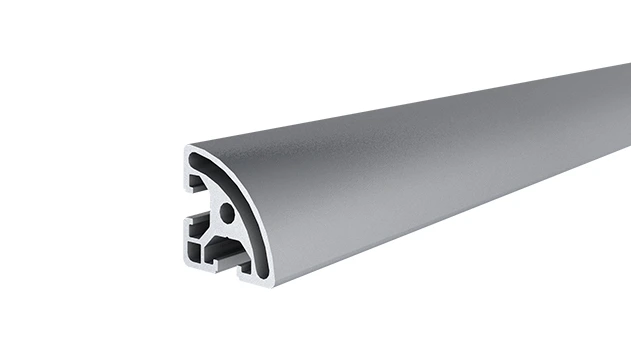
4040R is a 4.00x4.00 CM fractional 40 series square extrusion T-slot profile with two side open T-slots, each side with 4.00cm face,the other side is round face. The profile has align-a-grooves to assist in aligning connecting profiles.
In today's manufacturing landscape, sustainability isn't just a buzzword—it's a critical factor that shapes everything from production line design to long-term business success. As companies strive to reduce their environmental footprint while maintaining efficiency, the materials they choose play a pivotal role. One such material that's gaining traction for its versatility and eco-friendly credentials is the aluminum extrusion profile , and among its variants, the 4040r EU Standard Aluminum Profile stands out—especially when paired with prestigious environmental certifications like EPD (Environmental Product Declaration) and LEED (Leadership in Energy and Environmental Design). Let's dive into why these certifications matter, how the 4040r profile earns them, and what this means for businesses looking to build greener, more efficient operations.
What is the 4040r EU Standard Aluminum Profile?
Before we explore the certifications, let's get to know the star of the show: the 4040r EU Standard Aluminum Profile. Part of the broader family of aluminum profile systems, this specific variant is defined by its dimensions—40mm in width and 40mm in height—and adherence to strict EU manufacturing standards. What makes it unique? Its T-slot design, which allows for easy integration with aluminum profile accessories like brackets, connectors, and panels, making it infinitely customizable for a range of applications.
From assembly lines and material racks to workbenches and lean system structures, the 4040r profile is a workhorse. Its lightweight yet durable nature means it can support heavy loads without adding unnecessary bulk, while its corrosion-resistant properties ensure longevity even in demanding industrial environments. But what truly sets it apart is its commitment to sustainability—a trait that's formalized through EPD and LEED certifications.
Understanding EPD: Beyond Compliance, Toward Transparency
An Environmental Product Declaration (EPD) is more than just a stamp of approval; it's a comprehensive, third-party verified report that quantifies a product's environmental impact throughout its entire lifecycle. Think of it as a "nutrition label" for the planet—detailing everything from raw material extraction and manufacturing to transportation, use, and end-of-life disposal.
Why EPD Matters for Aluminum Profiles
For manufacturers and facility managers, an EPD isn't just about meeting regulatory requirements. It's about transparency. When a product like the 4040r aluminum profile carries an EPD, it provides concrete data on key environmental indicators: carbon footprint, energy consumption, water usage, and waste generation. This data helps businesses make informed choices, align their operations with sustainability goals, and even communicate their commitment to eco-conscious clients and stakeholders.
For the 4040r profile, earning an EPD involves rigorous testing and documentation. Let's break down the lifecycle stages that contribute to its environmental impact:
- Raw Material Extraction: Aluminum is derived from bauxite, but the 4040r profile prioritizes recycled aluminum (often 75% or more), significantly reducing the energy-intensive mining process.
- Manufacturing: The extrusion process—where aluminum is heated and shaped through a die—is optimized for energy efficiency, with many EU facilities using renewable energy sources.
- Transportation: Lightweight aluminum reduces fuel consumption during shipping, lowering greenhouse gas emissions.
- Use Phase: The profile's durability means less frequent replacement, minimizing waste over time.
- End-of-Life: Aluminum is 100% recyclable, with no loss in quality—a closed-loop system that aligns with circular economy principles.
By quantifying these stages, the EPD for the 4040r profile proves that it's not just "green by claim"—it's green by data.

LEED Certification: Building a Greener Future, One Profile at a Time
While EPD focuses on a product's lifecycle impact, LEED (Leadership in Energy and Environmental Design) is a globally recognized rating system for green buildings and spaces. Administered by the U.S. Green Building Council (USGBC), LEED awards points based on criteria like energy efficiency, water conservation, indoor air quality, and sustainable materials. For businesses constructing or renovating facilities—whether factories, warehouses, or offices—LEED certification is a mark of excellence in sustainable design.
How 4040r Aluminum Profile Contributes to LEED Points
You might be wondering: How does an aluminum profile fit into a building certification? The answer lies in LEED's "Materials and Resources" (MR) category, which rewards the use of sustainable, recycled, and locally sourced materials. Here's how the 4040r profile helps projects earn those crucial points:
MR Credit: Recycled Content – Since the 4040r profile uses high levels of recycled aluminum, it contributes directly to this credit. LEED awards points based on the percentage of recycled material, and aluminum's high recyclability makes this an easy win.
MR Credit: Regional Materials – Many 4040r profiles are manufactured in EU facilities, reducing transportation distances and associated carbon emissions. Sourcing materials locally (within 500 miles) can earn additional LEED points.
MR Credit: Construction Waste Management – The 4040r's modular design minimizes on-site waste. Unlike traditional building materials that require cutting or welding, T-slot profiles and their accessories are assembled with simple tools, reducing scrap and leftovers.
Beyond materials, the 4040r profile also supports LEED's "Indoor Environmental Quality" (IEQ) goals. Its smooth, non-porous surface resists mold and mildew, while aluminum itself is inert and emits no volatile organic compounds (VOCs)—ensuring healthier air quality for workers.
EPD vs. LEED: How They Work Together for the 4040r Profile
While EPD and LEED serve different purposes—one focuses on product lifecycle transparency, the other on building sustainability—they complement each other perfectly when it comes to the 4040r aluminum profile. To visualize their relationship, let's compare key aspects:
| Certification | Primary Focus | Key Requirements for 4040r Profile | Business Benefit |
|---|---|---|---|
| EPD | Product lifecycle environmental impact (cradle-to-grave) | Third-party verified data on carbon footprint, energy use, recycled content | Transparency for clients; data-driven sustainability reporting |
| LEED | Green building design and operation | Contribution to MR credits (recycled/regional materials), IEQ compliance | LEED point accumulation for facility certification; enhanced brand reputation |
Together, these certifications position the 4040r profile as a material that doesn't just meet sustainability standards—it exceeds them. For example, a manufacturer using 4040r profiles to build a workbench in a LEED-targeted facility can leverage the profile's EPD data to prove recycled content, while the workbench itself contributes to LEED points for sustainable materials. It's a win-win for both the product and the project.
Real-World Impact: 4040r Profile in Action
To understand why EPD and LEED certifications matter, let's look at a practical example: a automotive parts manufacturer looking to upgrade its assembly line with a lean system . The goal? Reduce waste, improve efficiency, and achieve LEED Gold certification for their facility.
By choosing the 4040r aluminum profile for their workbenches, material racks, and conveyor supports, the manufacturer gains several advantages:
- Sustainability Data: The EPD for the 4040r profile provides the recycled content percentage (say, 80%), which the manufacturer uses to claim LEED MR credits.
- Modularity: The T-slot design allows the lean system to be reconfigured as production needs change, eliminating the need for new materials and reducing waste.
- Durability: The profile's resistance to corrosion and wear means the system will last for decades, lowering the lifecycle carbon footprint.
- Worker Wellbeing: VOC-free aluminum contributes to better indoor air quality, supporting LEED IEQ credits and boosting employee satisfaction.
In the end, the manufacturer not only meets their LEED certification goals but also streamlines operations—proving that sustainability and efficiency can go hand in hand.
Why Choose EPD & LEED Certified Aluminum Profiles?
For businesses on the fence about investing in certified materials, the benefits are clear:
1. Competitive Edge
In a market where clients increasingly prioritize sustainability, EPD and LEED certifications are differentiators. A supplier using 4040r profiles can market their products as "LEED-contributing" or "EPD-verified," appealing to eco-conscious buyers.
2. Cost Savings
While certified materials may have a slightly higher upfront cost, they often lead to long-term savings. Reduced waste, lower energy bills (thanks to efficient manufacturing), and eligibility for green tax incentives can offset initial expenses.
3. Future-Proofing
As global regulations around carbon emissions and sustainability tighten, certified materials like the 4040r profile help businesses stay ahead of the curve. What's optional today may be mandatory tomorrow—and being prepared avoids costly retrofits.
4. Environmental Stewardship
At the end of the day, choosing EPD and LEED certified aluminum profiles is about more than profit—it's about responsibility. Aluminum's infinite recyclability, combined with transparent lifecycle data, ensures that every 4040r profile contributes to a circular economy, reducing reliance on finite resources and mitigating climate change.
Conclusion: Building a Greener Tomorrow, One Profile at a Time
The 4040r EU Standard Aluminum Profile isn't just a material—it's a statement. By earning EPD and LEED certifications, it demonstrates that sustainability and performance can coexist, offering businesses a path to greener operations without sacrificing efficiency. Whether you're designing a lean system, building a workbench, or retrofitting a facility for LEED certification, the 4040r profile proves that small choices in materials can lead to big environmental impact.
As we move toward a more sustainable future, certifications like EPD and LEED will only grow in importance. For manufacturers, suppliers, and facility managers, the question isn't whether to adopt eco-friendly materials—but which ones will deliver the best results. With its transparency, versatility, and proven environmental credentials, the 4040r EU Standard Aluminum Profile is more than up to the task.