- Company Articles
- Industry articles
- Industry standards
- 4040r EU Standard Aluminum Profile Future Trends: Innovations in Manufacturing

4040r EU Standard Aluminum Profile Future Trends: Innovations in Manufacturing
Related Product
4040R EU Standard Aluminum Profile
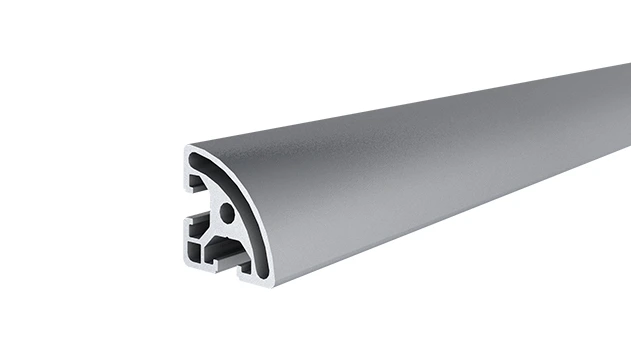
4040R is a 4.00x4.00 CM fractional 40 series square extrusion T-slot profile with two side open T-slots, each side with 4.00cm face,the other side is round face. The profile has align-a-grooves to assist in aligning connecting profiles.
In the fast-paced world of manufacturing, where efficiency, adaptability, and sustainability are no longer just buzzwords but critical business imperatives, the tools and materials that form the backbone of production lines are evolving at an unprecedented rate. Among these, the 4040r EU Standard Aluminum Profile has emerged as a quiet yet powerful game-changer. Far more than just a structural component, this modular, lightweight, and highly versatile material is reshaping how factories, workshops, and assembly lines are designed and operated. As we look ahead, the future of manufacturing will increasingly hinge on solutions that blend durability with flexibility, and the 4040r profile is poised to lead this charge. Let's explore the key trends driving its evolution and the innovations it promises to unlock.
Understanding the 4040r EU Standard Aluminum Profile
Before diving into future trends, it's essential to grasp what makes the 4040r EU Standard Aluminum Profile unique. Part of the broader family of aluminum extrusion profiles, the 4040r is defined by its standardized dimensions (40mm x 40mm cross-section) and a design optimized for modular assembly. Its "r" designation often refers to rounded edges, a feature that enhances safety in industrial settings by reducing sharp corners—a small detail that speaks to its user-centric engineering.
What truly sets it apart, however, is its compatibility with a vast ecosystem of aluminum profile accessories. From brackets and connectors to hinges and end caps, these accessories allow manufacturers to build everything from simple workbenches to complex conveyor systems with minimal tools and maximum precision. Unlike traditional steel structures, which often require welding or custom fabrication, the 4040r system is designed for quick assembly and disassembly, making it ideal for dynamic production environments where layouts need to shift with changing demands.
Current Role in Modern Manufacturing
Today, the 4040r profile is already a staple in industries ranging from automotive and electronics to pharmaceuticals and logistics. Its most common applications include lean system setups, where it forms the framework for workstations, material racks, and flow racks that streamline workflow and reduce waste. For example, a typical electronics assembly line might use 4040r-based workbenches equipped with ESD (Electrostatic Discharge) surfaces to protect sensitive components, paired with conveyor systems built from the same profiles to move parts between stations efficiently.
Its popularity stems from a unique balance of strength and lightness. Aluminum's natural resistance to corrosion and its high strength-to-weight ratio make the 4040r profile durable enough to withstand heavy loads (often up to several hundred kilograms per linear meter) while remaining easy to maneuver during reconfigurations. This combination has made it a favorite among manufacturers embracing lean manufacturing principles, where adaptability and cost-effectiveness are paramount.

Future Trend 1: Sustainability and Green Manufacturing
As the global push for sustainability intensifies, manufacturing processes are under increasing scrutiny to reduce their environmental footprint. Here, the 4040r profile shines as a poster child for green innovation. Aluminum is one of the most recyclable materials on the planet—nearly 75% of all aluminum ever produced is still in use today, thanks to recycling processes that require just 5% of the energy needed to produce primary aluminum. For manufacturers aiming to meet net-zero targets, this recyclability alone positions the 4040r profile as a superior alternative to steel or plastic, which often end up in landfills after their useful life.
Looking ahead, we can expect to see even greater emphasis on low-carbon production of 4040r profiles. Aluminum extrusion companies are already investing in renewable energy sources (such as solar or wind power) for their production facilities, and advancements in extrusion technology are reducing energy consumption per unit of output. Additionally, the modular nature of 4040r systems minimizes material waste: instead of scrapping an entire structure when needs change, components can be disassembled and repurposed, further lowering the environmental impact.
Another emerging trend is the integration of the 4040r profile with sustainable accessories, such as bio-based plastics for connectors or recycled aluminum alloys for structural components. These innovations will not only reduce the carbon footprint of the profile itself but also align with the growing consumer and regulatory demand for eco-friendly supply chains.
Future Trend 2: Integration with Industry 4.0 and Automation
The fourth industrial revolution—Industry 4.0—is transforming factories into smart, interconnected ecosystems where data-driven decision-making and automation reign supreme. In this context, the 4040r profile is evolving from a static structural element to a critical enabler of automated systems. Its modular design makes it the perfect platform for integrating sensors, actuators, and IoT (Internet of Things) devices that power smart manufacturing.
Consider conveyor systems, a cornerstone of material handling in manufacturing. Traditional conveyors are often rigid, built to fixed specifications that make upgrades or modifications costly and time-consuming. With 4040r profiles, however, conveyors can be easily reconfigured to accommodate new product sizes, speeds, or routes. Even better, the profiles' T-slots (a standard feature in aluminum extrusion profiles) allow for seamless installation of sensors that monitor belt speed, product flow, or equipment health. This data can then be fed into central management systems, enabling predictive maintenance and real-time adjustments to optimize throughput.
Workbenches, too, are becoming smarter with 4040r. Imagine a workstation where tools are automatically adjusted based on the operator's height (sensed via integrated cameras or proximity sensors), or where inventory levels of components stored in 4040r-based material racks are tracked via RFID tags embedded in the profile's accessories. These are not distant fantasies but near-term possibilities as manufacturers seek to create more efficient, human-centric work environments.
Future Trend 3: Advanced Customization and Design Flexibility
No two manufacturing facilities are identical, and in an era where product lifecycles are shorter than ever, one-size-fits-all solutions are becoming obsolete. The 4040r profile addresses this by offering unprecedented customization, made possible by its modular design and the ever-expanding range of aluminum profile accessories.
In the coming years, we'll see a shift toward hyper-specialized 4040r-based systems tailored to niche industries. For example, in the medical device sector, where cleanliness and compliance with strict regulations are critical, 4040r profiles with antimicrobial coatings could be paired with smooth, easy-to-clean surfaces and specialized aluminum profile accessories like sealed hinges to prevent bacterial buildup. In aerospace manufacturing, where precision is non-negotiable, profiles with tight tolerance controls and lightweight alloys could form the basis of jigs and fixtures that ensure parts meet exacting specifications.
This customization will extend beyond physical design to include functional adaptability. For instance, a single 4040r framework might serve as a production line during the day and a testing station at night, with accessories like adjustable shelving, tool holders, and lighting systems that can be swapped out in minutes. This level of flexibility not only reduces the need for multiple dedicated structures but also empowers small and medium-sized manufacturers (SMEs) to compete with larger players by enabling them to pivot quickly to new products or markets.
Future Trend 4: Material Innovations and Performance Enhancements
While the 4040r profile is already impressive, ongoing research into aluminum alloys and extrusion techniques is set to push its performance even further. One key area of focus is the development of high-strength aluminum alloys that maintain the profile's light weight while increasing its load-bearing capacity. This could open up new applications in heavy industries like construction or mining, where the 4040r profile might replace steel in certain structural components, reducing overall equipment weight and fuel consumption.
Surface treatments are another frontier. Advanced anodizing processes, for example, can enhance the profile's resistance to scratches, chemicals, and UV radiation, making it suitable for outdoor or harsh environments. Similarly, powder coating technologies are evolving to offer a wider range of colors and textures, allowing manufacturers to align their 4040r-based systems with brand aesthetics or safety color-coding standards (e.g., yellow for caution zones, green for eco-friendly areas).
Perhaps most exciting is the exploration of composite materials. While pure aluminum will remain the base, integrating carbon fiber or graphene into the extrusion process could create hybrid 4040r profiles with even higher strength-to-weight ratios. Though still in early stages, such innovations could revolutionize industries like electric vehicle manufacturing, where reducing vehicle weight directly translates to longer battery life.
Comparing 4040r Aluminum Extrusion Profile with Traditional Materials
| Feature | Steel (Traditional) | Wood | 4040r Aluminum Extrusion Profile |
|---|---|---|---|
| Weight | Heavy (7.85 g/cm³ density) | Moderate (varies by species, ~0.5-0.9 g/cm³) | Lightweight (2.7 g/cm³ density) |
| Recyclability | Recyclable, but high energy cost | Biodegradable, but limited recyclability in industrial use | 100% recyclable, low energy required for recycling |
| Customization | Requires welding/fabrication; low flexibility | Easy to cut, but limited structural adaptability | Modular; quick assembly with aluminum profile accessories |
| Durability | High strength, but prone to corrosion without coating | Prone to warping, rotting, or insect damage | Corrosion-resistant; high strength-to-weight ratio |
| Cost (Lifecycle) | Low upfront cost, high maintenance/modification costs | Low upfront cost, short lifespan in industrial settings | Higher upfront cost, low maintenance, long lifespan |
Challenges and Opportunities Ahead
Despite its promise, the 4040r profile faces challenges that could slow its adoption. One key hurdle is the initial cost: aluminum extrusion profiles are generally more expensive upfront than steel or wood, which can deter price-sensitive manufacturers, especially SMEs with tight budgets. However, this must be weighed against long-term savings from reduced maintenance, faster reconfigurations, and lower energy costs (due to lighter weight). Education will be critical here—suppliers and industry bodies need to better communicate the total cost of ownership (TCO) benefits of 4040r systems.
Another challenge is the need for skilled labor. While the 4040r system is designed for easy assembly, optimizing its use in smart manufacturing setups requires workers trained in modular design, IoT integration, and data analysis. As the industry moves toward more automated and connected systems, upskilling the workforce will be essential to unlocking the profile's full potential.
These challenges, however, are also opportunities. For suppliers, there's room to develop more cost-effective aluminum alloys and accessories, or to offer leasing or subscription models for 4040r systems to lower entry barriers. For educators and manufacturers, partnerships to create training programs focused on modular manufacturing and Industry 4.0 integration can help bridge the skills gap.
Conclusion: The 4040r Profile as a Catalyst for Manufacturing's Future
The 4040r EU Standard Aluminum Profile is more than just a material—it's a symbol of manufacturing's shift toward agility, sustainability, and innovation. As trends like green manufacturing, Industry 4.0, and hyper-customization reshape the industrial landscape, this unassuming profile will play a central role in turning vision into reality. Its ability to adapt to changing needs, integrate with cutting-edge technologies, and reduce environmental impact makes it a cornerstone of the factories of tomorrow.
For manufacturers willing to invest in the 4040r system, the rewards are clear: more efficient operations, lower long-term costs, and the flexibility to thrive in an uncertain future. As we look ahead, one thing is certain: the 4040r profile won't just keep up with manufacturing's evolution—it will lead it.