- Company Articles
- Industry articles
- Industry standards
- 4040r EU Standard Aluminum Profile vs. 4040 Non-EU: Dimensional Accuracy

4040r EU Standard Aluminum Profile vs. 4040 Non-EU: Dimensional Accuracy
Related Product
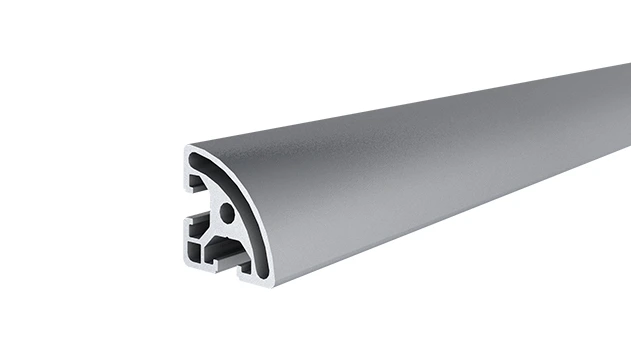
4040R EU Standard Aluminum Profile
4040R is a 4.00x4.00 CM fractional 40 series square extrusion T-slot profile with two side open T-slots, each side with 4.00cm face,the other side is round face. The profile has align-a-grooves to assist in aligning connecting profiles.
Walk into any modern factory, warehouse, or workshop, and you'll likely spot the unsung heroes of industrial design: aluminum profiles. These sleek, modular structures form the backbone of everything from workbenches and material racks to conveyor systems and lean manufacturing setups. Among the most popular is the 4040 profile—a versatile 40mm x 40mm cross-section that balances strength, weight, and adaptability. But here's the thing: not all 4040 profiles are created equal. In particular, the 4040r EU Standard Aluminum Profile and its non-EU counterparts often differ dramatically when it comes to one critical factor: dimensional accuracy. Let's dive into why that matters, what sets them apart, and how it impacts your operations.
First Things First: What Even Is a 4040 Aluminum Profile?
Before we compare standards, let's make sure we're on the same page. A 4040 aluminum profile is exactly what it sounds like: an extruded aluminum structure with a square or rectangular cross-section measuring roughly 40mm in width and 40mm in height. It's part of the broader family of aluminum extrusion profiles —products made by forcing heated aluminum through a die to create consistent, custom shapes. These profiles are prized for their lightweight strength, corrosion resistance, and modularity, thanks to T-slots that let you attach accessories like brackets, panels, and connectors with ease.
Think of 4040 profiles as the "building blocks" of industrial setups. Need a sturdy workbench? Frame it with 4040s. Setting up a lean material flow system? Use 4040s to build flow racks or roller tracks. Even small-scale projects, like a home workshop table or a retail display, rely on these profiles for their balance of durability and flexibility. But here's the catch: "4040" is just a nominal size. The actual dimensions—and how consistently they're produced—can vary wildly depending on where and how the profile is made.
EU Standard 4040r: Precision by Design
The "4040r EU Standard" isn't just a marketing term—it's a set of strict manufacturing guidelines developed by European standards bodies (like DIN or EN) to ensure consistency across the industry. The "r" often denotes "rounded" edges, a common feature in EU profiles to reduce sharpness and improve safety, but the real star here is the focus on dimensional accuracy. European manufacturers aren't just aiming for "close enough"—they're shooting for near-perfect consistency, batch after batch.
Why does the EU care so much about precision? Because European industries—from automotive to aerospace, medical device manufacturing to electronics—demand it. In these sectors, even a fraction of a millimeter can throw off an entire assembly line. For example, a lean system built with misaligned profiles might lead to jams in conveyor belts or unstable workbenches, grinding production to a halt. EU standards exist to prevent that.
To meet these standards, EU manufacturers invest heavily in high-quality dies (the metal molds used in extrusion), regular maintenance, and rigorous quality control. Each batch of 4040r profiles undergoes testing for key dimensions: width, height, wall thickness, and tolerance (how much the measurement can deviate from the nominal size). The result? Profiles that fit together like puzzle pieces, every single time.

Non-EU 4040 Profiles: The "Wild West" of Dimensional Consistency
Now, contrast that with non-EU 4040 profiles. These are produced in regions without the same strict standards—or where enforcement is lax. Some manufacturers prioritize cost-cutting over precision, using cheaper, lower-quality dies that wear out faster, skipping maintenance, or reducing quality checks to save time and money. The result? A "4040" profile that might measure 39.8mm in one section, 40.3mm in another, or have wall thicknesses that vary by 0.5mm along its length.
To be clear, not all non-EU profiles are low-quality. Some international manufacturers voluntarily adopt EU standards to compete in global markets. But many don't. The problem is that without a universal standard, buyers can't always tell the difference just by looking at a product listing. A profile labeled "4040" might meet EU specs, or it might be a loose interpretation at best.
Why would someone choose a non-EU 4040 profile, then? Price. They're often significantly cheaper than EU-standard options, which can be tempting for budget-conscious buyers. But as we'll see, those initial savings can quickly disappear when dimensional inconsistencies cause problems down the line.
Dimensional Accuracy: Breaking Down the Key Differences
Let's get specific. What exactly makes 4040r EU profiles more dimensionally accurate than many non-EU alternatives? Let's compare key measurements side by side.
| Dimension | 4040r EU Standard | Typical Non-EU 4040 | Impact of Variance |
|---|---|---|---|
| Width (Nominal: 40mm) | 39.9mm – 40.1mm (Tolerance: ±0.1mm) | 39.5mm – 40.5mm (Tolerance: ±0.5mm or more) | Loose or tight fits with accessories; misaligned T-slots. |
| Height (Nominal: 40mm) | 39.9mm – 40.1mm (Tolerance: ±0.1mm) | 39.4mm – 40.6mm (Tolerance: ±0.6mm or more) | Uneven workbench surfaces; unstable racking. |
| Wall Thickness (Typical: 1.5mm) | 1.4mm – 1.6mm (Tolerance: ±0.1mm) | 1.2mm – 1.8mm (Tolerance: ±0.3mm or more) | Weak spots in load-bearing structures; inconsistent weight capacity. |
| T-Slot Alignment | Slots centered, parallel, and evenly spaced. | Slots may be off-center or tilted; spacing varies. | Accessories (e.g., brackets, screws) won't tighten properly; tools slip during assembly. |
Let's unpack these numbers. For width and height, the EU standard allows a maximum deviation of just ±0.1mm—about the thickness of a human hair. Non-EU profiles, by contrast, might swing by ±0.5mm or more. That might sound tiny, but in practice, it's huge. Imagine trying to attach a bracket to a T-slot: if the slot is 0.3mm too narrow, the screw won't fit. If it's 0.3mm too wide, the bracket will wobble, making the entire structure unstable.
Wall thickness is another critical factor. A profile with inconsistent wall thickness is weaker in thinner areas, which can lead to bending or even failure under load. For example, a workbench made with non-EU 4040 profiles might sag in the middle over time if the wall thickness is too thin in spots, risking damage to tools or injury to workers.
Real-World Consequences: When "Close Enough" Isn't Enough
To understand why dimensional accuracy matters, let's walk through a hypothetical scenario. Suppose you're a manufacturer setting up a new assembly line. You need to build workbenches, material racks, and a conveyor system—all using 4040 aluminum profiles. You have two options: EU-standard 4040r profiles from a reputable aluminum profile supplier , or cheaper non-EU 4040 profiles from an unknown source.
You choose the non-EU profiles to save money. The first problem arises when assembling the workbenches. The T-slots on some profiles are slightly off-center, so the brackets won't line up. Your team has to drill new holes or file down the slots to make them fit—adding hours of extra labor. Then, when installing the conveyor system, the roller tracks (which rely on perfectly aligned profiles) keep jamming because the profiles are slightly warped. Products get stuck, and your production rate drops by 20%.
A few months later, one of the material racks starts to lean. Upon inspection, you find that the wall thickness of the vertical profiles varies by 0.4mm—thinner in some spots, thicker in others. The rack can't support the weight of the materials, so you have to replace it entirely. The "savings" from choosing non-EU profiles are now gone, eaten up by labor costs, lost production, and replacement parts.
Now, imagine the same scenario with 4040r EU profiles. The workbenches assemble in half the time because the brackets fit perfectly. The conveyor system runs smoothly, with no jams. The material racks stay stable for years. The initial higher cost is offset by faster setup, fewer disruptions, and longer-lasting equipment. That's the power of dimensional accuracy.
The Role of Accessories: Why Compatibility Hinges on Accuracy
Aluminum profiles don't work alone—they rely on aluminum profile accessories like connectors, end caps, gussets, and hinges to form functional structures. These accessories are designed to fit specific profile dimensions. EU-standard accessories, for example, are engineered to work with the tight tolerances of 4040r profiles. But if your profile is non-EU and has looser tolerances, those accessories might not fit at all.
Take a simple corner connector: it's supposed to slide into the T-slots of two perpendicular 4040 profiles and lock into place with a screw. If one profile is 40.5mm wide and the other is 39.5mm, the connector will be too loose on one side and too tight on the other. You might have to use washers to shim the loose side or force the tight side, which can strip the T-slot threads over time. Either way, the connection won't be as strong or reliable as it should be.
EU manufacturers solve this by designing profiles and accessories as a system. The same company that makes 4040r profiles also produces the connectors, ensuring a perfect match. Non-EU manufacturers, however, often source accessories from third parties with their own tolerances, leading to a "mismatched puzzle" effect.
How to Spot a High-Quality Profile (Before You Buy)
So, how can you tell if a 4040 profile meets EU standards or not? Here are a few tips:
- Ask for test reports: Reputable suppliers will provide certificates of compliance (CoC) showing that their profiles meet EU standards. Look for mentions of DIN or EN specifications.
- Request samples: Order a few meters of profile and measure it yourself with a caliper or micrometer. Check width, height, and wall thickness at multiple points along the length.
- Test accessories: Buy a few standard accessories (like a corner bracket or end cap) and see if they fit easily. If you have to force them, the tolerances are likely too loose.
- Check the finish: EU profiles often have a smoother, more consistent surface finish, with no visible defects like dents or scratches in the extrusion.
- Research the supplier: A quick online search can tell you if the supplier has a history of quality issues. Look for reviews from industrial buyers, not just hobbyists.
When to Choose EU vs. Non-EU: It's About Your Needs
Does this mean non-EU 4040 profiles are always a bad choice? Not necessarily. If you're building something low-stress—a simple storage rack for lightweight items, for example—minor dimensional variances might not matter. In that case, the cost savings could be worth it.
But for critical applications—anything involving heavy loads, precision assembly, or continuous operation—EU-standard 4040r profiles are almost always the better investment. Think of it this way: Would you skimp on the foundation of a house to save money? Probably not, because a weak foundation leads to bigger problems later. The same logic applies to aluminum profiles in manufacturing—they're the foundation of your operation.
The Bottom Line: Accuracy = Reliability = Savings
At the end of the day, the difference between 4040r EU standard and non-EU 4040 profiles comes down to dimensional accuracy—and that accuracy translates to reliability. EU profiles are built to precise specs, ensuring they work seamlessly with accessories, stand up to heavy use, and keep your operations running smoothly. Non-EU profiles might save you money upfront, but the hidden costs of labor, downtime, and replacements often make them more expensive in the long run.
So, the next time you're shopping for aluminum profiles, don't just look at the price tag. Ask about tolerances. Request test reports. Talk to your supplier about how their profiles are made. Your assembly line, your team, and your bottom line will thank you.