- Company Articles
- Industry articles
- Industry standards
- 4040r EU Standard Aluminum Profile vs. 5050 Profile: Space Efficiency

4040r EU Standard Aluminum Profile vs. 5050 Profile: Space Efficiency
Related Product
4040R EU Standard Aluminum Profile
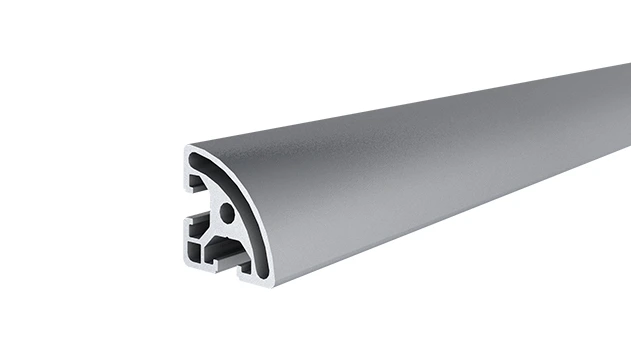
4040R is a 4.00x4.00 CM fractional 40 series square extrusion T-slot profile with two side open T-slots, each side with 4.00cm face,the other side is round face. The profile has align-a-grooves to assist in aligning connecting profiles.
In the fast-paced world of manufacturing, warehousing, and workshop design, the difference between a cluttered, inefficient space and a streamlined, productive one often comes down to the materials you choose. Aluminum profiles have become the backbone of modern facility setups—lightweight, durable, and infinitely customizable, they're the silent workhorses behind everything from assembly line workbenches to intricate material flow systems. Today, we're zeroing in on a comparison that matters to anyone tasked with optimizing space: the 4040r EU Standard Aluminum Profile versus the 5050 Profile. Both are industry staples, but when it comes to making the most of every square foot, one clearly pulls ahead. Let's dive in.
Aluminum Profiles 101: Why They're Non-Negotiable in Modern Facilities
Before we pit these two profiles against each other, let's ground ourselves in why aluminum extrusion profiles have become so indispensable. Unlike rigid materials like welded steel or fixed wooden frames, aluminum profiles are born from a process that prioritizes flexibility: heated aluminum is pushed through a die to create consistent cross-sectional shapes, resulting in lengths that can be cut, connected, and reconfigured with ease. This modularity is a game-changer—whether you're building a temporary workstation or a permanent production line, you're not stuck with a "one-and-done" structure. Add in aluminum's natural resistance to corrosion, impressive strength-to-weight ratio (it's about 30% the weight of steel), and compatibility with a vast array of aluminum profile accessories (connectors, brackets, end caps, and more), and it's easy to see why these profiles are the go-to for lean system enthusiasts and facility managers alike.
EU standard profiles take this a step further by adhering to strict dimensional guidelines, ensuring that a 4040r profile from one supplier will fit seamlessly with aluminum profile accessories from another. This standardization eliminates the guesswork, making it simple to source parts and scale systems as needs change. Now, let's zoom in on our two contenders.
Meet the 4040r EU Standard Aluminum Profile: Compact Powerhouse
The 4040r EU Standard Aluminum Profile is exactly what its name suggests: a 40mm x 40mm cross-section profile built to EU specifications. The "r" typically denotes rounded edges—a small detail that adds big benefits, from reducing the risk of snags on clothing or materials to giving finished structures a cleaner, more professional look. Don't let its compact size fool you, though: this profile punches well above its weight. With wall thicknesses ranging from 1.5mm to 3mm (depending on the application), it's more than capable of supporting the demands of most light to medium-duty tasks. Think: workbenches (like the aptly named Workbench E, a single-deck setup without casters), small material racks, lean system workstations, and even lightweight conveyor frames.
What really makes the 4040r shine is its versatility. Because it's one of the most common EU standard sizes, it boasts an extensive ecosystem of aluminum profile accessories. Need to connect two profiles at a right angle? Grab a 90° aluminum profile connector. Want to cap the end for safety? Slide on a 4040 aluminum profile end cap. This compatibility means you can build almost anything without overcomplicating the design—and without wasting space on unnecessary bulk.
Enter the 5050 Profile: The Heavyweight Contender
On the other side of the ring is the 5050 Profile, a beefier alternative with a 50mm x 50mm cross-section. Designed for applications where raw strength is the top priority, this profile is the choice for heavy-duty tasks: think industrial machinery frames, large storage racks for metal parts, or structures that need to support hundreds of kilograms of weight. With thicker walls (often 2mm to 4mm) and a larger surface area, it's undeniably stronger than the 4040r. But here's the catch: that extra strength comes with a trade-off, and that trade-off is space.
In a world where every inch counts, the 5050's larger footprint can quickly become a liability—unless you truly need its muscle. Let's break down why space efficiency matters, and how these two profiles stack up.
Space Efficiency Showdown: 4040r vs. 5050
Space efficiency isn't just about how much floor area a structure occupies—it's about balancing footprint, functionality, and adaptability. Let's unpack the key areas where the 4040r and 5050 differ, and how those differences impact your workspace.
1. Footprint: Smaller Size, Smarter Use of Space
The most immediate difference between the two profiles is their cross-sectional size: 40mm x 40mm for the 4040r, and 50mm x 50mm for the 5050. That 10mm discrepancy might seem minor, but in practice, it's the difference between a structure that fits neatly into your layout and one that forces you to rearrange. Let's start with the basics: floor space. A workbench frame built with 4040r uprights will have legs that are 40mm wide, while a 5050 frame will have 50mm legs. Multiply that by four legs, and you're looking at a base that's roughly 20% larger with the 5050. In a small workshop, that extra space could mean the difference between fitting a tool cabinet next to the bench or leaving it out entirely.
But it's not just floor space—vertical space matters too. When building racks or shelving, the 4040r's slimmer profile allows for tighter spacing between uprights. For example, a wall-mounted material rack using 4040r uprights might have supports spaced 800mm apart, while a 5050 rack would need 900mm spacing to accommodate the larger profiles. Over a 5-meter wall, that's an extra 500mm of storage length with the 4040r—enough for 2-3 additional storage bins. In a warehouse with dozens of racks, those small savings add up to significant gains in usable space.
2. Load Capacity: Do You Really Need the Extra Muscle?
Critics of the 4040r might argue, "Sure, it's smaller, but isn't the 5050 stronger?" They're not wrong—the 5050 can handle more weight. But the real question is: how much weight do you actually need to support? Let's put this in concrete terms. A standard 4040r profile with a 2mm wall thickness can safely support vertical loads of around 800kg per linear meter. For context, that's more than enough to hold a fully loaded Workbench E (think tools, components, and a laptop—maybe 200kg total) or a Material Rack B (3 rows, 3 floors) stocked with lightweight plastic parts. Even a small conveyor system moving electronics components would be well within the 4040r's comfort zone.
The 5050, by contrast, can handle upwards of 1,500kg per linear meter. That's impressive, but unless you're storing engine blocks or industrial machinery, it's overkill. Using a 5050 for a basic workbench is like using a truck to carry a backpack—you're burning space (and money) on capability you don't need. This is where the 4040r truly excels: it delivers just enough strength for 90% of applications, without the space penalty.
3. Adaptability and Modularity: Building for Change
In today's dynamic workspaces, adaptability is key. Lean systems, for example, thrive on the ability to reconfigure layouts as production needs shift. The 4040r is tailor-made for this flexibility, thanks in large part to its compatibility with a vast range of aluminum profile accessories. Need to adjust a workbench height? Swap out a few brackets. Expand a material rack? Add a couple of 4040r lengths and a 135° aluminum profile connector. Because the accessories are designed for a smaller profile, they're compact—meaning even when you modify a structure, you're not adding unnecessary bulk.
The 5050, while modular, struggles here. Its larger size means accessories like brackets and connectors are bulkier, too. A 90° aluminum profile connector for 5050 might be 15mm wider than one for 4040r, forcing you to space components further apart. Over time, these small gaps add up, turning a tight, efficient layout into a cluttered one. When you need to reconfigure, the 5050's heavier weight and larger size also make disassembly and reassembly more labor-intensive—wasting time that could be better spent on production.
4. Integration with Lean Systems: Aligning with "Less Waste, More Value"
Lean system principles are all about eliminating waste—whether that's time, materials, or space. The 4040r embodies this ethos. Lean workstations, for example, are designed to keep tools and materials within arm's reach, minimizing movement and maximizing productivity. A 4040r-based workstation can be built to fit the exact dimensions needed, with no extra space wasted. Imagine a U-shaped assembly line where each station is constructed with 4040r profiles: the tight spacing between workbenches and flow racks reduces the distance workers need to move, cutting down on "motion waste" (one of the seven deadly wastes in lean manufacturing).
The 5050, with its larger footprint, often introduces waste by default. A flow rack built with 5050 profiles might need to be 100mm deeper than one built with 4040r, pushing it further from the assembly line and forcing workers to stretch or walk further to retrieve parts. Over an 8-hour shift, those extra steps add up to lost productivity—and lost profits.

Real-World Examples: How Space Efficiency Translates to Results
Numbers and specs tell part of the story, but real-world applications bring it to life. Let's look at two scenarios where choosing 4040r over 5050 directly improved space efficiency.
Scenario 1: The Small Electronics Workshop
A local electronics manufacturer needed to set up three assembly workstations in a 20m x 15m space. Each workstation required a Workbench E (single deck, no casters), a small flow rack for components, and a turnover trolley. Using 4040r profiles, they built each workstation to a footprint of 1.2m x 0.8m—small enough to fit all three in just 2.88 square meters. With 5050 profiles, each workstation ballooned to 1.4m x 0.9m, totaling 3.78 square meters. The 0.9 square meter difference might not sound like much, but it allowed them to add a quality control station at the end of the line—turning a cramped layout into a fully functional production cell.
Scenario 2: The Warehouse Material Rack Overhaul
A warehouse manager wanted to optimize storage for small plastic parts. They needed 10 racks, each 2m tall and 1.5m wide. With 4040r uprights, they spaced shelves 600mm apart vertically, fitting 3 shelves per rack. The 40mm-deep uprights allowed for tight spacing between racks. Switching to 5050 uprights increased the depth to 50mm and required 650mm vertical spacing (due to bulkier shelf brackets), reducing shelves to 2 per rack. Over 10 racks, that's 10 fewer shelves—meaning they needed 3 extra racks to store the same inventory, eating up 30% more floor space.
When to Choose 5050: The Rare Exceptions
To be clear: the 5050 isn't a "bad" profile—it's just specialized. There are cases where its extra strength is non-negotiable. If you're storing heavy loads (think 50kg metal bins stacked 5 high) or building frames for vibrating equipment (like industrial pumps), the 5050's rigidity and load capacity are worth the space trade-off. Outdoor applications in harsh weather might also benefit, as the thicker walls offer slightly better durability against corrosion and impact. But for the vast majority of indoor, light to medium-duty tasks, the 4040r is the smarter choice.
Final Thoughts: Space Efficiency Starts with the Right Profile
At the end of the day, the 4040r EU Standard Aluminum Profile and 5050 Profile serve different purposes. The 5050 is a heavyweight, built for brute strength. The 4040r, though, is the space-savvy problem-solver—delivering enough strength for most tasks while minimizing footprint, maximizing adaptability, and aligning perfectly with lean system principles. For facility managers, lean system enthusiasts, and anyone who wants to make the most of their workspace, the choice is clear: when space efficiency matters, the 4040r is the way to go.
So, the next time you're planning a workspace upgrade, ask yourself: Do I need the 5050's muscle, or am I just defaulting to "bigger is better"? Chances are, the 4040r—paired with the right aluminum profile accessories—will give you the strength, flexibility, and space efficiency you need to build a workspace that works for you, not against you.