- Company Articles
- Industry articles
- Industry standards
- 4080A EU Standard Aluminum Profile Manufacturing: Compliance with EN Standards Explained

4080A EU Standard Aluminum Profile Manufacturing: Compliance with EN Standards Explained
Related Product
4080A EU Standard Aluminum Profile
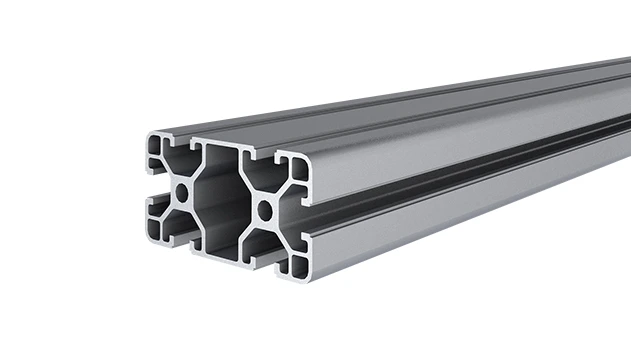
4080A is a 4.00x8.00 CM fractional 40 series square extrusion T-slot profile with two side open T-slots, each side with 4.00cm face, two side with 8.00cm face. The profile has align-a-grooves to assist in aligning connecting profiles.
Imagine walking into a bustling manufacturing facility: assembly lines hum with precision, workers move seamlessly between stations, and every tool and material has its place. Behind this efficiency lies a hidden backbone—aluminum profiles. Not just any profiles, but ones engineered to strict standards that ensure safety, reliability, and adaptability. Among these, the 4080A EU standard aluminum profile stands out as a workhorse, trusted by engineers and production managers across industries. But what makes this profile so special? And why does compliance with EN standards matter so much in its manufacturing? Let's dive in.
What Is the 4080A EU Standard Aluminum Profile?
At first glance, the 4080A EU standard aluminum profile might seem like just another piece of metal. But look closer, and you'll see it's a masterpiece of engineering. The "4080" refers to its cross-sectional dimensions: 40 millimeters in width and 80 millimeters in height—a versatile size that balances strength and flexibility. The "A" denotes its specific design within the EU standard series, characterized by T-slot grooves that run along its length, allowing for easy attachment of accessories like brackets, panels, and connectors.
This profile is part of the broader family of aluminum extrusion profiles —products formed by pushing heated aluminum billets through a die to create complex cross-sectional shapes. Extrusion is what gives aluminum profiles their versatility; unlike welded or machined parts, extruded profiles can be customized into nearly any shape, making them ideal for everything from simple frames to intricate machinery components. The 4080A, in particular, is prized for its structural rigidity, making it a go-to choice for heavy-duty applications like industrial workbenches, material handling racks, and automated conveyor systems.
But what truly sets the 4080A apart is its adherence to EU standards. In a global market where materials vary widely in quality, these standards act as a universal language—ensuring that no matter where the profile is manufactured, it meets the same rigorous benchmarks for performance and safety. For manufacturers, this means peace of mind; for end-users, it means systems that work together seamlessly, even when sourced from different suppliers.
Why EN Standards Matter in Aluminum Manufacturing
Standards might sound like technical jargon, but they're the unsung heroes of modern manufacturing. Imagine trying to build a car if every bolt had a different thread pattern, or constructing a building with steel beams of unpredictable strength. Chaos, right? EN standards—developed by the European Committee for Standardization (CEN)—prevent that chaos by establishing uniform requirements for products, processes, and services across Europe (and often beyond).
For aluminum extrusion profiles like the 4080A, EN standards serve three critical purposes: safety , interoperability , and quality assurance . Safety first: aluminum profiles are often used in load-bearing structures, from factory workbenches to machine guards. A profile that bends or fails under stress could lead to accidents, injuries, or costly downtime. EN standards set strict limits on mechanical properties like tensile strength, yield strength, and hardness, ensuring the profile can handle real-world loads.
Interoperability is equally important. In today's modular manufacturing environments, components from different suppliers need to fit together. A T-slot on a 4080A profile from one supplier should align perfectly with a bracket from another—no gaps, no forced fits. EN standards define dimensional tolerances, groove sizes, and surface finishes, so accessories like aluminum profile end caps , connectors, and hinges work universally with the profile.
Finally, quality assurance: EN compliance isn't just about meeting a checklist; it's about consistency. Manufacturers who adhere to EN standards must implement strict quality control processes, from raw material selection to final inspection. This means every batch of 4080A profiles performs as expected, reducing the risk of defects and ensuring long-term reliability.

Key EN Standards Governing 4080A Aluminum Profiles
When it comes to aluminum extrusion profiles, several EN standards come into play. Let's break down the most important ones for the 4080A:
| EN Standard | Focus Area | Key Requirements for 4080A Profiles |
|---|---|---|
| EN 755 | Aluminum and aluminum alloys – Extruded profiles | Specifies chemical composition, mechanical properties (tensile strength, elongation), and tolerances for extruded profiles. For 4080A, common alloys like 6063-T6 must meet minimum tensile strength of 160 MPa and yield strength of 110 MPa. |
| EN 12020 | Aluminum and aluminum alloys – Extruded profiles for general engineering purposes – Tolerances | Defines dimensional tolerances for profile width, height, straightness, and twist. For 4080A, width tolerance is typically ±0.3mm, height ±0.4mm, ensuring consistent fit with accessories. |
| EN 10204 | Metallic materials – Types of inspection documents | Outlines requirements for material certification. Manufacturers must provide a 3.1B certificate (third-party inspection) or 3.2 certificate (independent laboratory verification) to prove compliance with EN 755. |
| EN ISO 10274 | Aluminum and aluminum alloys – Extruded profiles – Surface quality | Sets standards for surface defects like scratches, dents, and oxidation. The 4080A's surface must be free of cracks or delamination, with acceptable minor imperfections defined by class (e.g., Class A for visible surfaces). |
EN 755 is perhaps the most critical. It classifies aluminum alloys and specifies the mechanical properties they must exhibit after extrusion and heat treatment. For example, the 4080A is often made from 6063 aluminum alloy, which is heat-treated to the T6 temper (solution heat-treated and artificially aged). EN 755 mandates that this alloy, in T6 temper, must have a minimum tensile strength of 160 megapascals (MPa) and a yield strength (the point at which it starts to deform permanently) of at least 110 MPa. These numbers aren't arbitrary—they're based on decades of testing to ensure the profile can support typical industrial loads without failure.
EN 12020, on the other hand, is all about precision. Imagine trying to attach a bracket to a 4080A profile where one section is 40.5mm wide and another is 39.5mm. The bracket might fit loosely on one and not at all on the other. EN 12020 eliminates this problem by defining tight tolerances: for the 4080A's width (40mm), the tolerance is usually ±0.3mm, and for height (80mm), ±0.4mm. This level of consistency ensures that aluminum profile accessories —from end caps to corner brackets—fit perfectly, every time.
EN 10204 ensures traceability. When you order a batch of 4080A profiles, the manufacturer must provide a certificate (usually type 3.1B) that includes details like the alloy composition, heat treatment parameters, and test results. This certificate acts as a "birth certificate" for the material, giving buyers confidence that what they're receiving meets EN standards.
The Manufacturing Process: Ensuring EN Compliance Every Step
Creating a 4080A EU standard aluminum profile isn't just about melting aluminum and shaping it—it's a carefully orchestrated process where every step is controlled to meet EN standards. Let's walk through the journey from raw material to finished product.
1. Billet Selection and Preparation
It all starts with the billet—the cylindrical block of aluminum that will be extruded. To meet EN 755, the billet must be made from a certified alloy, typically 6063 or 6082. Manufacturers source billets from reputable suppliers who provide EN 10204 certificates, ensuring the alloy composition (e.g., 0.4-0.8% silicon, 0.15-0.35% magnesium for 6063) is within EN-specified ranges. The billet is then cut to length, depending on the desired profile length, and heated to around 480-520°C (for 6063)—hot enough to become malleable but not so hot that it weakens the metal.
2. Extrusion: Shaping the Profile
The heated billet is loaded into an extrusion press, where a hydraulic ram pushes it through a steel die. The die is the blueprint for the 4080A's cross-section, with precision-machined channels that form the T-slots and outer dimensions. To meet EN 12020 tolerances, the die must be engineered to account for "die swell"—the tendency of the aluminum to expand slightly after exiting the die. Experienced die designers adjust the die dimensions to compensate, ensuring the final profile measures exactly 40mm x 80mm.
During extrusion, temperature and pressure are closely monitored. Too much heat can cause surface defects; too little pressure can result in incomplete filling of the die. Modern presses use computerized controls to maintain optimal conditions, and operators inspect the first few meters of extruded profile for dimensional accuracy and surface quality—catching issues early before they affect an entire batch.
3. Cooling and Heat Treatment
After extrusion, the hot profile is rapidly cooled using water sprays or air quenching. This step is critical for achieving the T6 temper (the "T" in 6063-T6 stands for heat treatment), which gives the aluminum its strength. EN 755 requires specific cooling rates to ensure the alloy's microstructure forms correctly. For 6063-T6, the profile must be cooled to below 200°C within minutes, then aged (heated to 175°C for 8-12 hours) to precipitate fine particles that strengthen the metal. This aging process is what pushes the tensile strength to meet EN 755's 160 MPa minimum.
4. Straightening and Cutting
Even with precise extrusion, profiles can develop slight bends or twists. To meet EN 12020's straightness tolerances (typically ≤1mm per meter), the profile is passed through a straightening machine. Rollers apply controlled pressure to bend the profile back to its intended shape. Once straight, the profile is cut to length using saws with precision guides, ensuring ends are square and lengths are consistent (±1mm for most applications).
5. Surface Treatment and Inspection
The final step is surface treatment. Most 4080A profiles receive anodizing—a process that creates a protective oxide layer on the surface, improving corrosion resistance and appearance. EN ISO 10274 specifies allowable surface defects: minor scratches or dents are acceptable, but cracks, pits, or delamination are not. After treatment, each profile undergoes a battery of inspections: calipers check dimensions, ultrasonic testers look for internal flaws, and tensile tests on sample coupons verify mechanical properties. Only profiles that pass all these checks move on to packaging and shipping.
Aluminum Profile Accessories: The Unsung Partners of the 4080A
A 4080A profile is only as good as the accessories that bring it to life. Aluminum profile accessories —end caps, connectors, hinges, and brackets—turn a simple length of aluminum into a fully functional system. But like the profile itself, these accessories must meet EN standards to ensure compatibility and safety.
Take the 4080 aluminum profile end cap , for example. This small plastic or metal cap fits over the end of the profile, protecting workers from sharp edges and preventing debris from entering the T-slots. EN standards don't specify end caps directly, but they must fit the profile's EN 12020 dimensions. A poorly fitting end cap could fall off, creating a hazard, or block T-slots needed for other accessories. Reputable suppliers design end caps to match the 4080A's exact groove spacing and outer dimensions, ensuring a snug, secure fit.
Connectors are another critical accessory. From simple L-brackets to complex 3-way joints, these components join profiles at angles, forming frames and structures. EN standards for mechanical strength apply here too: a connector used in a load-bearing application must withstand the same forces as the profile itself. Manufacturers test connectors for shear and tensile strength, ensuring they don't fail under the weight of equipment or materials placed on the 4080A frame.
Even small accessories matter. Gussets, which reinforce corners, must be thick enough to prevent bending; hinges must rotate smoothly without binding; and slot nuts, which slide into T-slots to secure bolts, must have the correct thread pitch to work with standard fasteners. When all these accessories comply with EN-aligned specifications, the result is a system that's not just functional, but also safe and durable.
Applications: How 4080A Profiles Support Lean Manufacturing Systems
In today's fast-paced manufacturing world, efficiency is king—and lean manufacturing is the strategy that delivers it. Lean systems focus on eliminating waste, streamlining workflows, and adapting quickly to change. The 4080A EU standard aluminum profile is a natural fit for lean environments, thanks to its modularity, strength, and compliance with EN standards.
Consider a lean pipe workbench —a staple in assembly lines. Traditionally made with steel pipes and fittings, modern lean workbenches increasingly use aluminum profiles like the 4080A. Why? Because aluminum is lighter than steel, making the workbench easier to reconfigure when production needs change. The T-slots allow tools, bins, and monitors to be attached exactly where workers need them, reducing motion waste. And because the 4080A meets EN standards for strength, the workbench can support heavy equipment without sagging, even over long periods.
Material handling is another area where the 4080A shines. Lean systems rely on just-in-time material delivery, which requires racks and conveyors that can adapt to varying part sizes. 4080A profiles are used to build adjustable material racks, where shelves can be moved up or down by simply loosening T-slot bolts and repositioning brackets. Conveyor frames made from 4080A are strong enough to support roller tracks and motors, while remaining lightweight enough to integrate into automated systems that move materials precisely where they're needed.
Perhaps the biggest advantage of the 4080A in lean systems is its role in continuous improvement. In lean manufacturing, nothing is set in stone—processes are constantly analyzed and optimized. A workbench that's perfect today might need to be extended or reconfigured next month. With 4080A profiles and compatible accessories, these changes can be made in hours, not days. No welding, no drilling—just unbolt, adjust, and reattach. This flexibility reduces downtime and allows teams to experiment with new layouts, driving ongoing efficiency gains.
Quality Control: Beyond the Factory Floor
Manufacturing a 4080A profile to EN standards doesn't end when it leaves the extrusion press. Rigorous quality control (QC) ensures that every profile meets specifications before it reaches the customer. Let's explore the key QC steps.
Dimensional Inspection
Using calibrated calipers, micrometers, and coordinate measuring machines (CMMs), inspectors check critical dimensions like width, height, T-slot depth, and wall thickness. These measurements are compared to EN 12020 tolerances, and any profile outside the acceptable range is rejected. For example, a 4080A profile with a width of 40.4mm (when the maximum allowed is 40.3mm) would be scrapped or reworked.
Mechanical Testing
Sample coupons are cut from each production batch and tested for tensile strength, yield strength, and elongation using a universal testing machine. These tests verify that the profile meets EN 755's mechanical property requirements. For 6063-T6, a coupon should stretch by at least 8% before breaking (elongation) and resist a pulling force of at least 160 MPa (tensile strength).
Surface Quality Checks
Profiles are visually inspected for surface defects like scratches, dents, oxidation, or discoloration. EN ISO 10274 classifies surface quality into levels (e.g., Class 1 for critical surfaces, Class 3 for non-visible surfaces), and inspectors ensure the profile meets the specified class. Anodized profiles are also checked for coating thickness and adhesion, using tools like eddy current testers.
Documentation and Traceability
Every batch of 4080A profiles comes with a detailed QC report, including test results, dimensional measurements, and a copy of the EN 10204 certificate. This documentation allows customers to trace each profile back to its raw material batch, extrusion run, and heat treatment cycle—essential for compliance audits and root cause analysis if issues arise later.
The Future of 4080A and EN Standards
As manufacturing evolves, so too will the standards and materials that drive it. The 4080A EU standard aluminum profile is no exception. Looking ahead, we can expect two key trends to shape its future: sustainability and smart manufacturing.
Sustainability is becoming a top priority for manufacturers, and aluminum is already a leader in this area—it's 100% recyclable, with recycled aluminum requiring just 5% of the energy needed to produce primary aluminum. Future EN standards may include stricter requirements for recycled content or carbon footprint labeling, pushing 4080A manufacturers to adopt greener practices, like using renewable energy in extrusion or sourcing billets from recycled aluminum.
Smart manufacturing, driven by Industry 4.0, is another trend. Imagine 4080A profiles with embedded RFID tags or QR codes that store EN compliance data, allowing operators to scan a profile and instantly verify its certification. Or extrusion presses equipped with AI-powered sensors that adjust parameters in real time to maintain EN tolerances, reducing waste and improving efficiency. These innovations won't replace EN standards—they'll make compliance easier and more transparent.
One thing is certain: the 4080A EU standard aluminum profile will remain a cornerstone of modern manufacturing. Its blend of strength, flexibility, and EN compliance makes it indispensable for building the systems that power our factories, workshops, and industries. Whether you're a production manager designing a new assembly line or a buyer sourcing materials for a lean project, choosing 4080A profiles means choosing reliability, safety, and peace of mind.
In the end, the 4080A EU standard aluminum profile is more than just a piece of metal. It's a symbol of the precision and collaboration that define modern manufacturing—proof that when we build to common standards, we build better, safer, and more efficiently. And in a world where every detail matters, that's something worth investing in.