- Company Articles
- Industry articles
- Industry standards
- 4080A vs 3060 EU Standard Aluminum Profiles: Narrow vs Wide Applications

4080A vs 3060 EU Standard Aluminum Profiles: Narrow vs Wide Applications
Related Product
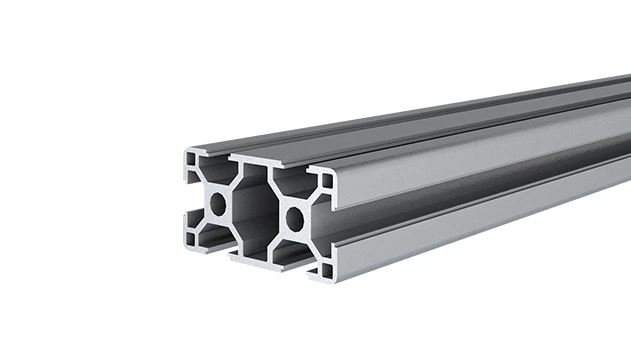
3060 EU Standard Aluminum Profile
3060 is a 3.00 x 6.00CM fractional 30 series square extrusion T-slot profile with four open T-slots, two side with 3.00cm face, two side with 6.0cm face. The profile has align-a-grooves to assist in aligning connecting profiles.
Walk into any modern factory, workshop, or even a tech startup's prototyping lab, and you'll likely spot them: sleek, silver structures holding up workbenches, guiding conveyor belts, or forming the frames of mobile carts. These are aluminum profiles—often called the "Lego blocks of manufacturing." But not all profiles are created equal. Today, we're diving into two heavyweights of the EU standard lineup: the 4080A and the 3060. Think of them as the SUV vs. the compact car of the aluminum world—each excels in its own lane, but choosing the wrong one can leave you struggling with wobbly workbenches, sagging shelves, or wasted space. Let's break down their differences, applications, and how to pick the right one for your project.
What Are EU Standard Aluminum Profiles, Anyway?
Before we meet our contenders, let's get clear on what "EU standard" means here. These profiles are part of a T-slot system—a design where grooves (or "T-slots") run along the length of the aluminum extrusion, allowing you to attach brackets, panels, and accessories without drilling or welding. It's this flexibility that makes them a favorite in lean manufacturing, prototyping, and custom setup projects. The EU standards ensure consistency in dimensions, slot sizes, and material quality, so a 4080A profile from one supplier will fit accessories from another—no guessing games.
At the heart of these profiles is aluminum extrusion profile —a process where heated aluminum is pushed through a die to create the specific cross-section (like 40x80mm or 30x60mm). This method ensures precision, strength, and uniformity, which is why these profiles are trusted in everything from small workbenches to industrial-scale material racks.
Meet the Contenders: 4080A vs 3060
Let's start with the basics: names. The numbers in "4080A" and "3060" tell you their cross-sectional dimensions. The first two digits are width, the next two are height, measured in millimeters. So, 4080A is 40mm wide and 80mm tall; 3060 is 30mm wide and 60mm tall. Simple enough, right? But there's more to their story than just size.
The 4080A: The Workhorse
The 4080A is the heavy lifter of the pair. Its 40mm width and 80mm height give it a sturdy, rectangular profile, and EU standards typically specify a material thickness of around 2.0mm for the walls. That extra thickness isn't just for show—it translates to serious load-bearing capacity. Picture a profile that can comfortably hold up a stack of steel plates or a workbench with a industrial drill press bolted to it. The T-slots on 4080A are usually 8mm wide, designed to fit beefy brackets and connectors that can handle torque and weight without bending.
At around 2.5kg per meter, it's not the lightest option, but that heft is a trade-off for stability. You'll often find 4080A in applications where "overbuilt" is better than "just enough"—think factory assembly lines, heavy-duty material racks, or machine bases that need to absorb vibration.
The 3060: The Space-Saver
If 4080A is the workhorse, the 3060 is the agile sprinter. At 30mm wide and 60mm tall, it's slimmer and more compact, with a material thickness of about 1.5mm. This makes it lighter (around 1.8kg per meter) and easier to maneuver, which is a big deal when you're building something that needs to be reconfigured often or moved by hand. Its T-slots are typically 6mm wide—smaller, but still plenty for lightweight accessories like nylon handles, small hinges, or plastic end caps.
Don't let its size fool you, though: the 3060 is no weakling. It's just engineered for different challenges—like fitting into tight spaces, supporting moderate loads, or keeping a setup lightweight and mobile. You'll spot it in electronics labs, small-scale assembly lines, and custom shelving where every inch of floor space counts.

Side-by-Side: Key Differences at a Glance
Numbers tell a clearer story than words here. Let's stack up the 4080A and 3060 on the metrics that matter most:
| Feature | 4080A EU Standard | 3060 EU Standard |
|---|---|---|
| Dimensions (Width x Height) | 40mm x 80mm | 30mm x 60mm |
| T-Slot Width | 8mm (accommodates heavy-duty fasteners) | 6mm (ideal for lightweight accessories) |
| Material Thickness | ~2.0mm (thicker walls for strength) | ~1.5mm (balanced for weight and rigidity) |
| Weight per Meter | ~2.5kg | ~1.8kg |
| Estimated Max Static Load* | Up to 800kg/m (with proper supports) | Up to 400kg/m (with proper supports) |
| Best For | Heavy loads, wide spans, industrial use | Light-to-moderate loads, tight spaces, mobility |
*Note: Load capacity depends on factors like support spacing, accessory quality, and installation. Always consult manufacturer specs for your specific use case.
Narrow Applications: Where 3060 Shines
Let's start with the 3060's playground: projects where size, weight, and flexibility are more critical than raw strength. These are "narrow" applications—not just in physical width, but in scope: smaller-scale, often dynamic setups that need to adapt quickly.
1. Compact Workbenches for Tight Spaces
Imagine a small electronics repair shop where every square foot is precious. A workbench built with 3060 profiles is slim enough to fit along a wall without blocking walkways, but still sturdy enough to hold a laptop, soldering iron, and a few tools. Since it's lightweight, you could even mount casters (small ones, of course) to roll it out of the way when not in use. I visited a phone repair shop last year that used 3060 for their entire bench setup—they'd added a fold-down shelf for extra workspace, and the whole thing weighed less than 50kg, making it easy to reposition for group repairs.
This is where the workbench keyword comes to life: 3060 lets you build functional, space-efficient work surfaces that don't feel like they're taking over the room.
2. Lightweight Mobile Carts
Need to move parts from station A to station B? A 3060 cart is your friend. Its light weight means even a fully loaded cart (with, say, 50kg of small components) can be pushed by one person. Plus, the narrow profile lets it glide through doorways and between tight production lines that a bulkier 4080A cart might get stuck in. I've seen startups use 3060 carts for everything from coffee runs in the office to transporting 3D printed parts between printers and post-processing stations.
3. Small-Scale Shelving and Storage
Not all storage needs to hold pallets of steel. If you're organizing screws, nuts, or small electronic components, 3060 shelves are perfect. They're easy to assemble (no heavy lifting required), and the T-slots let you add dividers or bins to keep things tidy. A 3060 shelf unit might hold 10-15kg per shelf—plenty for lightweight items—without the bulk of a 4080A setup. And if you need to move the shelf later? Just disassemble it and rebuild elsewhere—no power tools needed.
Wide Applications: Why 4080A Takes the Lead
Now, let's shift to the 4080A's territory: "wide" applications where strength, stability, and durability are non-negotiable. These are projects that need to stand up to heavy loads, constant use, and even harsh industrial environments.
1. Industrial Workbenches with Heavy Gear
Picture a workbench in an automotive parts factory, holding a 200kg hydraulic press. A 3060 frame here would flex under the weight, leading to wobbly tools and imprecise work. The 4080A, with its 2.0mm walls and wider base, distributes that weight evenly, keeping the bench rock-solid. Add in a thick plywood or steel top, and you've got a surface that can handle sledgehammers, welding torches, and daily abuse without a scratch.
2. Lean System Material Racks
In lean system setups—where efficiency and material flow are king—you need racks that can hold bulk raw materials (like sheets of metal or pallets of plastic) and feed them smoothly to the production line. 4080A is the backbone here. Its high load capacity means you can stack heavier items without worrying about shelves sagging over time. Plus, the 8mm T-slots let you attach heavy-duty roller tracks (another EU standard accessory) to create gravity-fed racks, where materials slide down to the pick point—no lifting required. I visited a furniture factory last month that used 4080A for their lean system racks, and they estimated it cut material retrieval time by 30% compared to their old wooden shelves.
3. Conveyor and Machine Frames
Conveyor systems are workhorses, moving products 24/7. The frame holding that conveyor needs to be rigid enough to keep the belt aligned and absorb vibrations from the motor. 4080A's width and thickness make it ideal here. It can span longer distances between supports (reducing the number of posts needed) and resist twisting under the constant motion of the conveyor. Similarly, machine frames—like those for CNC routers or injection molding machines—rely on 4080A for stability, ensuring the machine stays calibrated and produces precise parts.
Accessories Matter: The Right Parts for the Right Profile
You wouldn't put a compact car tire on an SUV, and the same logic applies to aluminum profile accessories . Both 4080A and 3060 work with T-slot systems, but their accessories are often designed with their specific strengths in mind.
For 4080A, you'll see heavy-duty brackets (like 90° steel connectors), large casters with locking brakes, and thick end caps to cover the T-slots. These accessories are built to handle the same loads as the profile itself—think a 50kg caster that won't bend when the rack is fully loaded. For 3060, accessories are lighter: nylon hinges that pivot smoothly, small plastic handles for pulling carts, and lightweight casters that make mobility a breeze. Some accessories are universal (like basic T-slot nuts), but mixing and matching—say, using a 4080A bracket on a 3060 profile—can lead to loose fits or stripped slots, so it's best to stick to profile-specific parts.
Cost: Is Wider Always More Expensive?
Let's talk budget. Unsurprisingly, 4080A costs more per meter than 3060—usually by 20-30%, depending on the supplier. But here's the catch: if you try to use 3060 for a heavy-duty job, you'll end up adding more supports (like extra vertical posts) to compensate for its lower load capacity, which can drive up costs. For example, a 4080A shelf might need supports every 1.5 meters, while a 3060 shelf with the same load might need supports every 0.8 meters—more profiles, more connectors, more labor. So, while 4080A has a higher upfront cost, it can be cheaper in the long run for wide applications.
For narrow applications, though, 3060 is the budget winner. Why pay for extra strength you don't need? A small workbench or lightweight cart built with 3060 will cost significantly less than the same setup with 4080A, with no sacrifice in performance.
How to Choose: A Quick Checklist
Still on the fence? Ask yourself these questions:
- What's your max load? If it's over 400kg/m, go 4080A. Under that, 3060 could work.
- How much space do you have? Tight quarters? 3060's slimmer profile saves space.
- Will it move? Lightweight and mobile? 3060. Stationary and heavy? 4080A.
- Long-term durability? Industrial use with heavy wear? 4080A's thicker walls last longer.
Final Thoughts: It's About the Job, Not the Profile
At the end of the day, the 4080A and 3060 aren't rivals—they're teammates. The 3060 excels in tight, lightweight, and mobile setups, while the 4080A dominates in heavy-duty, industrial, and high-load applications. The key is to match the profile to the job. A 3060 workbench in a small electronics lab is just as smart as a 4080A lean system rack in a car factory.
So, next time you're planning a build, take a step back and ask: What does this project really need? Strength? Space? Mobility? Let that answer guide you, and you'll end up with a setup that's not just functional, but built to last.