- Company Articles
- Industry articles
- Industry standards
- 4080B EU Standard Aluminum Profile: Material Composition & Manufacturing Process

4080B EU Standard Aluminum Profile: Material Composition & Manufacturing Process
Related Product
4080B EU Standard Aluminum Profile
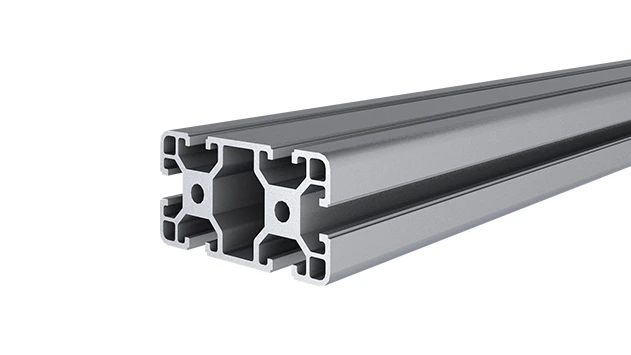
4080B is a 4.00x8.00 CM fractional 40 series square extrusion T-slot profile with two side open T-slots, each side with 4.00cm face, two side with 8.00cm face. The profile has align-a-grooves to assist in aligning connecting profiles.
Step onto the floor of any cutting-edge manufacturing plant, and you'll quickly notice the backbone of its operations: sleek, modular structures that hold tools, guide materials, and keep workflows moving. These aren't just random metal frames—they're often built from aluminum extrusion profiles, and one of the most trusted names in this space is the 4080B EU Standard Aluminum Profile. But what exactly goes into making this profile so reliable? How does it transition from raw materials to a critical component of lean systems worldwide? Let's take a deep dive into its material makeup, the intricate manufacturing journey, and why it's become a go-to choice for engineers and facility managers alike.
Material Composition: The Science Behind 4080B's Strength
At its core, the 4080B profile is a masterclass in material science, blending aluminum with carefully selected alloys to balance strength, flexibility, and durability. Aluminum itself is a popular choice for industrial applications thanks to its natural advantages: it's lightweight (about a third the density of steel), highly resistant to corrosion, and infinitely recyclable. But raw aluminum alone isn't enough to meet the demands of factory floors. That's where alloying comes in.
The 6063 Aluminum Alloy: A Perfect Extrusion Candidate
The 4080B profile is typically crafted from 6063 aluminum alloy, often called the "architectural alloy" for its smooth finish and excellent formability. Unlike high-strength alloys like 6061 (used in aerospace), 6063 prioritizes extrusion quality—critical for creating the precise 40mm x 80mm cross-section that gives the 4080B its name. Let's break down its key components:
- Aluminum (97.5-99%): The base metal, providing lightness and corrosion resistance.
- Magnesium (0.45-0.9%): Boosts strength and ductility, allowing the alloy to bend without cracking during extrusion.
- Silicon (0.2-0.6%): Works with magnesium to form Mg2Si particles, which strengthen the alloy during heat treatment.
- Iron (max 0.35%): kept low to avoid brittle intermetallic compounds that could weaken the profile.
- Trace elements (copper, manganese, zinc): Added in tiny amounts to fine-tune properties like machinability and surface finish.
This blend makes 6063 ideal for extrusion. When heated, it flows smoothly through dies, capturing even intricate details (like the T-slots along the 4080B's length, which allow for easy attachment of accessories). Once cooled and heat-treated, it achieves a tensile strength of 180-240 MPa—strong enough to support heavy tools on a workbench or materials on a material rack, yet light enough to reconfigure without heavy machinery.
Mechanical Properties: Why 4080B Stands Up to Daily Wear
To meet EU standards, the 4080B profile undergoes rigorous testing. Here's how its key properties stack up (typically in T5 or T6 temper, the most common heat-treated conditions):
| Property | T5 Temper (Air-Cooled) | T6 Temper (Artificially Aged) |
|---|---|---|
| Tensile Strength | 180-210 MPa | 215-240 MPa |
| Yield Strength | 110-140 MPa | 170-190 MPa |
| Elongation (25mm gauge) | 8-12% | 5-8% |
| Hardness (Brinell) | 50-60 HB | 70-80 HB |
For context, T6 temper offers higher strength but slightly less flexibility than T5—perfect for static structures like material racks, while T5 might be preferred for components that need a bit more give, like adjustable workbench frames. Either way, both meet the strict EU standards for industrial profiles, ensuring consistency across batches.
Manufacturing Process: From Billet to Finished Profile
Creating a 4080B profile is a blend of art and engineering, requiring precision at every step. Let's walk through the journey from raw aluminum to a ready-to-use extrusion.
Step 1: Billet Production – The Foundation
It all starts with aluminum ingots, which are melted in a furnace at around 750°C. Once molten, the alloying elements (magnesium, silicon, etc.) are added in precise quantities, and the mixture is stirred to ensure uniformity. This molten aluminum is then cast into cylindrical billets—typically 150-250mm in diameter and 3-6 meters long. To eliminate internal stresses and segregations (uneven distribution of alloys), the billets undergo homogenization: heating to 570°C for 6-12 hours, then cooling slowly. This step is critical—without it, the billet might crack during extrusion.
Step 2: Extrusion – Shaping the Profile
Extrusion is where the 4080B takes its iconic shape. First, the billet is preheated to 480-520°C (soft enough to flow but still solid). One end is cut at a slight angle to form a "butt," which helps it feed into the extrusion press. The billet is then loaded into a hollow container, and a hydraulic ram (applying up to 10,000 tons of force) pushes it through a custom die. The die, made of heat-resistant H13 tool steel, has an opening exactly matching the 40mm x 80mm cross-section of the 4080B, including T-slots and rounded edges.
As the billet is forced through the die, it emerges as a long, continuous profile. The extrusion speed depends on the profile's complexity—for the 4080B, it's typically 5-15 meters per minute. To maintain dimensional accuracy, the emerging profile is guided along a runout table and cooled rapidly with water sprays or air jets. Once cool enough to handle, it's cut to standard lengths (usually 3-6 meters) with a circular saw.
Step 3: Heat Treatment – Strengthening the Alloy
After extrusion, the profile is soft and ductile—ideal for shaping but not strong enough for industrial use. Heat treatment fixes this. For T6 temper, the process has two phases:
- Solution Annealing: The profile is heated to 520°C for 30-60 minutes, allowing alloying elements (like Mg2Si) to dissolve into the aluminum matrix. It's then quenched (rapidly cooled with water) to trap these elements in a supersaturated state—unstable but ready to strengthen.
- Artificial Aging: The quenched profile is heated to 175°C for 6-12 hours. During this time, the trapped Mg2Si particles precipitate out as tiny, evenly distributed crystals, acting as "speed bumps" for dislocations (atomic defects) in the aluminum. This hardens the alloy, boosting its strength to the T6 specifications in our earlier table.
Step 4: Surface Finishing – Protection and Aesthetics
The 4080B's surface isn't just for looks—it's a barrier against corrosion and wear. Common finishes include:
- Anodizing: The profile is submerged in an acid electrolyte and becomes the anode in an electric circuit. This oxidizes the surface, forming a hard, porous aluminum oxide layer (5-25μm thick). The pores can be sealed with hot water or dye for color (silver, black, or custom shades). Anodized finishes resist scratches and corrosion, making them popular for cleanrooms or outdoor use.
- Powder Coating: A dry powder (polyester, epoxy) is electrostatically sprayed onto the profile, then cured at 180-200°C, melting the powder into a smooth, durable film. Powder coating offers more color options and better UV resistance than anodizing, though it's slightly thicker (50-150μm).
- Mill Finish: The raw extrusion surface, with a matte, silver appearance. Used when cost or weight is a priority, though it's less corrosion-resistant than anodized or powder-coated options.
Step 5: Cutting and Machining – Ready for Assembly
Finally, the long extrusions are cut to customer-specified lengths (often 1-3 meters for workbenches or racks) using precision saws. Holes may be drilled for mounting accessories, and edges are deburred to remove sharpness. The result? A 4080B profile ready to be paired with aluminum profile accessories—joints, brackets, end caps—and built into a lean system.

Applications: How 4080B Powers Lean Systems
The 4080B's versatility makes it a cornerstone of lean manufacturing—a philosophy focused on minimizing waste and maximizing efficiency. Here are just a few ways it's used:
Workbenches: Sturdy, Customizable Workstations
In assembly lines, 4080B profiles form the frames of workbenches. Paired with plywood or aluminum honeycomb panels for the top, and adjustable feet for leveling, these workbenches support tools, components, and even heavy machinery. The T-slots allow workers to attach tool holders, LED lights, or ESD mats (critical for electronics manufacturing), adapting the workstation to the task at hand. Unlike fixed wooden benches, 4080B workbenches can be reconfigured in hours if production needs change—no sawing or welding required.
Material Racks: Organized, Accessible Storage
Material racks built with 4080B profiles keep components organized and within arm's reach. For example, a "Material Rack B (3 row and 3 floor)" (a common configuration) uses 4080B uprights and crossbars to support shelves, with roller tracks (another key accessory) to slide bins in and out smoothly. The profile's strength ensures the rack can hold hundreds of kilograms without bending, while its light weight makes installation easy—even for a small team.
Conveyors and Assembly Lines: Streamlining Flow
In lean systems, minimizing movement is key—and 4080B profiles excel here. They form the frames of roller conveyors, where products glide from one workstation to the next. The T-slots make it simple to attach roller track connectors, guides, and stops, ensuring materials flow smoothly and safely. For example, a 4080B-based conveyor might feed components to an assembly station, then carry finished products to packaging—all without manual lifting, reducing fatigue and errors.
Aluminum Profile Accessories: The Unsung Heroes
A 4080B profile is only as useful as the accessories that connect it. These small but critical components turn individual extrusions into functional systems:
- Joints and Connectors: 90° aluminum profile connectors, 45° reinforce joints, and parallel fixation joints lock profiles together without welding. Many use T-slot nuts and bolts, allowing tool-free adjustments.
- End Caps: Plastic or aluminum caps that fit over the ends of profiles, protecting workers from sharp edges and preventing dust buildup in T-slots.
- Brackets and Supports: L-brackets, corner codes, and center support brackets add stability to structures like workbenches and racks.
- Roller Tracks: Plastic or aluminum roller track guide rails (yellow, grey, or black ESD-safe) mount to 4080B profiles, creating gravity-fed material flow paths.
- Casters: Swivel casters with brakes turn static workbenches into mobile trollies, ideal for moving tools between stations.
These accessories are what make 4080B profiles truly modular. A factory might start with a simple workbench, then add shelves, a conveyor, or a tool rail later—all by swapping out or adding accessories. This flexibility is why lean system suppliers often bundle 4080B profiles with a range of accessories, ensuring customers can build exactly what they need.
Why 4080B Stands Out: EU Standards and Sustainability
What sets the 4080B apart from generic aluminum profiles? For starters, it meets strict EU standards for quality and safety. This includes dimensional tolerance (±0.2mm on cross-section), mechanical properties, and surface finish—ensuring consistency across suppliers. For manufacturers exporting to Europe, this compliance is non-negotiable.
Sustainability is another key factor. Aluminum is 100% recyclable, and recycling it uses just 5% of the energy needed to produce new aluminum. Many 4080B suppliers use recycled aluminum in their billets, reducing the profile's carbon footprint. Plus, its durability means it lasts for decades, reducing the need for frequent replacements—a win for both the planet and the bottom line.
Conclusion: Building the Future of Manufacturing
The 4080B EU Standard Aluminum Profile is more than just a piece of metal—it's a building block for efficient, adaptable manufacturing. From its carefully engineered 6063 alloy to its precision extrusion and modular accessories, every aspect is designed to support lean systems, reduce waste, and grow with your business. Whether you're setting up a new assembly line, upgrading workbenches, or organizing material storage, the 4080B delivers the strength, flexibility, and reliability modern factories demand. And as manufacturing continues to evolve, one thing is clear: profiles like the 4080B will remain at the heart of it all.