- Company Articles
- Industry articles
- Industry standards
- 4080B EU Standard Aluminum Profile vs Non-EU Standard Profiles: Quality Comparison

4080B EU Standard Aluminum Profile vs Non-EU Standard Profiles: Quality Comparison
Related Product
4080B EU Standard Aluminum Profile
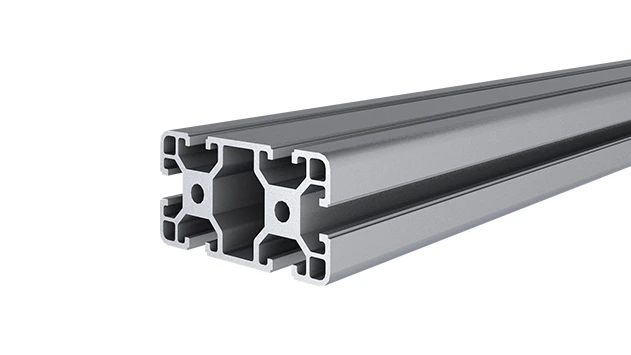
4080B is a 4.00x8.00 CM fractional 40 series square extrusion T-slot profile with two side open T-slots, each side with 4.00cm face, two side with 8.00cm face. The profile has align-a-grooves to assist in aligning connecting profiles.
Walk into any modern factory, warehouse, or workshop, and you'll likely spot them: sleek, modular structures holding up workbenches, guiding conveyor belts, or organizing material racks. These unsung heroes of industrial efficiency are aluminum extrusion profiles—versatile, lightweight, and surprisingly strong. But not all profiles are created equal. In the world of manufacturing, the choice between EU standard and non-EU standard aluminum profiles can mean the difference between a smooth, long-lasting operation and one plagued by downtime, safety risks, and constant repairs.
Today, we're zooming in on one of the most widely used EU standard profiles: the 4080B EU Standard Aluminum Profile . We'll break down what makes it tick, how it stacks up against non-EU alternatives, and why these differences matter for your business. Whether you're setting up a lean system, building workbenches, or designing material handling solutions, this deep dive will help you make an informed choice—one that balances quality, cost, and long-term reliability.
What Are EU Standard Aluminum Profiles, Anyway?
First things first: EU standards aren't just a fancy label. They're the result of decades of collaboration between engineers, manufacturers, and regulatory bodies to ensure consistency, safety, and performance. When we talk about EU standard aluminum profiles, we're referring to products that meet strict criteria set by organizations like the European Committee for Standardization (CEN), often under standards like EN 755 (for aluminum and aluminum alloys) or EN 12020 (for extruded profiles).
These standards cover everything from the composition of the aluminum alloy to the precision of the extrusion process, surface treatments, and even dimensional tolerances. The goal? To create profiles that are predictable, reliable, and compatible with a wide range of aluminum profile accessories —think connectors, end caps, and brackets—so you can mix and match components without worrying about fit issues.
Non-EU standard profiles, on the other hand, are a bit of a wildcard. They might adhere to regional standards (like ASTM in the U.S. or GB in China) or no formal standards at all. This lack of uniformity can lead to inconsistencies in material quality, manufacturing precision, and compatibility—problems that only become apparent once the profiles are in use.
Inside the 4080B EU Standard Aluminum Profile: A Closer Look
Let's get specific. The 4080B isn't just a random number and letter combo. The "40" and "80" refer to its cross-sectional dimensions: 40mm wide and 80mm tall. The "B" denotes a specific design variant within the EU standard lineup, often featuring T-slots (those handy grooves along the profile) spaced to accommodate standard accessories. But what really sets it apart?
1. Material: The Alloy Advantage
EU standards demand high-quality raw materials, and the 4080B typically uses 6063-T5 aluminum alloy. Why 6063-T5? It's a heat-treated alloy known for its excellent formability (critical for extrusion), corrosion resistance, and balanced strength-to-weight ratio. To put it in perspective: 6063-T5 has a tensile strength of around 180 MPa, which means it can withstand significant pressure without bending or warping—essential for supporting heavy workbenches or loaded material racks.
Non-EU profiles, by contrast, often cut corners here. Some use cheaper alloys with higher impurity levels or skip heat treatment, resulting in profiles that are softer, more prone to dents, or less resistant to rust. Imagine assembling a workbench with such profiles; over time, the legs might bow under the weight of tools and components, throwing off your workflow and risking accidents.
2. Manufacturing: Precision in Every Millimeter
Extruding aluminum profiles is a bit like squeezing toothpaste—only with extreme heat, pressure, and precision. EU standard manufacturers invest in advanced extrusion presses and strict quality control measures to ensure every 4080B profile meets tight dimensional tolerances. For example, the width and height might vary by no more than ±0.2mm, and the T-slots (which hold accessories like bolts and brackets) must align perfectly across profiles.
Why does this matter? Suppose you're building a lean system where components need to fit together seamlessly. If your profiles are even slightly off-kilter, connecting them with aluminum profile accessories becomes a frustrating puzzle. Holes might not line up, brackets might wobble, and the entire structure could feel unstable. Non-EU profiles often lack this precision; their tolerances can be twice as loose, leading to misalignments that slow down assembly and compromise structural integrity.
3. Surface Treatment: More Than Just Looks
Run your hand along a 4080B profile, and you'll notice a smooth, consistent finish. That's no accident. EU standards require rigorous surface treatments, usually anodizing or powder coating. Anodizing creates a protective oxide layer that boosts corrosion resistance and wear, while powder coating adds color and extra durability. Both processes are tightly controlled to ensure uniformity—no blotches, scratches, or thin spots.
Non-EU profiles might skimp on surface treatment to cut costs. You might find rough patches, uneven coloring, or thin coatings that wear off quickly. In a factory with high humidity or exposure to chemicals, this can lead to premature rusting, weakening the profile over time and creating safety hazards (think slippery, corroded surfaces on a workbench).

Non-EU Standard Profiles: The Hidden Costs of Cutting Corners
At first glance, non-EU standard profiles often seem like a steal. Their price tags can be 30-50% lower than EU equivalents, making them tempting for small businesses or projects with tight budgets. But as the saying goes, "You get what you pay for." Let's unpack the hidden costs that often come with these cheaper alternatives.
1. Inconsistent Performance
Without strict standards, non-EU profiles can vary dramatically from batch to batch—even from the same supplier. One rack might hold up fine, while the next bends under the same load. This inconsistency makes planning a nightmare. A lean system relies on predictability; if your material racks can't reliably support inventory, you risk delays, damaged goods, or even workplace injuries.
2. Compatibility Headaches
Remember those aluminum profile accessories we mentioned earlier? Non-EU profiles often use non-standard T-slot sizes or spacing, which means you're stuck buying proprietary accessories from the same supplier. If that supplier goes out of business or discontinues a part, replacing a broken bracket or end cap becomes a scavenger hunt. EU standards, by contrast, ensure universal compatibility—you can mix accessories from different manufacturers, giving you flexibility and peace of mind.
3. Short Lifespan, High Maintenance
A 4080B EU profile, when properly installed, can last 10-15 years in a typical factory environment. Non-EU profiles? Maybe 3-5 years, if you're lucky. Their lower-grade alloys and shoddy surface treatments mean they wear out faster, requiring frequent replacements. Add in the cost of downtime (when a workbench collapses or a material rack fails) and maintenance (repainting, reinforcing weak spots), and the initial savings vanish quickly.
Head-to-Head: 4080B EU vs. Non-EU Profiles (The Data)
To make this comparison concrete, let's put the key differences side by side. The table below breaks down critical factors like material quality, strength, and precision—so you can see exactly where the 4080B shines.
| Feature | 4080B EU Standard Aluminum Profile | Non-EU Standard Aluminum Profile (Typical) |
|---|---|---|
| Material Alloy | 6063-T5 (high-purity aluminum with controlled alloying elements) | Unknown or lower-grade alloys (may contain impurities like iron or silicon) |
| Tensile Strength | ~180 MPa (resists bending/breaking under load) | ~120-150 MPa (more prone to deformation) |
| Dimensional Tolerance | ±0.2mm (width/height); T-slots aligned to ±0.1mm | ±0.4mm or more; T-slot misalignment common |
| Surface Treatment | Anodized (10-15µm thickness) or powder-coated (60-80µm); uniform, corrosion-resistant | Thin anodization (<5µm) or no coating; uneven, prone to rust |
| Accessory Compatibility | Works with all EU-standard aluminum profile accessories (universal fit) | Often requires proprietary accessories; limited compatibility |
| Expected Lifespan (Industrial Use) | 10-15 years | 3-5 years |
| Certifications | CE marked; meets EN 755, EN 12020 | No formal certifications; may lack safety/quality documentation |
Real-World Impact: When Standards Make All the Difference
Numbers tell part of the story, but real-life examples bring it home. Take the case of a mid-sized electronics manufacturer in Germany we'll call "TechFlow." A few years back, TechFlow was using non-EU profiles to build their assembly line workbenches and material racks. At first, it seemed like a smart budget move—until the problems started.
"Within six months, our workbenches were wobbling," recalls TechFlow's operations manager, Maria. "The profiles had warped under the weight of our equipment, and the T-slots were so misaligned that we couldn't attach accessories like tool holders or cable management clips. Then, a material rack collapsed, damaging $10,000 worth of components. That's when we switched to 4080B EU profiles."
The difference was night and day. Maria's team reported fewer breakdowns, faster assembly times (thanks to compatible aluminum profile accessories ), and a 40% reduction in maintenance costs. "We paid more upfront, but the 4080B profiles have lasted five years with zero issues," she says. "It was an investment in reliability—and it paid off."
Another example: a automotive parts supplier in Poland that specializes in lean manufacturing. Their lean system relies on modular conveyor tracks and workstations that need to reconfigure quickly for new production runs. With non-EU profiles, reconfiguring took hours—profiles wouldn't line up, and joints were loose. After switching to 4080B, setup time dropped to 30 minutes. "The precision of the EU profiles means every connection is tight and secure," says the plant manager. "We can adapt to changes without fighting the equipment."
Choosing Wisely: When to Invest in 4080B EU Profiles
So, when is the 4080B EU Standard Aluminum Profile the right choice? Here are a few scenarios where quality and reliability should take priority over upfront cost:
- Safety-critical applications: If your structure supports heavy loads (like material racks), workers (like work platforms), or sensitive equipment, EU standards reduce the risk of failure.
- Lean systems and modular setups: Lean system efficiency depends on quick, easy reconfiguration. EU profiles and their compatible accessories make this seamless.
- Long-term use: If you need your setup to last 5+ years, the 4080B's durability will save you money in replacements and downtime.
- Branding and professionalism: For customer-facing facilities (like showrooms or demo labs), the clean, consistent look of EU profiles signals quality and attention to detail.
Of course, there are cases where non-EU profiles might suffice—temporary structures, low-load applications (like lightweight shelving), or one-off projects with no long-term needs. But even then, ask yourself: Can you afford the risk of failure? For most businesses, the answer is no.
Final Thoughts: It's About More Than Metal
At the end of the day, choosing between 4080B EU standard and non-EU standard aluminum profiles isn't just about metal—it's about your business's efficiency, safety, and bottom line. The 4080B represents decades of engineering expertise, strict quality control, and a commitment to performance. It's not the cheapest option, but it's the smart one for anyone who values reliability.
So, the next time you're shopping for aluminum profiles, look beyond the price tag. Ask about the alloy, the tolerances, and the certifications. And remember: a profile is only as good as its accessories and the system it supports. By investing in 4080B EU standard profiles and compatible aluminum profile accessories , you're not just building structures—you're building a foundation for success.