- Company Articles
- Industry articles
- Industry standards
- 85 Staggered Roller Track Dimensions: Standard Sizes & Custom Options

85 Staggered Roller Track Dimensions: Standard Sizes & Custom Options
Related Product
85 Staggered Roller Track
Triple staggered roller track is designed to enhance carton flow in various applications, such as flow racks and carton flow systems. This triple-staggered roller track is ideal for bins, boxes, or products that require smoother, more efficient rolling.
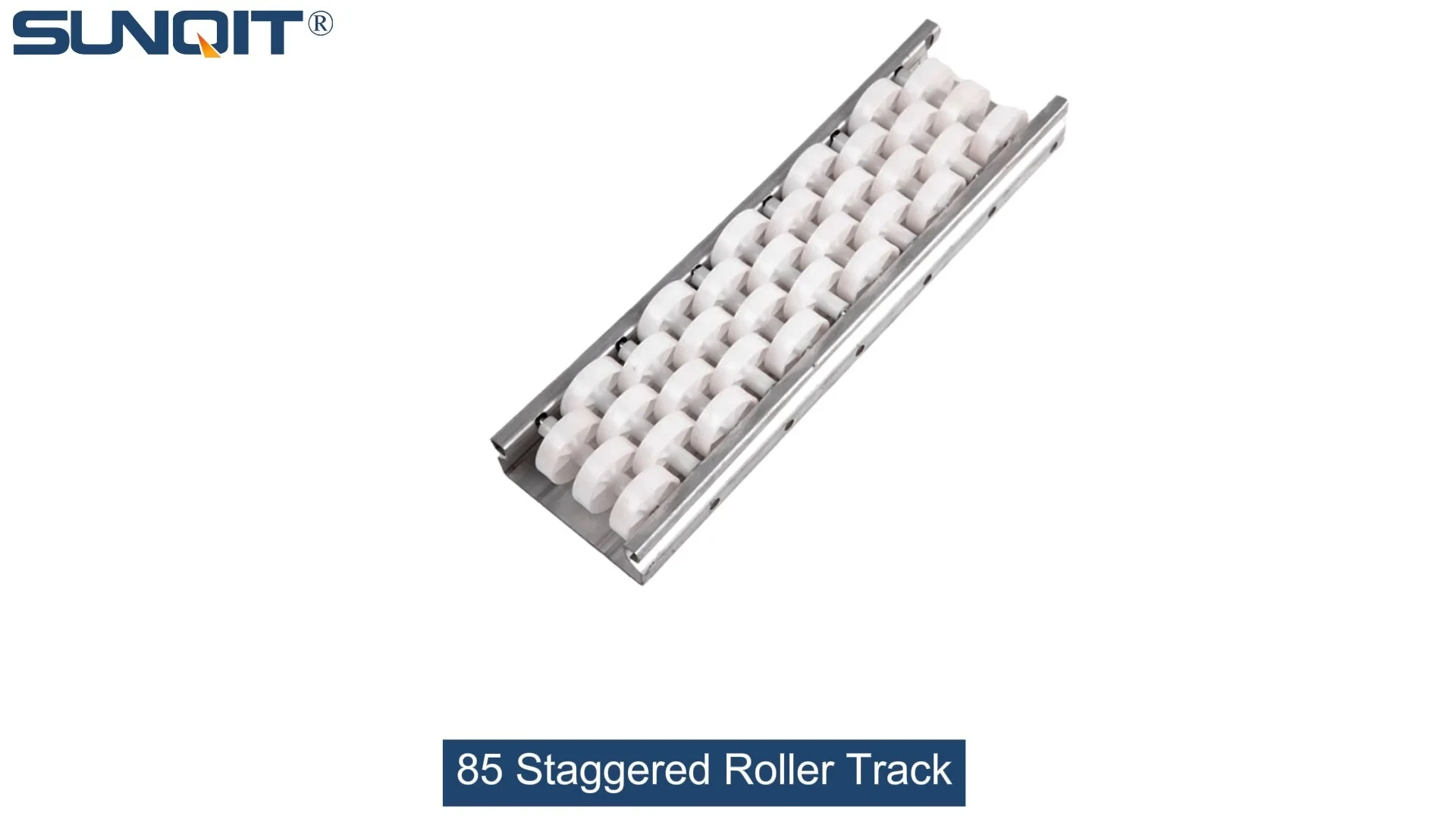
In the bustling world of manufacturing, where every second counts and efficiency is the heartbeat of production, there's a quiet workhorse that keeps the rhythm steady: the 85 Staggered Roller Track. You might not notice it at first glance—sitting humbly on the assembly line, components from station to station—but its role is irreplaceable. Think of it as the silent conductor of a symphony, ensuring that parts glide smoothly, workers stay focused, and deadlines are met without a hitch. And here's the thing: its dimensions aren't just numbers on a spec sheet. They're the blueprint for how well your entire production line dances.
Whether you're assembling smartphones in a 3C factory, packaging medical devices, or managing a busy warehouse, the right roller track dimensions can turn chaos into order. The wrong ones? They might lead to jams, slowdowns, or even damaged products—small issues that snowball into big delays. That's why we're diving deep into the world of 85 Staggered Roller Track today: to break down its standard sizes, explore how customization can tailor it to your unique needs, and show you why getting these details right matters more than you might think.
What is 85 Staggered Roller Track, Anyway?
Before we get into dimensions, let's make sure we're all on the same page. The 85 Staggered Roller Track is a type of conveyor component designed to move materials with minimal friction. Unlike straight roller tracks where rollers are aligned in a single row, "staggered" means the rollers are arranged in two offset rows—think of it like a zig-zag pattern. This design does two key things: first, it provides better support for irregularly shaped items (no more wobbling!), and second, it ensures smoother, more consistent movement, even at higher speeds.
The "85" in its name refers to the center distance between the two rows of rollers—85mm, to be exact. This measurement is crucial because it determines the track's ability to handle different product sizes. Too narrow, and larger items might get stuck; too wide, and smaller parts could slip through the gaps. It's this balance that makes the 85 Staggered Roller Track a favorite across industries like automotive, electronics, and logistics.
Fun fact: In lean manufacturing, where "waste reduction" is king, the staggered design is a small but mighty hero. By reducing friction and improving material flow, it cuts down on the time workers spend pushing or adjusting items—freeing them up to focus on more skilled tasks. It's lean in action: making every part of the process work smarter, not harder.
Standard Dimensions: The Building Blocks of Efficiency
When you're starting a new project or upgrading an existing line, standard sizes are often the first port of call. They're tried-and-tested, readily available, and designed to fit most common manufacturing scenarios. Let's break down the key dimensions of our standard 85 Staggered Roller Track, and what each one means for your operation.
| Dimension | Standard Range | What It Means for You |
|---|---|---|
| Track Width | 150mm – 600mm | The width of the track surface,.A 150mm track might handle small electronic components, while a 600mm track is better for larger parts like automotive panels. |
| Overall Length | 1m – 6m | How long the track section is. Shorter lengths (1-2m) work well for tight workstations, while longer ones (4-6m) are ideal for moving materials across longer distances in the factory. |
| Roller Diameter | 38mm – 50mm | The size of the rollers themselves. Larger rollers (50mm) handle heavier loads and roll more smoothly, while smaller ones (38mm) are lighter and better for lightweight items. |
| Roller Spacing (Staggered) | 30mm – 50mm | The distance between adjacent rollers in each row. Closer spacing (30mm) supports smaller, lighter parts; wider spacing (50mm) works for larger, sturdier items without wasting materials. |
| Load Capacity | 50kg/m – 200kg/m | How much weight the track can handle per meter. A 50kg/m track is great for plastic components, while a 200kg/m track might be used for metal parts in automotive manufacturing. |
| Material Thickness | 1.5mm – 2.5mm (Aluminum) | The thickness of the aluminum profile that forms the track frame. Thicker material (2.5mm) means more durability for high-traffic lines, while thinner (1.5mm) saves weight for lighter use. |
Let's take a real-world example. Imagine you're running a 3C assembly line for smartwatches. The components are small—maybe 100mm wide at most—and lightweight. A standard 150mm width track with 38mm rollers and 30mm spacing would be perfect here. The close roller spacing ensures tiny parts don't tip, and the narrow width keeps the track compact, fitting neatly into your workstation. On the flip side, if you're in automotive manufacturing, moving door panels that are 500mm wide and weigh 15kg each, you'd opt for a 600mm width track, 50mm rollers, and 50mm spacing to handle the heft.

Standard Sizes: More Than Just "One-Size-Fits-All"
You might be thinking, "If standard sizes exist, why not just pick one and go?" Here's the truth: standard sizes are a starting point, not the finish line. They're designed to cover the most common needs across industries, which means they work well for many scenarios—but not all. Let's dig into a few key standard specs and why they're set that way.
The 85mm Staggered Spacing: Why It's Special
Remember that "85" in the name? The 85mm center distance between the two roller rows is what makes this track unique. Why 85mm? Over years of working with manufacturers, we've found this spacing strikes the perfect balance between stability and flexibility. It's wide enough to prevent long, thin items (like circuit boards) from sagging between rollers, but narrow enough to keep the track compact—so it doesn't take up unnecessary space on your factory floor.
Length Options: From Workstation to Warehouse
Standard lengths range from 1m to 6m, and there's a reason for that sweet spot. A 1m track is ideal for connecting two workstations right next to each other—say, from a soldering station to a testing station in a 3C plant. A 6m track, on the other hand, might span the length of a small warehouse, moving boxes from the receiving area to the shipping zone. And if 6m isn't long enough? No problem—standard tracks are designed to connect seamlessly, so you can link multiple sections to reach the length you need.
Load Capacity: Safety First
We can't talk about dimensions without mentioning load capacity. It's not just about "can it hold the weight?"—it's about safety and longevity. A track rated for 50kg/m might technically hold 60kg/m for a day, but over time, that extra stress will wear down the rollers and frame, leading to breakdowns. That's why our standard sizes are tested rigorously: to ensure they handle their rated load day in, day out, without compromising performance. For example, our 200kg/m track uses reinforced aluminum profiles and high-quality steel rollers—built to withstand the heavy demands of automotive part manufacturing.

Custom Options: When "Standard" Just Isn't Enough
Here's where things get exciting. Manufacturing isn't one-size-fits-all, and your roller track shouldn't be either. Maybe you're in the medical device industry, where you need extra corrosion resistance. Or perhaps you're dealing with electrostatic-sensitive components in 3C assembly, requiring ESD (Electrostatic Discharge) protection. Whatever your challenge, customization lets you tweak the 85 Staggered Roller Track to fit your workflow like a glove. Let's explore the most common custom options and how they solve real-world problems.
Industry-Specific Dimensions
Different industries have different "pain points," and dimensions play a big role in solving them. Let's take a look at a few examples:
- 3C Electronics: When assembling smartphones or laptops, components are tiny and sensitive to static. We've customized 85 Staggered Roller Tracks with narrower widths (as low as 100mm) to fit tight workstation setups, paired with ESD-safe roller materials (like conductive plastic) to prevent static damage. One client in Shenzhen needed a track that could handle circuit boards as small as 70mm wide—we adjusted the roller spacing to 25mm (closer than standard) to keep those delicate boards stable.
- Medical Devices: Cleanliness and corrosion resistance are non-negotiable here. A medical equipment manufacturer approached us needing a track that could withstand frequent sanitization with harsh chemicals. We swapped standard aluminum for 304 stainless steel (thicker 2.5mm walls) and added sealed roller bearings to prevent water ingress. The result? A track that stays rust-free even in daily cleaning routines.
- Heavy Machinery: For manufacturers building large industrial parts (think engine blocks), standard load capacities just don't cut it. We once customized an 85 Staggered Roller Track with reinforced aluminum profiles (3mm thickness) and larger 60mm steel rollers, boosting the load capacity to 300kg/m. Now, their heavy parts glide smoothly without straining the track.
Material Upgrades for Tough Environments
Sometimes, it's not just about size—it's about what the track is made of. While standard tracks use high-quality aluminum (lightweight, corrosion-resistant, and cost-effective), custom projects often call for upgrades:
- Stainless Steel: Ideal for wet or corrosive environments, like food processing or outdoor warehouses. We offer 304 and 316 stainless steel options, with thicknesses up to 3mm for extra durability.
- ESD-Coated Aluminum: For electronics manufacturing, where static can fry sensitive components. The ESD coating (surface resistance 10^6-10^9 Ω) ensures static dissipates safely, protecting your products.
- Heat-Resistant Plastics: In high-temperature environments (like near ovens or welding stations), standard plastic rollers can warp. We use heat-resistant POM (Polyoxymethylene) rollers that stand up to temperatures up to 120°C.
Special Features: More Than Just a "Track"
Customization isn't limited to dimensions and materials. Sometimes, it's about adding little extras that make a big difference in day-to-day use:
- Guide Rails: For parts that need to stay perfectly aligned (like bottles in a packaging line), we add side guide rails—adjustable in width to fit different product sizes.
- Brake Systems: In assembly lines where workers need parts to stop at specific stations, we integrate simple brake mechanisms that halt the roller track when activated, then release smoothly.
- Noise Reduction: In factories where noise levels are a concern (hello, OSHA standards!), we use rubber-coated rollers and shock-absorbing mounts to cut down on the "clatter" of materials moving over the track.
Pro Tip: When thinking about customization, start with your biggest workflow frustration. Is it parts getting stuck? Static damage? Not enough space? That's your starting point. Our team of engineers doesn't just "make a track"—we listen to your pain points and design a solution that addresses them head-on.

Why Lean Matters: Beyond Dimensions
At this point, you might be thinking, "Okay, dimensions and customization are important—but so is cost. Why invest in a high-quality 85 Staggered Roller Track instead of a cheaper, generic one?" The answer lies in lean manufacturing —a philosophy we live and breathe. Lean isn't just a buzzword here; it's how we design every product, including our roller tracks.
Lean is about eliminating waste and continuous improvement . A well-designed 85 Staggered Roller Track does both. Let's break it down:
- Waste Reduction: Poorly sized tracks lead to waste—time wasted unjamming parts, money wasted on damaged products, labor wasted moving items manually. Our standard and custom dimensions are engineered to minimize these issues, so your team spends less time fixing problems and more time adding value.
- Reusability: Manufacturing lines change—new products, new processes, new layouts. Our 85 Staggered Roller Tracks are built with modularity in mind. Need to reconfigure your line next year? Disassemble the track, adjust the length by adding/removing sections, and reuse it elsewhere. No need to buy new—saving you money and reducing waste.
- Continuous Improvement: We design our tracks to be adjustable. Need to increase the load capacity later? Swap out the rollers. Want to add ESD protection as your product line expands? Upgrade the coating. It's not a "set it and forget it" solution—it grows with your business.
Take it from a client in the automotive industry: They initially opted for a budget roller track from a competitor, only to face constant jams and bent rollers. After switching to our 85 Staggered Roller Track (custom-sized to their door panel dimensions), they reported a 23% reduction in line downtime and a 15% increase in daily output. The upfront investment paid for itself in three months. That's the power of lean design—dimensions that work with your process, not against it.
How to Choose: Standard or Custom?
So, how do you decide whether to go with standard dimensions or customize? Here's a simple checklist to guide you:
- Stick with Standard If: Your materials are standard-sized (e.g., boxes, components within 150-600mm width), your load is within 50-200kg/m, and you don't have special environment needs (like extreme heat, chemicals, or static).
- Go Custom If: You're dealing with non-standard materials (too small, too large, irregularly shaped), have environment challenges (static, corrosion, high temps), or your workflow has unique pain points (jams, noise, space constraints).
When in doubt, reach out. Our team has worked with hundreds of manufacturers across,,, and 3C industries, and we're happy to walk through your needs—no obligation. Sometimes, a small customization (like adjusting roller spacing by 10mm) can make a world of difference.
Final Thoughts: Your Track, Your Success
The 85 Staggered Roller Track might not be the most glamorous part of your production line, but it's one of the most critical. Its dimensions are the foundation of efficiency, safety, and reliability—three things no manufacturer can afford to overlook. Whether you opt for a standard size that fits your current needs or customize a solution that grows with your business, remember: this isn't just about buying a "track." It's about investing in the smooth, steady rhythm of your entire operation.
At the end of the day, we believe manufacturing is about people—your team, your customers, and the products you pour your passion into. The right 85 Staggered Roller Track doesn't just move materials; it moves your business forward. So let's make sure it's built to move your way.