- Company Articles
- Industry articles
- Industry standards
- Quality Certification Standards for 3060 National Standard Profile A

Quality Certification Standards for 3060 National Standard Profile A
Related Product
3060 National Standard Profile A
Workbench, production line, logistic rack, warehouse rack Industry: Manufacturer workshop, Automobile, Electronic, Assembling, logistic
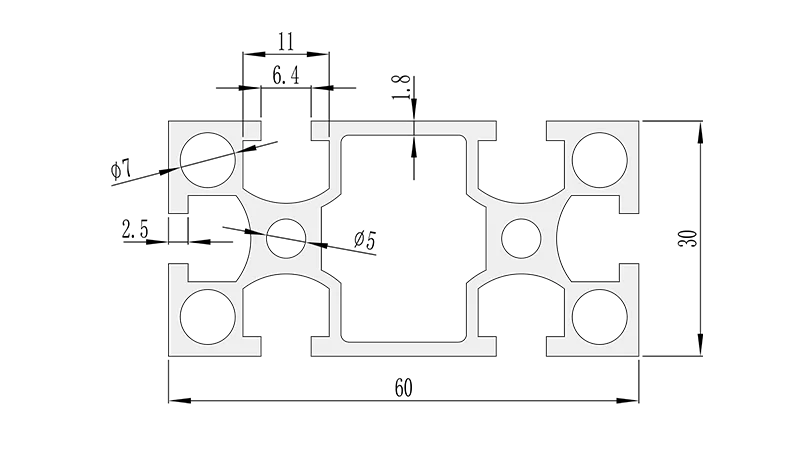
In the fast-paced world of manufacturing, where efficiency, durability, and precision are the cornerstones of success, aluminum profiles have emerged as unsung heroes. Among these, the 3060 National Standard Profile A stands out as a versatile and reliable workhorse, finding its way into everything from lean system setups and workbenches to material racks and conveyor systems. But what makes this specific aluminum extrusion profile a preferred choice for engineers and facility managers? The answer lies not just in its design, but in the rigorous quality certification standards that govern its production. These standards ensure that every piece of 3060 National Standard Profile A delivers consistent performance, compatibility with aluminum profile accessories, and long-term reliability—traits that are non-negotiable in today's competitive industrial landscape.
Whether you're a manufacturer building a lean production line, a supplier sourcing components for global clients, or a facility manager upgrading your workspace, understanding the quality certification standards for 3060 National Standard Profile A is critical. It's not just about meeting regulatory requirements; it's about ensuring that the profiles you invest in will integrate seamlessly with your existing systems, withstand the demands of daily use, and contribute to the overall efficiency of your operations. In this article, we'll dive deep into these standards, exploring everything from material composition and dimensional accuracy to mechanical properties and surface treatment. By the end, you'll have a clear picture of what makes a certified 3060 National Standard Profile A stand out—and why settling for anything less could cost you in the long run.
What is 3060 National Standard Profile A?
Before we delve into certification, let's first clarify what 3060 National Standard Profile A is. As the name suggests, it's a type of aluminum extrusion profile defined by China's national standards (GB/T), with the "3060" referring to its cross-sectional dimensions: 30mm in width and 60mm in height. The "A" denotes a specific variation in its wall thickness, slot design, or structural features, distinguishing it from other 3060 sub-types (such as "B" or "C" variants). This profile is typically made from 6000-series aluminum alloys, known for their excellent balance of strength, corrosion resistance, and machinability—properties that make it ideal for structural applications.
One of the key reasons for its popularity is its versatility. 3060 National Standard Profile A is widely used in constructing workbenches, material racks (like the Material Rack B with 3 rows and 3 floors, a common configuration in warehouses), and even turnover trolleys. Its T-slot design allows for easy attachment of aluminum profile accessories, such as connectors, end caps, and brackets, making it a favorite for modular systems. In lean manufacturing setups, this modularity is a game-changer: it enables quick reconfiguration of production lines, reducing downtime and adapting to changing workflow needs. But none of this would be possible without strict quality certifications ensuring that every profile meets the same high standards.
Material Composition: The Foundation of Quality
At the heart of any quality aluminum profile is its material composition. For 3060 National Standard Profile A, certification standards start with the aluminum alloy itself. Most certified profiles use 6061 or 6063 aluminum alloys, which are renowned for their extrudability and mechanical properties. 6063, in particular, is favored for extrusion profiles due to its excellent surface finish and formability, while 6061 offers higher strength, making it suitable for load-bearing applications.
Quality certification bodies, such as the International Organization for Standardization (ISO) or China's National Center for Quality Supervision and Test of Aluminum Processing Products (NCQSTAPP), set strict limits on alloy composition. For example, 6063 alloy must contain between 0.45% and 0.9% silicon (Si), 0.15% to 0.35% magnesium (Mg), and less than 0.10% iron (Fe). These percentages are not arbitrary: they're carefully calibrated to ensure the alloy can be extruded into the desired shape without cracking, while still maintaining the necessary strength and corrosion resistance. Impurities like iron or copper, if present in excess, can weaken the profile or cause defects during extrusion—certification ensures these are kept in check.
To verify compliance, manufacturers must submit samples to accredited labs for chemical analysis. Techniques like optical emission spectroscopy (OES) are used to measure the concentration of each element in the alloy. A profile that fails to meet the specified composition ranges cannot earn certification, as it would pose risks in real-world use. For instance, a profile with too much iron might be prone to brittleness, making it unsuitable for a workbench that needs to support heavy equipment. In short, material composition certification is the first line of defense against subpar performance.
Dimensional Accuracy: Precision That Matters
Imagine assembling a workbench using 3060 National Standard Profile A, only to find that the profiles are slightly warped or their dimensions are inconsistent. The result? Misaligned holes, ill-fitting aluminum profile accessories, and a shaky, unstable structure. This is why dimensional accuracy is a cornerstone of quality certification for 3060 National Standard Profile A. Certification standards define strict tolerances for key dimensions, ensuring that every profile is uniform and compatible with other components.
Key dimensional parameters include width, height, wall thickness, straightness, and slot dimensions. For example, the cross-sectional width of 30mm must typically be within ±0.3mm, while the height of 60mm has a tolerance of ±0.4mm. Wall thickness, which affects the profile's strength, is usually specified as 1.5mm or 2.0mm for 3060 Profile A, with a tolerance of ±0.15mm. Straightness is another critical factor: a profile that bends more than 0.5mm per meter can cause assembly issues, so certification standards often limit straightness deviation to ≤0.3mm/m for lengths up to 6 meters.
To illustrate the importance of these tolerances, let's consider a common application: a roller track system used in a lean production line. Roller tracks rely on profiles with precise slot positions to attach brackets (like the Roller Track Placon Mount for Aluminum Profile Flat) and guide rails (such as Aluminum Guide Rail A or B). If the slots in the 3060 profiles are misaligned by even 0.5mm, the brackets won't fit securely, leading to wobbly roller tracks and potential jams during material transport. This not only disrupts workflow but also poses safety risks. By adhering to strict dimensional tolerances, certified profiles ensure that such issues are minimized, allowing for smooth assembly and reliable operation.
| Dimension | Standard Specification | Certified Tolerance | Non-Certified Risk |
|---|---|---|---|
| Width | 30mm | ±0.3mm | Misalignment with accessories |
| Height | 60mm | ±0.4mm | Uneven load distribution |
| Wall Thickness | 1.5mm / 2.0mm | ±0.15mm | Reduced structural strength |
| Straightness | ≤0.3mm/m | ≤0.5mm/m (max) | Difficult assembly, unstable structures |
| Slot Width | 8mm (typical) | ±0.2mm | Poor fit with connectors, bolts |
Mechanical Properties: Strength You Can Rely On
A profile's dimensions might be perfect, but if it can't withstand the loads and stresses of daily use, it's useless. This is where mechanical properties come into play. Quality certification for 3060 National Standard Profile A includes rigorous testing of tensile strength, yield strength, and elongation—key indicators of how the profile will perform under stress.
Tensile strength refers to the maximum stress a profile can withstand before breaking, while yield strength is the stress at which it begins to deform permanently. For 6063-T5 alloy (a common temper for extruded profiles), certification standards typically require a tensile strength of ≥160 MPa and a yield strength of ≥110 MPa. Elongation, the percentage of deformation before fracture, is also important: a minimum elongation of 8% ensures the profile can bend slightly without snapping, which is crucial in applications where flexibility is needed (e.g., attaching casters to a turnover trolley).
Why do these numbers matter? Let's take a workbench as an example. A Workbench E (Single Deck-Without Caster) built with 3060 National Standard Profile A might need to support tools, components, and even workers during maintenance. If the profile's yield strength is too low, the workbench could sag under heavy loads, leading to instability or even collapse. Certified profiles, with their guaranteed mechanical properties, provide the peace of mind that the workbench will hold up over time. Similarly, in material racks like the 3-row, 3-floor Material Rack B, the profiles must support multiple layers of inventory without bending—tensile strength ensures they can handle the weight without failure.
Testing for these properties involves cutting samples from the extruded profiles and subjecting them to tension tests using specialized equipment. Only profiles that meet or exceed the specified values earn certification. This level of scrutiny ensures that whether you're building a lightweight assembly line or a heavy-duty storage rack, the 3060 National Standard Profile A you use will deliver the strength you need.
Surface Treatment: More Than Just Aesthetics
While the internal properties of 3060 National Standard Profile A are critical, its surface treatment plays a vital role in both performance and longevity. Surface treatments protect the profile from corrosion, enhance its appearance, and even improve its friction characteristics—all of which are covered by quality certification standards.
The most common surface treatments for aluminum profiles are anodizing, powder coating, and electrophoresis. Anodizing, a process that creates a protective oxide layer on the surface, is particularly popular for 3060 Profile A. Certification standards for anodizing specify the thickness of the oxide layer (typically ≥10 μm for general use), as well as its corrosion resistance. For example, a salt spray test might require the profile to withstand 1000 hours without red rust—ensuring it holds up in humid or industrial environments.
Powder coating, another common treatment, involves applying a dry powder that's cured into a hard finish. Certification here focuses on adhesion (the coating shouldn't peel or chip), color consistency (no visible variations across batches), and thickness (usually 60-80 μm). This is especially important for profiles used in visible areas, like office partitions or retail displays, where appearance matters as much as function.
Even seemingly minor surface defects can have big consequences. A scratch in the anodized layer could expose the aluminum to corrosion, weakening the profile over time. A poorly adhered powder coating might chip off, leaving the underlying metal vulnerable. Certification standards address these issues by setting strict limits on defects: no more than 2 minor scratches per meter, no blisters or pinholes, and uniform color across the profile. For industries like food processing or pharmaceuticals, where cleanliness is critical, some certifications even require special treatments (e.g., antimicrobial coatings) to prevent bacterial growth—though this is less common for standard 3060 Profile A.
Manufacturing Process: Consistency Through Control
Quality certification isn't just about testing the final product—it also extends to the manufacturing process itself. For 3060 National Standard Profile A, certification bodies audit production facilities to ensure that every step, from extrusion to cutting, is controlled and consistent. This includes monitoring parameters like extrusion temperature, cooling rate, and aging time, all of which affect the profile's properties.
Extrusion, the process of forcing heated aluminum through a die to form the profile, is particularly critical. The temperature of the billet (the raw aluminum ingot) must be precisely controlled—too hot, and the profile might warp; too cold, and it could crack. Certification standards often specify a temperature range of 480-520°C for 6063 alloy. After extrusion, the profiles are aged (heat-treated) to enhance their strength. For T5 temper, this involves air cooling followed by artificial aging at 175°C for 8-12 hours. Deviations from this process can result in profiles that don't meet the required mechanical properties, which is why certification auditors check process logs and temperature records to ensure compliance.
Cutting is another area where consistency matters. Profiles are typically cut to length using saws or laser cutters, and certification standards require that the cut ends are square (within ±0.5°) and free of burrs. A burr might seem trivial, but it can scratch workers during assembly or prevent aluminum profile accessories (like end caps) from fitting properly. Automated cutting machines, which are standard in certified facilities, ensure that every cut is precise and clean, reducing the risk of defects.
Compliance with International and National Standards
While 3060 National Standard Profile A is defined by China's GB/T standards, many manufacturers also seek international certifications to expand their market reach. The most common international standard is ISO 9001, which sets requirements for quality management systems. An ISO 9001-certified supplier demonstrates that they have processes in place to consistently produce quality products and continuously improve their operations.
Other relevant standards include ASTM B221 (Standard Specification for Aluminum and Aluminum-Alloy Extruded Bars, Rods, Wire, Profiles, and Tubes), which is widely recognized in North America, and EN 755 (European Standard for Aluminum Extrusions). For suppliers exporting to Europe, compliance with EN 755 ensures that their 3060 profiles meet the same standards as local producers, simplifying market access.
Why does international compliance matter? For global manufacturers, using profiles certified to both national and international standards ensures consistency across production facilities in different countries. For example, a company with factories in China and Germany can source 3060 National Standard Profile A from a supplier certified to GB/T and EN 755, knowing that the profiles will perform the same regardless of where they're used. This reduces the risk of compatibility issues and simplifies inventory management.
The Risks of Non-Certified Profiles
Now that we've covered what certification entails, let's consider the flip side: what happens when you use non-certified 3060 National Standard Profile A? The consequences can range from minor inconveniences to major safety hazards and financial losses.
First, non-certified profiles often have inconsistent dimensions. This means that when you try to assemble a structure—say, a workbench with aluminum profile accessories like Internal Rotary Aluminum Joints—some profiles might fit, while others don't. This leads to wasted time, as workers struggle to force components together, and increased costs, as you may need to purchase additional parts or even redesign the structure. In a lean system, where efficiency is paramount, these delays can disrupt production schedules and erode profits.
Second, poor material quality and mechanical properties can lead to premature failure. A non-certified profile with subpar tensile strength might bend or break under normal loads, causing equipment damage or workplace accidents. For example, a material rack holding heavy components could collapse if the profiles can't support the weight, resulting in damaged inventory and potential injuries. The cost of replacing damaged goods and paying for medical bills far outweighs the savings from buying cheaper, non-certified profiles.
Third, non-certified profiles often have inadequate surface treatment, making them prone to corrosion. In humid environments or facilities with exposure to chemicals, this can lead to rust, weakening the profile over time. A corroded profile in a roller track system, for instance, might cause rollers to jam, halting production until the track is replaced. Again, the downtime and replacement costs add up quickly.
Finally, using non-certified profiles can damage your reputation. If a customer receives a product assembled with faulty profiles—say, a flimsy workbench that sags—they're unlikely to do business with you again. In industries where safety is regulated (e.g., automotive or aerospace), non-certified components could even lead to legal liability if they cause an accident.
How to Verify Certification
So, how can you ensure that the 3060 National Standard Profile A you're buying is truly certified? The first step is to ask your supplier for certification documents. Reputable suppliers will readily provide test reports from accredited labs, showing compliance with GB/T, ISO, or other relevant standards. These reports should include details like material composition, dimensional measurements, mechanical properties, and surface treatment results.
You can also check for certification marks on the profiles themselves. Many certified profiles have stamps or labels indicating their standard (e.g., "GB/T 6892") and temper (e.g., "T5"). While not all certifications require physical marks, their presence is a good sign.
Another tip is to visit the supplier's facility if possible. A certified manufacturer will have well-organized production lines, quality control stations, and documentation of their processes. If a supplier is hesitant to let you tour their facility or provide certification documents, it's a red flag—proceed with caution.
Finally, consider the supplier's reputation. Established suppliers with years of experience in the industry are more likely to prioritize quality and certification. Online reviews, customer testimonials, and industry awards can also give you insight into a supplier's reliability. Remember, a slightly higher price from a certified supplier is often worth it for the peace of mind and long-term savings.
Conclusion: Investing in Quality for Long-Term Success
In the world of industrial manufacturing, 3060 National Standard Profile A is more than just a piece of aluminum—it's a building block of efficient, safe, and reliable operations. The quality certification standards that govern its production ensure that every profile meets strict criteria for material composition, dimensional accuracy, mechanical strength, and surface treatment. These standards aren't just bureaucratic hurdles; they're safeguards that protect your business from inefficiency, accidents, and unnecessary costs.
Whether you're constructing workbenches, material racks, or lean production lines, choosing certified 3060 National Standard Profile A means investing in compatibility with aluminum profile accessories, durability in daily use, and peace of mind. It ensures that your structures will assemble smoothly, perform consistently, and last for years—all of which contribute to a more efficient, profitable operation.
So, the next time you're sourcing aluminum profiles, remember: certification isn't an extra expense—it's an investment in quality. By prioritizing certified 3060 National Standard Profile A, you're not just buying a product; you're buying reliability, safety, and the foundation for a lean, successful business.