- Company Articles
- Industry articles
- Industry standards
- Recyclability of 3060 National Standard Profile A: Closing the Circular Economy Loop

Recyclability of 3060 National Standard Profile A: Closing the Circular Economy Loop
Related Product
3060 National Standard Profile A
Workbench, production line, logistic rack, warehouse rack Industry: Manufacturer workshop, Automobile, Electronic, Assembling, logistic
In today's manufacturing landscape, the buzz around sustainability isn't just a trend—it's a critical shift toward responsible production. As industries grapple with reducing waste, lowering carbon footprints, and meeting stringent environmental regulations, the materials we choose play a starring role. Among these, aluminum has emerged as a champion of the circular economy, and within the aluminum family, the 3060 National Standard Profile A stands out as a paragon of recyclability and efficiency. This article dives into why this specific aluminum extrusion profile has become a cornerstone for businesses aiming to close the loop, exploring its lifecycle, environmental impact, and the ways it aligns with the principles of sustainable manufacturing.
Aluminum: The Unsung Hero of Circular Manufacturing
Before we zoom in on the 3060 National Standard Profile A, let's take a step back to appreciate why aluminum itself is a sustainability standout. Unlike many materials that degrade after a single use, aluminum is infinitely recyclable. That means a aluminum can, a car part, or an industrial profile can be melted down, reprocessed, and turned into a new product repeatedly—without losing an ounce of its structural integrity. This isn't just a nice feature; it's a game-changer for the planet. Producing aluminum from recycled scrap uses a staggering 95% less energy than extracting it from bauxite ore, according to the Aluminum Association. That translates to fewer greenhouse gas emissions, reduced reliance on mining, and a significantly lighter environmental footprint.
But not all aluminum products are created equal when it comes to recyclability. Factors like alloy composition, coatings, and the presence of non-aluminum components can complicate the recycling process. This is where standardized profiles like the 3060 National Standard Profile A shine. Designed with both performance and sustainability in mind, this profile is engineered to be easily recycled, making it a top choice for manufacturers committed to closing the circular economy loop.
Meet 3060 National Standard Profile A: More Than Just a Piece of Metal
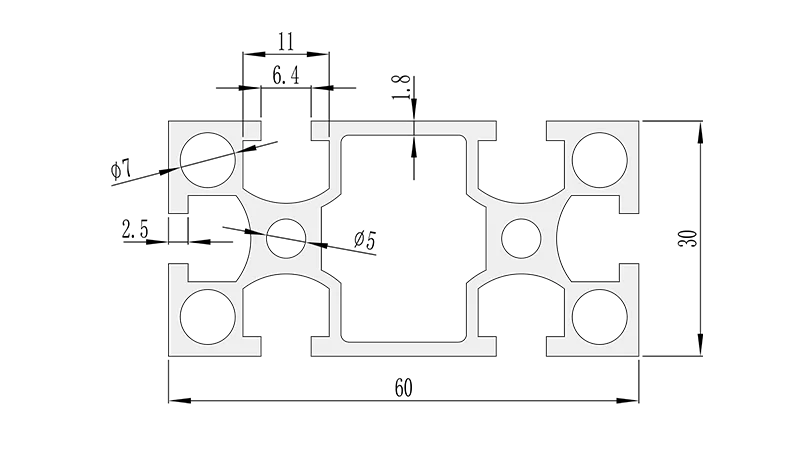
So, what exactly is the 3060 National Standard Profile A? In simple terms, it's a type of aluminum extrusion profile—a long, uniform shape created by forcing heated aluminum through a die. The "3060" refers to its dimensions: 30mm in width and 60mm in height, a common size used in industrial applications like workbenches, material racks, conveyor systems, and machine frames. As a "national standard" profile, it adheres to strict specifications for material purity, strength, and dimensional accuracy, ensuring consistency across manufacturers and applications.
What makes this profile particularly interesting for sustainability is its versatility. Walk into any modern factory, and you're likely to spot it in action: supporting heavy-duty workbenches on a production line, forming the frame of a flow rack in a warehouse, or serving as the backbone of a conveyor system transporting components. Its popularity isn't just due to its strength (it boasts excellent load-bearing capacity for its weight) but also its adaptability—thanks in large part to aluminum profile accessories. These accessories, including connectors, end caps, and brackets, are designed to work seamlessly with the 3060 profile, allowing businesses to customize structures without compromising the material's recyclability.
Why 3060 National Standard Profile A is a Recycler's Dream
The recyclability of the 3060 National Standard Profile A isn't an accident—it's built into its design from the ground up. Let's break down the key features that make it so easy to recycle:
1. High-Purity Aluminum Composition
At its core, the 3060 profile is made from high-purity aluminum alloy, typically 6063 or similar. These alloys are chosen for their balance of strength, corrosion resistance, and yes, recyclability. They contain minimal impurities and are free from hazardous additives, which means when the profile reaches the end of its life, it can be melted down without requiring extensive purification. This not only simplifies the recycling process but also reduces the energy and cost involved.
2. Minimal Coating and Additives
Some aluminum products rely on heavy coatings (like paints or plastics) for protection or aesthetics, which can complicate recycling. The 3060 National Standard Profile A, however, often comes with a clear anodized finish—a thin, protective layer created by electrolytic oxidation. Unlike paint, anodizing doesn't add foreign materials; it simply enhances the aluminum's natural oxide layer. This means during recycling, the anodized layer burns off easily in the melting process, leaving pure aluminum behind. For applications where color is needed, powder coating is a common choice, and while it does add a layer, modern recycling facilities can remove it through thermal or chemical processes, ensuring the aluminum itself remains untainted.
3. Compatibility with Aluminum Profile Accessories
A profile is only as good as the accessories that connect it, and the 3060 National Standard Profile A's ecosystem of aluminum profile accessories is designed with recyclability in mind. From corner brackets to T-slot nuts, these accessories are typically made from the same high-purity aluminum alloys as the profile itself. This means when a structure (like a workbench or material rack) is disassembled, the profile and its accessories can be recycled together without sorting—saving time and reducing the risk of contamination. Even non-aluminum accessories, like plastic end caps, are often designed to be easily removed, ensuring the aluminum components remain clean for recycling.
4. Durable Design = Longer Lifespan
Recyclability is important, but so is longevity. The longer a product lasts, the fewer times it needs to be replaced—and the less waste is generated. The 3060 National Standard Profile A excels here, too. Its robust design and corrosion resistance mean it can withstand years (even decades) of heavy use in industrial environments. Whether it's supporting daily production in a factory or enduring the wear and tear of a busy warehouse, this profile is built to go the distance. And when it does finally reach the end of its useful life, it's ready to be recycled and start anew.
From Factory Floor to Recycling Bin: The Lifecycle of 3060 Profile A
To truly understand the circular economy impact of the 3060 National Standard Profile A, let's walk through its lifecycle—from production to recycling and beyond.
Stage 1: Extrusion and Fabrication
It all starts with aluminum billets—recycled or primary aluminum that's heated to around 500°C (932°F) until it's malleable. The billet is then pushed through a die shaped like the 3060 profile, emerging as a long, continuous length. This extrusion process is efficient, producing minimal waste (any offcuts are immediately recycled back into the production stream). Once extruded, the profile may undergo secondary processes like cutting to length, anodizing, or drilling T-slots for accessories. Again, waste from these steps is negligible and recyclable.
Stage 2: In-Use Phase
Next, the 3060 profile finds its way into factories, warehouses, and workshops. Here, it spends years (sometimes decades) performing its role—whether as part of a workbench where assemblers build electronics, a material rack storing components, or a conveyor system moving products along a line. Thanks to its durability, it rarely needs replacement due to wear and tear, reducing the demand for new aluminum production.
Stage 3: End-of-Life and Recycling
Eventually, the day comes when the structure containing the 3060 profile is no longer needed—maybe the factory is reconfiguring its layout, or the product line is updated. Instead of ending up in a landfill, the profile is disassembled. Any non-aluminum accessories (like plastic casters or rubber gaskets) are removed, and the aluminum components—profile and aluminum accessories alike—are collected and sent to a recycling facility.
At the recycling plant, the aluminum is shredded into small pieces to increase surface area, then melted in a furnace at around 700°C (1292°F). Impurities (like paint residues or small amounts of other metals) rise to the surface as slag and are removed. The molten aluminum is then cast into new billets, which are sent back to extrusion facilities to become… you guessed it, new 3060 National Standard Profile A (or other aluminum products). The loop is closed.
How 3060 National Standard Profile A Stacks Up: A Sustainability Comparison
To put the recyclability of 3060 National Standard Profile A into perspective, let's compare it to other common industrial materials. The table below highlights key sustainability metrics:
| Material | Recyclability Rate | Energy Savings vs. Primary Production | Lifecycle Environmental Impact | Common Industrial Uses |
|---|---|---|---|---|
| 3060 National Standard Profile A (Aluminum) | 95-100% (infinitely recyclable) | 95% | Low (minimal emissions, no toxic byproducts) | Workbenches, material racks, conveyors, machine frames |
| Steel (Carbon Steel) | 80-90% (recyclable, but quality degrades over time) | 74% | Medium-High (high embodied energy, CO2 emissions) | Heavy machinery, structural supports |
| Plastic (PVC/ABS) | 5-10% (limited recyclability, often downcycled) | ~30% (varies by type) | High (persistent in environment, toxic additives) | Light-duty racks, packaging, non-structural components |
| Wood (Hardwood) | Biodegradable, but not truly recyclable | N/A (renewable but slow-growing) | Medium (deforestation risks, chemical treatments) | Workbenches, pallets (limited industrial use) |
As the table shows, 3060 National Standard Profile A outperforms other materials in nearly every sustainability category. Its near-perfect recyclability rate, massive energy savings, and low environmental impact make it a clear choice for businesses prioritizing circular economy principles.
Real-World Impact: How Businesses Are Using 3060 Profile A to Go Green
Talk is cheap—what do actual businesses have to say about using 3060 National Standard Profile A for sustainability? Let's look at a few examples:
Case Study 1: Automotive Parts Manufacturer
A mid-sized automotive parts manufacturer in the Midwest recently reconfigured its production line to use 3060 National Standard Profile A for workbenches and material racks. Previously, the company relied on steel frames, which were heavy, prone to rust, and difficult to recycle. By switching to aluminum profiles, they reduced the weight of their workstations by 40%, making them easier to reposition as production needs changed. When it came time to upgrade their facility last year, they were able to recycle 100% of the old aluminum profiles, which were turned into new billets. The result? A 25% reduction in waste sent to landfills and a 15% drop in their carbon footprint related to material sourcing.
Case Study 2: E-Commerce Fulfillment Center
An e-commerce giant with a large fulfillment center in the South needed a flexible, sustainable solution for their picking racks. They chose 3060 National Standard Profile A paired with aluminum profile accessories like adjustable shelves and roller tracks. The system allowed them to quickly reconfigure racks as inventory needs changed, reducing downtime. When the center expanded last year, the old racks were disassembled, and the aluminum was recycled. The energy saved from recycling that aluminum alone was enough to power 50 homes for a month, according to the company's sustainability report. "We're not just moving packages faster—we're moving them more responsibly," said the facility's operations manager.
Challenges and the Road Ahead: Making Recycling Even Easier
While 3060 National Standard Profile A is a leader in recyclability, there are still challenges to overcome in the circular economy for aluminum profiles. One of the biggest hurdles is collection: many small and medium-sized businesses still don't have clear processes for recycling old aluminum structures, leading some profiles to end up in landfills. Education is key here—suppliers and industry groups need to better inform customers about the recyclability of their aluminum products and connect them with local recycling facilities.
Another challenge is the mixing of materials. Even with standardized profiles, some manufacturers still use non-recyclable accessories (like cheap plastic brackets) that can contaminate aluminum recycling streams. To combat this, more suppliers are offering "closed-loop" systems, where they not only sell 3060 profiles and aluminum profile accessories but also take back old structures for recycling. This ensures proper sorting and reduces the risk of contamination.
Looking ahead, the future is bright for 3060 National Standard Profile A and aluminum recycling. Innovations in extrusion technology are making profiles even lighter and stronger, while advances in recycling processes are improving the efficiency of material recovery. There's also growing interest in "digital product passports"—QR codes or RFID tags on profiles that track their lifecycle, making it easier to ensure they're recycled at the end of use. As more businesses adopt circular economy models, the demand for sustainable materials like 3060 profile will only grow.
Closing the Loop: Why 3060 National Standard Profile A Matters
In a world where sustainability is no longer optional, the 3060 National Standard Profile A stands out as more than just an industrial material—it's a tool for change. Its infinite recyclability, durable design, and compatibility with eco-friendly accessories make it a cornerstone of the circular economy in manufacturing. By choosing this profile, businesses aren't just investing in a strong, versatile product—they're investing in a future where waste is minimized, resources are conserved, and every piece of aluminum gets a second (and third, and fourth) life.
So the next time you walk through a factory or warehouse, take a closer look at those aluminum frames and racks. Chances are, you're looking at 3060 National Standard Profile A—quietly doing its part to close the loop, one extrusion at a time. And that's something we can all feel good about.