- Company Articles
- Industry articles
- Industry standards
- Reusable Structures: 2040 National Standard Profile for Sustainable Workstations

Reusable Structures: 2040 National Standard Profile for Sustainable Workstations
Related Product
2040 National Standard Profile
45° external bending joint, used for 45° external connection of two aluminum pipes.
Introduction: The Quiet Revolution in Factory Floors
Walk through a manufacturing plant today, and you'll sense a shift in the air. It's not just about churning out more products faster—though productivity still matters. These days, there's a new priority: sustainability. Business owners, workers, and customers alike are asking: How can we make things without breaking the planet? The answer often starts small, with the most basic element of production: the workstation.
For too long, workstations have been the unsung heroes of waste. Think about the typical setup: a heavy steel frame welded into place, a wooden top nailed down, shelves bolted so tight they might as well be permanent. When a new product line launches or a workflow changes, those workstations become obsolete. They're too rigid to adapt, so they end up in scrapyards, replaced by brand-new ones. It's a cycle of waste that's costly for wallets and terrible for the environment. But what if there was a better way? Enter the 2040 National Standard Profile—a simple aluminum extrusion that's rewriting the rules of workstation design.
What Exactly is the 2040 National Standard Profile?
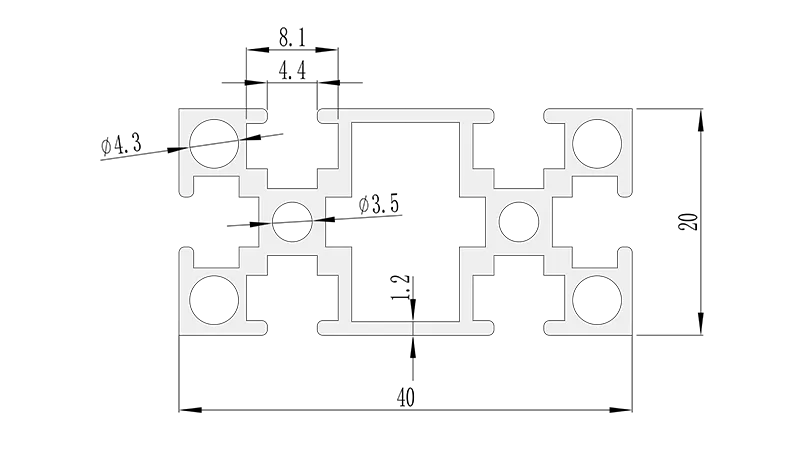
Let's start with the basics. The 2040 National Standard Profile is an aluminum extrusion, meaning it's formed by pushing heated aluminum through a die to create a specific cross-sectional shape. Its name gives away its dimensions: 20mm in width and 40mm in height. But don't let the small size fool you—this profile is a workhorse. What makes it "national standard" is its adherence to strict industry guidelines, ensuring consistency across manufacturers. That means no matter where you buy it, the 2040 Profile will fit with accessories from other suppliers—a game-changer for modularity.
The real genius lies in its T-slot design: long, narrow grooves running along its length that let you attach almost anything. Need a shelf? Slide a bracket into the slot and tighten a screw. Want to add a light? Clip on a holder. Need to move the entire setup? Loosen a few fasteners, disassemble, and rebuild elsewhere. It's like building with industrial-grade Lego bricks—only sturdier, more versatile, and infinitely more sustainable.
Sustainability at Its Core: Why Aluminum Matters
Aluminum is the star here, and for good reason. Unlike steel or wood, aluminum is 100% recyclable. That means when a 2040 Profile workstation finally reaches the end of its life (which takes decades), the aluminum can be melted down and reused to make new profiles—no loss in quality, no waste. Compare that to wood, which rots, or steel, which rusts and often ends up in landfills. Recycling aluminum also uses just 5% of the energy required to produce new aluminum from raw ore. That's a 95% energy savings—an environmental win that also cuts costs.
But sustainability isn't just about recycling. It's about reducing waste in the first place. The 2040 Profile's modular design means you rarely need to replace the entire workstation. A cracked workbench top? Swap it out in 10 minutes. Too short for new tools? Add a few extra profile sections. This "repair, don't replace" approach slashes the amount of material that ends up as scrap. It's sustainability that makes sense for both the planet and the bottom line.
Building Blocks: Aluminum Profile Accessories That Make It Work
A profile alone is just a piece of metal. It's the aluminum profile accessories that turn it into a functional workstation. Let's meet the key players:
- Adjustable Leveling Feet: Factory floors are rarely perfect. These small, threaded feet screw into the base of the 2040 Profile, letting you tweak the height by millimeters to keep workbenches steady. They're not just about stability—they protect floors from scratches and reduce vibration, which is crucial for precision tasks like electronics assembly.
- Roller Track: Imagine parts gliding smoothly from one workstation to the next without anyone lifting a finger. Roller track, often made of durable plastic or aluminum, clips into the T-slots of the 2040 Profile, creating a mini-conveyor belt. It cuts down on bending, reaching, and wasted time—making workflows faster and easier on workers' bodies.
- Workbench Tops: The profile forms the frame, but the top is where the action happens. From anti-static surfaces (a must for sensitive electronics) to heat-resistant panels (great for welding stations), there's a top for every job. And since it's modular, replacing a damaged top takes minutes, not days of downtime.
What's amazing is how these accessories work together. A typical workstation might start with a 2040 Profile frame, leveled with adjustable feet, fitted with roller track for material flow, and topped with an anti-static panel. If next month the team needs a tool rack, just slide a bracket into the T-slot and secure it. No redesign, no new materials—just adaptability.
From Rigid to Responsive: A Workbench Case Study
Let's bring this to life with a real example. Take a small automotive parts manufacturer that used to build workstations from steel pipes welded to wooden tops. When they introduced a new line of smaller, more intricate parts, their old workstations became a problem. The shelves were too deep, the surfaces too cluttered, and there was no easy way to add storage for tiny screws and bolts. Their options? Spend $10,000 on new custom workstations or try to make do with the old ones (and risk inefficiency). Instead, they switched to the 2040 National Standard Profile.
Today, their workstations are unrecognizable. The frame is built from lightweight 2040 Profile, with adjustable leveling feet that keep the benches steady on their uneven factory floor. Roller track runs along the back edge, letting bins of parts glide from station to station without lifting. The workbench tops are anti-static aluminum, which protects sensitive components, and modular shelves clip on where needed. When they added a new tool last quarter, they didn't buy a new workstation—they just added a bracket to the existing frame. Total cost for the upgrade? Less than $2,000. And the old steel-and-wood workstations? They recycled the steel and repurposed the wood for shipping crates. Zero waste, maximum impact.
Traditional vs. 2040 Profile Workstations: The Numbers Tell the Story
Still on the fence? Let's compare traditional workstations with those built using the 2040 National Standard Profile. The differences might surprise you:
| Aspect | Traditional Workstations (Steel/Wood) | 2040 National Standard Profile Workstations |
|---|---|---|
| Sustainability | High waste: Welded/bolted construction makes reuse impossible; ends up in landfills. | Low waste: Aluminum is 100% recyclable; modular design allows reuse of components. |
| Flexibility | Rigid: Built for one task; reconfiguration requires cutting/welding (often not feasible). | Adaptable: T-slots and accessories let you add/remove parts in minutes for new workflows. |
| Lifespan | 3–5 years: Wood warps, steel rusts, and rigid design becomes obsolete quickly. | 10+ years: Aluminum resists corrosion; components can be replaced individually, extending life. |
| Upfront Cost | Lower: Steel and wood are cheap initially (e.g., $500–$800 per workstation). | Higher: Aluminum and accessories cost more upfront (e.g., $800–$1,200 per workstation). |
| Long-Term Cost | Higher: Need replacement every 3–5 years; waste disposal fees add up. | Lower: One-time investment with minimal replacement costs; energy savings from recycling. |
Lean Systems Love It: Waste Reduction in Action
Lean manufacturing—the practice of minimizing waste while maximizing value—has been around for decades, but the 2040 Profile is like lean in a box. Here's how it aligns with key lean principles:
Eliminating Overproduction: Instead of building a new workstation for every product, you build one modular system that adapts. No more "just in case" extra workstations cluttering the floor.
Reducing Inventory Waste: Since 2040 Profile accessories are standardized, you don't need to stockpile custom parts. A few brackets, feet, and roller tracks will cover most needs.
Cutting Motion Waste: Roller track and adjustable heights mean workers move less. Parts glide to them, tools are within reach, and surfaces are at the perfect height—reducing fatigue and errors.
One lean consultant I spoke to called the 2040 Profile "a lean practitioner's dream." It turns abstract ideas about waste reduction into tangible, everyday solutions.
Common Concerns: Addressing the Doubts
We get it—change is hard. "Is aluminum strong enough?" "Won't this be too expensive?" Let's tackle the big questions:
Strength: Aluminum is lighter than steel, but the 2040 Profile is engineered to handle heavy loads. Most models can support 500+ pounds per linear foot—plenty for tools, parts, and equipment. It's also resistant to dents and corrosion, so it holds up in tough factory environments.
Cost: Yes, the upfront price tag is higher than a basic wooden table. But consider the lifespan: a 2040 Profile workstation can last 10+ years, while a wooden one might need replacing every 3–5. Factor in the cost of waste disposal, downtime from reconfigurations, and the growing consumer demand for sustainable practices (which boosts brand reputation), and the 2040 Profile becomes the cheaper option long-term.
Complexity: "Do we need special training to build these?" Nope. Most accessories click or screw into place with basic tools like hex keys. Suppliers often provide free design templates, and there are endless online tutorials. It's DIY-friendly, which is a huge plus for small teams.
Conclusion: Building Workstations That Grow with You
The 2040 National Standard Profile isn't just a piece of aluminum—it's a mindset. It's about seeing workstations not as fixed assets, but as evolving tools that adapt to your needs. It's about choosing sustainability without sacrificing strength or efficiency. And it's about proving that being green and being profitable don't have to be opposites—they can be partners.
So, whether you're a small workshop or a large factory, the 2040 Profile offers a path forward. Pair it with aluminum profile accessories like adjustable leveling feet and roller track, and you're not just building workstations—you're building a future where waste is minimized, workers are happier, and the planet is healthier. It's a quiet revolution, but one that's already changing factory floors for the better. And the best part? It all starts with a simple piece of aluminum.