- Company Articles
- Industry articles
- Industry standards
- Role of 3060 National Standard Profile A in Lean Pipe Systems: Core Components

Role of 3060 National Standard Profile A in Lean Pipe Systems: Core Components
Related Product
3060 National Standard Profile A
Workbench, production line, logistic rack, warehouse rack Industry: Manufacturer workshop, Automobile, Electronic, Assembling, logistic
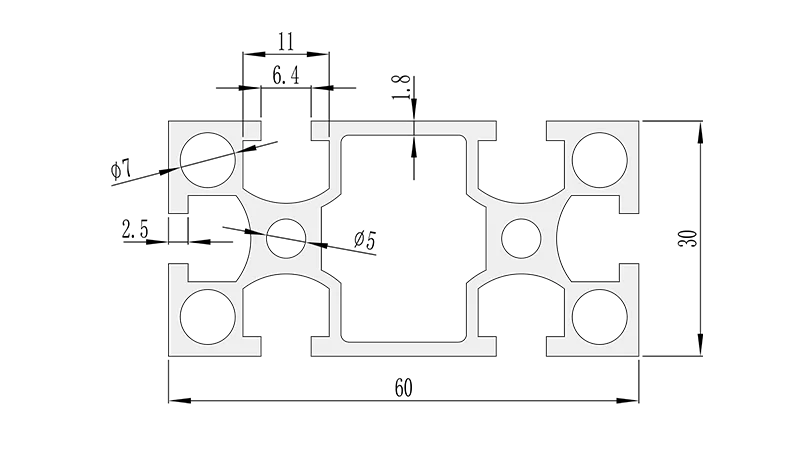
Walk into any modern factory or manufacturing plant today, and you'll notice something different from the rigid, one-size-fits-all setups of the past. The lines move smoother, the workstations adapt quickly to new tasks, and there's a quiet efficiency in how materials flow from one step to the next. A big part of that change? Lean pipe systems. These modular, flexible structures have become the backbone of lean manufacturing, helping businesses cut waste, boost productivity, and stay agile in a fast-changing market. But within every great lean pipe system, there's a star player—the components that hold it all together and make its flexibility possible. Today, we're shining a spotlight on one such component: the 3060 National Standard Profile A. It might not sound glamorous, but this unassuming aluminum extrusion is the unsung hero behind some of the most effective lean solutions out there, from workbenches that adjust to any task to flow racks that keep production moving without a hitch.
Understanding Lean Pipe Systems: More Than Just Pipes and Joints
Before we dive into the 3060 Profile A, let's take a step back and talk about what lean pipe systems really are. At their core, they're modular structures built from pipes, joints, and accessories that can be assembled, disassembled, and reconfigured with minimal effort. Unlike traditional fixed equipment—think heavy steel workbenches or welded racks—lean pipe systems are designed to evolve with your needs. Need to add a shelf to a workstation? Swap out a section of pipe. Move a flow rack to a new part of the factory? Just disassemble it and rebuild it in the new spot. This flexibility is why they're a cornerstone of lean manufacturing, a philosophy all about eliminating waste (whether that's time, space, or materials) and focusing on value.
But here's the thing: not all lean pipe systems are created equal. The materials used, the design of the components, and how well they work together can make a huge difference in how effective the system is. That's where aluminum profiles come in. In recent years, aluminum has become the material of choice for many lean systems, thanks to its unique blend of strength, lightweight design, and corrosion resistance. And among aluminum profiles, the 3060 National Standard Profile A has emerged as a go-to option for manufacturers who need something that's both versatile and reliable. It's not the smallest profile out there, nor the largest, but it hits that sweet spot of size, strength, and adaptability that makes it perfect for a wide range of applications.
What Exactly Is 3060 National Standard Profile A?
Let's start with the basics: the name. "3060" refers to the profile's dimensions—30 millimeters in width and 60 millimeters in height. That rectangular cross-section might seem simple, but it's carefully engineered to balance structural stability with practicality. The "National Standard" part means it's designed to meet specific industry guidelines for dimensions, material thickness, and performance, ensuring consistency no matter which supplier you buy it from. And "Profile A" typically indicates a specific variation of the 3060 design, often with standardized T-slots (those grooves running along the length of the profile) that make it easy to attach accessories like brackets, shelves, or handles.
But numbers and specs only tell part of the story. What really makes the 3060 Profile A stand out is how it's made. Like most aluminum profiles, it's created through an extrusion process: heated aluminum billets are pushed through a die, which shapes them into the 30x60mm cross-section with T-slots. This process not only ensures precision but also creates a profile with uniform strength—no weak spots, just consistent durability from end to end. The result is a profile that's surprisingly strong for its weight. While exact load capacities can vary based on wall thickness and length, a typical 3060 Profile A can easily support 50-100 kg per linear meter when properly installed, which is more than enough for most workbench surfaces, shelving, or flow rack frames.
Another key feature is the T-slots. These grooves aren't just there for looks; they're the secret to the profile's modularity. Using aluminum profile accessories like T-bolts, nuts, and brackets, you can attach almost anything to the 3060 Profile A without drilling or welding. Need to add a tool holder to a workbench? Slide a T-bolt into the slot, tighten a nut, and you're done. Want to adjust the height of a shelf on a flow rack? Loosen the bolts, move the bracket, and retighten. It's this "tool-less" adjustability that makes the 3060 Profile A such a powerful component in lean systems—no more waiting for a maintenance crew to drill new holes or weld parts together when your needs change.
The Core Role of 3060 Profile A in Lean Pipe Systems
So, why is the 3060 Profile A considered a "core component" of lean pipe systems? Let's break it down into three key areas: flexibility, structural integrity, and compatibility.
1. Flexibility: The Heart of Lean Manufacturing
Lean manufacturing is all about responding quickly to change. Maybe a new product line requires a different workstation layout, or a sudden increase in demand means you need to expand your flow rack storage. In these situations, rigid equipment becomes a liability. But with the 3060 Profile A, flexibility is built in. Its modular design means you can reconfigure your system in hours (or even minutes) instead of days. For example, a workbench built with 3060 profiles can easily be extended by adding more sections, or its height can be adjusted by swapping out leg components—no need to buy a whole new workbench. This adaptability not only saves money but also reduces downtime, letting your team stay focused on what matters: production.
I remember visiting a small electronics manufacturer a few years back that had just switched to 3060 Profile A-based workbenches. Their old setup used fixed wooden workbenches that were a hassle to modify. When they introduced a new, larger circuit board, they had to either replace the workbenches entirely or squeeze the boards onto surfaces that were too small. With the 3060 profiles, they simply added extensions to the workbenches using aluminum profile accessories—T-joints and extra profile sections—and had the new setup ready by the end of the day. That's the kind of flexibility that turns "we can't do that" into "we can do that tomorrow."
2. Structural Integrity: Strong Enough to Depend On
Flexibility is great, but it doesn't mean much if the system falls apart under load. Here's where the 3060 Profile A really delivers. Its 30x60mm cross-section provides a stable base for all kinds of structures. The wider 60mm height gives it excellent resistance to bending, while the 30mm width adds lateral stability—important for preventing wobbling or tipping. This makes it ideal for applications where stability is key, like workbenches where precision assembly happens or flow racks that hold heavy materials.
Compare that to smaller profiles, like the 2020 (20x20mm), which is great for lightweight applications but can feel flimsy under heavier loads. Or larger profiles like the 4080 (40x80mm), which are strong but overkill for many tasks and add unnecessary weight. The 3060 Profile A hits that perfect middle ground: strong enough for most manufacturing needs, but not so heavy that it's hard to handle or transport. It's the kind of profile you can trust to hold up day in and day out, even in busy factories where equipment takes a beating.
3. Compatibility: Playing Well with Others
A lean pipe system is only as good as the accessories it works with. The 3060 Profile A's standardized design means it's compatible with a wide range of aluminum profile accessories, from simple brackets and shelves to more specialized components like roller tracks or caster mounts. This compatibility is crucial because it lets you build exactly what you need without being locked into a single supplier's proprietary parts. Need a roller track for a flow rack? There are dozens of options that fit the 3060's T-slots. Want to add casters to a workbench for mobility? Just pick up a set of caster mounts designed for national standard profiles—they'll slide right into the T-slots and secure with a nut.
This interoperability also future-proofs your investment. As your needs grow, you can mix and match components from different suppliers, adding new features to your existing system instead of replacing it. For example, a basic workbench built with 3060 profiles today can become a fully equipped assembly station tomorrow with the addition of a tool rail, a parts bin holder, and a monitor mount—all attached via standard accessories.
Practical Applications: From Workbenches to Flow Racks
Theory is great, but let's look at real-world examples of how the 3060 Profile A is used in lean pipe systems. Two of the most common applications are workbenches and flow racks—both staples in manufacturing environments, and both areas where the 3060 Profile A really shines.
Workbenches: The Foundation of the Production Line
Workbenches are where the magic happens—where operators assemble products, test components, or package goods. A good workbench needs to be sturdy, adjustable, and tailored to the task at hand. That's where the 3060 Profile A comes in. Let's say you're building a workbench for electronics assembly. The frame would likely be made from 3060 profiles: four legs (each a vertical 3060 section), connected by horizontal rails at the top and bottom for stability. The top surface could be a plywood or aluminum panel attached to the top rails using angle brackets secured in the T-slots. Need a shelf for tools? Add a couple of horizontal 3060 profiles halfway up the legs, again using brackets in the T-slots. Want to adjust the height? Use adjustable feet (another common aluminum profile accessory) on the legs, which screw into the bottom of the 3060 profiles and let you fine-tune the height by turning a dial.
What makes this setup so effective is how easy it is to customize. If an operator needs a larger surface area, you can add a side extension by attaching more 3060 profiles to one side. If the workbench needs to be mobile, swap out the adjustable feet for casters (mounted via caster brackets in the T-slots). And if the task changes—say, you start assembling larger products—you can reinforce the frame with diagonal braces (using 3060 profiles and corner brackets) to increase stability. The 3060 Profile A's strength ensures the workbench can handle the weight of tools, materials, and the product itself, while its flexibility lets you adapt it to any task.
Flow Racks: Keeping Materials Moving
Flow racks are another critical component of lean systems, designed to keep materials moving from storage to the production line efficiently (often using gravity to feed parts to operators). A typical flow rack has multiple levels of sloped shelves, each fitted with roller tracks that let bins or boxes glide forward as the front one is removed. The frame of these racks is often built with 3060 Profile A, and for good reason: the profile's strength supports the weight of the materials, while its T-slots make it easy to mount the roller tracks at the perfect angle.
Imagine a flow rack for automotive parts. The vertical supports are 3060 profiles, spaced a few feet apart to create bays. Horizontal 3060 profiles run between the vertical supports to form the shelves, and roller tracks are attached to these horizontal profiles using brackets that slide into the T-slots. The angle of the roller tracks can be adjusted by raising or lowering one end of the horizontal profile (using shims or adjustable brackets), ensuring parts flow smoothly without jamming. Because the 3060 Profile A is strong enough to support multiple levels of heavy parts bins, you can maximize vertical space in your facility, reducing the floor area needed for storage.
What's more, if you need to change the number of levels or the spacing between them, it's a simple matter of moving the horizontal profiles up or down the vertical supports—no drilling, no welding, just loosening a few bolts and repositioning. This is a huge advantage over traditional wooden or steel flow racks, which are fixed in place and nearly impossible to modify without major work.
Why 3060 Profile A Stands Out Among Other Aluminum Profiles
With so many aluminum profiles on the market—2020, 3030, 4040, 4080, to name a few—why does the 3060 Profile A get so much attention? Let's compare it to a few common alternatives to see what makes it unique.
| Profile Type | Dimensions (WxH) | Typical Load Capacity (per linear meter) | Best For | Limitations |
|---|---|---|---|---|
| 2020 National Standard | 20x20mm | 20-30 kg | Light-duty shelving, small carts, prototyping | Too small for heavy loads or large workbenches |
| 3030 National Standard | 30x30mm | 30-60 kg | Medium-duty carts, small workbenches | Limited vertical space for accessories; less stable than 3060 for tall structures |
| 3060 National Standard Profile A | 30x60mm | 50-100 kg | Workbenches, flow racks, medium-duty shelving, assembly stations | Slightly heavier than smaller profiles; overkill for very light applications |
| 4040 National Standard | 40x40mm | 60-120 kg | Heavy-duty shelving, large workbenches, machine guards | Bulky; takes up more space than 3060 for similar applications |
As the table shows, the 3060 Profile A fills a gap between smaller, lighter profiles and larger, heavier ones. It offers more load capacity than 2020 or 3030 profiles, making it suitable for workbenches and flow racks, but it's more compact and lightweight than 4040 profiles, which is a big plus when you need to keep your system mobile or fit it into tight spaces.
Another advantage is its versatility. The 30x60mm rectangle is a practical shape for both vertical and horizontal use. As a vertical support (like a workbench leg), the 60mm height provides stability against tipping. As a horizontal beam (like a shelf rail), the 30mm width is narrow enough to keep the system compact but wide enough to mount multiple accessories side by side. The T-slots, which are typically spaced at standard intervals (like 20mm or 40mm), also mean you can attach accessories at precise intervals, ensuring your setup is both functional and neat.
Finally, there's cost. While prices can vary, the 3060 Profile A is generally more affordable than larger profiles like 4040 or 4080, making it a cost-effective choice for businesses on a budget. At the same time, it's more durable and versatile than smaller, cheaper profiles like 2020, so you're getting better value for your money in the long run.
Long-Term Value: Cost-Efficiency and Sustainability
Lean manufacturing isn't just about efficiency—it's also about smart spending. The 3060 Profile A delivers long-term value in two key ways: cost-efficiency and sustainability.
From a cost perspective, the initial investment in 3060 Profile A-based systems might be slightly higher than basic steel pipe systems, but the savings add up quickly. Because the system is modular, you only buy what you need today, and you can expand or reconfigure it as your business grows—no need to replace the entire system. The tool-less assembly also reduces labor costs; your own team can build and modify the system without hiring outside contractors. And because aluminum is resistant to rust and corrosion, your 3060 Profile A components will last for years, even in harsh factory environments, reducing the need for frequent replacements.
Sustainability is another big factor. Aluminum is 100% recyclable, and recycling it uses just 5% of the energy needed to produce new aluminum. This makes the 3060 Profile A a greener choice than steel, which is heavier to transport (increasing carbon emissions) and harder to recycle. For companies looking to reduce their environmental footprint, switching to aluminum profiles like the 3060 is a simple yet impactful step.
I recently worked with a manufacturer that was hesitant to switch from steel pipe systems to aluminum. They were worried about the upfront cost, but after crunching the numbers, they realized that the ability to reconfigure their workbenches and flow racks as their product line changed would save them tens of thousands of dollars over five years. Plus, the lighter weight of the aluminum systems reduced the strain on their floor load capacity, allowing them to add more workstations in the same space. Within a year, they were converts—and they've since expanded their use of 3060 Profile A to other areas of the factory.
Conclusion: The Backbone of Lean Manufacturing Systems
At the end of the day, the 3060 National Standard Profile A might not be the most glamorous component in your factory, but it's one of the most important. It's the backbone that holds your lean pipe system together, the flexibility that lets you adapt to change, and the reliability that keeps your production line running smoothly. Whether you're building a workbench, a flow rack, or a custom material handling system, the 3060 Profile A delivers the perfect combination of strength, versatility, and cost-efficiency.
In a world where manufacturing is more competitive than ever, lean systems are no longer a luxury—they're a necessity. And within those systems, components like the 3060 Profile A are the difference between a system that just gets the job done and one that helps you thrive. So the next time you walk through your factory, take a closer look at those aluminum frames holding up the workbenches or supporting the flow racks. Chances are, you'll see the 3060 Profile A hard at work, quietly making your operations leaner, more efficient, and ready for whatever the future brings.