- Company Articles
- Industry articles
- Industry standards
- Safety Standards for 4040r EU Standard Aluminum Profile in Industrial Settings

Safety Standards for 4040r EU Standard Aluminum Profile in Industrial Settings
Related Product
4040R EU Standard Aluminum Profile
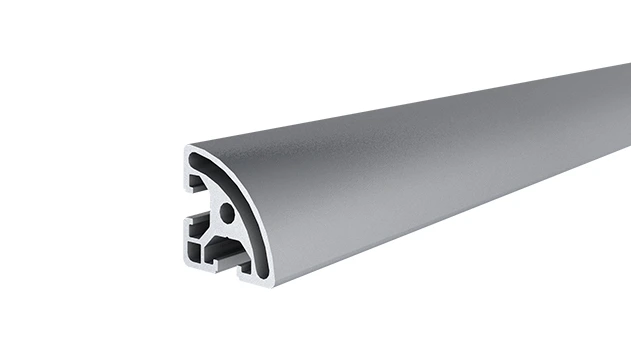
4040R is a 4.00x4.00 CM fractional 40 series square extrusion T-slot profile with two side open T-slots, each side with 4.00cm face,the other side is round face. The profile has align-a-grooves to assist in aligning connecting profiles.
Walk through any modern factory, warehouse, or manufacturing plant, and you'll likely spot the silent workhorses of industrial efficiency: aluminum profiles. These modular, lightweight structures form the backbone of workbenches, material racks, conveyor systems, and assembly lines, enabling the flexibility and adaptability that today's fast-paced industries demand. Among the most widely used profiles is the 4040r EU standard aluminum profile—a 40x40mm extruded aluminum beam known for its strength, versatility, and compliance with rigorous European safety norms. But in an environment where every second counts and productivity reigns supreme, it's easy to overlook a critical factor: safety. When aluminum profiles are used to build structures that workers interact with daily—leaning on workbenches, loading materials onto racks, or moving trolleys across floors—compromising on safety standards isn't just a risk; it's a recipe for disaster. In this article, we'll dive deep into the safety standards that govern 4040r EU standard aluminum profiles, why they matter, and how adhering to them protects both your workforce and your bottom line.
Understanding the 4040r EU Standard Aluminum Profile
Before we explore safety standards, let's first understand what makes the 4040r EU standard aluminum profile a staple in industrial settings. The "4040" refers to its cross-sectional dimensions: 40mm in width and 40mm in height, making it a compact yet robust choice for structural applications. The "r" in its name is a nod to its rounded edges—a subtle but crucial design feature that sets it apart from sharp-edged alternatives, reducing the risk of cuts and abrasions during handling and daily use. As an EU standard profile, it adheres to strict manufacturing and performance criteria outlined by European norms, ensuring consistency, quality, and interoperability across suppliers.
At its core, the 4040r profile is typically extruded from aluminum alloy 6063-T5, a material celebrated for its winning combination of lightness and strength. This alloy, composed primarily of aluminum, magnesium, and silicon, undergoes heat treatment (T5) to enhance its mechanical properties, resulting in a profile that can withstand significant loads while remaining easy to handle and install. Unlike heavier steel structures, 4040r profiles reduce strain on workers during assembly and reconfiguration—an ergonomic benefit thats safety by minimizing fatigue-related errors.
What truly makes the 4040r profile indispensable, however, is its modularity. Thanks to a system of grooves (or "T-slots") running along its length, it seamlessly integrates with aluminum profile accessories such as connectors, brackets, hinges, and caster wheels. This modularity allows teams to build everything from simple workbenches to complex lean system setups in hours, not days. But with great flexibility comes great responsibility: the safety of these structures depends not just on the profile itself, but on how well it's paired with compliant accessories and installed according to standards.
Why Safety Standards Matter in Industrial Aluminum Profiles
In industrial environments, where heavy materials are moved, machinery operates at high speeds, and workers are in constant proximity to structures, the consequences of safety lapses are stark. A workbench built with substandard aluminum profiles or faulty accessories could collapse under load, sending tools and parts crashing to the floor. A material rack with inadequate bracing might tip over, injuring nearby employees. Even something as small as a loose caster wheel on a mobile trolley could cause it to veer off course, leading to collisions or falls. These aren't hypothetical scenarios—they're real risks that cost businesses billions annually in downtime, workers' compensation claims, and legal penalties.
Beyond the immediate physical and financial costs, poor safety standards erode trust. Employees who feel their workplace prioritizes speed over their well-being are less engaged, more likely to leave, and more prone to accidents due to distraction or stress. In contrast, facilities that invest in compliant, safe structures see higher morale, lower turnover, and smoother operations—proof that safety and productivity aren't opposing goals, but two sides of the same coin.
For 4040r EU standard aluminum profiles, safety standards act as a blueprint for reliability. They ensure that the profile itself is free from defects, that its accessories won't fail under stress, and that the structures built with it can withstand the demands of daily use. Whether it's a static workbench in a electronics assembly line or a dynamic conveyor system in a logistics hub, adhering to these standards isn't just about checking boxes—it's about creating an environment where workers can focus on their tasks without worrying about the structures around them.

Key Safety Standards for 4040r Aluminum Profiles
1. Material Safety and Compliance
The foundation of safety for any aluminum profile lies in its material composition and compliance with EU regulations. The 4040r profile must meet strict criteria to ensure it's free from hazardous substances and built to last. Two key regulations govern this: REACH (Registration, Evaluation, Authorization, and Restriction of Chemicals) and RoHS (Restriction of Hazardous Substances). REACH restricts the use of substances like lead, cadmium, and mercury, which can leach into the environment or pose health risks during manufacturing or disposal. RoHS, on the other hand, ensures that electrical and electronic equipment (including aluminum profiles used in ESD-sensitive workbenches) contains minimal levels of hazardous materials, protecting both workers and end-users.
Beyond chemical safety, the mechanical properties of the 4040r profile are regulated by EN 755, the European standard for extruded aluminum profiles. EN 755-2 specifies requirements for mechanical properties such as tensile strength, yield strength, and elongation. For alloy 6063-T5, this means a minimum tensile strength of 160 MPa, a yield strength of at least 110 MPa, and an elongation of 8% (the ability to stretch before breaking). These values aren't arbitrary—they ensure the profile can bear static and dynamic loads without deforming or failing. Reputable suppliers test their 4040r profiles against these standards, providing certificates of compliance to customers to verify material integrity.
2. Structural Integrity and Load Capacity
A 4040r profile is only as safe as the structure it supports. Whether it's a workbench holding 500kg of electronic components or a material rack stacked with heavy parts, structural integrity depends on two critical factors: load capacity and the quality of aluminum profile accessories.
Load capacity refers to the maximum weight a structure can safely bear, divided into static load (weight applied without movement) and dynamic load (weight with movement, such as when materials are placed, removed, or vibrated). For example, a static workbench built with 4040r profiles and reinforced with heavy-duty brackets might handle 600kg, but if that same workbench is fitted with caster wheels for mobility, its dynamic load capacity could drop to 400kg—since moving loads exert additional stress on the structure. EU standards, such as EN 15635 for storage racks and EN 10002-1 for tensile testing, provide guidelines for calculating these capacities based on profile thickness, accessory type, and assembly method.
Aluminum profile accessories play a starring role here. A 4040r profile with a 2mm wall thickness might theoretically support 800kg, but if paired with low-quality connectors that crack under pressure, the entire structure could fail at half that load. This is why standards like EN 15048-2 for structural fasteners mandate that accessories—from 90-degree brackets to T-slot nuts—meet the same rigorous testing as the profiles themselves. For instance, a connector used to join two 4040r profiles must withstand a shear force of at least 5kN (approximately 500kg) without breaking, ensuring it doesn't snap when the structure is loaded.
To illustrate how load capacity varies with configuration, consider the table below, which compares common 4040r-based structures and their safe load limits when built with compliant accessories:
| Structure Type | Max Static Load (kg) | Max Dynamic Load (kg) | Key Accessories | Relevant EU Standard |
|---|---|---|---|---|
| 4040r Workbench (Fixed, Single Deck) | 600 | 450 | 90° Aluminum Connectors, Steel Brackets, Plywood Top | EN 755-2, EN 10002-1 |
| 4040r Workbench (Mobile with Caster Wheels) | 400 | 300 | Locking Caster Wheels (500kg Total Load Rating), Reinforced Base | EN 12530 (Casters), EN 755-2 |
| 4040r Material Rack (3-Tier, 1.8m Height) | 500 (per shelf) | 350 (per shelf) | Shelf Brackets, Cross Beams, Anti-Tip Anchors | EN 15635 (Storage Racks), EN 13155 (Stability) |
| 4040r Lean System Conveyor (Roller Track) | 200 (per linear meter) | 150 (per linear meter) | Roller Track, Aluminum Guide Rails, Support Brackets | EN 619 (Conveyors), EN 755-2 |
3. Installation Safety: The Human Factor
Even the highest-quality 4040r profile and accessories can't guarantee safety if installed incorrectly. Installation is where human error often creeps in—over-tightening bolts, misaligning profiles, or skipping critical steps in the assembly process. To mitigate this, EU standards outline precise guidelines for installing aluminum profiles, from torque specifications to alignment checks.
Take torque, for example. The bolts and nuts used to secure aluminum profile accessories must be tightened to a specific torque to ensure they don't loosen over time or strip the T-slot threads. For M8 bolts (common in 4040r assemblies), the recommended torque is typically 12-15 Nm—tight enough to hold the joint securely but not so tight that the aluminum deforms. Using a torque wrench is non-negotiable here; "eyeballing" it or using a power drill without a torque setting is a common mistake that leads to loose connections or cracked profiles.
Alignment is another critical factor. When building a workbench or rack, 4040r profiles must be squared to prevent "racking"—a lateral shift that weakens the structure and increases the risk of collapse. A simple carpenter's square or laser level can ensure that vertical and horizontal profiles meet at 90-degree angles, distributing weight evenly across the frame. For larger structures, like a 5-meter-long conveyor, using a string line to check straightness prevents uneven loading that could strain the roller track and accessories.
Mobility adds another layer of complexity. When installing caster wheels on a 4040r trolley or mobile workbench, each caster must be mounted flush with the profile's base to avoid uneven weight distribution. The wheels themselves must feature robust locking mechanisms—preferably dual-locking (braking both the wheel and swivel) to prevent movement on inclines or during loading. A common oversight is failing to test the brakes after installation; a caster that rolls even slightly when locked can cause the trolley to drift, leading to collisions with other equipment or workers.
4. Ergonomics and Workplace Safety
Safety isn't just about preventing catastrophic failures—it's also about designing structures that protect workers from daily wear and tear. The 4040r profile's rounded edges (the "r" in its name) are a prime example of ergonomic safety in action. Sharp edges on metal profiles can cause lacerations when workers brush against them or grip the structure during assembly. By rounding these edges to a radius of at least 1.5mm, the 4040r profile reduces the risk of cuts, making it safer for repeated, close contact.
Ergonomics also plays a role in workbench design. A 4040r workbench that's too low forces workers to hunch over, leading to back pain and repetitive strain injuries; one that's too high causes shoulder and neck fatigue. EU standards like EN ISO 14738 for workbench dimensions recommend a height of 800-900mm for seated work and 900-1100mm for standing work, depending on the average height of the workforce. The modularity of 4040r profiles makes it easy to adjust height using telescoping legs or stackable accessories, ensuring the workbench fits the worker, not the other way around.
Lighting and accessibility are other ergonomic considerations. A 4040r workbench with overhead shelves built too low can block task lighting, forcing workers to strain their eyes to see small components. Similarly, material racks constructed with 4040r profiles should have shelves spaced at least 300mm apart to allow easy access without overreaching—a common cause of muscle strains. By following EN ISO 6385 for ergonomic design of work systems, teams can use 4040r profiles to create spaces that prioritize both safety and comfort.
5. Maintenance and Inspection: Sustaining Safety Over Time
Safety isn't a one-time achievement; it requires ongoing effort to maintain. Even a perfectly installed 4040r structure will degrade over time—bolts loosen, caster wheels wear, and profiles may develop small cracks from repeated loading. Regular maintenance and inspection are critical to catching these issues before they escalate into hazards.
EU standard EN 13000 for lifting equipment provides a framework for inspection intervals, but for most 4040r-based structures, a monthly check is sufficient. During these inspections, teams should:
•
Check for loose fasteners:
Use a torque wrench to retighten bolts and nuts to the recommended torque (e.g., 12 Nm for M8 bolts).
•
Inspect accessories for wear:
Look for cracks in brackets, bent connectors, or worn caster wheels (flat spots or seized bearings are red flags).
•
Test load capacity:
Periodically load the structure to 80% of its max static load and check for deflection (bending). Excessive deflection (more than 2mm per meter of length) indicates a weakened component.
•
Clean profiles and accessories:
Dust, grease, and debris can hide cracks or corrosion. Wiping down 4040r profiles with a mild detergent prevents buildup and makes defects easier to spot.
Damaged components should be replaced immediately with compliant spares. Using off-brand aluminum profile accessories as "temporary" fixes is a dangerous gamble—even a single non-compliant bracket can compromise the entire structure. Reputable suppliers often provide replacement parts that match the original specifications, ensuring the structure remains safe and compliant.
Case Study: The Cost of Cutting Corners
To underscore the importance of safety standards, consider the case of a small electronics manufacturer that opted for non-compliant 4040r accessories to save costs. The company built a series of workbenches using genuine 4040r profiles but paired them with cheap, uncertified connectors sourced from an unregulated supplier. Within six months, several workers reported that the workbenches felt "wobbly" when loaded with circuit boards and tools. Management dismissed the concerns, citing tight deadlines and budget constraints.
Tragedy struck when a workbench holding 400kg of components collapsed during a morning shift. The cause? A cracked connector that failed under the static load, sending the top shelf crashing to the floor. A worker standing nearby suffered a fractured ankle, and the company faced $50,000 in medical bills, $20,000 in equipment damage, and a two-week production shutdown while the workbenches were rebuilt with compliant accessories. The lesson was clear: the $200 saved on cheap connectors cost the company over $70,000—and nearly cost a worker their mobility.
In contrast, a neighboring automotive plant that strictly followed 4040r safety standards reported zero profile-related incidents over five years. By investing in certified profiles and accessories, training staff on proper installation, and conducting monthly inspections, the plant not only protected its workers but also maintained consistent productivity, with no downtime due to structural failures.
Conclusion: Safety as the Foundation of Efficiency
The 4040r EU standard aluminum profile is more than just a building block for industrial structures—it's a commitment to safety. From its rounded edges to its compliance with EN 755 and REACH, every aspect of its design and manufacturing is rooted in protecting the workers who rely on it daily. By adhering to material standards, prioritizing structural integrity, following installation guidelines, and maintaining vigilance through regular inspections, businesses can harness the 4040r profile's versatility without sacrificing safety.
In the end, safety standards aren't a burden—they're an investment. An investment in your workforce's well-being, in your company's reputation, and in the long-term efficiency that comes from knowing your structures won't fail when you need them most. So the next time you're planning a workbench, rack, or lean system, remember: the 4040r profile is only as safe as the standards you uphold. Choose compliance, choose quality, and build a workplace where safety and productivity go hand in hand.