- Company Articles
- Industry articles
- Industry standards
- Safety Standards for Aluminum Workbench B: Ensuring Workplace Compliance

Safety Standards for Aluminum Workbench B: Ensuring Workplace Compliance
Related Product
Aluminum Workbench B
Aluminum tube workbench is more flexible and durable, compared with traditional PE/ABS coated steel tube. It is easy to assemble, anti corrosion, rust protection, and recycle use after disassemble.
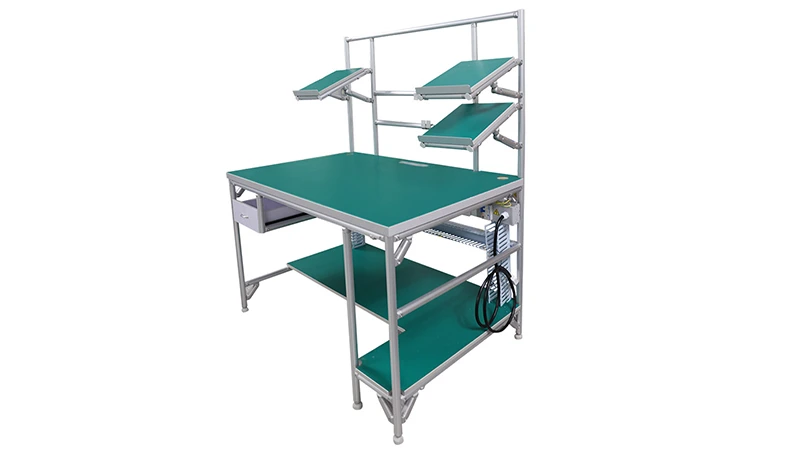
Walk into any production assembly floor, and you'll quickly notice the backbone of daily operations: workbenches. They're where components are sorted, products are assembled, tools are organized, and teams spend hours of their shift bringing ideas to life. But here's the thing—these workbenches aren't just pieces of furniture. They're critical to worker safety, productivity, and even the quality of the end product. When it comes to Aluminum Workbench B, a staple in lean systems across manufacturing, adhering to strict safety standards isn't just a "nice-to-have"—it's the difference between a smooth, accident-free workflow and costly disruptions that risk lives and livelihoods.
Aluminum Workbench B isn't just another piece of equipment. Designed for durability and flexibility, it's engineered to handle the demands of production assembly, from light electronics work to heavier component handling. Its aluminum frame offers strength without the bulk of steel, making it easy to reconfigure for changing needs—all while keeping workers close to the action. But with that adaptability comes responsibility: ensuring every joint, wheel, and surface meets safety benchmarks that protect those who use it daily.
In this article, we'll dive into the safety standards that make Aluminum Workbench B a reliable choice for compliant workplaces. We'll break down why these standards matter, how they're implemented, and what happens when they're overlooked. Whether you're a facility manager, safety officer, or someone just curious about workplace safety, this guide will show you how the right workbench—built and maintained to standard—can transform your operations for the better.
What Makes Aluminum Workbench B Unique?
Before we jump into safety standards, let's get clear on what Aluminum Workbench B is and why it's so widely used. Unlike generic workbenches, this model is designed with lean principles in mind—maximizing efficiency while minimizing waste. Its aluminum profile construction (think lightweight yet sturdy extruded aluminum) makes it resistant to rust and corrosion, ideal for both dry and slightly humid environments. The single-deck, caster-free design (Workbench E, as some suppliers call it) keeps it stable during use, while optional add-ons like side shelves or tool hooks enhance functionality.
But what really sets it apart is its focus on adaptability. Aluminum Workbench B can be customized with aluminum pipe accessories—joints, clamps, and brackets—that let teams adjust height, add storage, or reposition components without welding or heavy tools. This flexibility is a boon for dynamic production lines, but it also means every modification must align with safety guidelines to avoid compromising structural integrity. After all, a workbench that's easy to tweak is only useful if those tweaks don't turn into safety hazards.
Core Safety Standards: The Foundation of Workplace Compliance
Safety standards for Aluminum Workbench B aren't arbitrary. They're built on decades of research into workplace accidents, ergonomic studies, and industry best practices. Let's break down the key areas these standards cover, and why each one is non-negotiable.
1. Structural Integrity: It All Starts with the Frame
Imagine leaning on a workbench to reach a tool, only to have the frame buckle. Scary, right? That's why structural integrity is the first line of defense. Aluminum Workbench B's frame is made from aluminum profile, a material chosen for its high strength-to-weight ratio. But not all aluminum profiles are created equal. Safety standards dictate that the profile must have a minimum wall thickness (often 1.2mm or higher) to withstand static and dynamic loads. The extrusion process—how the aluminum is shaped—also matters: uneven walls or weak points in the profile can lead to cracks under stress.
Then there are the joints. Aluminum Workbench B uses multi-angle fixed aluminum joints to connect the frame's legs, shelves, and supports. These joints must be precision-engineered to distribute weight evenly, preventing stress concentration. For example, a 90° aluminum pipe joint inside connection should fit snugly, with no gaps that could loosen over time. Even the smallest misalignment here can cause the workbench to wobble, increasing the risk of slips or falls.
| Component | Key Safety Requirement | Why It Matters |
|---|---|---|
| Aluminum Profile | Minimum wall thickness of 1.2mm; uniform extrusion without defects | Prevents frame bending or cracking under load |
| Multi-Angle Joints | Zero gaps when connected; torque-tested to 500N·m | Ensures even weight distribution across the frame |
| Tabletop Support | Reinforced cross-bracing every 60cm | Stops the tabletop from sagging under heavy tools or materials |
| Leg Base | Non-slip, heavy-duty split foot seat | Anchors the workbench to the floor, preventing tipping |
2. Load Capacity: Don't Overestimate, Don't Underprepare
How much weight can Aluminum Workbench B actually hold? That's not a question to guess at. Safety standards specify clear load limits, both for the entire workbench and individual components like shelves or drawers. For example, the single-deck top (without casters) is typically rated for 200–300kg of evenly distributed weight. But here's a common mistake: piling all that weight in one corner. Even a compliant workbench can fail if load isn't spread out—think of it like stacking books on one side of a table; eventually, it'll tip.
Load testing is rigorous. Manufacturers simulate real-world use by placing weighted plates across the tabletop, incrementally increasing the load to 125% of the rated capacity, and monitoring for deflection (how much the tabletop bends). If it sags more than 2mm under the maximum load, it fails. Why 2mm? Because beyond that, tools slide, components roll, and workers strain to reach items that aren't level—all precursors to accidents.
And let's not forget dynamic loads. When a worker slams a tool down or drops a component, that's a sudden, short burst of force. Aluminum Workbench B must absorb these impacts without loosening joints or cracking the frame. Standards often require impact testing with a 5kg weight dropped from 30cm onto the tabletop—no damage, no permanent deformation, no failure.
3. Ergonomics: Keeping Workers Comfortable (and Safe)
Safety isn't just about preventing catastrophic failures. It's also about protecting workers from daily wear and tear that leads to long-term injuries. Aluminum Workbench B's ergonomic design is a key part of this. Let's start with height: the ideal workbench height is between 75–90cm for most adults, but one size doesn't fit all. That's why many models offer adjustable feet—threaded, anti-slip foot adjusters that let workers tweak the height by up to 5cm. This might seem small, but for someone spending 8 hours a day bent over a workbench that's too low, it's the difference between a sore back and a pain-free shift.
Then there's the tabletop itself. A smooth, non-porous surface prevents tools from slipping, but it also needs to be gentle on hands. Some models add a thin rubber mat or anti-fatigue padding, reducing pressure on wrists during repetitive tasks like assembly. Even the edge of the tabletop matters—sharp corners are a hazard for bumps and scrapes, so safety standards often require rounded edges with a radius of at least 2mm.
And while Aluminum Workbench B typically doesn't come with casters (it's a "single deck without caster" model), many facilities add them for mobility. When casters are used, they must meet standards too: lockable caster wheels that engage firmly to prevent rolling during use, and a weight rating that matches the workbench's load capacity. A caster that fails mid-task can send tools crashing to the floor—or worse, the workbench itself tipping.
4. ESD Protection: Safeguarding Sensitive Work
In electronics manufacturing, static electricity is a silent killer. A single static discharge can fry a circuit board, ruin hours of work, or even render a product unsafe for use. That's where ESD (Electrostatic Discharge) protection comes in—and for Aluminum Workbench B used in these environments, it's a critical safety standard.
An ESD-compliant Aluminum Workbench B isn't just about adding a grounding strap (though that's part of it). The entire workbench must be designed to dissipate static charge, not build it up. The tabletop, for example, is often made from a static-dissipative material with a surface resistance between 10^6 and 10^9 ohms—low enough to bleed static away, but not so low that it conducts electricity dangerously. The aluminum frame, being conductive, is grounded via a braided wire to the building's earth system, ensuring any static charge flows harmlessly away from sensitive components.
Even the smallest details matter here. The anti-slip foot adjusters? They're often made with conductive rubber to maintain the grounding path. Tools placed on the workbench? They should rest on ESD-safe mats. And regular testing is a must: using a resistance meter to check the tabletop and grounding system weekly, and logging results to prove compliance. Skip this, and you're not just risking product defects—you're violating safety regulations that protect both workers and customers.
5. Compliance with Industry Regulations
Safety standards for Aluminum Workbench B don't exist in a vacuum. They're shaped by global regulations like OSHA (Occupational Safety and Health Administration) in the U.S., CE marking in the EU, and ISO 45001 for occupational health and safety management. These bodies set baseline requirements, but smart facilities go further, adopting internal standards that exceed minimums.
For example, OSHA requires workbenches to be "stable and capable of supporting intended loads," but it doesn't specify exact load limits. That's where manufacturers step in, designing Aluminum Workbench B to meet OSHA's intent while providing clear ratings (e.g., "300kg maximum static load"). CE marking, on the other hand, requires testing against EN 527-1, a European standard for office furniture that covers stability, strength, and safety. Passing these tests isn't just about sticking a label on the product—it's about proving, through independent testing, that the workbench won't fail when it matters most.

The Cost of Cutting Corners: What Happens When Standards Are Ignored
Let's get real: safety standards can feel like a hassle. They add time to setup, cost to procurement, and paperwork to maintenance. But the alternative? Far worse. Consider a scenario where a facility opts for a cheaper, non-compliant version of Aluminum Workbench B. The aluminum profile is thinner than required, the joints are poorly cast, and the ESD protection is nonexistent. What happens next?
First, the workbench sags under the weight of tools, causing a worker to strain their back reaching for a component. Then, a loose joint causes the side shelf to collapse,ing a foot. Later, static buildup on the tabletop damages a batch of circuit boards, costing thousands in rework. Finally, an OSHA inspection flags the violations, resulting in fines and a shutdown until the issue is fixed. Suddenly, that "cheaper" workbench becomes the most expensive one in the shop.
But the true cost is human. In 2023, the Bureau of Labor Statistics reported over 20,000 workplace injuries related to workbench and workstation hazards—sprains, fractures, and even amputations. Many of these could have been prevented with compliant equipment. When workers feel unsafe, morale drops, turnover rises, and productivity plummets. It's a domino effect that no business can afford.

Maintaining Compliance: It's Not a One-Time Task
Buying a compliant Aluminum Workbench B is just the first step. Safety standards require ongoing maintenance to ensure it stays compliant. Think of it like a car: even the best vehicle needs oil changes and tire rotations to run safely. Here's what that looks like for your workbench:
Weekly Inspections: Check for loose joints, bent aluminum profiles, or damaged tabletop surfaces. Tighten any bolts on multi-angle fixed aluminum joints, and replace worn anti-slip foot adjusters. If the workbench has casters, test the locks to ensure they engage fully.
Monthly ESD Testing: Use a static meter to verify the tabletop's resistance is within the 10^6–10^9 ohm range. Clean the surface with a mild, ESD-safe cleaner to remove dirt that can block static dissipation.
Quarterly Load Checks: Place a calibrated weight (up to the workbench's rated capacity) on the tabletop for 24 hours, then measure for deflection. If it sags more than 2mm, the frame may be weakened and needs repair.
Annual Professional Audits: Bring in a third-party inspector to verify compliance with OSHA, CE, or ISO standards. They'll check everything from weld quality on joints to the integrity of the grounding system, giving you peace of mind that your workbench is still up to snuff.
Choosing the Right Supplier: Your Partner in Safety
You can't build a compliant workplace with subpar equipment. That's why choosing the right supplier for Aluminum Workbench B is as important as the standards themselves. Look for suppliers who don't just sell products but stand behind them with certifications: ISO 9001 for quality management, ISO 14001 for environmental responsibility, and specific ESD certifications like ANSI/ESD S20.20 for electrostatic protection.
A good supplier will also provide documentation: test reports for load capacity, material certifications for aluminum profiles, and user manuals that detail assembly, maintenance, and safety limits. Avoid suppliers who can't produce these—if they're cutting corners on paperwork, they're likely cutting corners on safety.
And don't underestimate customer support. When you have a question about adjusting the foot height or replacing a joint, you need a supplier who responds quickly with expert advice. After all, even the best workbench is only as good as the support behind it.
Final Thoughts: Safety as a Culture, Not Just a Standard
At the end of the day, safety standards for Aluminum Workbench B are more than a list of rules—they're a commitment to the people who make your business run. When you invest in a compliant workbench, you're saying, "We value you enough to provide tools that keep you safe." That mindset ripples through every aspect of your operation: happier workers, better products, and a reputation as a responsible employer.
So the next time you walk past an Aluminum Workbench B on the production assembly floor, take a closer look. Notice the sturdy aluminum profile, the tight joints, the even tabletop, and the grounding wire quietly doing its job. Those aren't just features—they're promises. Promises that the workbench won't fail, that static won't destroy hours of labor, and that every worker who stands at it can go home as safely as they arrived.
Compliance isn't easy, but it's worth it. Because in the world of manufacturing, the best products are built on a foundation of safety—and Aluminum Workbench B, when held to the highest standards, is that foundation.