- Company Articles
- Industry articles
- Industry standards
- Sizing Guide: 4080A EU Standard Aluminum Profile Dimensions & Tolerances

Sizing Guide: 4080A EU Standard Aluminum Profile Dimensions & Tolerances
Related Product
4080A EU Standard Aluminum Profile
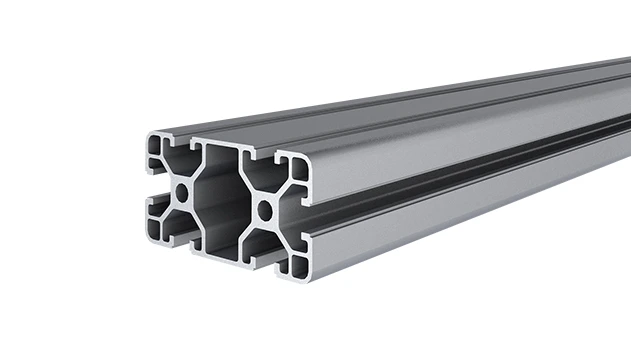
4080A is a 4.00x8.00 CM fractional 40 series square extrusion T-slot profile with two side open T-slots, each side with 4.00cm face, two side with 8.00cm face. The profile has align-a-grooves to assist in aligning connecting profiles.
Sizing Guide: 4080A EU Standard Aluminum Profile Dimensions & Tolerances
If you've ever walked through a manufacturing plant, a workshop, or even a modern warehouse, you've probably seen them—those sleek, modular metal structures holding up workbenches, guiding conveyor belts, or organizing tools. Chances are, many of those structures are built with aluminum extrusion profiles, and one of the most versatile players in that space is the 4080A EU Standard Aluminum Profile. Whether you're setting up a lean system, building a custom workbench, or designing a material rack, understanding the dimensions and tolerances of this profile isn't just "nice to know"—it's the difference between a setup that works seamlessly and one that frustrates you with loose connections or misaligned parts.
In this guide, we're going to break down everything you need to know about the 4080A's sizing: from the basic width and height to the nitty-gritty of slot dimensions and tolerance ranges. We'll also touch on why these details matter, how they impact your projects, and even dive into the accessories that make this profile so adaptable. Let's start with the basics: what exactly is a 4080A EU Standard Aluminum Profile, and why has it become a go-to for engineers, fabricators, and DIY enthusiasts alike?
What Is the 4080A EU Standard Aluminum Profile?
First things first: the "4080A" in the name isn't random. It's a code that tells you the profile's most critical dimensions at a glance. In EU standard aluminum extrusion profiles, the numbers typically refer to the width and height in millimeters. So, "4080" means the profile is 40mm wide and 80mm tall. The "A" denotes a specific design variation—usually related to the number of T-slots (the grooves running along the profile) or the wall thickness, though this can vary slightly between manufacturers. For the 4080A, you'll usually find it has four T-slots (one on each side), making it ideal for multi-directional connections—perfect for building sturdy, flexible structures.
But why aluminum? Unlike steel, aluminum extrusion profiles are lightweight, corrosion-resistant, and surprisingly strong, thanks to alloys like 6063-T5 (the most common grade for these profiles). They're also easy to cut, drill, and assemble, which is why they're a favorite for lean system setups, where adaptability and quick reconfiguration are key. And because they're extruded—pushed through a die to create their shape—they offer consistent dimensions across every meter, which brings us to the heart of this guide: the numbers that make or break your project.

Key Dimensions: Breaking Down the 4080A's Structure
Let's get specific. When you order a 4080A profile, you're not just buying a "40x80mm stick"—there's more to it. Below is a detailed breakdown of its core dimensions, along with why each one matters.
| Dimension | Typical Value (mm) | Why It Matters |
|---|---|---|
| Width (W) | 40 ± 0.3 | Determines how much surface area you have for mounting accessories (e.g., brackets, panels) on the profile's shorter side. |
| Height (H) | 80 ± 0.3 | Affects the profile's load-bearing capacity; taller profiles like the 4080A resist bending better than shorter ones (e.g., 4040A). |
| Wall Thickness (t) | 2.0 – 2.5 (varies by manufacturer) | Thicker walls mean higher strength but more weight. 2.0mm is standard for most light-to-medium applications. |
| T-Slot Width (s) | 8 ± 0.1 | Must match the size of your T-slot nuts and bolts; an 8mm slot works with M5 or M6 fasteners (common in EU standards). |
| T-Slot Depth (d) | 10 – 12 | Dictates how far a bolt can extend into the profile, ensuring a secure connection with accessories. |
| Overall Length (L) | 2000, 3000, or custom-cut | Standard lengths are 2m or 3m, but most suppliers will cut to your project's exact needs (e.g., 1.8m for a workbench leg). |
Let's zoom in on a few of these. Take the T-slot width: if the slot is supposed to be 8mm but measures 7.8mm on a particular profile, your 8mm T-slot nut might not slide in smoothly. That's a small difference, but when you're assembling a 20-meter conveyor system, those tiny gaps add up—leading to wobbly rails or stuck bolts. Similarly, wall thickness impacts weight and strength. A 2.5mm wall might be overkill for a small shelving unit but necessary for a heavy-duty workbench holding 500kg of tools.
Another dimension to note is the "web" and "flange" thickness—the internal parts of the profile that connect the outer walls. These reinforce the profile, preventing it from twisting under load. For the 4080A, the web (the vertical internal support) is usually around 2.0mm, while the flange (the horizontal support) is slightly thicker at 2.2mm. This balance makes the profile strong in both vertical (compression) and horizontal (bending) directions—ideal for structures like material racks or assembly line workstations.
Tolerances: Why "Close Enough" Isn't Good Enough
Now, let's talk about tolerances—the allowable variation in each dimension. No manufacturing process is perfect, so even the best extruders can't make every 4080A profile exactly 40.000mm wide or 80.000mm tall. Tolerances tell you how much "wiggle room" there is. For EU standard profiles, tolerances are usually defined by standards like EN 755-9, which sets limits for dimensions, straightness, and surface quality.
For example, the width tolerance for a 40mm profile might be ±0.3mm, meaning a "40mm" profile could measure anywhere from 39.7mm to 40.3mm. That might sound like a lot, but in practice, reputable suppliers aim for much tighter control—often ±0.1mm for critical dimensions like T-slot width. Why? Because when you're connecting two profiles at a 90° angle using a corner bracket, both profiles need to align perfectly. If one is 0.2mm wider than the other, the bracket might sit unevenly, creating a gap that weakens the joint over time.
Straightness is another tolerance to watch. A 3m profile that's bowed by 2mm might not seem like much, but when you mount it horizontally as a shelf support, that bow could turn into a visible sag under weight. EN 755-9 typically allows for 1mm of deviation per meter, so a 3m profile should be straight within 3mm. Again, good suppliers will hit under 2mm to ensure your structures look and perform professionally.
So, how do you check these tolerances? Most suppliers provide a technical datasheet with (actual measured) values for their profiles. If you're ordering in bulk, ask for a sample first—measure the T-slot with a caliper, check straightness by rolling the profile on a flat surface, and verify the wall thickness with a micrometer. It might take an extra 10 minutes, but it'll save you hours of frustration later.
Material Matters: The Aluminum Behind the Profile
While dimensions and tolerances are critical, the material itself plays a huge role in how the 4080A performs. As mentioned earlier, most 4080A profiles are made from 6063-T5 aluminum alloy. Let's break that down: "6063" is the alloy designation (aluminum with magnesium and silicon), and "T5" refers to the temper (heat treatment). T5 means the profile is cooled quickly after extrusion (quenched) and then artificially aged to increase strength without making it brittle.
Why does this matter for sizing? Because aluminum expands and contracts with temperature changes. If you're installing a profile in a hot warehouse in summer, it might be 0.1mm wider than in winter. That's a natural tolerance, but it's something to consider if your project requires extremely tight fits (e.g., precision guides for machinery). 6063-T5 has a low coefficient of thermal expansion compared to other metals, so these changes are minimal—usually around 0.02mm per meter per °C. For most applications, like a lean system workbench, this is negligible, but it's worth noting for outdoor or high-temperature environments.
Another material factor is surface finish. The 4080A often comes with a mill finish (matte, slightly rough) or anodized finish (smooth, colored, and more corrosion-resistant). Anodizing adds a thin layer (5-20μm) to the surface, which can affect dimensions slightly. For example, an anodized profile might have a T-slot width reduced by 0.01mm due to the anodizing layer. Again, small, but if you're using unanodized accessories with anodized profiles, that tiny layer could cause a tight fit. Most suppliers account for this by adjusting their extrusion dies, so the final anodized dimension still hits the 8mm T-slot target.
Applications: Where the 4080A Shines
Now that we understand the "what" and "why" of sizing, let's talk about the "how." The 4080A's dimensions make it incredibly versatile, but here are a few common use cases where its size is a perfect fit:
Lean System Setups
Lean manufacturing thrives on efficiency, and the 4080A is a workhorse here. Its 40x80mm size strikes a balance between strength and weight, making it ideal for building modular production lines. For example, a lean system might use 4080A profiles as the main frame for a conveyor support, with 2040 profiles (smaller, 20x40mm) for side rails. The T-slots let you attach sensors, tool holders, or cable management clips exactly where you need them—no drilling required. And because the dimensions are consistent, you can reconfigure the line in hours instead of days when production needs change.
Workbenches and Tables
A standard workbench height is around 850mm, so a 4080A leg cut to 800mm (plus a 50mm foot) is perfect. The 80mm height gives the leg stability (wider base = less tipping), while the 40mm width keeps it from looking bulky. Add an aluminum honeycomb panel on top, and you've got a sturdy, lightweight workbench that won't rust in a damp workshop. The T-slots along the sides let you mount vice grips, LED lights, or storage bins—customizing the bench to your workflow.
Material Racks and Shelving
Need a rack for heavy boxes? The 4080A's 80mm height and thick walls can handle it. A typical setup might have vertical 4080A posts every 1.2m, with horizontal 4080A beams spanning between them. Add aluminum guide rails or roller tracks, and you've got a gravity-fed shelving system where boxes slide easily to the front. The T-slots make it simple to adjust shelf heights—just loosen the brackets, slide them up or down, and retighten. No more drilling new holes for every shelf change!
Conveyor Frames
Conveyors need straight, strong frames to keep belts or rollers aligned. The 4080A's tight tolerances ensure the frame doesn't bow, even over 5m lengths. Pair it with roller track connectors and plastic roller track guide rails (yellow or grey, depending on your color scheme), and you've got a smooth-running system that won't jam. The T-slots also let you mount motor brackets or tensioners without weakening the frame with extra holes.
Aluminum Profile Accessories: The Perfect Partners for 4080A
You could have the most precisely sized 4080A profile, but without the right accessories, it's just a metal stick. Aluminum profile accessories are designed to work with the profile's dimensions, turning it into a functional structure. Here are a few key ones to know, and how their sizing interacts with the 4080A:
- Aluminum Profile End Caps: These plastic or metal caps snap into the ends of the profile, covering sharp edges and keeping out dust. For the 4080A, you'll need end caps designed for 40x80mm profiles—measure the inner dimensions (usually 36x76mm, accounting for wall thickness) to ensure a snug fit. A 4040 end cap will be too small, while a 4590 cap will be too big.
- Connectors: 90° aluminum profile connectors, 45° brackets, and 135° joints let you join profiles at angles. These have bolts that fit into the T-slots, so their shank diameter must match the slot width (e.g., M6 bolts for 8mm slots). A connector with a misaligned bolt hole won't sit flush, throwing off your structure's squareness.
- T-Slot Nuts and Bolts: These are the "glue" of aluminum extrusion systems. A standard M6 T-slot nut should slide smoothly in an 8mm T-slot. If the nut is too wide, it'll jam; too narrow, and it'll wobble, leading to loose connections.
- Aluminum Pipe Clamps: Used to attach pipes, cables, or hoses to the profile. The clamp's inner diameter should match the pipe (e.g., 20mm for a basic aluminum tube), and the mounting part must fit the T-slot.
- Casters and Feet: For mobile structures like trolleys, caster wheels mount to the bottom of 4080A legs. The caster plate should have holes spaced to align with the T-slots (usually 30mm or 40mm apart) to ensure a secure bolt-on fit.
When shopping for accessories, always check the manufacturer's specs for compatibility with 4080A profiles. A common mistake is assuming "one size fits all," but a 4080B (with different T-slot spacing) might use different connectors. Stick to accessories labeled for "4080A EU standard" to avoid sizing headaches.
Installation Tips: Making the Most of Your 4080A Profiles
Even with perfect dimensions, installation can go wrong if you rush. Here are a few pro tips to ensure your 4080A setup goes smoothly:
Measure Twice, Cut Once: Most suppliers will cut profiles to length, but double-check their measurements. A 3m profile cut to 2.99m is fine, but 2.89m will leave a gap in your frame. Use a tape measure with mm markings, and confirm the cut with the supplier before they ship.
Deburr the Edges: After cutting, the ends of the profile will have sharp burrs. Use a deburring tool to smooth them—this prevents cuts and ensures end caps fit tightly.
Use the Right Tools: A hex key (Allen wrench) is essential for T-slot bolts, but invest in a torque wrench if you're working on critical structures. Over-tightening can strip the T-slot; under-tightening leads to looseness. Most M6 bolts should be tightened to 4-5 Nm (check the bolt's specs).
Check Alignment Early: When assembling a frame, square it up before fully tightening all bolts. Use a carpenter's square to check 90° angles, and measure diagonally (corner to corner) to ensure the frame is rectangular (both diagonals should be equal). Tighten bolts incrementally—don't fully tighten one corner before the others.
Account for Thermal Expansion: If installing outdoors or in a facility with extreme temperature swings, leave a tiny gap (0.5mm) between profile ends in long runs. This lets the aluminum expand without buckling.
Troubleshooting Common Sizing Issues
Even with careful planning, you might run into sizing snags. Here's how to fix the most common ones:
Problem: T-slot nuts won't slide into the slot. Solution: Check the slot width with a caliper. If it's too narrow, gently file the edges (a few passes with a fine file should do it). If the nut is the issue (too wide), try a different brand—some nuts have slightly smaller tolerances.
Problem: Profile is bowed or twisted. Solution: For minor bowing, clamp the profile to a flat surface and apply gentle pressure to straighten it. For severe twists, return it to the supplier—this is a manufacturing defect, not a normal tolerance.
Problem: Accessories don't align (e.g., a bracket hole doesn't line up with the T-slot). Solution: Check if the accessory is designed for EU vs. US standards (US profiles often have different T-slot spacing). If it's EU, the profile might be out of tolerance—contact the supplier for a replacement.
Problem: Shelves sag under load. Solution: Add more vertical supports (closer spacing between posts) or switch to a thicker wall profile (e.g., 2.5mm instead of 2.0mm). You can also reinforce the shelf with a cross beam of 4080A in the middle.
Conclusion: Why Sizing Matters for Your Project
The 4080A EU Standard Aluminum Profile is more than just a piece of metal—it's a building block for efficiency, flexibility, and durability. Its dimensions and tolerances might seem like small details, but they're the foundation of every successful project, from a simple shelving unit to a complex lean system. By understanding the 40mm width, 80mm height, T-slot sizing, and allowable variations, you can choose the right profile, select compatible accessories, and install with confidence.
Remember, the best suppliers will provide detailed datasheets, sample profiles, and even technical support to help you get the sizing right. Don't hesitate to ask questions—whether it's about wall thickness for a heavy load or anodizing effects on T-slot width. After all, a profile that's sized correctly isn't just a part of your project; it's the reason your project works.
So, the next time you pick up a 4080A profile, take a moment to appreciate the precision that went into making it. Those millimeters and tolerances? They're the unsung heroes of every smooth-running workshop, warehouse, and production line.