- Company Articles
- Industry articles
- Industry standards
- Small vs. Large-Scale Production: 3060 National Standard Profile A Application Differences

Small vs. Large-Scale Production: 3060 National Standard Profile A Application Differences
Related Product
3060 National Standard Profile A
Workbench, production line, logistic rack, warehouse rack Industry: Manufacturer workshop, Automobile, Electronic, Assembling, logistic
Walk into any production facility—whether it's a cozy 500 sq ft workshop crafting custom electronics or a sprawling 100,000 sq ft factory churning out automotive parts—and you'll notice one common thread: the backbone of their operations lies in the tools they choose. For many manufacturers, that backbone is aluminum profiles. Lightweight yet sturdy, adaptable yet reliable, aluminum profiles have become the unsung heroes of modern production. Today, we're zooming in on a star player in this category: the 3060 National Standard Profile A . But here's the thing—how this profile performs depends entirely on the scale of production. A small-scale workshop and a large-scale plant don't just use the same tools differently; they rely on them to solve entirely unique challenges. Let's dive into how 3060 Profile A becomes a chameleon, adapting to the needs of both small and large operations, and why that matters for anyone looking to build a production line that doesn't just work, but thrives.
First Things First: What Makes 3060 National Standard Profile A Special?
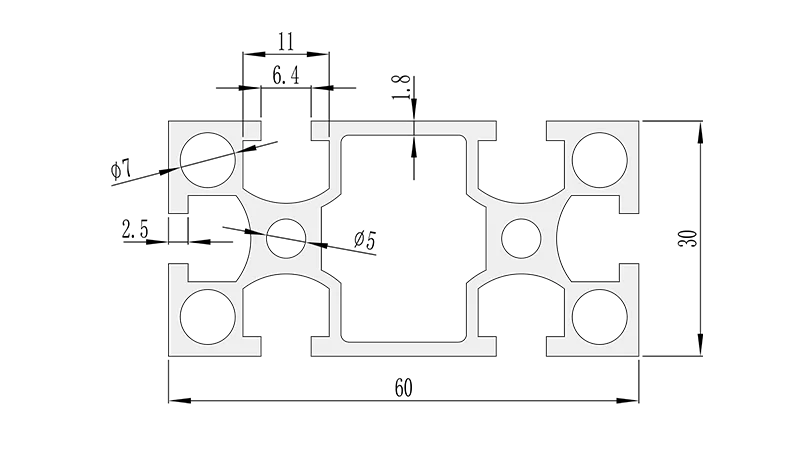
Before we compare scales, let's get to know the star of the show. The 3060 National Standard Profile A is a type of aluminum extrusion—think of it as a pre-shaped aluminum bar with a specific cross-section (30mm wide, 60mm tall, hence "3060"). What sets it apart? Its T-slot design. Those grooves running along its length aren't just for show; they're the reason this profile is a favorite among manufacturers. They let you slide in bolts, brackets, and aluminum profile accessories (like end caps, connectors, or even board holders) without welding or drilling. It's like building with giant, industrial-grade Legos—fast, flexible, and infinitely customizable.
But why 3060 specifically? It hits a sweet spot between size and strength. At 30x60mm, it's beefy enough to support heavy loads (we're talking hundreds of pounds) but not so bulky that it's overkill for smaller setups. It's also compatible with a wide range of accessories, from simple corner brackets to complex hinges, making it a Swiss Army knife for production line design. Now, let's see how this "Swiss Army knife" behaves when the stage gets bigger—or smaller.
Small-Scale Production: Flexibility Over Everything
Small-scale production facilities—think local machine shops, startup assembly lines, or custom craft workshops—live and die by one word: flexibility. These operations often have limited space, tight budgets, and ever-changing product lines. A workshop that builds custom drones one month might switch to medical device components the next. That means their equipment can't be set in stone. Enter 3060 Profile A, which becomes less of a tool and more of a collaborator in adaptability.
The Go-To Applications: Workbenches and Mobile Stations
In small spaces, every square inch counts. That's why the most common use of 3060 Profile A here is building workbenches . Unlike fixed wooden or steel workbenches, a 3060-based workbench can evolve with the job. Need to add a shelf for tools? Slide in some brackets and a plywood top. Want to mount a vice or a small conveyor? Use T-slot nuts to attach it securely, then remove it later if the project changes. Even better, add casters (another handy aluminum profile accessory ) and suddenly your workbench becomes a mobile station—perfect for moving materials from one corner of the shop to another without breaking a sweat.
Real-Life Example: Maria runs a small electronics repair shop with three technicians. Last year, she switched from static wooden benches to 3060 Profile A workbenches. "Before, if we got a bulk order of laptop repairs, we'd be tripping over each other trying to share tools," she says. "Now, we can reconfigure the benches in 10 minutes—push two together for a larger workspace, or roll one to the testing area. The T-slots let us mount anti-static mats and cable organizers, so no more tangled wires. It's like the benches grow with us."
Another small-scale staple? Mini flow racks . These are shallow, sloped racks that let parts glide from the back to the front, making picking and assembly faster. For a small operation, a 3060-based flow rack might hold just 10-20 bins of components, but it's designed to be expandable. Add a few more profile sections and roller tracks (yep, those are accessories too) and suddenly you can double capacity when a big order comes in. No need to buy a whole new rack—just build onto the existing one.
Why 3060 Profile A Shines Here:
- Low Cost, High ROI: Small budgets mean you can't waste money on equipment that might become obsolete. 3060 Profile A is affordable upfront, and since it's reusable (you can disassemble and rebuild it), you're not throwing away cash when projects change.
- Quick Setup: No need for welders or heavy machinery. Maria's team built their first workbench in under two hours using just a hex key and a rubber mallet.
- Lightweight but Sturdy: In small spaces, moving equipment is a regular task. 3060 aluminum is light enough for two people to carry, but strong enough to hold a 200lb load of tools without bending.
Large-Scale Production: Durability and Standardization Take the Lead
Now, step into a large-scale production plant. Here, the game changes. We're talking about facilities that produce thousands of units daily—think smartphone assembly lines, automotive part factories, or pharmaceutical packaging plants. The priorities here? Consistency, speed, and durability. A single breakdown in the line can cost thousands of dollars in lost production. That's where 3060 Profile A shifts from "flexible collaborator" to "reliable backbone," often as part of a larger lean system .
The Heavy Hitters: Flow Racks and Integrated Conveyors
In large-scale settings, 3060 Profile A isn't just for workbenches—it's the building block of entire material handling systems. Take flow racks , for example. In a car parts plant, a flow rack might hold hundreds of brake calipers, feeding them to the assembly line via gravity. These racks need to withstand constant use (forklifts loading them, workers pulling parts every minute) and maintain precise angles to ensure smooth flow. 3060 Profile A, with its high load capacity and compatibility with heavy-duty roller tracks (another key accessory), is ideal here. Manufacturers often reinforce it with cross-braces (using 90° or 135° connectors) to handle the weight, turning a simple profile into a rugged, industrial-grade structure.
Then there are integrated conveyor systems. In a lean system, the goal is to minimize waste—including time wasted moving materials. 3060 Profile A is frequently used to build the frames for roller or belt conveyors, supporting motors, guides, and sensors. Unlike small-scale setups, these conveyors run 24/7, so the profile must resist wear and tear. The aluminum's corrosion resistance (especially when paired with anodized finishes) ensures the frame doesn't degrade, even in dusty or humid factory environments.
Real-Life Example: Raj manages a pharmaceutical packaging plant with a 200-foot production line. "We used to rely on steel frames for our conveyors, but they were heavy and rusted easily near our cleaning stations," he explains. "Switching to 3060 Profile A cut our installation time in half—no welding, just bolt-together joints. And since aluminum doesn't rust, we don't have to replace frames every few years. Plus, when we upgraded to a faster conveyor belt, we just modified the existing 3060 frame instead of building a new one. It saved us $50,000 in downtime alone."
Why 3060 Profile A Delivers Here:
- Lean System Compatibility: Lean manufacturing is all about reducing waste and streamlining flow. 3060 Profile A's modular design lets plants reconfigure lines quickly—say, adding a new work cell or adjusting a conveyor angle—to adapt to lean principles like "5S" or "just-in-time" production.
- Scalability: Large plants grow, and 3060 Profile A grows with them. Need to extend a flow rack by 10 feet? Just add more profiles and connectors. No need to redesign the entire system.
- Consistency: In large-scale production, every part of the line must match. 3060 Profile A is manufactured to strict national standards, so every piece is identical. That means a flow rack built in the east wing of the factory will perform exactly like one in the west wing.
Side-by-Side: How Small and Large Scales Use 3060 Profile A Differently
| Factor | Small-Scale Production | Large-Scale Production |
|---|---|---|
| Primary Application | Workbenches, mobile trolleys, small flow racks for low-volume parts | Large flow racks, conveyor frames, lean system work cells, material storage systems |
| Key Accessories Used | Basic brackets, casters, lightweight roller tracks, plywood worktop supports | Heavy-duty hinges, reinforced roller tracks, sensor mounts, cross-brace connectors |
| Load Capacity Focus | Light to medium (50-200 lbs per shelf/bench) | Medium to heavy (200-500+ lbs per section) |
| Customization Frequency | High (monthly/quarterly, as projects change) | Low to medium (annual upgrades or line reconfigurations) |
| Integration with Lean Systems | Basic (simple 5S organization, mobile workstations) | Advanced (full value stream mapping, automated material flow, error-proofing stations) |
The Secret Sauce: Why 3060 Profile A Works for Both
At first glance, small and large-scale production seem to have opposite needs. Small needs flexibility; large needs durability. Small needs low cost; large needs standardization. But 3060 Profile A bridges these gaps because it's not just a piece of aluminum—it's a system. Its T-slot design and vast array of aluminum profile accessories mean it can scale up or down without losing performance. A small workshop uses it with casters and lightweight brackets for mobility; a large plant uses the same profile with heavy-duty connectors and roller tracks for industrial strength. It's like a guitar that sounds great in a coffee shop and on a stadium stage—it adapts to the venue.
Another secret? It grows with businesses. Many startups begin with small 3060-based workbenches, then expand into flow racks as they scale. When they hit large-scale production, they don't have to switch to a new system—they just add more profiles and beef up the accessories. That continuity saves time, money, and the headache of retraining staff on new equipment.
Final Thoughts: It's Not About the Scale—It's About the Solution
Whether you're running a one-person workshop or a multinational factory, the goal is the same: to build a production line that works for you . The 3060 National Standard Profile A doesn't care if you're making 10 units a day or 10,000—it just cares about solving your unique problems. For small operations, it's the flexible sidekick that bends without breaking. For large operations, it's the steady backbone that keeps the line moving, day in and day out. And in both cases, it's a reminder that the best tools aren't just about what they do—they're about how they help people do their jobs better, faster, and with less stress.
So, the next time you walk into a production facility, take a closer look at the frames holding up the workbenches, the flow racks, the conveyors. Chances are, you'll spot 3060 Profile A hard at work—quietly proving that great tools don't just fit the scale; they elevate it.