- Company Articles
- Industry articles
- Industry standards
- Space Optimization with 3060 National Standard Profile A: Compact Storage Solutions

Space Optimization with 3060 National Standard Profile A: Compact Storage Solutions
Related Product
3060 National Standard Profile A
Workbench, production line, logistic rack, warehouse rack Industry: Manufacturer workshop, Automobile, Electronic, Assembling, logistic
The Space Crunch in Modern Workspaces: A Silent Productivity Killer
Walk into any small to medium-sized workshop, warehouse, or even office storage room these days, and you'll likely be greeted by the same silent challenge: space . It's the invisible bottleneck that slows down operations, turns simple tasks into treasure hunts, and quietly eats away at productivity. Maybe you've experienced it yourself: spending 10 minutes digging through a cluttered shelf for a single tool, or watching as a delivery truck idles outside because there's no room to unload materials. In a world where every square foot counts, inefficient storage isn't just an inconvenience—it's a business problem.
Traditional storage solutions often make the problem worse. Bulky wooden shelves that can't be adjusted, metal racks that rust and warp over time, or one-size-fits-all cabinets that leave gaps of wasted space between items. These systems are static, rigid, and about as flexible as a concrete wall. When your storage needs change—and they always do—you're stuck either squeezing new items into old spaces or shelling out for expensive replacements. It's a cycle that leaves businesses feeling like they're constantly playing catch-up with their own growth.
But what if there was a way to build storage that grows with you? A system that bends, adapts, and shrinks or expands based on what you need today, tomorrow, and next quarter? That's where modern aluminum extrusion profiles come in—and among them, the 3060 National Standard Profile A stands out as a quiet hero in the fight against wasted space. Let's dive into how this unassuming piece of aluminum is transforming compact storage from a headache into a competitive advantage.
Meet 3060 National Standard Profile A: The Unsung Hero of Modular Storage
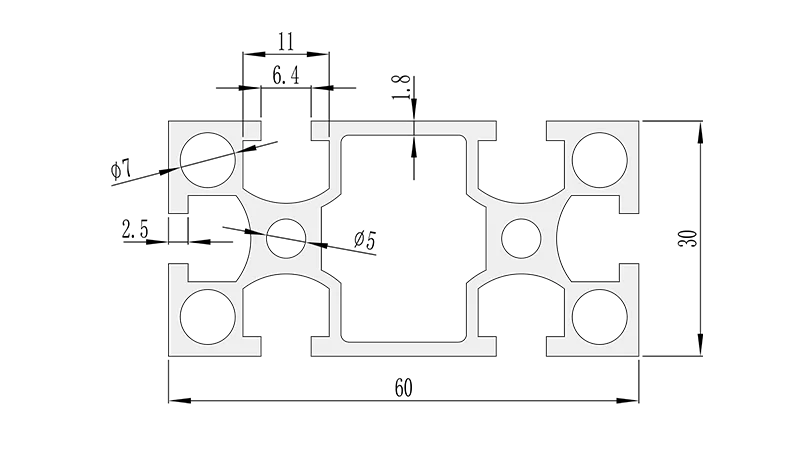
First things first: What exactly is 3060 National Standard Profile A? At its core, it's a type of aluminum extrusion profile—a long, slender piece of aluminum shaped through a process that pushes molten metal through a die to create a consistent cross-section. The "3060" refers to its dimensions: 30 millimeters in width and 60 millimeters in height. The "National Standard" tag means it adheres to strict manufacturing guidelines, ensuring compatibility with a wide range of accessories and components. And "Profile A" denotes a specific design within the 3060 category, often featuring a smooth surface and standardized T-slot configuration along its length.
But why does this matter for compact storage? Let's start with the basics: aluminum. Unlike wood, which warps, or steel, which is heavy and prone to rust, aluminum is lightweight yet surprisingly strong. A single 3060 profile can support significant weight—think 50-100 kg per linear meter, depending on the setup—without bending or sagging. That strength-to-weight ratio is a game-changer for vertical storage: you can stack higher without worrying about structural failure, turning unused airspace into valuable storage real estate.
Then there's the standardization. When a profile is "national standard," it means manufacturers across the industry design accessories—like brackets, connectors, and shelves—to fit it perfectly. No more hunting for custom parts or forcing ill-fitting components together with duct tape and hope. This standardization turns 3060 Profile A into a building block, one that you can mix and match with other parts to create exactly the storage solution you need, right when you need it.
Key Features of 3060 Profile A That Make Compact Storage Possible
To truly appreciate how 3060 National Standard Profile A transforms space, let's break down its standout features—features that don't just sound good on paper, but solve real-world storage problems.
1. The T-Slot Design: Your Storage's Secret Flexibility
Run your finger along the length of a 3060 Profile A, and you'll notice something important: narrow, evenly spaced grooves called T-slots. These slots are the profile's superpower. They allow you to slide in accessories like nuts, bolts, and brackets without drilling a single hole. Want to add a shelf 12 inches from the top? Slide a T-nut into the slot, bolt on a bracket, and you're done. Need to move that shelf down 6 inches next month? Loosen the bolt, slide the bracket, and retighten. It's that simple.
This flexibility is a lifesaver for compact storage. Traditional shelves are fixed at set heights, which means if you have a tall item, you either leave a gap above it (wasting space) or can't store it at all. With T-slots, every shelf, hook, or divider is adjustable. You can customize the vertical spacing to fit your items perfectly, whether you're storing small tools, bulky boxes, or irregularly shaped parts. No more wasted inches—every centimeter of space works for you.
2. Modularity: Build, Break, Rebuild—No Tools Required (Well, Almost)
Imagine building a storage rack like you would with Legos. That's the modularity of 3060 Profile A. Because the profiles connect using standardized aluminum profile accessories —think corner brackets, straight connectors, and cross-joints—you can assemble a basic rack in an hour, then take it apart and rebuild it as a workbench next week. Or add side extensions, extra shelves, or even wheels if you need mobility.
This modularity is especially valuable for businesses with evolving needs. A startup might start with a small material rack for inventory, then expand into a full production line with workbenches and flow racks as orders grow. With 3060 Profile A, you're not stuck with a "one-and-done" storage system. You're investing in a toolkit that adapts to how your business changes, saving you from the cost and hassle of replacing entire systems every time your storage needs shift.
3. Strength Without the Bulk: Maximize Storage, Minimize Footprint
Compact storage isn't just about fitting more items into less space—it's about doing so safely. A flimsy shelf that collapses under weight isn't just useless; it's dangerous. 3060 Profile A hits the sweet spot between strength and size. Its 30x60mm cross-section provides rigidity, while aluminum's inherent strength means it can support heavy loads without needing to be overly thick or wide. This means you can build storage systems that take up minimal floor space but reach higher, storing more items vertically.
For example, a traditional steel rack might need thick, heavy uprights to support 500 kg of weight, taking up 10 inches of floor space per upright. A 3060 Profile A upright, by contrast, is slimmer (30mm wide) but just as strong, freeing up those extra inches for more storage or easier movement around the rack. Over time, those saved inches add up to significant space gains—space that can be used for new equipment, more inventory, or simply a less cluttered, more efficient workspace.
From Racks to Workbenches: Real-World Compact Storage with 3060 Profile A
Enough theory—let's look at how 3060 National Standard Profile A translates into real storage solutions. Here are two common scenarios where this profile turns cramped spaces into organized, efficient hubs:
Case Study 1: The Material Rack B (3 Row and 3 Floor) —Vertical Storage That Thinks Tall
A local electronics manufacturer was struggling with storing small component boxes. Their old wooden shelves had fixed heights, leaving gaps between boxes and making it hard to access items on the lower shelves. They needed a solution that could store more boxes in the same footprint while keeping everything within arm's reach.
The answer? A custom Material Rack B (3 row and 3 floor) built with 3060 Profile A. Here's how it worked: The rack featured three vertical columns of 3060 profiles, connected by horizontal cross-braces for stability. Between the columns, they added adjustable shelves using T-slot brackets, creating three rows (left, middle, right) and three floors (top, middle, bottom) of storage. Each shelf was spaced to fit the component boxes exactly—no more gaps. They even added dividers using smaller aluminum profiles to separate different component types, making it easy to find what they needed at a glance.
The result? The same floor space that once held 45 boxes now held 72—an increase of 60% storage capacity. And because the shelves were adjustable, when they started stocking larger boxes for a new product line, they simply moved the shelves up to make room. No new rack, no wasted money—just a quick adjustment.
Case Study 2: The Space-Saving Workbench —Storage and Workspace in One
A small machine shop had a problem: they needed more workspace for assembling parts, but every square foot was already taken by storage racks. They couldn't afford to expand their facility, so they needed a way to combine storage and work surface into a single, compact unit.
Enter the 3060 Profile A workbench. They built a sturdy frame using 3060 profiles for the legs and cross-braces, then added a plywood top for the work surface. Underneath the top, they installed hanging shelves and tool hooks using T-slot accessories, storing wrenches, screwdrivers, and small parts within arm's reach. On the back of the workbench, they added a vertical rack with adjustable shelves for larger tools and materials. The entire unit was on casters (another easy add-on with aluminum profile accessories), so they could roll it out of the way when not in use or position it next to the assembly line when needed.
The transformation was dramatic. What was once two separate pieces of furniture—a workbench and a storage rack—became one multi-functional unit. They reclaimed 15 square feet of floor space, and employees spent less time walking to fetch tools, boosting assembly speed by 20%. It was storage and workspace in one, proving that compact solutions don't have to mean sacrificing functionality.
Case Study 3: Lean and Mean—Supporting Lean System Principles
A furniture manufacturer wanted to adopt lean manufacturing principles to reduce waste and improve efficiency. One of their biggest pain points was "motion waste"—employees walking long distances to fetch materials from storage areas. They needed a way to bring materials closer to the production line without cluttering the workspace.
Using 3060 Profile A, they built a series of flow racks along the assembly line. These racks used gravity to feed materials downward, so the next set of parts was always at the front, within easy reach of workers. The racks were narrow—only 18 inches deep—so they didn't block walkways, and they were modular, allowing the manufacturer to add sections as production lines expanded. They even color-coded the shelves using plastic strip accessories to match different product models, reducing errors.
By integrating 3060 Profile A into their lean system, the manufacturer cut material retrieval time by 40%. Employees stayed at their workstations, focused on assembling furniture instead of walking to storage. It was a small change with a big impact—proof that compact storage isn't just about saving space; it's about making work easier, faster, and more satisfying.
Traditional vs. 3060 Profile A Storage: A Side-by-Side Comparison
Still not convinced that 3060 National Standard Profile A is worth the switch? Let's put it head-to-head with traditional storage solutions in a table that breaks down the key factors that matter most to businesses:
| Feature | Traditional Wooden Shelves | Standard Metal Racks | 3060 National Standard Profile A System |
|---|---|---|---|
| Space Efficiency | Low. Fixed shelf heights lead to wasted vertical space. | Medium. Some adjustability, but limited by bolt holes. | High. T-slot design allows custom spacing; fits items of all sizes. |
| Flexibility | Very Low. Permanent; cannot be reconfigured without damage. | Low. Requires tools to adjust; limited to pre-drilled holes. | Very High. Modular; reconfigure shelves, add/remove components in minutes. |
| Durability | Low. Warps with moisture; scratches easily; rots over time. | Medium. Prone to rust; paint chips; bolts loosen with vibration. | High. Aluminum resists corrosion; T-slot connections stay tight; supports heavy loads without bending. |
| Cost Over Time | High. Need replacement every 3-5 years; repairs are expensive. | Medium. Lasts 5-7 years but requires replacement parts; not adaptable to growth. | Low. Lasts 10+ years; reconfigurable for new needs; no need to replace entire system. |
| Installation Time | Long. Requires cutting, drilling, and finishing; 4-6 hours for a basic rack. | Medium. Bolt-together assembly; 2-3 hours for a basic rack. | Short. Snap-together with T-slot accessories; 1-2 hours for a custom rack. |
| Adaptability to Growth | Very Low. Cannot expand; must buy new shelves as needs grow. | Low. Can add extensions, but limited by design; often mismatched with original. | Very High. Add new profiles, shelves, or accessories to expand; matches existing system perfectly. |
The data speaks for itself: 3060 National Standard Profile A outperforms traditional solutions in nearly every category that matters for compact storage. It's not just a better way to store items—it's a smarter investment in your business's efficiency and growth.
Why 3060 Profile A Isn't Just for Storage: Building a Lean, Space-Efficient Workplace
So far, we've focused on storage, but 3060 National Standard Profile A's benefits extend far beyond racks and shelves. It's a foundational component of a lean system —a workplace designed to minimize waste, maximize value, and keep operations running smoothly. When you build storage, workbenches, and even production lines with 3060 Profile A, you're not just organizing space—you're creating a workflow that feels intuitive, efficient, and adaptable.
Imagine a factory floor where everything has a place: tools hang from 3060 profile hooks within arm's reach of workbenches, materials flow along gravity-fed racks built from the same profiles, and workstations adjust in height to fit each employee. It's a space where there's no "junk drawer" because every item has a designated spot, and no one wastes time searching for what they need. That's the power of a lean system built on 3060 Profile A—it turns chaos into order, and order into productivity.
And because the system is modular, it's easy to experiment and improve. Maybe you notice that a certain shelf is always overflowing, so you add an extra level. Or you realize a workstation would work better with a side table, so you bolt one on using T-slot brackets. Lean isn't about perfection—it's about continuous improvement. With 3060 Profile A, improvement is as simple as making a quick adjustment.
Getting Started with 3060 National Standard Profile A: Tips for First-Time Builders
Ready to dive in? Here are a few tips to help you make the most of 3060 Profile A for your compact storage needs:
- Start with a plan. Sketch your storage needs before buying profiles. Measure the space, list the items you'll store, and note their dimensions. This will help you determine how many profiles, brackets, and shelves you need.
- Invest in quality accessories. Cheap brackets or T-nuts can slip or break, compromising your system. Stick with reputable brands that make aluminum profile accessories specifically for national standard profiles.
- Build vertically. Don't forget about the space above eye level. 3060 Profile A is strong enough to support overhead storage, freeing up floor space for other uses.
- Test and adjust. Assemble a small section first, load it with items, and see how it works. You might realize you need more shelves or different spacing—and with T-slots, fixing it is easy.
Remember: you don't have to build everything at once. Start with a single rack or workbench, then expand as you see how the system improves your space. The beauty of 3060 Profile A is that it grows with you, one profile at a time.
Conclusion: Space Optimization Isn't Just About Storage—it's About Freedom
At the end of the day, compact storage with 3060 National Standard Profile A isn't just about fitting more items into less space. It's about freedom—the freedom to grow without moving to a bigger facility, the freedom to adapt to new products or workflows, and the freedom to focus on what matters: running your business.
Gone are the days of being held back by rigid, outdated storage systems. With 3060 Profile A, you're in control. You design the storage that fits your space, your items, and your way of working. You build a system that doesn't just store things—it supports your team, streamlines your processes, and makes every square foot of your workplace work harder for you.
So if you're tired of fighting with cluttered shelves, wasted space, and storage that never seems to keep up, give 3060 National Standard Profile A a try. It might just be the solution that turns your space from a bottleneck into your business's greatest asset.