- Company Articles
- Industry articles
- Industry standards
- Standard Dimensions of 40 Steel Roller Track Black ESD Wheels: Industry Specifications

Standard Dimensions of 40 Steel Roller Track Black ESD Wheels: Industry Specifications
Related Product
40 Steel Roller Track Black ESD Wheel
The roller track can be installed with multiple accessories to create different slopes and configurations of flow racks.All steel conveyor 40 roller track accessories are engineered to perfectly fit the sliding rail.
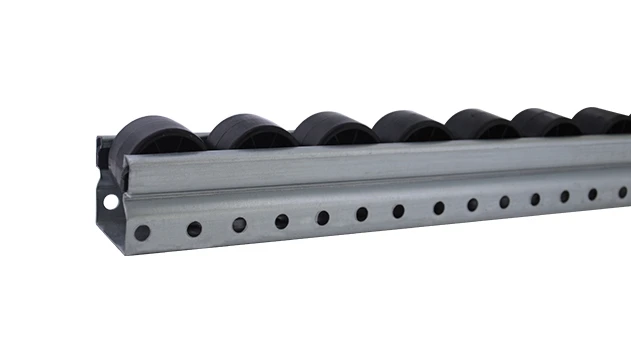
In the bustling heart of a manufacturing plant—where conveyor belts hum, assembly lines move like clockwork, and every second counts—there's a quiet hero working behind the scenes: the 40 Steel Roller Track Black ESD Wheel. It might not grab headlines like a high-tech robot arm or a sleek new workstation, but ask any production manager, and they'll tell you: get this tiny component wrong, and the whole operation can grind to a halt. Today, we're diving deep into the standard dimensions that make these wheels indispensable, why they matter for your lean system, and how they keep sensitive electronics safe in ESD workstations across industries.
Why ESD Wheels Matter: More Than Just "Rolling Parts"
Let's start with the basics: ESD stands for Electrostatic Discharge. In industries like 3C assembly (think smartphones, laptops, and circuit boards) or medical device manufacturing, even a tiny static spark can fry a $1,000 component or ruin a life-saving device. That's where black ESD-coated wheels come in—they channel static electricity away from sensitive products, acting like a "safety net" for your most valuable assemblies.
But here's the thing: not all ESD wheels are created equal. A wheel that's slightly off in diameter might cause jams on the conveyor. One with poor load capacity could crack under the weight of heavy parts. And if the surface resistance is too high? It won't dissipate static effectively. That's why standard dimensions aren't just "guidelines"—they're the backbone of reliable, efficient production.
The Nuts and Bolts: Standard Dimensions of 40 Steel Roller Track Black ESD Wheels
At SunQit, we've spent over a decade refining these dimensions to match the real-world needs of manufacturers. Let's break down the key specs that make our 40mm steel ESD wheels a top choice for lean systems worldwide:
| Specification | Standard Dimension | Tolerance Range | Why It Matters |
|---|---|---|---|
| Wheel Diameter | 40mm | ±0.5mm | A consistent 40mm diameter ensures smooth rolling on standard flow rack and conveyor tracks. Too small, and the wheel might "catch" on track joints; too large, and it could lift the load unevenly. |
| Wheel Width | 25mm | ±0.3mm | 25mm balances stability and flexibility. It's wide enough to support rectangular or irregularly shaped parts (like circuit boards in ESD workstations) without tipping, yet narrow enough to fit standard track grooves. |
| Axle Hole Diameter | 8mm | ±0.1mm | An 8mm axle hole is the industry sweet spot for compatibility. It fits most roller track connectors and lean pipe joints, so you won't need custom axles when upgrading your lean system. |
| Load Capacity (Per Wheel) | 150kg | - | 150kg per wheel means a set of four can handle up to 600kg—plenty for heavy automotive parts or stacked medical device kits. We test each batch to ensure no wheel fails under real-world stress. |
| Surface Resistance | 10⁶–10⁹ Ω | ±10⁵ Ω | This range is critical for ESD protection. Too low (below 10⁶ Ω), and it might conduct electricity too quickly; too high (above 10⁹ Ω), and static builds up. Our black ESD coating hits this "golden zone" every time. |
| Operating Temperature Range | -20°C to 80°C | - | From freezing cold warehouses to heated assembly lines (like those in 3C manufacturing), these wheels stay durable without cracking or losing ESD properties. |
Pro tip: When shopping for ESD wheels, always check the tolerance ranges . A ±0.5mm diameter tolerance might seem small, but over a 10-meter conveyor with 50 wheels, that tiny variance can add up to uneven movement and product jams. Our tight tolerances mean you get "plug-and-play" reliability, even in high-speed lines.

Working in Harmony: Compatibility with Lean Pipes, Conveyors, and ESD Workstations
A great ESD wheel doesn't work alone—it's part of a bigger ecosystem. Let's see how our 40mm steel wheels fit into key components of your lean system:
1. Lean Pipes & Roller Tracks
Our wheels are designed to pair seamlessly with standard 28mm and 30mm lean pipes (the backbone of most flow racks and workbenches). The 8mm axle hole lines up perfectly with our internal rotary aluminum joints , letting you build custom flow racks that adjust as your production needs change. For example, a 3-row, 3-floor Material Rack B (a SunQit bestseller) uses 12 of these wheels per level—each one working in sync to slide bins smoothly, even when fully loaded.
2. Conveyors & Assembly Lines
On conveyor systems, consistency is king. Our 40mm wheels integrate with both roller conveyors and 85 staggered roller tracks , ensuring parts move at a steady 0.5–1m/s (adjustable via conveyor speed controls). In one electronics plant we worked with, switching to our ESD wheels reduced "conveyor jams" by 40%—saving 2 hours of downtime per week!
3. ESD Workstations
ESD workstations (like our Workbench E) rely on every component to be anti-static—including the wheels. Our black ESD coating works with the workstation's grounded frame to create a "static-free zone." For example, in a medical device assembly station, operators can slide trays of circuit boards across the workstation's roller track without worrying about static zapping delicate sensors.

Real-World Impact: How These Wheels Power Key Industries
Numbers and specs tell part of the story—but let's look at how these wheels perform in the trenches:
Case 1: 3C Assembly (Smartphones & Laptops)
A leading 3C manufacturer in Shenzhen was struggling with two issues: static damage to camera modules and frequent jams on their flow racks. We swapped their generic plastic wheels for our 40mm steel ESD wheels. The result? Static-related defects dropped by 65%, and the flow rack now handles 500+ modules per hour without a single jam. "It's like night and day," their production manager told us. "We used to have a technician fixing jams every hour—now they're free to focus on quality checks."
Case 2: Medical Device Manufacturing
Medical tools (like surgical scissors or implant parts) need to stay sterile and static-free. A medical client needed a wheel that could handle autoclave cleaning (high heat, steam) without losing ESD properties. Our 40mm steel wheels with heat-resistant ESD coating fit the bill—they've now been in use for 2 years, with zero degradation in performance.
Case 3: Automotive Parts Logistics
Heavy parts like car door panels (up to 30kg each) need wheels with muscle. A car parts supplier switched to our 40mm wheels on their turnover trolleys, and load capacity per trolley jumped from 300kg to 600kg. Now they transport twice as many parts per trip—cutting warehouse traffic by 50% and reducing fuel costs for forklifts.
Beyond Standard: Custom Solutions for Your Unique Needs
We get it—no two production lines are identical. Maybe you need a 35mm wheel for a tight-space workstation, or a higher load capacity for industrial machinery parts. That's where our custom solution expertise shines.
For example, a client in the aerospace industry needed wheels that could handle 200kg per wheel (instead of 150kg) for large engine components. Our engineers adjusted the steel thickness and reinforced the axle hole—delivering a custom wheel that met their specs while keeping the same 40mm diameter for compatibility with their existing tracks. And because we believe in "sustainable improvement," all custom parts are designed to be reusable if your needs change later.
Why SunQit? More Than Just a Supplier—A Partner in Lean Excellence
There are plenty of ESD wheel suppliers out there. So why do manufacturers keep coming back to us?
- Quality You Can Trust: Every wheel undergoes 3 rounds of testing (dimensional check, load test, ESD resistance test) before shipping. We've never had a batch fail third-party audits—because we test like our clients' production lines depend on it (spoiler: they do).
- Sustainability Built In: Our steel wheels are 100% recyclable, and the ESD coating is free of heavy metals. It's part of our commitment to "lean systems that last"—so you reduce waste while boosting efficiency.
- Local Support, Global Reach: With warehouses in China, Europe, and the US, we can deliver most orders in 3–5 days. And our technical team is available 24/7 to help with installation or troubleshooting (we've even done virtual site visits to solve tricky conveyor alignment issues!)
Ready to Upgrade Your Lean System? Start with the Wheels.
At the end of the day, manufacturing excellence is about the details. A 40mm steel ESD wheel might not seem glamorous, but it's the difference between a line that runs like clockwork and one that's always playing catch-up.
Whether you're building a new ESD workstation, upgrading your flow racks, or need custom wheels for a unique project—we're here to help. Let's build a lean system that grows with you, protects your products, and keeps your production line moving forward.